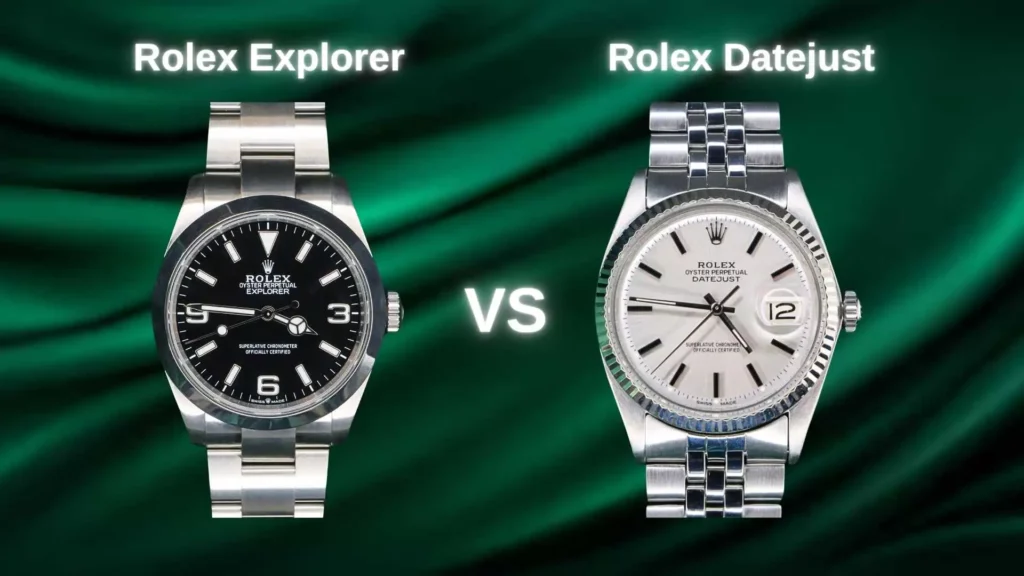
The Rolex Explorer vs Datejust question comes up constantly, and for good reason. They sit at similar price points, share the same DNA, and both make a strong case for being a one-watch collection. But the moment you put them side by side, the differences are obvious: one was built to climb mountains, the other was built to read a date in a meeting.
This guide walks through the references, the 2026 prices, the sizing, and the lifestyle fit, so you can stop debating and start narrowing down which Rolex really belongs on your wrist.
Rolex Explorer Overview
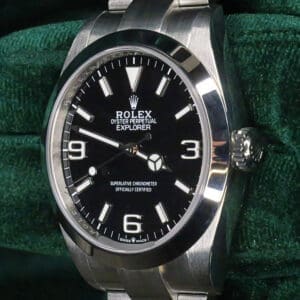
The Rolex Explorer is a time-only sports watch with a 3-6-9 dial layout, Mercedes hands, and an Oystersteel case. No date, no rotating bezel, no GMT, just the tools you need to read the time at 4 a.m. on a glacier.
It launched in 1953 to mark the Hillary–Norgay Everest summit, and the dial design hasn’t meaningfully changed in over 70 years. Modern Explorers run on the Caliber 3230 with a 70-hour power reserve and Paraflex shock absorbers. They’re 100m water resistant, COSC-certified, and the simplest watch Rolex makes that still wears the crown.
Most Popular Rolex Explorer References:
- Rolex Explorer Ref. 1016
- Rolex Explorer Ref. 114270
- Rolex Explorer Ref. 124270 / 124273
- Rolex Explorer Ref. 224270
For the full lineup and what to look for on each, see our Rolex Explorer buying guide.

Rolex Datejust Overview
The Datejust is the Rolex you’ve seen on a wrist somewhere this week without realizing it. Launched in 1945 as the first self-winding wristwatch with a date display, it’s the most produced and most configurable model in the Rolex catalog.
Key features include the Cyclops magnifier over the date, a choice of fluted or smooth bezel, Jubilee or Oyster bracelet, and a dial menu that runs from sunburst silver to mint green ombre. Modern references run the Caliber 3235 with a 70-hour reserve.
It’s the model Rolex has used to introduce more dial colors, materials, and configurations than any other line in their catalog. That’s part of why two Datejusts can look almost nothing alike.
Most Popular Rolex Datejust References:
- Rolex Datejust Ref. 1601
- Rolex Datejust Ref. 16233
- Rolex Datejust Ref. 116200
- Rolex Datejust Ref. 126334
Our Rolex Datejust buying guide walks through the full catalog if you want to go deeper.
Rolex Explorer vs Datejust: Most Notable Differences

Both watches are built on the same Oyster Perpetual foundation, but the design choices stack up to produce two very different watches on the wrist. Here’s what separates them.
1. Case Materials and Finish
The Explorer is Oystersteel only, with a brushed case and a smooth steel bezel. There’s no two-tone Explorer in the steel models, no precious metal upgrades, no diamond options. The matte finish hides hairline scratches well, which is part of why owners who actually wear theirs tend to keep them polish-free for decades.
The Datejust offers Oystersteel, two-tone Rolesor (steel with yellow, white, or Everose gold), and full precious metal configurations. The bezel options run from smooth to fluted to gem-set. Even the steel Datejust 41 (Ref. 126334) uses 18k white gold for the fluted bezel. That’s a Rolex-only detail that most buyers never notice.
2. Movement and Mechanical Features
Both modern references run movements from the same family. The Explorer 124270 uses the Caliber 3230, time-only, with a 70-hour reserve. The Datejust 126334 uses the Caliber 3235, same architecture, but with a date complication and a Chronergy escapement.
In daily use, the difference is exactly one feature: a date window. Both are accurate to -2/+2 seconds per day, both have Paraflex shock absorbers, and both run on Rolex’s recommended 10-year service interval. If you don’t care about a date, the Explorer is the simpler tool. If you do, the Datejust is the obvious answer.
3. Dial Readability and Lume
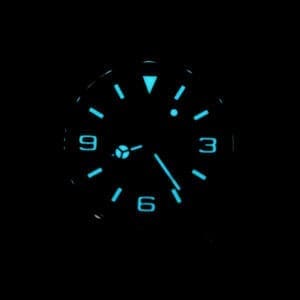
The Explorer’s dial is a tool-watch dial: matte black, oversized 3-6-9 Arabic numerals, broad Mercedes hands, and Chromalight that glows blue for hours. You can read it in a dark hotel room without thinking about it.
The Datejust trades that legibility for variety. Stick markers, Roman numerals, applied indices, sunburst dials, fluted-motif dials, mother-of-pearl, diamond markers — the menu is enormous. The Cyclops over the date adds magnification but also adds visual weight to the dial. It’s a more interesting watch to look at, but a slower watch to read at a glance.
4. Bracelet Comfort and Adjustability
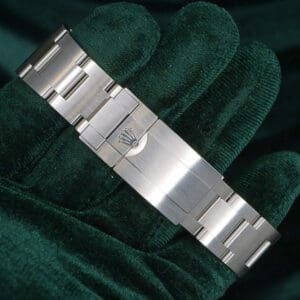
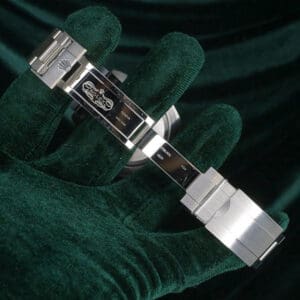
The Explorer ships on the Oyster bracelet only: three-link, brushed center, polished outer links on the modern references, with the Oysterlock clasp and 5mm Easylink extension.
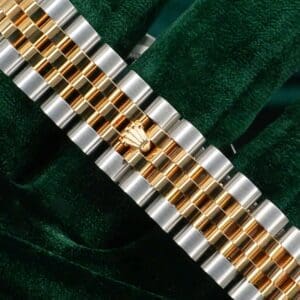
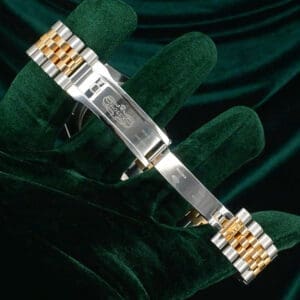
The Datejust gives you a real choice. The Jubilee (five-link) is the original Datejust bracelet from 1945 and the dressier of the two. The Oyster bracelet is sportier and adds a bit of weight. Most buyers default to Jubilee with a fluted bezel, which is the configuration that defines the model. The Oyster on a smooth bezel reads as the more casual setup.
We walk through Jubilee vs Oyster in detail in a separate guide if you’re still torn.
5. Size, Wearability, and Wrist Presence
The current Explorer comes in three sizes: 36mm (Ref. 124270), 36mm two-tone (Ref. 124273), and 40mm (Ref. 224270, added in 2023 after years of complaints that the 36mm was too small for modern wrists). All three are slim, around 11.6mm thick.
The Datejust runs 28mm, 31mm, 36mm, and 41mm. The 41mm with a fluted bezel and Jubilee bracelet has more wrist presence than any current Explorer. That’s the trade-off. Forum consensus puts the Explorer firmly in “smart casual” territory, while a fluted-bezel Datejust 41 reads as the dressier piece.
If you’re between sizes: a 36mm Datejust on Oyster will wear closer to the Explorer 124270 than you’d expect, and a 39mm or 40mm Explorer wears closer to a 41mm Datejust than the spec sheet suggests. For Datejust shoppers specifically, the Datejust 41 vs 36 breakdown covers the size question in more depth.
6. Price and Market Demand (2026)
Rolex raised retail prices roughly 7% in January 2026, which has shifted the secondary market on most of these references. Below are the current numbers based on WatchCharts data and dealer listings. For pricing across the wider catalog, our Rolex pricing guide covers it model by model.
Rolex Explorer Ref. 124270 (36mm)
- Retail: $7,900 USD
- Secondary market: ~$7,500 USD, trading 5.1% below retail
- This is the surprise of the lineup. The modern 36mm Explorer trades at a discount to retail, partly because the 40mm 224270 absorbed the demand from buyers who wanted a larger case
Rolex Explorer Ref. 224270 (40mm)
- Retail: $8,350 USD
- Secondary market: ~$8,500 USD, trading roughly 2.6% above retail
- The 40mm size addressed the most common Explorer complaint and is the default recommendation right now for buyers who don’t have a strong preference for vintage proportions
Rolex Explorer Ref. 1016 (Vintage)
- Secondary market: $12,000–$30,000+ depending on dial, condition, and provenance
- Recent EveryWatch sales in early 2026 have hit anywhere from $11,600 (rougher examples in Japan) to $45,000 (top-tier collector pieces with Tiffany dials or original tropical gilt). Most clean, papered examples sit in the $17,000–$25,000 band
- The 1016 ran from 1963 to 1989, which is an unusually long production window — if you’re shopping vintage, that means dial variants matter more than year
Rolex Datejust Ref. 116200 (Discontinued)
- Secondary market: $5,500–$8,500 USD with papers
- The 116200 was discontinued in 2016 and replaced by the 126200, so this is now a discontinued reference. Pricing is genuinely below current retail for any new Datejust, which makes it one of the most accessible entry points into the model
Rolex Datejust Ref. 126334 (Datejust 41)
- Retail: $11,650 USD
- Secondary market: $13,500–$19,500 USD depending on dial and configuration, averaging around $14,300 (about 22.7% above retail)
- This is the most popular Datejust on the pre-owned market right now. The Wimbledon dial (slate with Roman numerals) and the newer mint green dial trade at the top of the range. White gold fluted bezel adds presence without committing to two-tone. For Wimbledon-specific shoppers, our Wimbledon dial in 36mm vs 41mm comparison covers how the two sizes wear differently.
The pattern is worth noting: the steel Explorer trades at or below retail, while the steel-with-white-gold-bezel Datejust 41 commands a real premium. Five years ago that gap was much smaller.
Most Notable Rolex Explorer References

The Explorer line is a four-reference conversation in 2026, with one vintage anchor and three modern options. Each fits a different buyer profile.
1. Ref. 1016 — The Vintage Benchmark
Produced 1963 to 1989 in a 36mm steel case with a smooth bezel. Matte black dial, painted 3-6-9 Arabic numerals, tritium lume, and Mercedes hands. Calibers 1560 (early) or 1570 (mid-1970s onward, with hacking seconds). Acrylic crystal, 50m water resistance.
Most 1016s on the market today have replacement service crystals or relumed dials — neither is automatically a problem, but both affect price. Original gilt dials (early production) and tropical brown dials command the largest premiums. Original bracelets are increasingly hard to find in good condition.
If you’re new to vintage Rolex, our vintage Rolex buying guide covers what to check before you commit.
2. Ref. 114270 — The Transitional Favorite
Produced 2001 to 2010, also 36mm steel with a smooth polished bezel. Glossy black dial with white gold applied 3-6-9 indices, Super-LumiNova lume on later examples, sapphire crystal, and the upgraded Caliber 3130 with a 48-hour reserve.
This is the Explorer that gets recommended to first-time vintage-Rolex buyers more than any other. It looks neo-vintage, runs a robust modern movement, and trades around $5,000 in 2026, roughly $1,000 less than the 124270 it predates by a generation. If you want the 36mm Explorer aesthetic without the vintage complications, this is the answer.
3. Ref. 124270 / 124273 — The Modern 36mm
Launched April 2021. The 124270 is full Oystersteel; the 124273 is two-tone Rolesor with a yellow gold bezel and bracelet center links. Both are 36mm with matte black dials, Chromalight markers, and the Caliber 3230 with a 70-hour reserve and Paraflex shock absorbers.
The 124270 brought the Explorer back to 36mm after eleven years of the 39mm 214270, which was a controversial call at the time. The market response was mixed enough that Rolex added the 40mm 224270 two years later.
4. Ref. 224270 — The Modern 40mm
Introduced March 2023 to give buyers a larger option alongside the 124270. Same Caliber 3230, same dial layout, same 100m water resistance. The case grows to 40mm, and the lugs are slightly more pronounced than the 36mm.
This is the Explorer most buyers gravitate toward in 2026 if they don’t have a strong reason to choose otherwise. It wears closer to a Submariner in size without the bezel weight, and it trades at a small premium to retail rather than a discount. That’s the better signal for long-term value retention.
Most Notable Rolex Datejust References

The Datejust catalog is too large to cover comprehensively, so this section focuses on the four references most buyers really consider. They span vintage steel, two-tone Rolesor, discontinued steel value picks, and the current 41mm bestseller, in roughly that order of date.
1. Ref. 1601 — The Vintage Entry Point
Produced from the late 1950s to the early 1970s. The 36mm model comes in steel or yellow gold with a fluted bezel, featuring dial options such as silver, champagne, and black, along with rarer pie-pan and textured dials that drive collector interest. Calibers 1565 or 1575 automatic, with the Cyclops magnifier and either Jubilee or Oyster bracelet.
The 1601 is the most accessible way into a vintage Datejust. Steel examples with original dials trade in the mid-$4,000s as of 2026. Pie-pan dials and unusual configurations push higher.
2. Ref. 16233 — The Two-Tone Classic
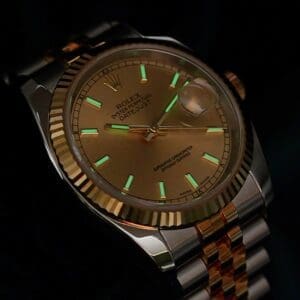
The 36mm two-tone (yellow Rolesor) Datejust most people picture when they hear “Datejust.” It features the Caliber 3135, a Cyclops lens over the date, a sapphire crystal, and dial options across champagne, silver, black, white, and the occasional textured execution. Quickset date, COSC certification.
This is also one of the most accessible ways into the model on the pre-owned market today, particularly for buyers who want the gold-bezel look without the full two-tone bracelet investment.

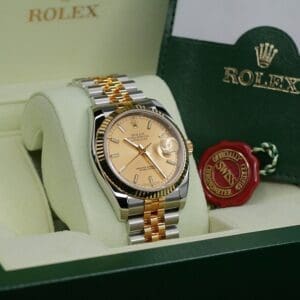
3. Ref. 116200 — The Discontinued Value Pick
Produced 2005 to 2016, discontinued for almost a decade now. It features a 36mm full steel case with a smooth bezel and the same Caliber 3135 as the 16233, along with a 48-hour power reserve and quickset date.
The 116200 is undervalued in the current market, trading well below new Datejust retail with papered examples in the $6,500–$8,500 range. For buyers who want a 36mm steel Datejust without the white-gold-bezel premium of the current 126200, this is the obvious target.
4. Ref. 126334 — The Modern 41mm Bestseller
Launched 2017 as part of the Datejust 41 redesign. It features a 41mm steel case with an 18k white gold fluted bezel, powered by the Caliber 3235.
Dial options now include sunburst blue, black, silver, slate (Wimbledon), the recent mint green, and a fluted-motif blue introduced in 2022. New for 2026: a green ombre dial (Ref. 126334-0033) released for the Oyster centennial.
This is the most popular Datejust reference on the pre-owned market right now and the one that earns the steepest premium over retail. Wimbledon and mint green dials sit at the top of the range; white and silver stick-marker dials are the most accessible.
Which Watch Should You Choose?
Choose the Rolex Explorer if:
- You want a date-free, single-purpose tool watch with a clean dial
- You prefer a brushed case that hides scratches over a polished one that shows them
- You’re choosing your one Rolex and you want the one that disappears under a cuff and reads at a glance
- You like the Explorer 40 (224270) sizing, or you specifically want the 36mm vintage-honest proportions
Choose the Rolex Datejust if:
- You want a date complication you use
- You want flexibility: size options from 28mm to 41mm, dozens of dial choices, fluted or smooth bezels, Jubilee or Oyster
- You wear the watch in business or formal contexts often enough that the polished bezel and bracelet center links earn their place
- You like the idea of a watch that’s recognizably Rolex from across the room
If you’re choosing your first Rolex and you don’t have a strong pull toward either profile, try the Datejust 36 on Oyster bracelet with a smooth bezel, and try the Explorer 36 next to it. They’ll wear more similarly than you’d expect, and the date function will probably tip the call.
Frequently Asked Questions
Is the Datejust good for daily wear?
Yes. The Datejust was designed as a daily-wear watch and handles the role as well as anything Rolex makes. It has a screw-down crown, 100m water resistance, and an Oyster case built to the same standard as the sports models. The polished surfaces show hairlines faster than a brushed Explorer, but a Datejust on Oyster bracelet with a smooth bezel is genuinely tougher in daily use than its dressy reputation suggests.
Which holds Its value better, Explorer or Datejust?
As of 2026, the Datejust 41 with a fluted bezel holds its value more strongly than the current Explorer 36. The 126334 trades around 22% above retail; the 124270 trades roughly 5% below. The Explorer 40 (224270) sits closer to retail. Vintage references move on a different curve: a clean 1016 has appreciated steadily while modern steel sport prices corrected after the 2022 peak. For a deeper look at Rolex value retention across the catalog, we cover it model by model.
Does the Rolex Explorer come with a date?
No. The Explorer I (Refs. 1016, 114270, 124270, 124273, and 224270) is a time-only watch. If you want a date complication on a tool-watch platform from Rolex, the Explorer II (Ref. 226570) adds a date and a 24-hour GMT hand at a 42mm case size. Our Explorer II buying guide covers it in detail. The Datejust is the better answer if a date is non-negotiable but a GMT isn’t required.
Is the Explorer a good first Rolex?
The Explorer is one of the most recommended first Rolex watches because it’s quiet, durable, and not easily dated by trends. The current 36mm 124270 is also one of the few new Rolex references trading at or below retail, which means buying new from an authorized dealer is genuinely realistic. That’s unusual in the current market. If you’re still weighing options, our roundup of entry-level luxury watches lays out what to consider beyond just Rolex.
Where to Buy Authentic Watches Online
There are a handful of legitimate channels for buying a Rolex Explorer or Datejust on the pre-owned market. Chrono24 is the largest aggregator and offers buyer protection on transactions through its escrow service.
eBay runs an Authenticity Guarantee program for watches over $2,000, where every piece is inspected by independent experts before shipping to the buyer. Grailzee is a watch-focused auction platform that’s gained traction with collectors looking for less common configurations.
We also sell, buy, and trade luxury watches, and the reason clients come to us instead of a marketplace is the way we handle the watch before you buy it. We do tour videos of the actual piece you’re considering and walk you through condition notes that listings tend to skip: polish history, bracelet stretch, dial originality.
You also get an actual conversation about whether the watch fits what you’re looking for. You’re not buying off a stock photo and a paragraph of generic copy.
That’s reflected in our 4.9-star Google rating, which comes from clients who appreciated being talked out of the wrong watch as often as they were talked into the right one. You can also browse our current collection to see what’s in stock.
If you want that kind of walkthrough on a specific Explorer or Datejust reference, reach out and we’ll line up options for you.
Final Thoughts on Rolex Explorer vs Datejust
The Explorer vs Datejust choice usually comes down to two things: do you want a date, and do you want a watch that announces itself or one that doesn’t. Once you’ve answered those, the rest is sizing and dial preference.
Two bonus tips most buyers learn the hard way. First, on the pre-owned market, condition matters more than reference; a heavily polished case can knock $1,000 to $3,000 off resale value, and a refinished dial knocks even more.
Always ask about polish history before you commit. Our polished vs unpolished Rolex guide covers what to look for.
Second, the waiting list for a new steel Datejust 41 with a fluted bezel and Jubilee bracelet is real and can run a year or more at most authorized dealers. The pre-owned market is often the faster path to the exact configuration you want, and at current spreads, the math sometimes works in your favor.
A Rolex is a long-term piece. The right one is the one you’ll reach for on a Tuesday morning, not the one that photographs well on Saturday. If you’re cross-shopping other models in the catalog, our wider Rolex buying guide is the place to start.
999+ Timepieces Available
Explore Our Timepieces
Authenticated, unworn, and ready to ship worldwide.
Rolex · Audemars Piguet · Patek Philippe · Omega · Cartier · Richard Mille · Hublot · Tudor
Newly Listed
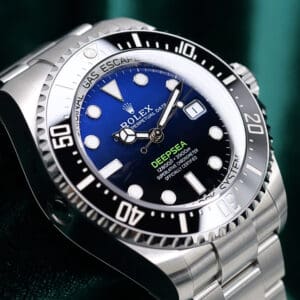
2026 NEW UNWORN Rolex Deepsea "James Cameron" D-Blue Black and Blue Dial Black Ceramic Bezel Stainless Steel 44mm COMPLETE SET 136660-0005
$20,208.00
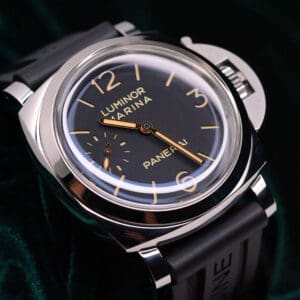
Panerai Luminor Marina 1950 3 Days Limited Edition Black Sandwich Dial Stainless Steel Black Rubber Strap 47mm MINT COMPLETE SET PAM00422
$7,503.00
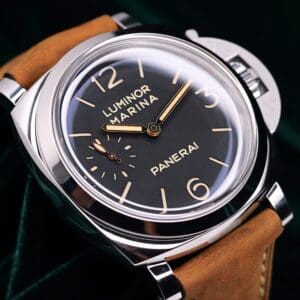
Panerai Luminor Marina 1950 3 Days Black Dial Stainless Steel Brown Leather Strap 47mm LIMITED EDITION MINT CONDITION COMPLETE SET PAM00422
$7,503.00
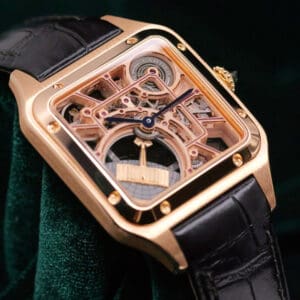
Cartier Santos-Dumont Micro-Rotor Skeleton Dial Black Alligator Strap 18k Rose Gold 43.5 x 31mm MINT CONDITION COMPLETE SET WHSA0030
$40,425.00
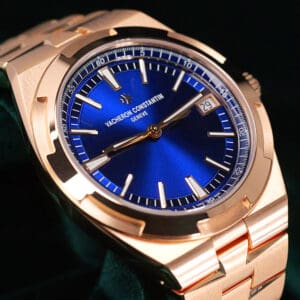
2026 Vacheron Constantin Overseas Blue Dial 18k Rose Gold 41mm MINT CONDITION COMPLETE SET 4520V/210R-B705
$72,764.00
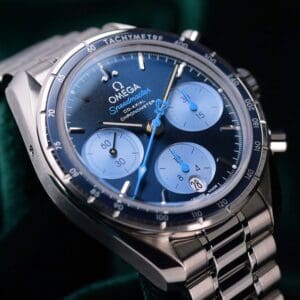
Omega Speedmaster 38 Orbis Edition Blue Dial Stainless Steel 38mm MINT CONDITION COMPLETE SET 324.30.38.50.03.002
$6,599.00
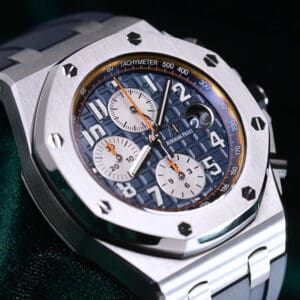
Audemars Piguet Royal Oak Offshore Chronograph “Navy” Blue Dial Orange Accents Blue Rubber Strap Stainless Steel 42mm MINT CONDITION COMPLETE SET 26470ST.OO.A027CA.01
$22,245.00
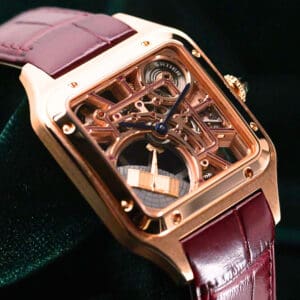
Cartier Santos-Dumont Micro-Rotor Skeleton Dial 18K Rose Gold Burgundy Alligator Strap 31mm MINT CONDITION COMPLETE SET WHSA0030
$40,425.00
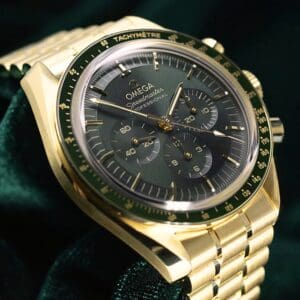
Omega Speedmaster Professional Moonwatch "Moonshine" Green Dial 18K Yellow Gold 42mm MINT CONDITION COMPLETE SET 310.60.42.50.10.001
$35,695.00
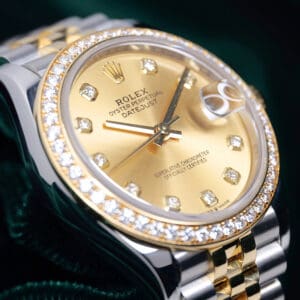
Rolex Datejust 31 Champagne Diamond Dial Diamond Bezel Jubilee Yellow Gold & Stainless Steel 31mm MINT CONDITION COMPLETE SET 278383RBR
$31,990.00
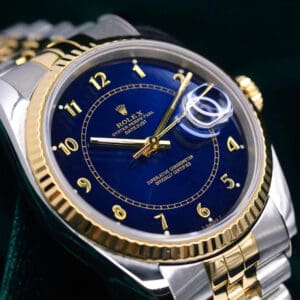
Rolex Datejust Blue Arabic Numeral Refinished Dial Fluted Bezel Jubilee Bracelet 18k Yellow Gold Stainless Steel 36mm MINT CONDITION 16233
$7,975.00
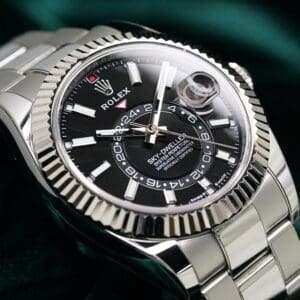
2025 Rolex Sky-Dweller Bright Black Dial 18k White Gold Fluted Bezel Stainless Steel Oyster Bracelet 42mm MINT CONDITION COMPLETE SET 336934
$22,895.00