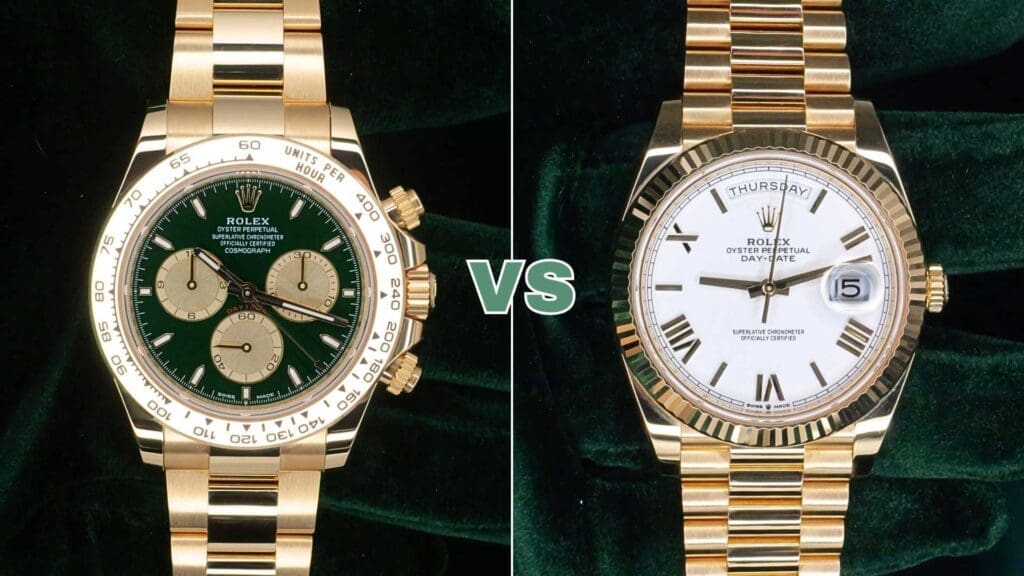
The Daytona vs Day-Date debate isn’t about which Rolex is better. It’s about what you value more when the watch is on your wrist. Daytona is built around performance, timing, and sport-driven design. Day-Date signals prestige, presence, and calendar authority.
The Rolex Daytona is a purpose-built chronograph with deep motorsport roots and everyday versatility. The Rolex Day-Date sits at the top of Rolex’s lineup, made only in precious metals and designed to signal status at a glance. Both are icons, but they serve very different roles.
What changed in 2026 matters here. Rolex used Watches & Wonders to drop two off-catalogue “Exceptional Watches” that touch both models — a Rolesium Daytona with a grand feu enamel dial and a Day-Date 40 in a new Jubilee Gold alloy.
Pricing moved too. Steel Daytona retail climbed to roughly $16,900, and the Day-Date 40 in yellow gold jumped 6.4% to about $40,250 — the largest percentage increase across the catalogue. The comparison below reflects what these models actually cost and feel like today, not five years ago.
Rolex Daytona Overview
Check More Daytonas
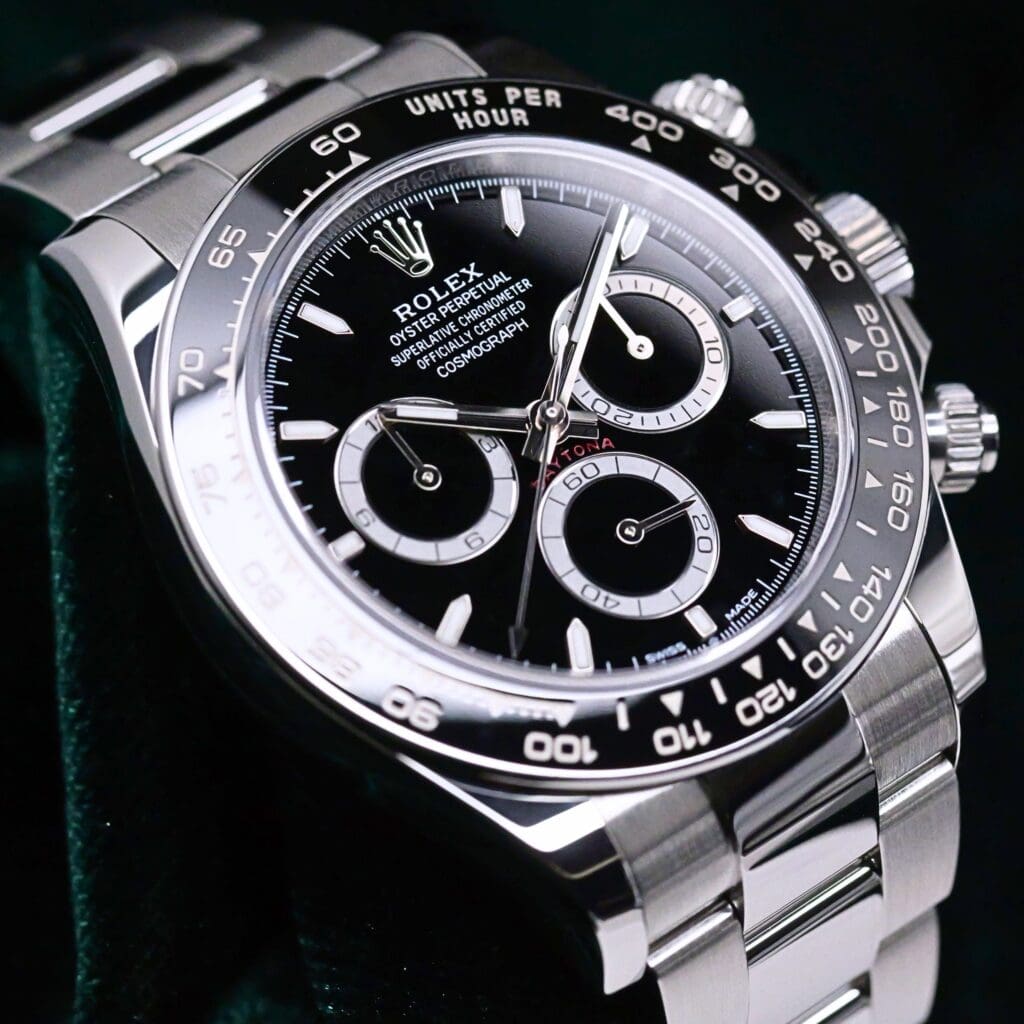
Rolex Cosmograph Daytona "Reverse Panda" Black Dial Black Ceramic Bezel Oyster Bracelet Stainless Steel 40mm MINT CONDITION COMPLETE SET 126500LN
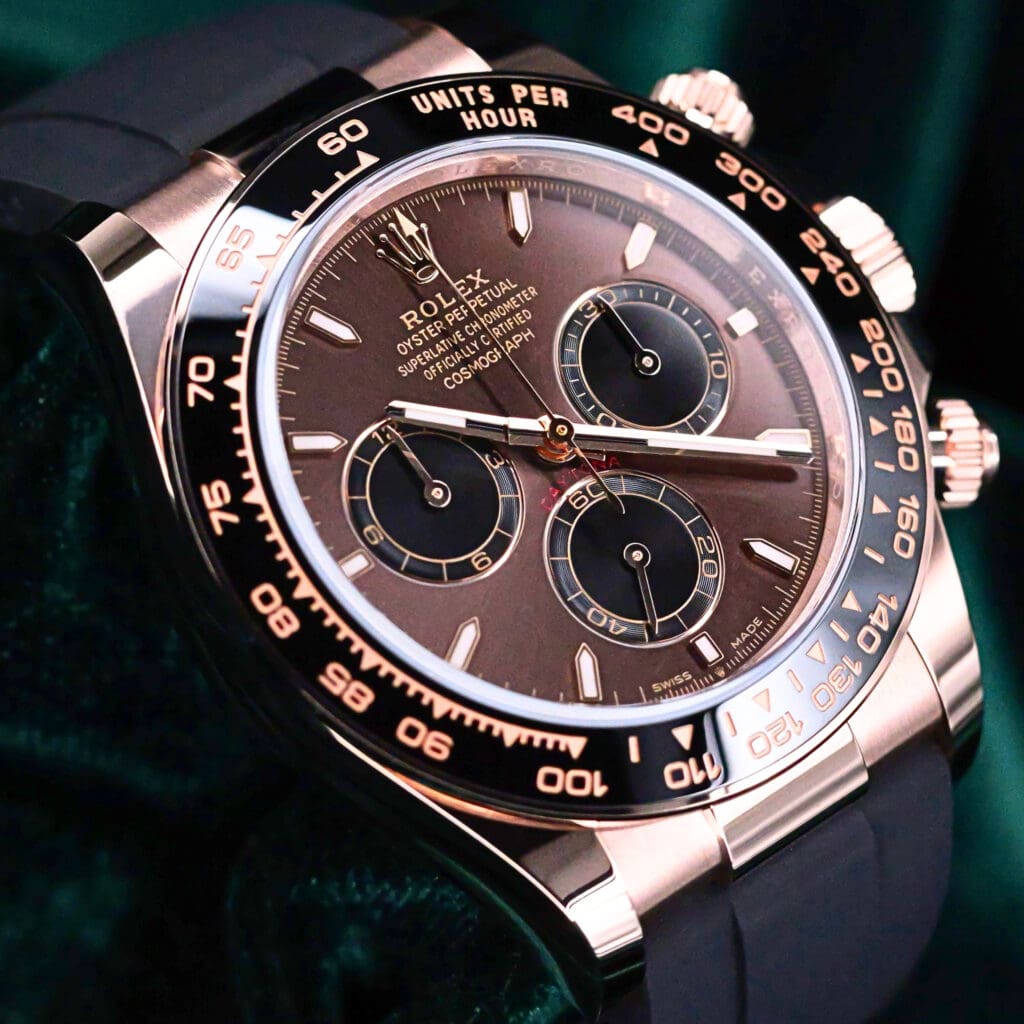
Rolex Cosmograph Daytona Chocolate Brown Dial Black Ceramic Bezel Black Subdials Black Oysterflex 18K Rose Gold 40mm MINT CONDITION 126515LN-0010
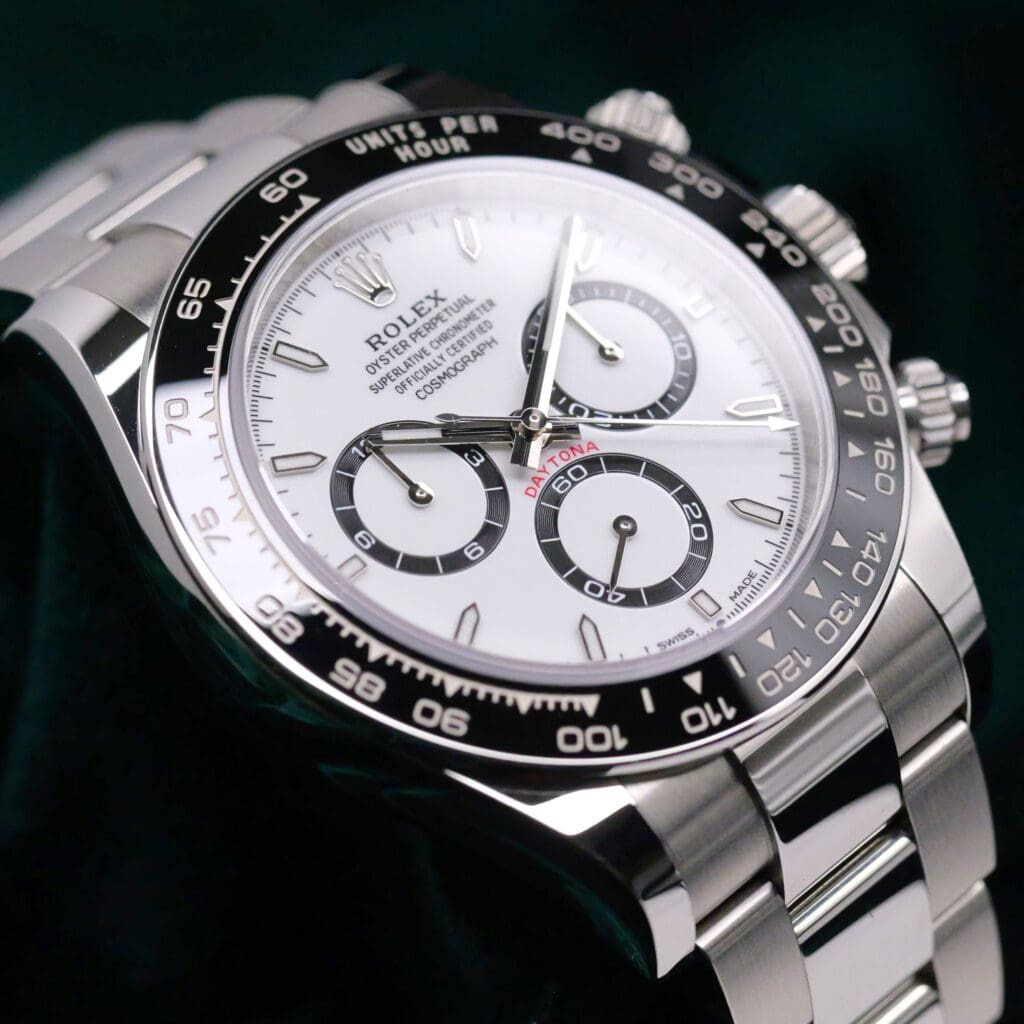
Rolex Daytona Cosmograph "Panda" White Dial Black Ceramic Bezel Oyster Bracelet Stainless Steel 40mm MINT CONDITION COMPLETE SET 126500LN-0001
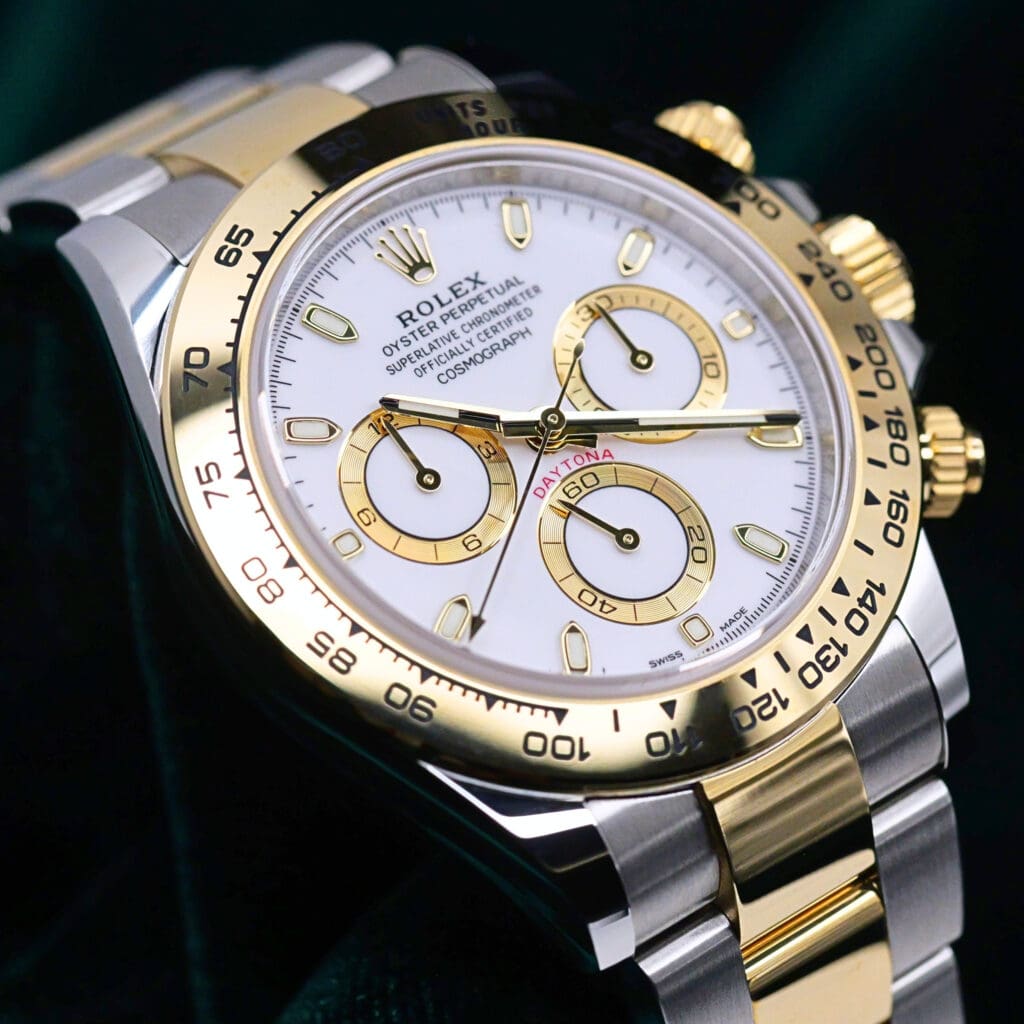
Rolex Cosmograph Daytona White Dial Gold Subdials Oyster Bracelet Two-Tone 18K Yellow Gold Stainless Steel 40mm MINT CONDITION COMPLETE SET 116503
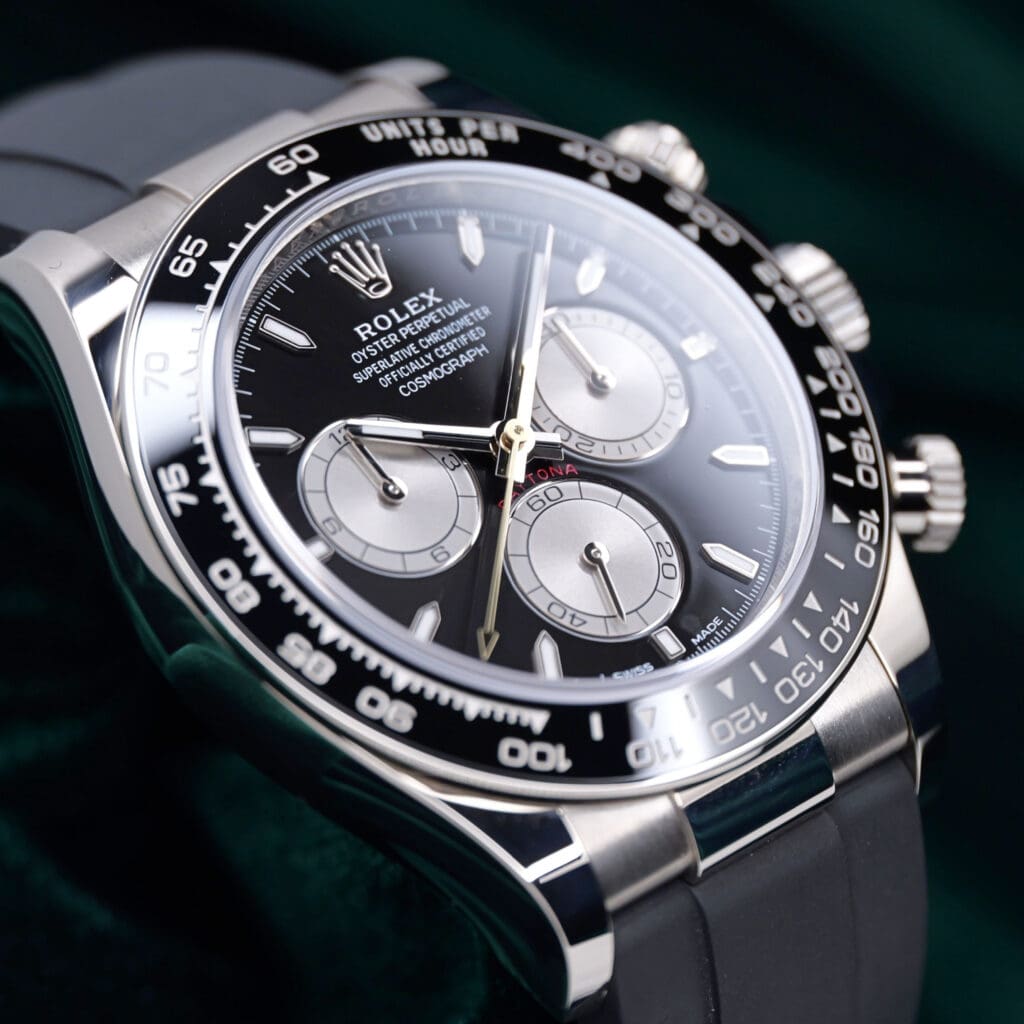
2026 NEW UNWORN Rolex Cosmograph Daytona "Baby Le Mans" Black Dial Silver Subdials Black Ceramic Bezel Black Oysterflex Strap 18k White Gold 40mm COMPLETE SET 126519LN

Rolex Cosmograph Daytona "Panda" White Dial Black Ceramic Bezel Stainless Steel Oyster Bracelet 40mm MINT CONDITION COMPLETE SET 116500LN-0001
The Rolex Daytona started life as a professional racing tool. Rolex launched the model in 1963 to support motorsport timing, especially for endurance racing and speed measurement. The tachymeter bezel, screw-down pushers, and high-contrast dial were built with one job in mind: let drivers read and record elapsed time quickly and accurately.
The Daytona moved beyond the racetrack a long time ago. Limited production, sustained demand, and a design that aged well pushed it into icon territory. Today, you buy a Daytona as much for the history and collectability as for the chronograph function. It never lost its performance-first identity, though, which is why it still feels relevant decades later.
Rolex built the Daytona for people who value function, precision, and versatility. You can wear it daily without feeling overdressed, but it still carries serious credibility among collectors. If you’re mapping the references before committing, our full Rolex Daytona buying guide walks through the family.
Its biggest accomplishment isn’t one technical breakthrough; it’s consistency. Rolex refined the Daytona slowly, keeping its proportions, layout, and purpose intact while improving reliability behind the scenes.
The most recent meaningful evolution came in 2023, when Rolex replaced the long-running Ref. 116500LN with the new Ref. 126500LN. The case got subtly resculpted (now 11.9mm thick, about 0.5mm thinner), the lugs were tidied up, and the bezel insert got a new outer steel ring.
Inside is the new Caliber 4131 — a Chronergy-escapement movement with a 72-hour power reserve and Rolex’s tightened -2/+2 seconds-per-day standard. The 116500LN is now discontinued, so when someone talks about “the modern steel Daytona” today, they mean the 126500LN.
Most popular Rolex Daytona references:
- Rolex Daytona Ref. 6239 — early “Paul Newman” dial
- Rolex Daytona Ref. 6263 — “Big Red” with acrylic bezel
- Rolex Daytona Ref. 16520 — Zenith-powered automatic Daytona
- Rolex Daytona Ref. 116500LN — discontinued in 2023, the last 4130-powered steel ceramic Daytona
- Rolex Daytona Ref. 126500LN — current 2023-generation steel ceramic Daytona, Caliber 4131
- Rolex Daytona Ref. 126506 — platinum Daytona with ice-blue dial and sapphire caseback
Rolex Day-Date Overview
See More Day-Dates
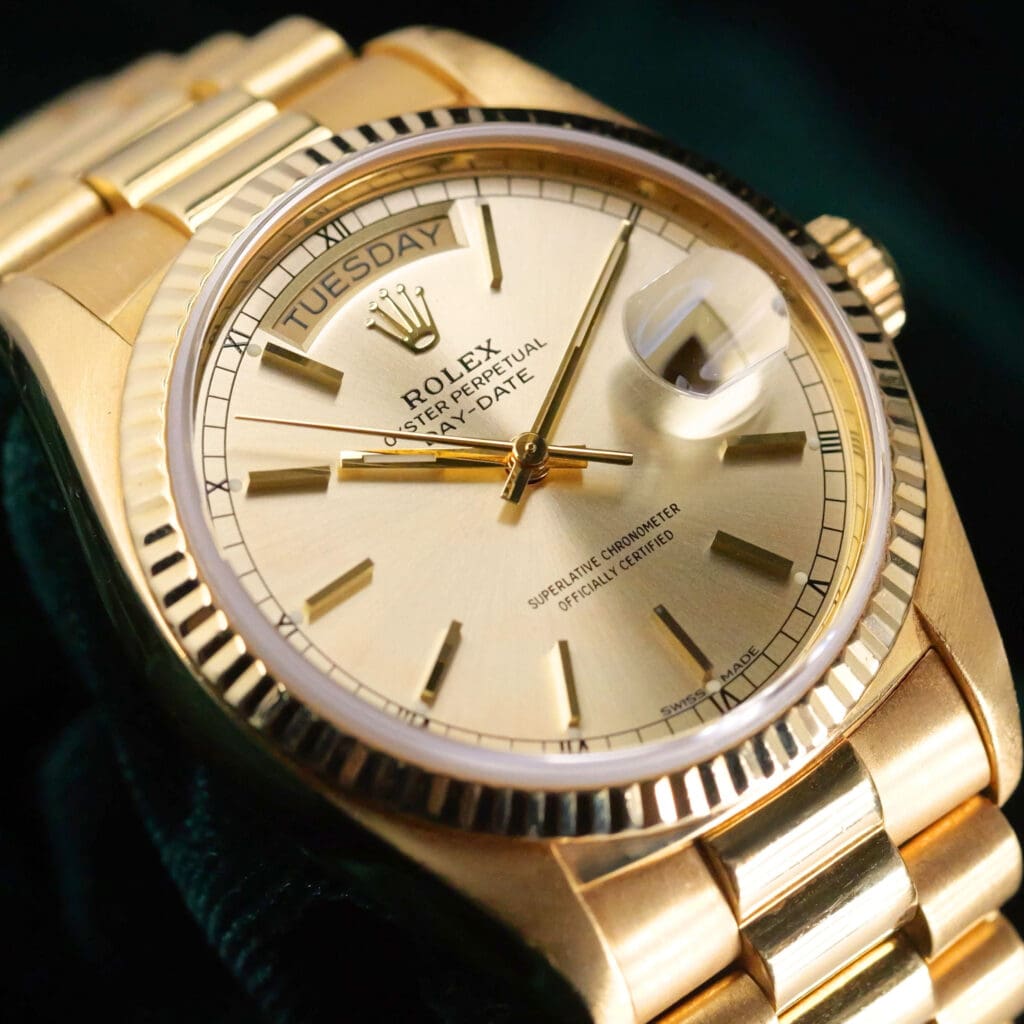
Rolex Day-Date Champagne Dial Fluted Bezel President Bracelet 18k Yellow Gold 36mm MINT CONDITION 18038
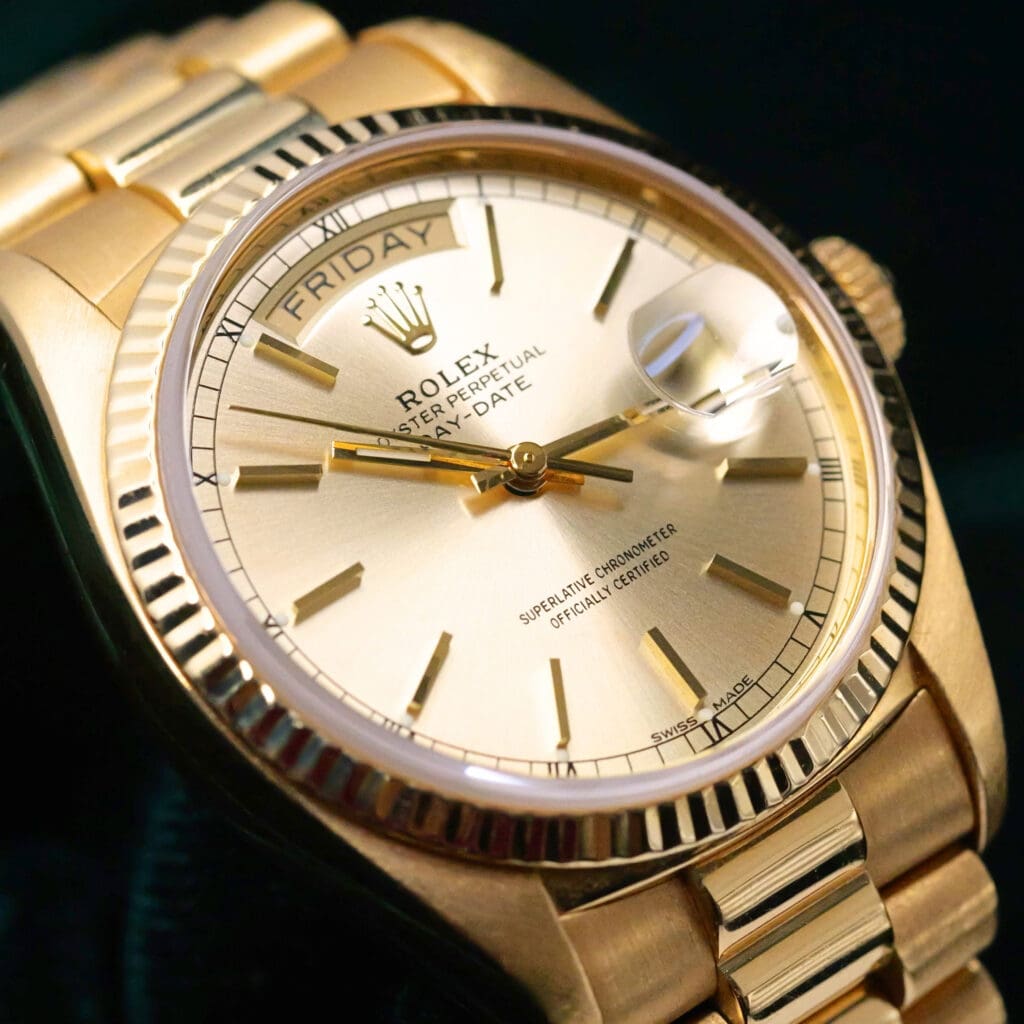
Rolex Day-Date "President" Champagne Stick Dial Fluted Bezel President Bracelet 18K Yellow Gold 36mm VERY GOOD CONDITION 18038
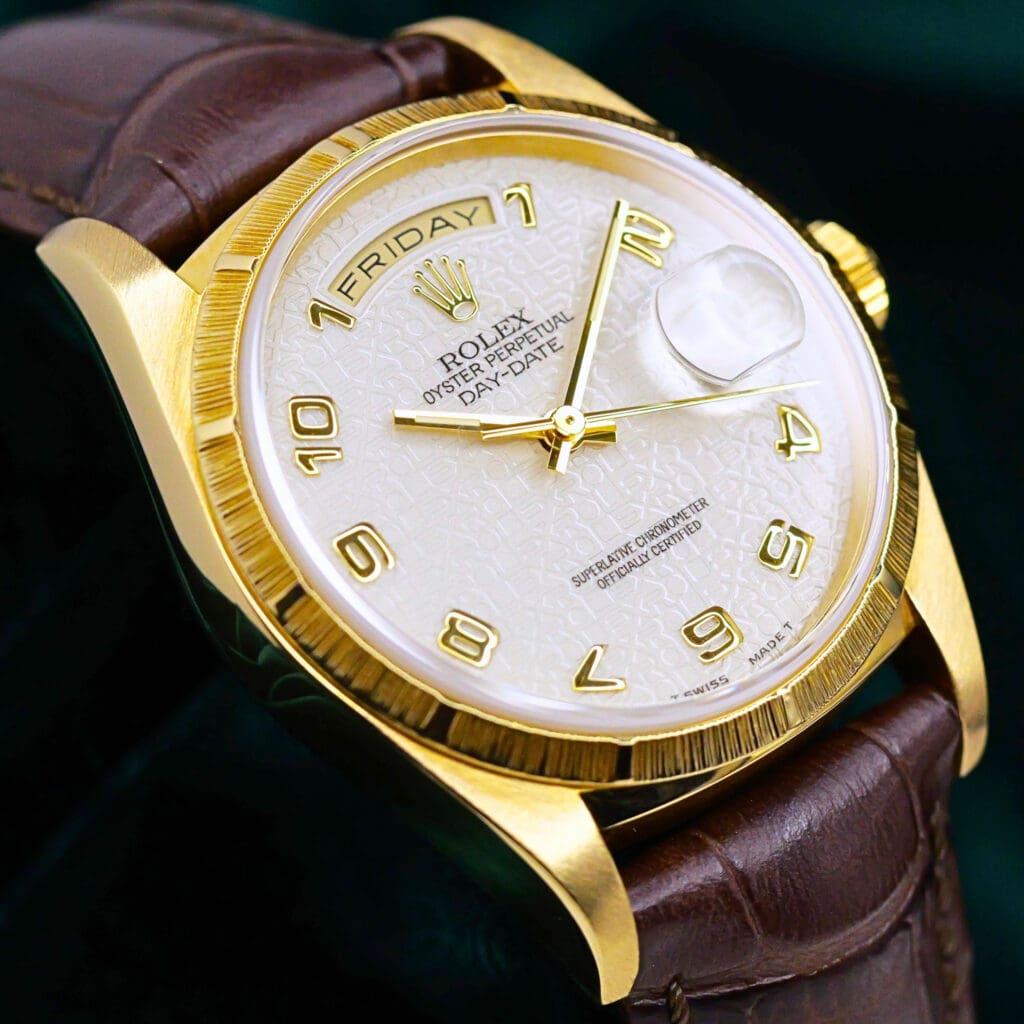
Rolex Day-Date Ivory Jubilee Arabic Dial Bark Bezel 18K Yellow Gold Brown Leather Strap 36mm MINT CONDITION 18248
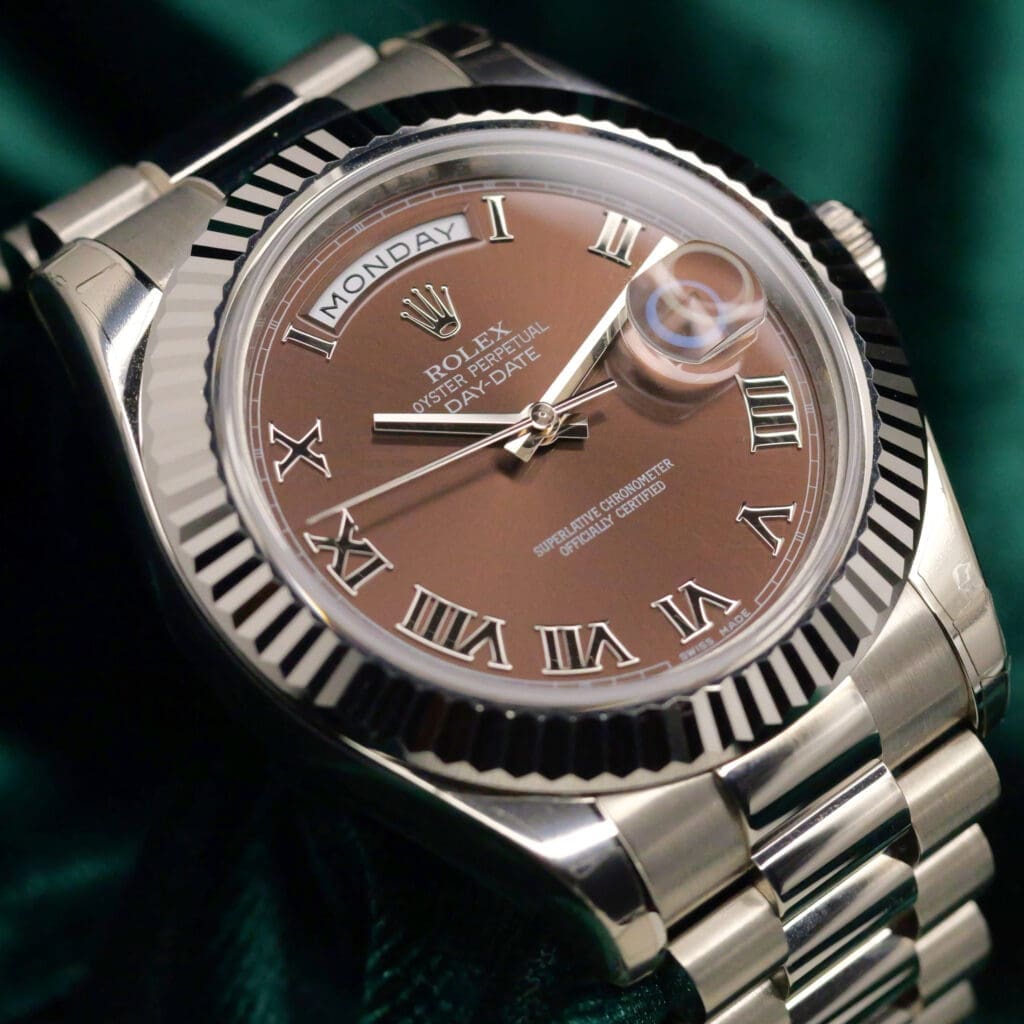
Rolex Day-Date II Brown Chocolate Dial Roman Numerals Fluted Bezel President Bracelet 18K White Gold 41mm MINT CONDITION COMPLETE SET 218239
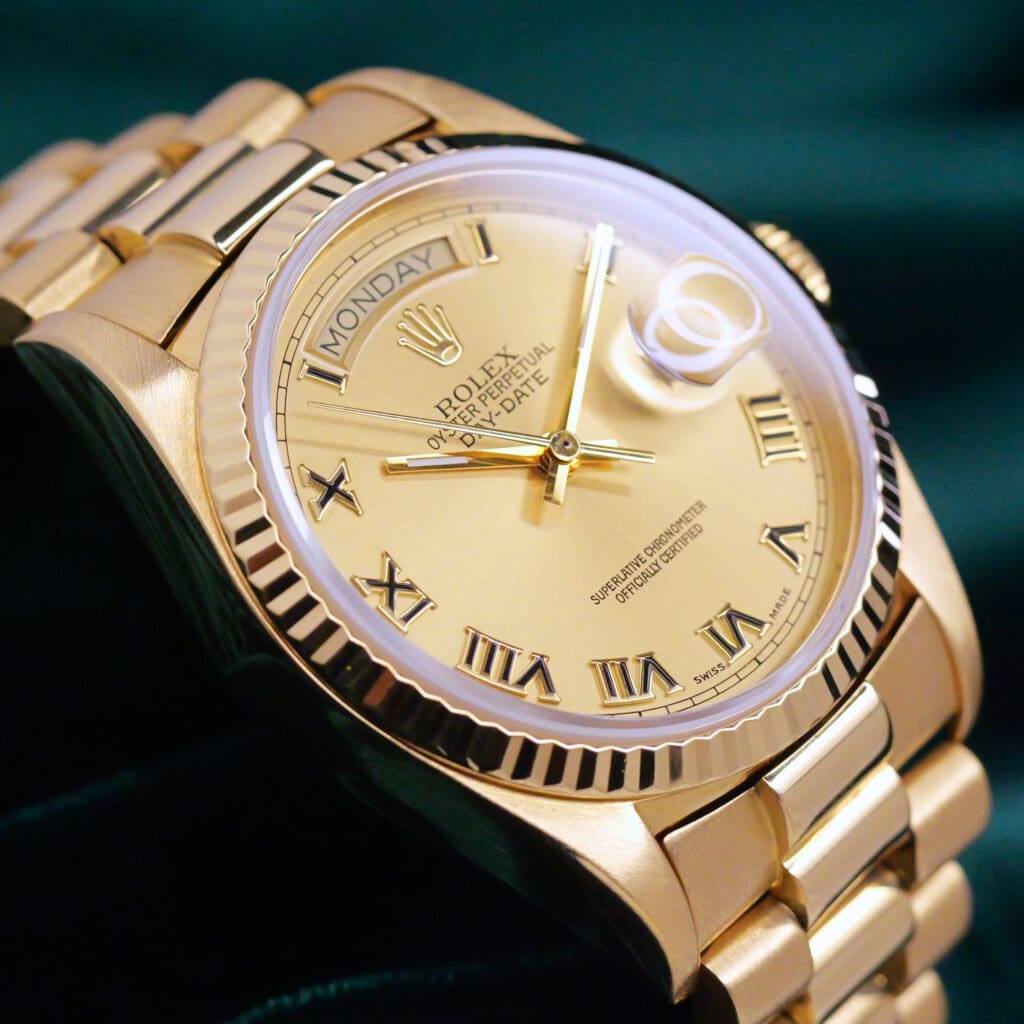
Rolex Day-Date 36 Champagne Gold Dial Roman Numeral Markers Fluted Bezel Presidential Bracelet 18K Yellow Gold NEAR MINT CONDITION 18038
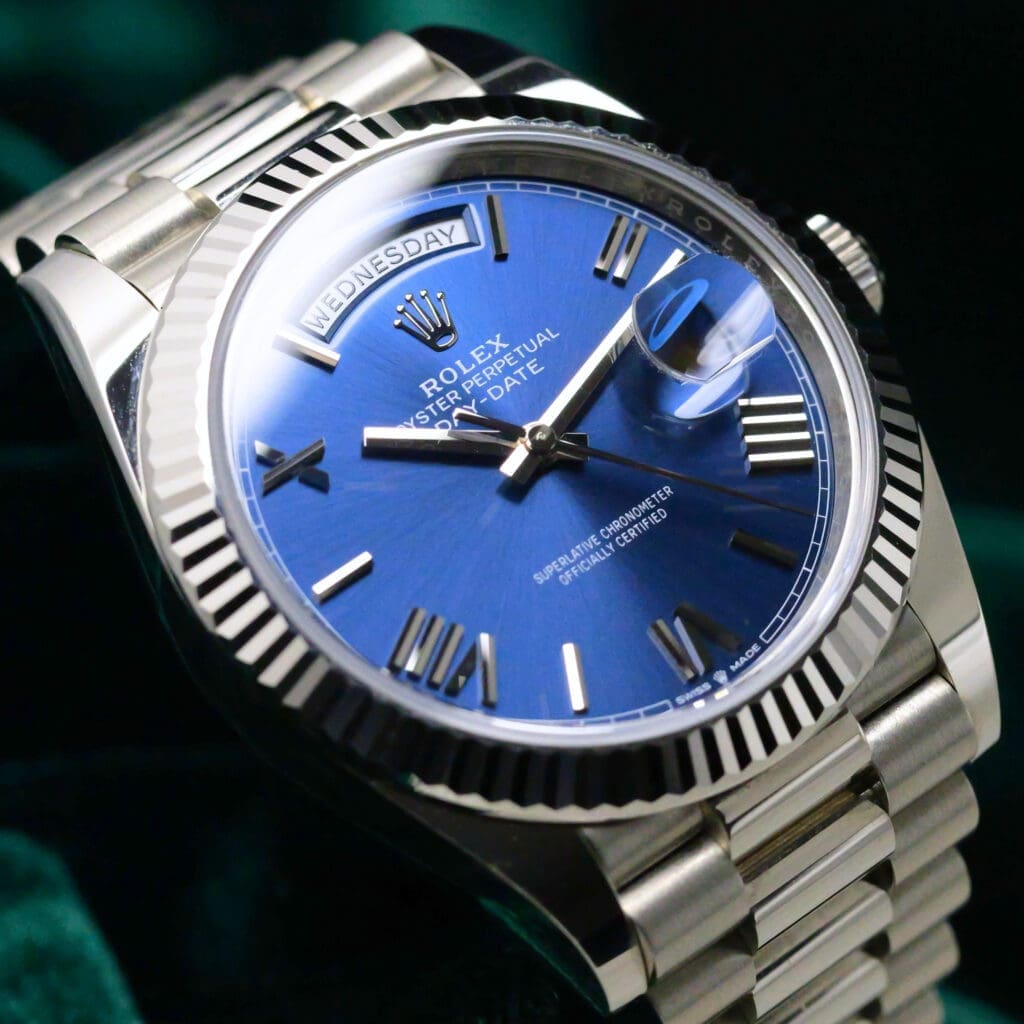
Rolex Day-Date Blue Roman Dial Fluted Bezel President Bracelet 18K White Gold 40mm MINT CONDITION COMPLETE SET 228239
The Rolex Day-Date has been at the top of Rolex’s lineup since its debut in 1956. Rolex introduced it as the first wristwatch to display the full day of the week spelled out, paired with a date window. From the start, Rolex positioned the Day-Date as a watch for leaders, decision-makers, and people whose presence mattered before they ever spoke.
You don’t buy a Day-Date for utility or sport. You buy it because it signals authority, permanence, and success. Presidents, heads of state, and industry leaders wore it publicly, which is why collectors later gave it the nickname “The President.”
If you’re deciding between the Day-Date references before committing, our Rolex Day-Date buying guide breaks down the lineup.
The modern Day-Date 40 references all run the in-house Caliber 3255, a 70-hour reserve movement with the Chronergy escapement and a Paramagnetic blue Parachrom hairspring. Same -2/+2 seconds-per-day precision standard as the current Daytona.
Day-Date does its work quietly — no chronograph subdials, no tachymeter — just an instantaneous day and date that flip at midnight without dragging.
What Is the Rolex Day-Date Designed For?
Rolex designed the Day-Date for status, clarity, and formal presence. You read the day and date instantly thanks to the clean dial layout and large apertures. The watch prioritizes visibility and symbolism over technical complexity.
When you wear a Day-Date, it communicates seniority more than sport. That’s the point of the watch: it isn’t trying to be versatile, it’s trying to be unmistakable.
Day-Date Case, Bracelet, and Wrist Presence
Rolex produces the Day-Date only in precious metals. You will never find one in steel. Options include yellow gold, white gold, Everose gold, and platinum.
The President bracelet, created specifically for this model, gives the watch its unmistakable look with semi-circular links and a solid, weighty feel. On your wrist, the Day-Date feels substantial and formal — designed to get noticed in boardrooms and dining rooms, not on a hike.
Day-Date Movement and Display
The Caliber 3255 drives both the time and the dual day-date complication. At midnight, the day at 12 o’clock and the date at 3 o’clock both switch cleanly and instantly, which is the kind of small precision detail that defines the watch.
The day window at 12 o’clock remains unique to the Day-Date line and is the easiest way to spot one across a room, even without seeing the bracelet or case material.
Most popular Rolex Day-Date references:
- Rolex Day-Date 40 Ref. 228238 — yellow gold
- Rolex Day-Date 40 Ref. 228239 — white gold
- Rolex Day-Date 40 Ref. 228235 — Everose gold (and in 2026, the new Jubilee Gold variant)
- Rolex Day-Date 40 Ref. 228206 — platinum with ice-blue dial
What’s New in 2026: Rolesium Daytona and Jubilee Gold Day-Date
At Watches & Wonders 2026, Rolex used the centenary of the Oyster case to release two pieces that directly involve this comparison. Both sit on the “Exceptional Watches” page rather than the main catalogue, which means low production and tighter allocation.
Rolesium Daytona Ref. 126502 pairs an Oystersteel case with platinum components (the bezel ring and caseback ring) and adds a sapphire caseback (rare on a non-precious-metal Daytona).
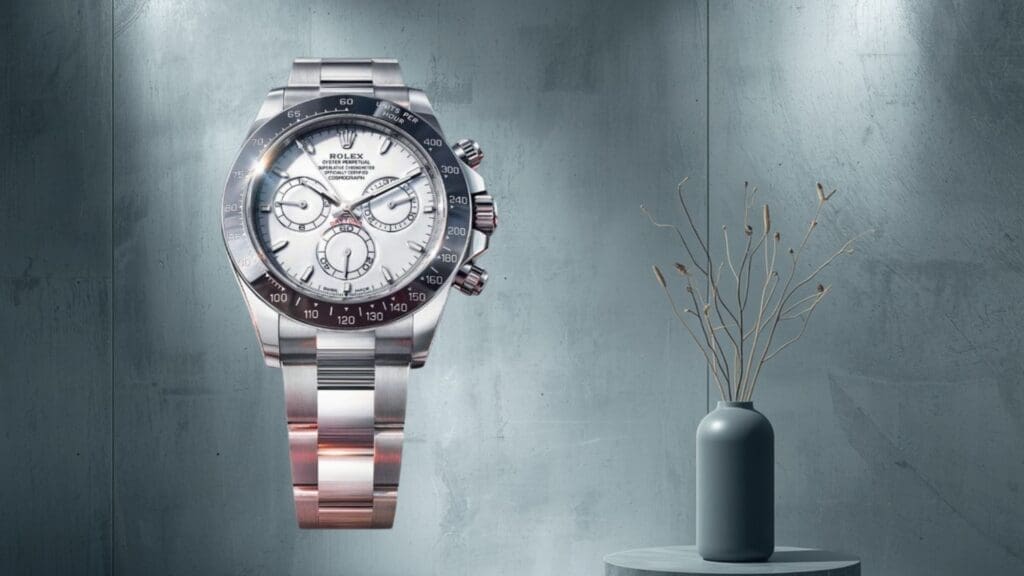
The dial is white grand feu enamel, which is unusual for Rolex, and the Cerachrom bezel is anthracite with tungsten carbide. The tachymeter numerals are oriented upright all the way around, referencing the original 1963 Cosmograph.
Day-Date 40 Ref. 228235 in Jubilee Gold introduces a new proprietary gold alloy that carries the warmth of yellow gold with a softer, slightly cooler edge. Rolex paired it with a green dial. Like the Rolesium Daytona, it’s off-catalogue.
These releases don’t change the core comparison between the two models — they don’t shift the use case, the wrist presence, or the buyer type. What they do is raise the ceiling on both lineups.
If you’re choosing between a Daytona and a Day-Date today, the standard production pieces (Ref. 126500LN and Ref. 228238) remain the right benchmarks — but the off-catalogue ceiling is now noticeably higher than it was a year ago.
Daytona vs Day-Date: What Makes Them Different?
The difference between the Rolex Daytona and the Rolex Day-Date comes down to intent. Daytona exists as a tool watch built around performance and timing. Day-Date exists as a prestige calendar watch designed to project authority.
Both sit inside the wider Rolex catalogue, and once you understand that split, the rest of the comparison becomes much clearer.

Purpose and Daily Use
The Daytona centers on timing and activity. The chronograph isn’t decoration; it’s the reason the watch exists. Its design supports regular, hands-on wear, and it fits naturally into an active lifestyle without demanding special occasions.
The Day-Date focuses on calendar clarity and symbolism. You glance at the day and date instantly, but the bigger message is presence. It works best in professional or formal settings where appearance carries weight.
Materials and Construction
The Daytona is most commonly bought in stainless steel, but Rolex also makes it in yellow gold, white gold, Everose gold, and platinum. Steel keeps the watch durable, lighter on the wrist, and easier to live with day to day, which is part of why the steel 126500LN dominates demand.
The Day-Date comes only in precious metals. Rolex intentionally limits it to gold and platinum to reinforce its flagship status. That choice adds weight, cost, and visual impact, but it also defines the model’s identity.
Comfort and Versatility
The Daytona wears comfortably for long hours. Its balanced 40mm case, Oyster bracelet, and manageable weight make it easy to pair with casual or smart-casual clothing. You can wear it without thinking about the setting.
The Day-Date feels heavier and more deliberate. The President bracelet and solid precious-metal construction give it wrist presence, but you feel that weight throughout the day. It suits structured outfits and formal environments more than relaxed ones.
Design Language and Visual Impact
The Daytona uses restrained sport design. The dial stays functional, the bezel serves a purpose, and the overall look feels confident without being loud. It rewards people who notice details.
The Day-Date makes a statement immediately. The day window at 12 o’clock, the precious-metal case, and the President bracelet signal status from across the room. You don’t wear it to blend in.
Ownership Experience
Owning a Daytona means treating it like a high-performance daily watch. You wear it often, service it normally (for the rough budget, see our breakdown of the Rolex Daytona service cost), and don’t worry too much about attention or context.
Owning a Day-Date feels more intentional. You think about where you wear it, how it fits your image, and how much visibility you’re comfortable with. It demands less physical caution but more lifestyle awareness.
999+ Timepieces Available
Explore Our Timepieces
Authenticated, unworn, and ready to ship worldwide.
Rolex · Audemars Piguet · Patek Philippe · Omega · Cartier · Richard Mille · Hublot · Tudor
Newly Listed
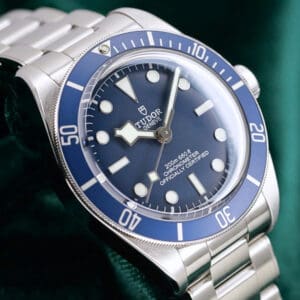
Tudor Black Bay 58 Blue Dial Stainless Steel 39mm MINT CONDITION COMPLETE SET 79030B-0001
$4,068.00
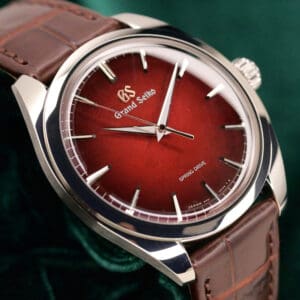
2026 NEW UNWORN Grand Seiko Elegance "Morning Glow" Limited Edition Red Dial Crocodile Strap 38.5mm COMPLETE SET SBGY035G
$9,816.00
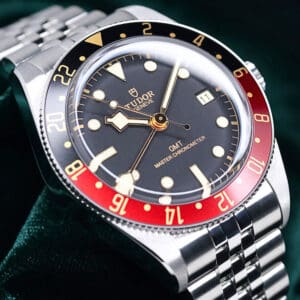
2026 NEW UNWORN Tudor Black Bay 58 GMT "Coke" Black Dial Black Burgundy Red Bezel Five-Link Stainless Steel Bracelet 39mm COMPLETE SET 7939G1A0NRU-0003
$7,385.00
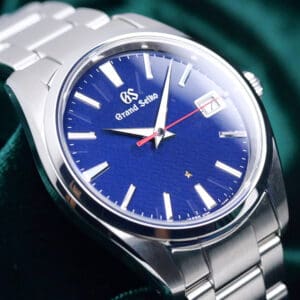
Grand Seiko Heritage 60th Anniversary Limited Edition Blue Dial Stainless Steel 40mm MINT CONDITION COMPLETE SET SBGP007G
$4,268.00
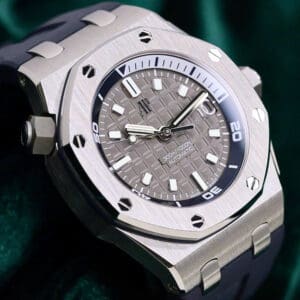
Audemars Piguet Royal Oak Offshore Diver Grey Dial Blue Rubber Strap Stainless Steel 42mm MINT CONDITION COMPLETE SET 15720ST.OO.A009CA.01
$27,788.00
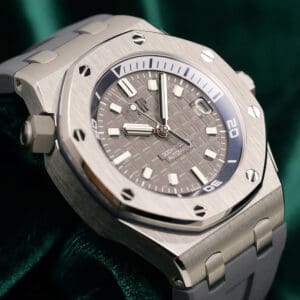
Audemars Piguet Royal Oak Offshore Diver Grey Dial Blue Inner Bezel Grey Rubber Strap Stainless Steel 42mm MINT CONDITION COMPLETE SET 15720ST.OO.A009CA.01
$27,788.00
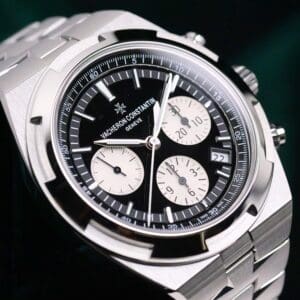
Vacheron Constantin Overseas Chronograph "Reverse Panda" Black Dial Silver Subdials Stainless Steel 42.5mm MINT CONDITION COMPLETE SET 5500V/110A-B481
$34,095.00

Rolex Sky-Dweller Black Dial 18K White Gold Fluted Bezel Oyster Bracelet Stainless Steel 42mm MINT CONDITION COMPLETE SET 336934-0007
$21,945.00

2026 Rolex Datejust Green Ombre Dial Smooth Bezel Jubilee Bracelet Stainless Steel 41mm MINT CONDITION COMPLETE SET 126300
$16,480.00

2026 NEW UNWORN Cartier Santos-Dumont Silver Dial Platinum Mesh Bracelet Platinum 31mm COMPLETE SET WGSA0124
$64,790.00

2026 Tudor Black Bay 58 Black Dial Jubilee Bracelet Stainless Steel 39mm MINT CONDITION COMPLETE SET 7939A1A0NU
$5,717.00

NEW UNWORN Rolex Submariner Date “Sub Date” Black Dial Black Ceramic Bezel Oyster Bracelet Stainless Steel 41mm COMPLETE SET 126610LN
$15,595.00
Price and Market Demand in 2026
The Daytona, especially in steel, consistently trades above retail on the secondary market. The Ref. 126500LN retails at approximately $16,900 in the US as of 2026 (Rolex raised steel Daytona pricing about 5.6% in January 2026), and trades on the grey market in roughly the $28,000 to $34,000 range depending on dial.
Panda dials command 20–30% premiums over black. WatchCharts data shows the 126500LN sold in a median of about 10 days in April 2026, faster than 98% of watches on the market. Liquidity here is exceptional.
The Day-Date story has shifted in the past year. The Day-Date 40 in yellow gold (Ref. 228238) saw the steepest percentage increase across the 2026 Rolex price list — about 6.4%, moving to roughly $40,250 retail, driven mainly by rising gold input costs.
On the secondary market, the 228238 trades around $38,000 to $48,000 depending on dial, with strong recent momentum (up about 13.8% year-over-year per WatchCharts). That’s a real change from the prior pattern of Day-Dates trading at or below retail.
The platinum Day-Date 228206 sits higher again (around $57,000 to $62,000 in 2026) but moves slower (median 74 days to sell in early 2026 per WatchCharts), reflecting the narrower buyer pool.
Overall, the Daytona benefits from broad, performance-driven demand and faster turnover. The Day-Date increasingly relies on rising gold input costs and prestige buyer demand, which gives it slower liquidity but firmer pricing than it had a few years ago.
For the wider context on where each line sits in the catalogue, our Rolex pricing guide covers retail and grey market across every collection.
Notable Rolex Daytona References

The Rolex Daytona’s reputation is built reference by reference. Certain models define entire eras and shape collector demand, pricing behavior, and long-term desirability. These are the references buyers and collectors consistently track.
For a deeper read on how the dials themselves shape value, we break down the Daytona dial landscape in a separate guide.
1. Rolex Daytona Ref. 6239 — “Paul Newman”
This reference introduced the Daytona to the world in the 1960s and later became legendary due to its exotic dial variant, now known as the “Paul Newman.” Initially slow-selling, it gained massive collector status decades later when vintage Rolex interest surged.
Key Specs:
- Case: 37mm stainless steel
- Bezel: Steel tachymeter bezel
- Movement: Manual-wind chronograph
- Dial: Standard or “exotic” Paul Newman dial
- Approx. Market Price: $120,000–$500,000+ (dial dependent)
2. Rolex Daytona Ref. 6263 — “Big Red”
The Ref. 6263 marked a major evolution with screw-down chronograph pushers and a bold acrylic bezel. The “Big Red” nickname comes from the oversized red “Daytona” text on the dial, making it one of the most visually recognizable vintage Daytonas.
Key Specs:
- Case: 37mm stainless steel
- Bezel: Black acrylic tachymeter
- Movement: Manual-wind chronograph
- Dial: Large red “Daytona” text
- Approx. Market Price: $90,000–$200,000+
3. Rolex Daytona Ref. 16520 — “Zenith Daytona”
This is the reference that brought the Daytona into the automatic era. Rolex modified the Zenith El Primero movement extensively, and collectors value this era for its limited production window and transitional status.
Key Specs:
- Case: 40mm stainless steel
- Bezel: Steel tachymeter bezel
- Movement: Modified Zenith El Primero automatic (Cal. 4030)
- Dial: Gloss or matte variants
- Approx. Market Price: $25,000–$35,000
4. Rolex Daytona Ref. 116500LN — “Ceramic Daytona” (Discontinued 2023)
The 116500LN defined the previous-generation Daytona era from 2016 to 2023. Its ceramic bezel, balanced proportions, and Caliber 4130 movement turned it into one of the most sought-after steel Rolex watches ever produced.
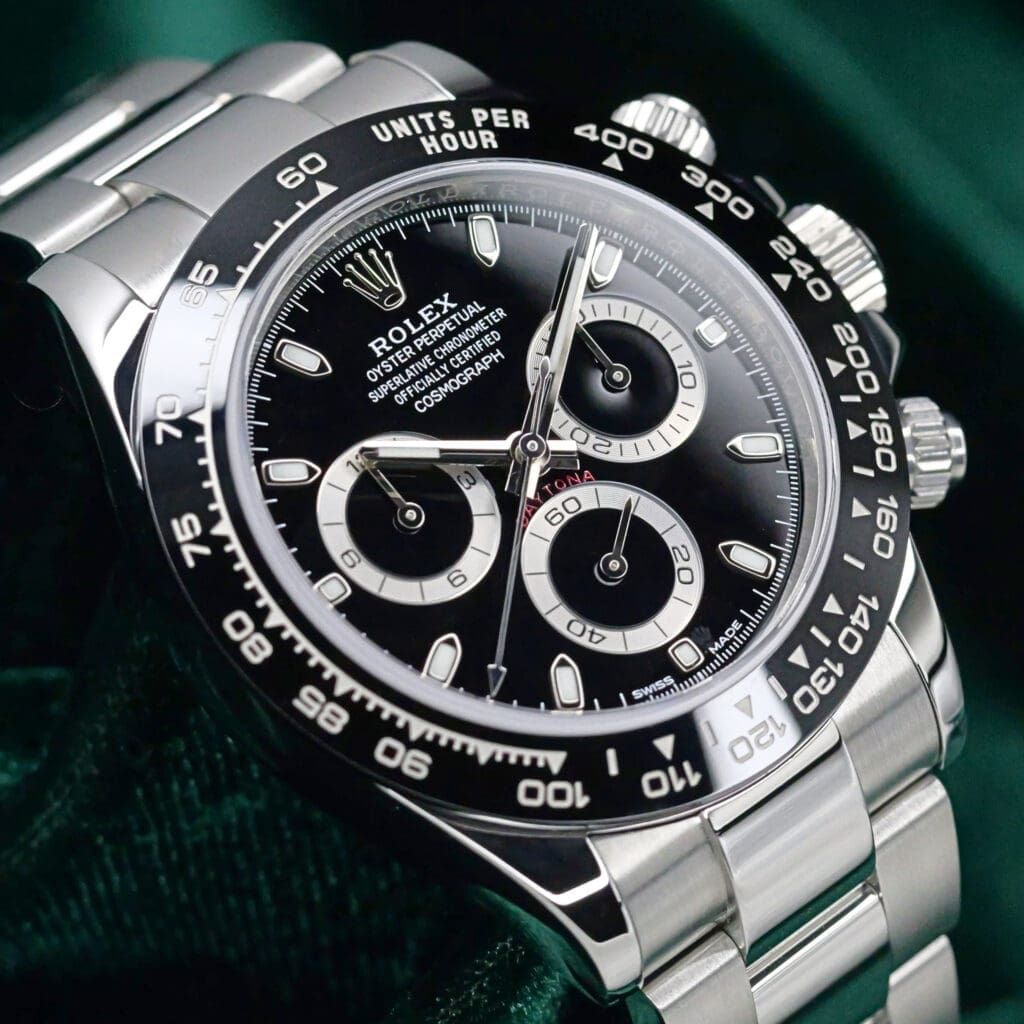
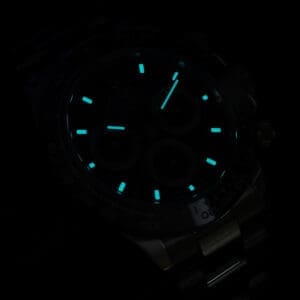
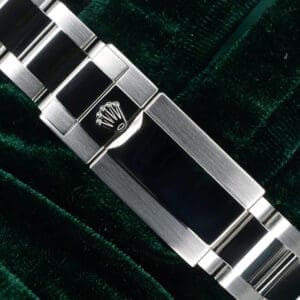
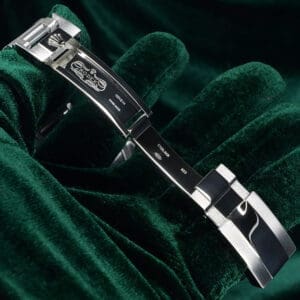
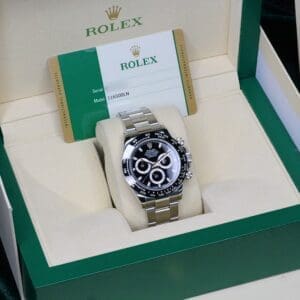
Now discontinued, it currently trades roughly $3,000 below the newer 126500LN on the secondary market, which has made it an interesting alternative for buyers who prefer the older case profile.
Key Specs:
- Case: 40mm stainless steel (12.2mm thick)
- Bezel: Black ceramic (Cerachrom)
- Movement: Caliber 4130
- Dial: Black or white (“Panda”)
- Approx. Market Price: $24,000–$28,000
5. Rolex Daytona Ref. 126500LN — Current Steel Daytona (2023–present)
This is the current production steel Daytona and the one most buyers are evaluating today. The case is 0.5mm thinner than the outgoing 116500LN, the lugs are slightly more symmetrical, the subdials are tighter, and the new outer steel bezel ring keeps the ceramic insert from running to the edge.
Key Specs:
- Case: 40mm stainless steel (11.9mm thick)
- Bezel: Black ceramic (Cerachrom)
- Movement: Caliber 4131 (72-hour reserve, Chronergy escapement)
- Dial: Black (126500LN-0002) or “Panda” white (126500LN-0001)
- Approx. Retail Price: $16,900
- Approx. Market Price: $28,000–$34,000
6. Rolex Daytona Ref. 126506 — Platinum Daytona
This reference pushed the Daytona fully into high luxury. Crafted in platinum and paired with an ice-blue dial, it combines performance heritage with serious wrist weight. The 126506 is also unusual for a Daytona in showing the Caliber 4131 through a sapphire caseback, with a solid gold rotor visible underneath.
Key Specs:
- Case: 40mm platinum
- Bezel: Brown ceramic
- Movement: Caliber 4131 (sapphire caseback, gold rotor)
- Dial: Ice blue with chestnut subdials
Notable Rolex Day-Date References

The Rolex Day-Date is defined by material, presence, and symbolism more than technical variation. Collectors focus on metal, case size, dial configuration, and production era, because those factors shape both desirability and long-term value. The references below define the modern Day-Date landscape.
1. Rolex Day-Date 40 Ref. 228238 — Yellow Gold
This is the most traditional and instantly recognizable Day-Date configuration. Yellow gold paired with the President bracelet is the image most people associate with the model. The champagne Roman dial in particular is the most liquid configuration and the one that defines the “President look” for most buyers.
Key Specs:
- Case: 40mm
- Material: 18k yellow gold
- Bracelet: President (ceramic-insert links to reduce stretch)
- Movement: Caliber 3255 (70-hour reserve)
- Dial: Multiple options (champagne, black, green, silver)
- Approx. Retail Price: $40,250
- Approx. Market Price: $38,000–$48,000
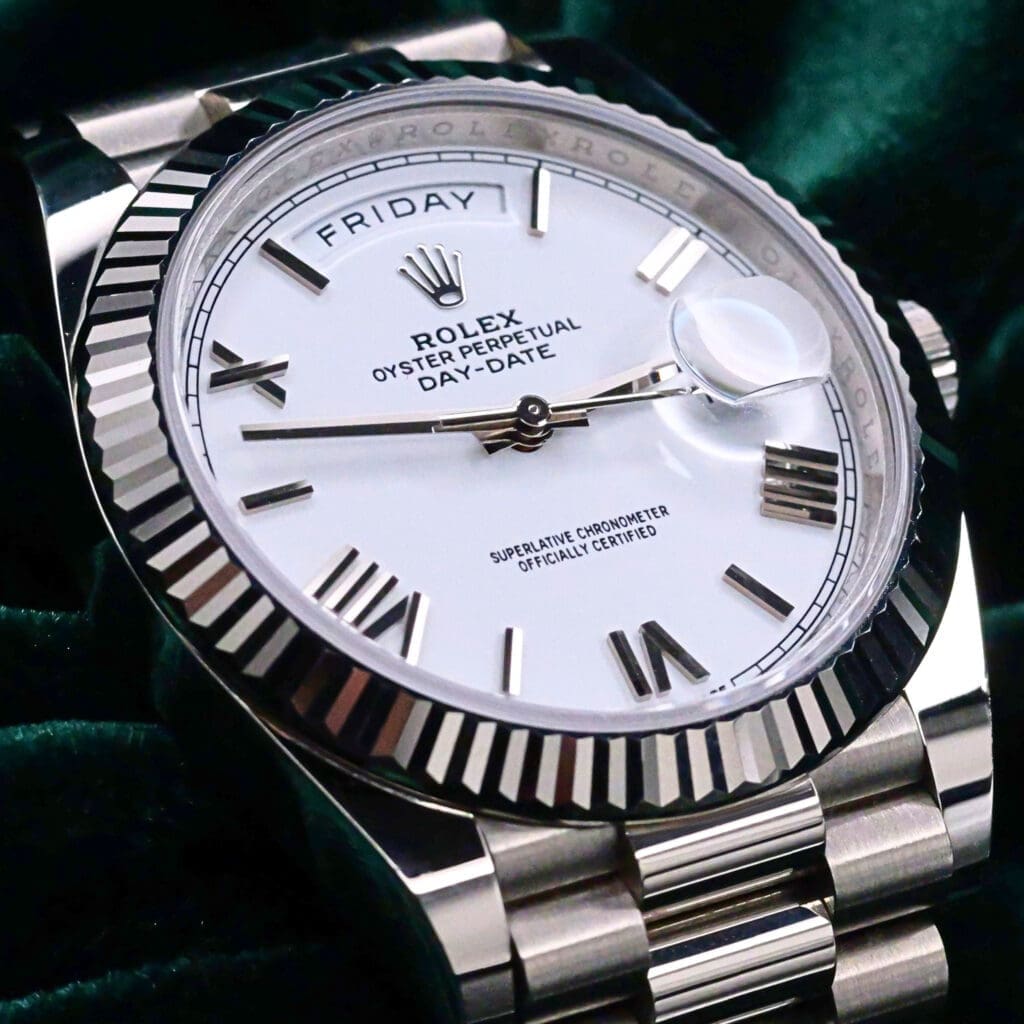
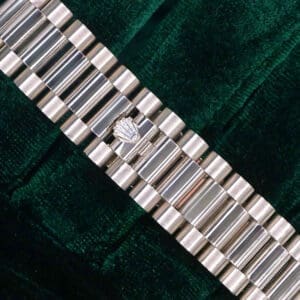
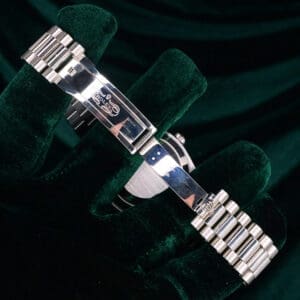
2. Rolex Day-Date 40 Ref. 228239 — White Gold
The white gold Day-Date offers the same prestige as yellow gold but with a more understated appearance. Collectors often choose this reference for discretion — same weight, same build, less visual heat.
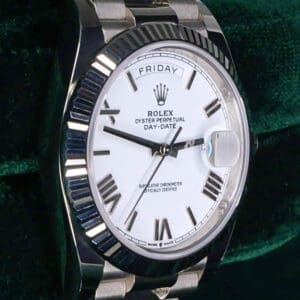

Key Specs:
- Case: 40mm
- Material: 18k white gold
- Bracelet: President
- Movement: Caliber 3255 (70-hour reserve)
- Dial: Black, blue, silver, meteorite
- Approx. Market Price: $40,000–$46,000
3. Rolex Day-Date 40 Ref. 228206 — Platinum “Ice Blue”
The most prestigious modern Day-Date. Platinum construction and the platinum-exclusive ice-blue dial set it apart immediately to anyone who knows Rolex. Heavier than gold, produced in smaller numbers, and slower to trade on the secondary market — but that slower turnover keeps pricing firm.
Key Specs:
- Case: 40mm
- Material: Platinum
- Bracelet: President (platinum)
- Movement: Caliber 3255 (70-hour reserve)
- Dial: Ice blue (platinum exclusive)
- Approx. Market Price: $57,000–$62,000
These references show how the Day-Date expresses prestige through material and presence rather than complication. Unlike the Daytona, where reference changes often reflect technical evolution, Day-Date references reflect status preferences and personal identity — which is why pricing and demand vary more widely across the range.
Which Should You Buy: Daytona or Day-Date?
Choosing between the Rolex Daytona and the Rolex Day-Date comes down to how you plan to live with the watch. By this point the trade-offs should be clear, but here’s the short version for someone making the call right now.
Choose the Rolex Daytona If
- You want one watch that works across most situations, from casual wear to smart-casual settings.
- You prefer sport-focused design that feels purposeful rather than formal.
- You value comfort during long wear, lighter weight, and easy day-to-day usability.
- You care about resale liquidity and fast secondary-market demand.
- You’re drawn to mechanical complexity — a chronograph movement you can use, not just look at.
Choose the Rolex Day-Date If
- You want a Rolex that people recognize instantly.
- You prefer the feel, presence, and permanence of precious metals on your wrist.
- You wear suits, formal attire, or professional clothing more often than casual outfits.
- You value prestige, tradition, and symbolic luxury over all-around versatility.
- You’re comfortable with slower resale in exchange for firm pricing and the value floor that rising gold prices give a gold watch.
Daytona vs Day-Date: Frequently Asked Questions
Is the Day-Date More Expensive Than the Daytona?
At retail and on the secondary market, the steel Daytona is significantly cheaper than any Day-Date. Steel Daytona Ref. 126500LN retails around $16,900 and trades around $28,000–$34,000. The cheapest current Day-Date 40 in yellow gold retails around $40,250 and trades $38,000–$48,000.
Daytonas in precious metal (platinum 126506, gold 126518LN) move higher than the gold Day-Date, but the steel Daytona — the most common reference — is the more affordable entry point.
Which One Holds Value Better in 2026?
The Day-Date 228238 had a stronger one-year run, up about 13.8% year-over-year, while the steel Daytona was roughly flat. Over the longer term, the steel Daytona has historically been the better store of value because of its broader demand and faster liquidity.
The Day-Date’s recent strength is partly tied to rising gold prices, which set a “melt value” floor that steel doesn’t have. For a wider read on which references move best on the resale market, see our breakdown of Rolex models that hold value.
Is the Day-Date the Same as the Rolex President?
Yes. “President” is the unofficial nickname for the Day-Date, named after the President bracelet that Rolex designed specifically for the model in 1956. The terms are used interchangeably, but Rolex officially calls the watch the Day-Date.
If you’re shopping around the President name specifically, our Rolex President buying guide walks through what’s actually under that label.
Can the Daytona Be Worn Formally?
A steel Daytona on the Oyster bracelet works in business-casual settings and most professional environments, but it doesn’t carry the same formal weight as a Day-Date. For black-tie or boardroom-level formality, the Day-Date is the safer pick. For everything down to and including most business attire, the Daytona is fine.
Does the Day-Date Come in Steel?
No. The Day-Date has only ever been produced in precious metals — yellow gold, white gold, Everose gold, platinum, and now Jubilee Gold as of 2026. If someone is selling a “steel Day-Date,” it’s not a Day-Date — it’s likely a Datejust or a fake.
Where to Buy Authentic Rolex Daytona and Day-Date Watches Online
There are a handful of legitimate online channels for buying a Daytona or Day-Date. Chrono24 is the largest international marketplace and the easiest place to compare listings across dealers and private sellers. (If it’s your first time on the platform, we cover what to watch for on Chrono24 in detail.)
eBay, through its Authenticity Guarantee program, inspects luxury watches before they ship to the buyer. Grailzee runs auction-style listings on pre-owned pieces. Independent grey-market dealers and watch forums sit alongside these as another category worth being aware of.
For a wider look at the channels and trade-offs, our pillar on where to source a pre-owned luxury watch covers the full landscape.
We also sell, buy, and trade luxury watches — and the reason clients choose us over a big marketplace is the layered communication before you commit.
Tour videos of the actual watch you’re looking at, detailed condition notes, and a real conversation with someone who has had the piece in hand. You’re not buying blind off a listing, and you’re not chasing a seller across a forum thread.
That’s reflected in our 4.9-star Google rating, which comes from clients who appreciate the back-and-forth before the buying decision more than the speed of the transaction.
If you want a closer look at a specific Daytona or Day-Date — a 126500LN panda vs black dial, a 228238 in a particular dial configuration, or a 228206 platinum — browse our available watches or reach out, and we’ll line up tour videos and condition notes on the references that match what you’re after.
Final Thoughts on Daytona vs Day-Date
The Daytona vs Day-Date decision has very little to do with specifications, trends, or hype. It comes down to how the watch fits into your daily life and what you want it to say when it’s on your wrist.
The Daytona succeeds because you can wear it often, comfortably, and without overthinking the setting. Its secondary-market liquidity is among the best in the watch world. The Day-Date plays a different role. It isn’t meant to blend in or adapt.
Two things worth keeping in mind if you’re shopping. First, dial choice on both watches drives a 20–30% price swing (panda on the Daytona, champagne Roman or green on the Day-Date 228238) so it pays to be specific about which dial you actually want before you start chasing a listing.
Second, condition and box-and-papers status moves Day-Date pricing 10–30% on the secondary market and matters even more on the older Daytona references. If your shortlist also includes the Submariner, we cover that head-to-head in our Daytona vs Submariner breakdown.
For Day-Date shoppers also weighing the Datejust, our Day-Date vs Datejust comparison walks through where the two diverge.
Neither choice is better. One is a sport icon built around performance, the other is Rolex’s prestige flagship built around symbolism. The right watch is the one that aligns naturally with how you live and what you value most.
999+ Timepieces Available
Explore Our Timepieces
Authenticated, unworn, and ready to ship worldwide.
Rolex · Audemars Piguet · Patek Philippe · Omega · Cartier · Richard Mille · Hublot · Tudor
Newly Listed
Tudor Black Bay 58 Blue Dial Stainless Steel 39mm MINT CONDITION COMPLETE SET 79030B-0001
$4,068.00
2026 NEW UNWORN Grand Seiko Elegance "Morning Glow" Limited Edition Red Dial Crocodile Strap 38.5mm COMPLETE SET SBGY035G
$9,816.00
2026 NEW UNWORN Tudor Black Bay 58 GMT "Coke" Black Dial Black Burgundy Red Bezel Five-Link Stainless Steel Bracelet 39mm COMPLETE SET 7939G1A0NRU-0003
$7,385.00
Grand Seiko Heritage 60th Anniversary Limited Edition Blue Dial Stainless Steel 40mm MINT CONDITION COMPLETE SET SBGP007G
$4,268.00
Audemars Piguet Royal Oak Offshore Diver Grey Dial Blue Rubber Strap Stainless Steel 42mm MINT CONDITION COMPLETE SET 15720ST.OO.A009CA.01
$27,788.00
Audemars Piguet Royal Oak Offshore Diver Grey Dial Blue Inner Bezel Grey Rubber Strap Stainless Steel 42mm MINT CONDITION COMPLETE SET 15720ST.OO.A009CA.01
$27,788.00
Vacheron Constantin Overseas Chronograph "Reverse Panda" Black Dial Silver Subdials Stainless Steel 42.5mm MINT CONDITION COMPLETE SET 5500V/110A-B481
$34,095.00
Rolex Sky-Dweller Black Dial 18K White Gold Fluted Bezel Oyster Bracelet Stainless Steel 42mm MINT CONDITION COMPLETE SET 336934-0007
$21,945.00
2026 Rolex Datejust Green Ombre Dial Smooth Bezel Jubilee Bracelet Stainless Steel 41mm MINT CONDITION COMPLETE SET 126300
$16,480.00
2026 NEW UNWORN Cartier Santos-Dumont Silver Dial Platinum Mesh Bracelet Platinum 31mm COMPLETE SET WGSA0124
$64,790.00
2026 Tudor Black Bay 58 Black Dial Jubilee Bracelet Stainless Steel 39mm MINT CONDITION COMPLETE SET 7939A1A0NU
$5,717.00
NEW UNWORN Rolex Submariner Date “Sub Date” Black Dial Black Ceramic Bezel Oyster Bracelet Stainless Steel 41mm COMPLETE SET 126610LN
$15,595.00