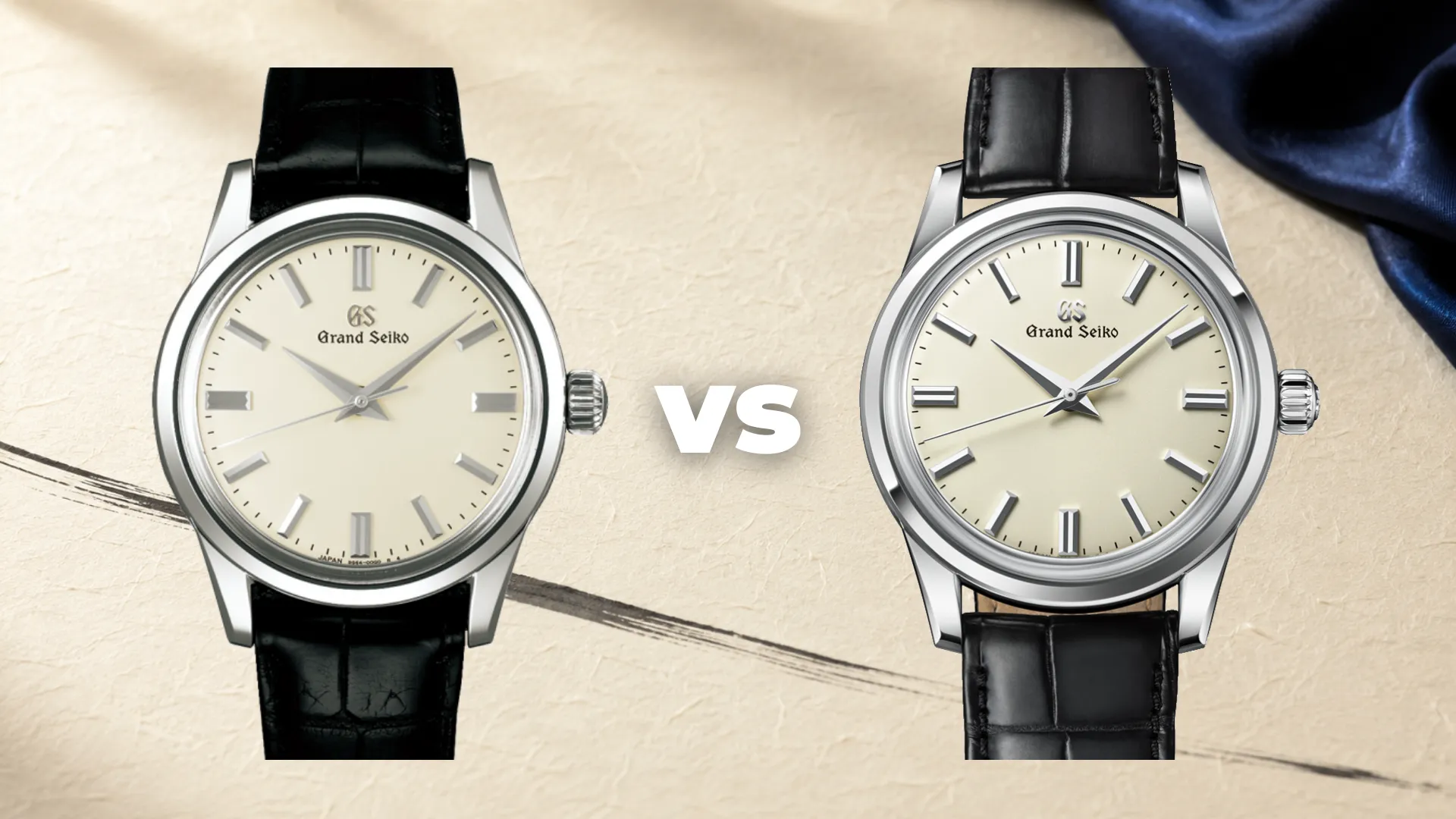

The Rolex GMT-Master vs Submariner comparison comes up so often because the two watches read as the same watch from a few feet away. Same case shape, same crown guards, same Oyster bracelet, same matte black dial in most configurations.
Side by side on a counter, even some collectors have to look twice. What gets lost in that visual overlap is that the original GMT-Master came out of a different brief than the Submariner. One was built for a Pan Am pilot tracking time zones mid-flight. The other was built for a diver trying not to drown.
This guide walks through what separates the two lines: purpose, bezel, market behavior, and current prices in 2026. The point is to help you choose the right one without falling for the silhouette.
Rolex GMT-Master Overview
The Rolex GMT-Master was introduced in 1955 in collaboration with Pan American World Airways, created to meet the needs of commercial pilots flying long-haul international routes. Managing multiple time zones mechanically was a real cockpit problem at the time, and Rolex designed the GMT-Master as a working tool, not a sports watch.
Unlike the later GMT-Master II, the original features a fixed 24-hour hand paired with a rotating 24-hour bezel. The hour hand is not independently adjustable, which means setting a new local time means stopping the movement. That single distinction is why the original GMT and the modern GMT II are different watches, not different generations of the same watch.
The GMT-Master also created the dual-time watch category. Its layout (local hour and minute hands plus a 24-hour hand referencing a rotating bezel) became the template every other GMT watch borrowed.
By the early 1980s, evolving travel needs exposed the limit: pilots wanted to change local time without losing reference time. Rolex answered with the GMT-Master II in 1982, which kept the original in production alongside it until 1999.
Today, collectors value the GMT-Master for its aviation lineage and its clearly defined production eras. Aluminum bezel inserts run across the entire model line, with color variations becoming the main collector identifiers.
Early gilt dials and later matte dials separate the periods, while transitional references mark Rolex’s gradual shift toward modern movements. The red-and-blue “Pepsi” bezel (first seen on the 6542 in 1955) has carried more cultural weight than almost any other watch design.
That weight got heavier in April 2026, when Rolex discontinued the modern ceramic Pepsi GMT-Master II (ref. 126710BLRO) at Watches & Wonders Geneva without naming a successor. The original GMT-Master line had already been out of production since 1999, and now the Pepsi colorway is out of the steel catalog entirely.


For buyers looking at vintage GMT-Masters, that’s a meaningful tailwind on values for the 1675 and 16700 references with Pepsi configurations.
Most Popular Rolex GMT-Master References:
- Rolex GMT-Master Ref. 6542
- Rolex GMT-Master Ref. 1675
- Rolex GMT-Master Ref. 16750
- Rolex GMT-Master Ref. 16700

Rolex Submariner Overview
The Rolex Submariner debuted in 1953 as a purpose-built dive watch, built for a moment when commercial diving and underwater exploration were both moving fast. From the start, it had to be readable, water-resistant, and timer-accurate at depth. It was built to those specs, not styled around them.
The dive use case dictated almost every design choice. Large luminous hour markers, oversized hands, and a clean dial layout meant a diver could read elapsed time instantly in low light. Water resistance started at 100m on the earliest references and pushed to 300m on the 16610.
The unidirectional bezel, introduced as the design evolved, became a safety feature. If the bezel got knocked, it could only rotate in the direction that shortened perceived dive time, never extended it.
Military and commercial divers picked it up early, including British Royal Navy units that received the famous MilSub variants. As diving techniques matured, the Submariner matured alongside them, refining the same idea rather than reinventing it.
Collectors care about the Submariner because its value is reference-driven down to small details. Dial text, case proportions, lug holes, the switch from tritium to Super-LumiNova, the move from aluminum to ceramic — small changes that define entire eras.

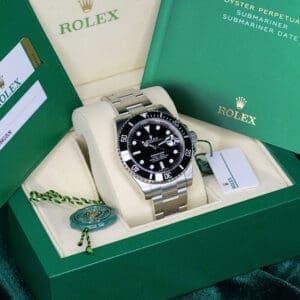
No-date models are especially loved for their visual symmetry, and the Mercedes hands plus oversized lume plots are core to the line’s look. Where many similar dive watches were replaced or radically redesigned, the Submariner just kept refining.
Most Popular Rolex Submariner References:
- Rolex Submariner Ref. 6204
- Rolex Submariner Ref. 5513
- Rolex Submariner Ref. 1680 — “Red Sub”
- Rolex Submariner Ref. 16610

How the GMT-Master and Submariner Differ
The Rolex GMT-Master and Submariner share a case shape and a tool-watch silhouette, but they were built for completely different jobs. The differences below are the ones that matter for how you wear, use, and value either watch.
1. Core Purpose
The GMT-Master was built as a cockpit tool to help pilots track multiple time zones during long-haul flights. The job was simple: keep local time on the main dial, keep reference time visible at all times via the 24-hour hand and bezel, and never confuse the two during turnaround.
The Submariner was built as a dive instrument to time underwater stays with maximum clarity and the smallest possible margin of error. Different problem, different watch.
2. Timekeeping Capability
The GMT-Master delivers dual-time capability through a fixed 24-hour hand combined with a rotating 24-hour bezel. The wearer reads a second time zone without doing math. The Submariner displays a single time only and skips every extra complication that might cost legibility or robustness underwater.
This is the practical split: if you regularly cross time zones, the GMT-Master earns its place on the wrist. If you don’t, the Submariner removes complexity you’d never use.
3. Bezel Design and Function
The bezel is where the two watches stop pretending to look alike under closer inspection. The GMT-Master uses a bidirectional 24-hour bezel marked with all 24 hours, designed to read time-zone offsets, not to time anything. Spin it forward eight hours and you’re reading Tokyo from a New York-set dial.
The Submariner uses a unidirectional 60-minute bezel designed to time elapsed periods underwater. The unidirectional design is a safety feature, not a styling choice.
If the bezel gets bumped during a dive, it can only rotate to shorten the displayed elapsed time, never extend it. A diver overstaying air supply because of an accidentally rotated bezel is exactly the failure mode this design exists to prevent.
4. Dial Layout and Legibility
The GMT-Master dial carries more visual information: a fourth hand and a 24-hour scale on the bezel that the eye has to parse. It’s still a clean dial, but compared to a Submariner it’s working harder.
The Submariner dial is a study in subtraction: oversized luminous markers, Mercedes hands with a lot of lume, and nothing competing for attention. At depth, in low light, every quarter-second the eye spends parsing the dial is time spent not watching the bezel.
5. Price and Market Demand
This is where the two lines diverge most clearly in 2026. The original GMT-Master line lives entirely in the vintage Rolex market (Rolex stopped making it in 1999), so prices are driven by reference, condition, originality, dial era, and bezel configuration.
Verified 2026 ranges: vintage 1675s start around $11,000 for clean Pepsi examples and climb past $40,000 for early gilt dials with originality. The 16700, the final GMT-Master before the line ended, trades roughly $11,000 to $18,000. Early 6542 examples in good original condition start north of $120,000 and exceptional ones cross $200,000+.
The Submariner spans both vintage and modern markets, which gives it a much broader pricing range and significantly higher liquidity. Pre-owned 16610 watches typically trade between $8,000 and $12,000 depending on production year, condition, dial variant (tritium vs Super-LumiNova), and whether the original box and papers are included.
Vintage 5513s sit roughly $11,000 to $25,000 depending on dial mark and condition. Red Sub 1680s in good condition trade around $18,000 to $35,000+ depending on dial mark and provenance.
The April 2026 discontinuation of the modern ceramic Pepsi GMT-Master II changed the GMT side of this equation. Secondary market prices on the steel Pepsi have surged past $30,000, with unworn examples pushing above $40,000.
That pricing pressure has flowed back into the vintage GMT-Master market, particularly for clean Pepsi 1675s and 16700s. The Submariner market has stayed more stable through the same period.
Notable Rolex GMT-Master References
A handful of GMT-Master references define the model’s evolution from cockpit tool to collectible icon. These are the ones most buyers shortlist.
1. Rolex GMT-Master Ref. 6542
The 6542 is the original GMT-Master, developed with Pan Am to meet the needs of long-haul pilots. It established the foundational GMT layout (24-hour hand plus rotating bezel) and its short five-year production run plus early production quirks (Bakelite bezels, radium dials) make it the most historically important GMT reference.
Key Specs:
- Production era: 1954–1959
- Case size: 38 mm
- Bezel: Bakelite (early), later aluminum replacements
- Dial: Gilt (radium lume on early examples)
- Movement: Caliber 1036 / 1065
- Bracelet: Oyster or Jubilee
- Market range: ~USD 120,000–300,000+ (condition and originality dependent)
2. Rolex GMT-Master Ref. 1675
The 1675 is the longest-running GMT-Master and the one most collectors think of when they picture a vintage GMT. It produced for over two decades and refined the original concept with crown guards, an aluminum bezel insert (replacing fragile Bakelite), and updated movements.
It became the standard dual-time watch for both pilots and civilian travelers, and it’s the entry point for most collectors getting into vintage GMT-Master ownership.
Key Specs:
- Production era: 1959–1980
- Case size: 40 mm
- Bezel: Aluminum (Pepsi most common)
- Dial: Gilt early, matte later
- Movement: Caliber 1565 / 1575
- Bracelet: Oyster or Jubilee
- Market range: ~USD 11,000–40,000+ depending on dial era and condition
3. Rolex GMT-Master Ref. 16750
The 16750 is the transitional GMT-Master that bridges vintage and modern eras. It introduced a higher-beat movement and a sapphire crystal option while keeping the original GMT-Master layout intact.
For collectors who want the look of a vintage GMT with fewer of the ownership headaches, this is usually the reference.
Key Specs:
- Production era: 1981–1988
- Case size: 40 mm
- Bezel: Aluminum
- Dial: Matte early, glossy later
- Movement: Caliber 3075
- Bracelet: Oyster or Jubilee
- Market range: ~USD 13,000–25,000+
4. Rolex GMT-Master Ref. 16700
The 16700 was the final GMT-Master produced before the line was discontinued in 1999. It looks almost identical to a contemporary GMT-Master II from the front, but it retains the original fixed-hour-hand GMT functionality.
That makes it a frequent point of confusion when people compare GMT-Master and GMT-Master II references on a listing site.
Key Specs:
- Production era: 1988–1999
- Case size: 40 mm
- Bezel: Aluminum (Pepsi or black)
- Dial: Glossy with applied markers
- Movement: Caliber 3175
- Bracelet: Oyster
- Market range: ~USD 11,000–18,000+
Notable Rolex Submariner References
These four Submariner references define the major stages of the model’s design and technical evolution. They’re also the references most buyers compare when they’re shopping the line.
1. Rolex Submariner Ref. 6204
The 6204 is one of the earliest Submariners and the foundation of Rolex’s professional dive watch program. It established the core principles (clear dial, rotating bezel for elapsed time, real water resistance) that every Submariner since has refined rather than replaced.
Key Specs:
- Production era: 1953–1954
- Case size: 37 mm
- Water resistance: 100 m
- Bezel: Bi-directional, aluminum
- Dial: Gilt with radium lume
- Movement: Caliber A260
- Bracelet: Oyster
- Market range: ~USD 80,000–200,000+
2. Rolex Submariner Ref. 5513
The 5513 is one of the longest-running Submariner references and the no-date Sub many collectors consider the purest form of the model. Its consistent layout, balanced proportions, and lack of a date window keep the dial perfectly symmetrical, which is the visual case the no-date Sub has always made against the date version.
Key Specs:
- Production era: 1962–1989
- Case size: 40 mm
- Water resistance: 200 m
- Bezel: Aluminum, unidirectional (later production)
- Dial: Gilt early, matte later
- Movement: Caliber 1520 / 1530
- Bracelet: Oyster
- Market range: ~USD 11,000–25,000+ for clean examples
3. Rolex Submariner Ref. 1680 — “Red Sub”
The Red Sub is collected hard because it’s the first Submariner with a date complication, which is a meaningful turning point for the line. Its short production window with red “Submariner” text on the dial, paired with multiple dial mark variations (Mark I through Mark VI), has made it one of the most studied vintage Submariner references.
Mark variations alone can swing values by thousands.
Key Specs:
- Production era: Late 1960s–1970s
- Case size: 40 mm
- Water resistance: 200 m
- Bezel: Aluminum
- Dial: Matte with red text
- Movement: Caliber 1575
- Bracelet: Oyster
- Market range: ~USD 18,000–35,000+ depending on dial mark
4. Rolex Submariner Ref. 16610
The 16610 is the modern aluminum-bezel Submariner and the reference most current owners wear daily. Long production run, the bulletproof Caliber 3135, sapphire crystal, and 300m water resistance make it the sweet spot between vintage charm and daily-driver reliability.
It’s also the most liquid Submariner on the secondary market: clean examples typically sell within three weeks of being listed.
Key Specs:
- Production era: 1988–2010
- Case size: 40 mm
- Water resistance: 300 m
- Bezel: Aluminum, unidirectional
- Dial: Glossy with applied markers (later models)
- Movement: Caliber 3135
- Bracelet: Oyster
- Market range: ~USD 8,000–12,000+
Side-by-Side: GMT-Master vs Submariner
| Feature | GMT-Master | Submariner |
| Year introduced | 1955 | 1953 |
| Original use case | Pilots tracking dual time zones | Divers timing underwater stays |
| Bezel | 24-hour, bidirectional | 60-minute, unidirectional |
| Hands | 4 (hour, minute, seconds, GMT) | 3 (hour, minute, seconds) |
| Time zones tracked | 2 (via fixed 24-hr hand + bezel) | 1 |
| Production status | Discontinued 1999 | Continuous since 1953 |
| Water resistance | 50–100m typical | 100–300m by reference |
| Entry price (2026) | ~$11,000 (1675 / 16700) | ~$8,000 (16610) |
| Market liquidity | Lower (vintage only) | Higher (vintage + modern) |

Which Rolex Should You Choose?
The choice between the GMT-Master and the Submariner is less about looks and more about how you’ll wear it, how you’ll use it, and what kind of ownership experience you want. Both are Rolex sport-watch icons. They suit very different buyers.
Choose the GMT-Master if:
- You’re drawn to aviation history and want a watch with a clearly defined collector story
- You want a true dual-time piece, even one with the older fixed-GMT functionality — some collectors prefer it because the hour hand always reads “home time” natively, with no menu-diving or repositioning required
- You appreciate aluminum bezels, gilt or matte dials, and the kind of reference-by-reference nuance that turns shopping into research
- You’re comfortable owning a discontinued model with vintage-era pricing dynamics, longer service intervals, and the patience that comes with owning a 50-year-old watch
- You want to factor in what the April 2026 Pepsi discontinuation has done to the broader GMT category: vintage GMT-Master values for Pepsi configurations are seeing real upward pressure as the only path to a steel red-and-blue Rolex bezel
Choose the Submariner if:
- You want a tool watch you can wear daily without thinking about it
- You value simplicity and instant legibility
- You prefer a watch that works in a wetsuit, a suit, or a t-shirt without ever feeling out of place You like the idea of a reference that’s been refined for 70+ years and still feels current
- You value ongoing production, easier service through Rolex itself, and the deepest secondary-market liquidity in luxury watches
- You want a lower-friction ownership experience; modern Submariner parts are stocked, service is predictable, and resale is straightforward when you decide to move on
Where to Buy Authentic Watches Online
There are a handful of legitimate online channels for buying a vintage GMT-Master or Submariner.
Chrono24 is the largest dedicated luxury watch marketplace and lists thousands of references from dealers worldwide. It’s useful for surveying inventory and getting a sense of asking prices, though buyer protection depends on the seller’s tier.
eBay through its Authenticity Guarantee program inspects watches over $2,000 before they ship, which closes the biggest gap that historically made eBay risky for high-value Rolex. Bezel and WatchBox both run their own in-house authentication and curate inventory more tightly: smaller selection, tighter quality control.
We also sell, buy, and trade luxury watches. The reason clients work with us instead of clicking “buy now” on a marketplace is that the GMT-Master and Submariner are exactly the kind of references where details decide value.
Before you commit to a vintage 1675 or a 16610, we walk you through the actual watch on a video call: bezel condition, dial originality, lume color, case sharpness, bracelet stretch, and any service history that matters. You’re not buying off a polished listing photo. You’re talking to someone who has the watch in hand.
That layered approach is reflected in our 4.9-star Google rating, which comes from clients who wanted to know what they were buying before they sent the wire.
If you want that kind of walkthrough on a specific GMT-Master or Submariner reference, reach out and we can help you source one that matches what you’re looking for.
Final Thoughts on Rolex GMT-Master vs Submariner
The GMT-Master and the Submariner solve two different problems. The GMT-Master is the answer if you want aviation history, vintage character, and a clearly defined collector arc, with the April 2026 Pepsi discontinuation putting renewed pressure on every red-and-blue bezel still in circulation.
The Submariner is the answer if you want simplicity, durability, and the lowest friction ownership experience in luxury watches.
Two things buyers often miss: the GMT-Master’s fixed 24-hour hand keeps “home time” visible in a way the GMT-Master II’s adjustable layout can’t, and the cyclops on date Subs adds crystal height that no-date references avoid. Choose the one that fits the wrist you have, not the one the algorithm keeps showing you.
If you want a wider lay of the land first, our full Rolex buying guide covers every model in the lineup.
999+ Timepieces Available
Explore Our Timepieces
Authenticated, unworn, and ready to ship worldwide.
Rolex · Audemars Piguet · Patek Philippe · Omega · Cartier · Richard Mille · Hublot · Tudor
Newly Listed

2025 NEW Hermes Kelly Sellier en Desordre 20 Vert Mangrove Epsom Leather Permabrass Hardware
$38,900.00
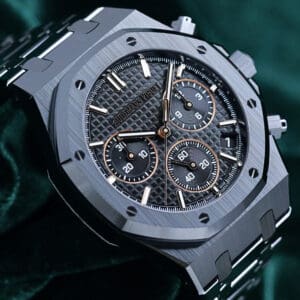
2026 NEW UNWORN Audemars Piguet Royal Oak Chronograph Black Dial Black Ceramic Bezel Black Ceramic Bracelet 41mm COMPLETE SET 26240CE.OO.1225CE.02
$129,800.00
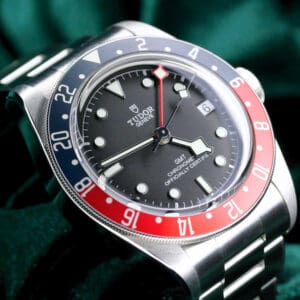
Tudor Black Bay GMT Pepsi Black Dial Red and Blue Bezel Stainless Steel 41mm MINT CONDITION COMPLETE SET 79830RB
$4,294.00
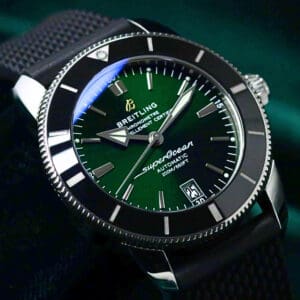
Breitling Superocean Heritage II Green Dial Black Ceramic Bezel Black Rubber Strap Stainless Steel 42mm MINT CONDITION COMPLETE SET AB2010121L1S1
$5,236.00
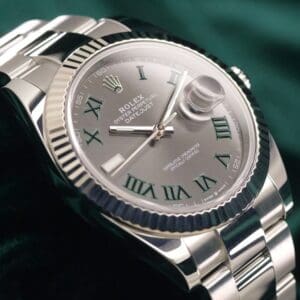
2025 Rolex Datejust Wimbledon Slate Gray Dial Fluted 18K White Gold Bezel Oyster Bracelet Stainless Steel 41mm MINT CONDITION COMPLETE SET 126334
$15,694.00
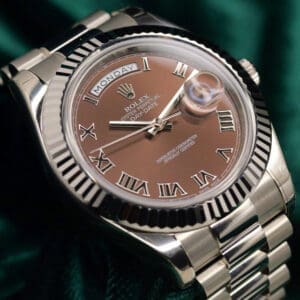
Rolex Day-Date II Brown Chocolate Dial Roman Numerals Fluted Bezel President Bracelet 18K White Gold 41mm MINT CONDITION COMPLETE SET 218239
$49,390.00
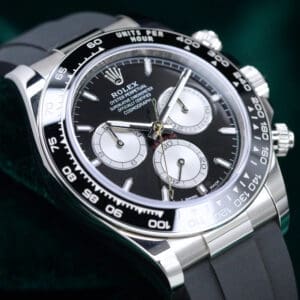
2026 NEW UNWORN Rolex Cosmograph Daytona "Baby Le Mans" Black Dial Silver Subdials Black Ceramic Bezel Black Oysterflex Strap 18K White Gold 40mm COMPLETE SET 126519LN-0002
$57,200.00
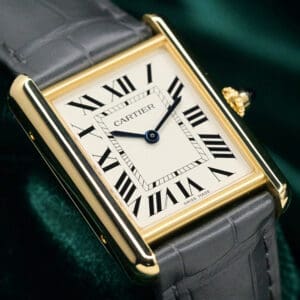
2025 Cartier Tank Louis Cartier Silver Dial Gray Alligator Strap 18K Yellow Gold 25.5mm MINT CONDITION COMPLETE SET WGTA0343
$13,189.00
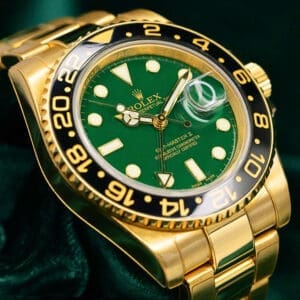
Rolex GMT-Master II Green Dial Black Ceramic Bezel Oyster Bracelet 18K Yellow Gold 40mm MINT CONDITION COMPLETE SET 116718LN
$46,745.00
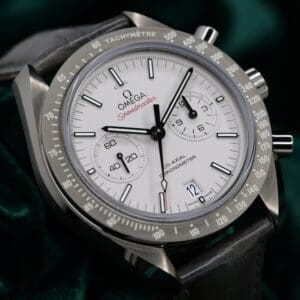
Omega Speedmaster Grey Side of the Moon Grey Dial Alligator Leather Strap Grey Ceramic 44.25mm MINT CONDITION 311.93.44.51.99.001
$8,690.00
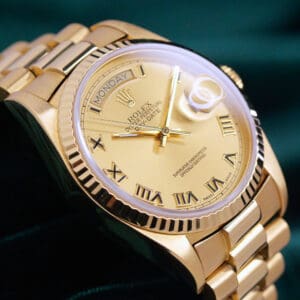
Rolex Day-Date 36 Champagne Gold Dial Roman Numeral Markers Fluted Bezel Presidential Bracelet 18K Yellow Gold NEAR MINT CONDITION 18038
$20,345.00
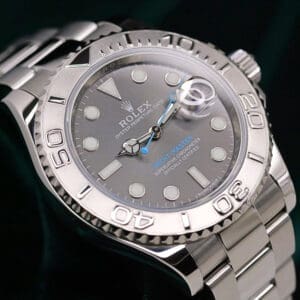
Rolex Yacht-Master Rhodium Grey Dial Platinum Bezel Oyster Bracelet Stainless Steel 40mm MINT CONDITION COMPLETE SET 116622
$14,300.00