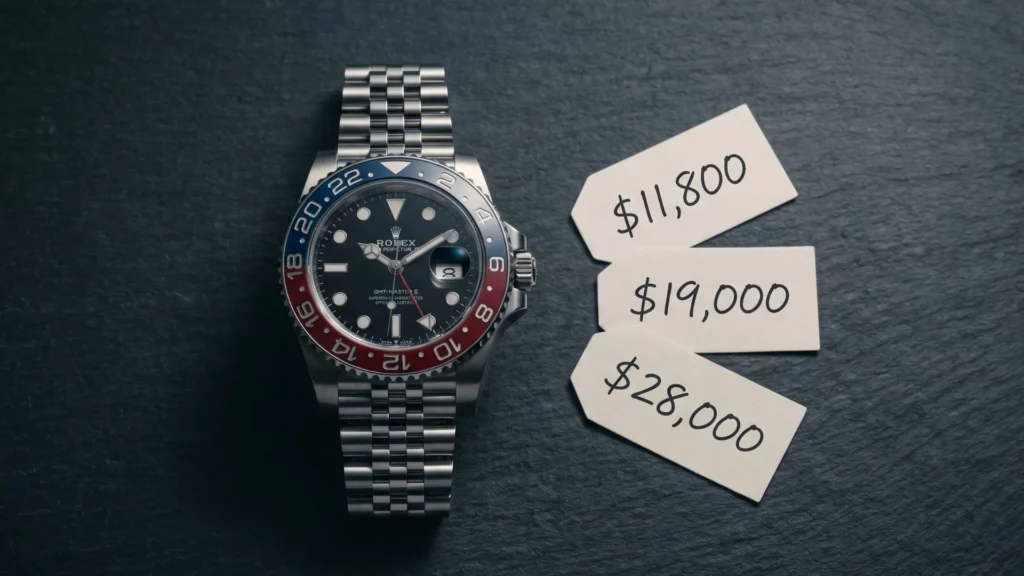
The Rolex Pepsi is gone from the catalog. On April 14, 2026, at Watches & Wonders Geneva, Rolex pulled both the steel ref. 126710BLRO and the white gold ref. 126719BLRO from production. No Coke replacement was announced. For the first time in the Cerachrom era, the steel GMT-Master II lineup carries no red bezel.
Secondary market prices reacted within hours. Average pre-owned 126710BLRO examples now trade around $25,000, with unworn 2026-dated pieces pushing $40,000+, based on current Chrono24 listings and WatchCharts data.
Robb Report tracked the immediate market shift in its post-event coverage.
This Rolex Pepsi buying guide covers every major reference, what each costs after the discontinuation, how to spot a fake, and which one fits your budget. Read through before you make a move.
What Is the Rolex Pepsi?
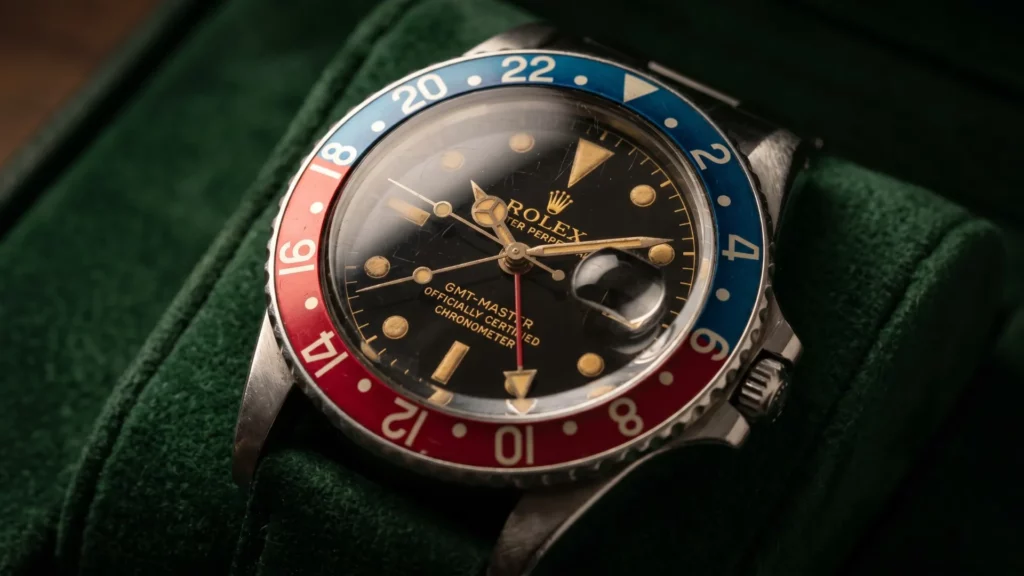
The “Rolex Pepsi” is any GMT-Master or GMT-Master II with a red and blue bezel. The nickname comes from the color match with the Pepsi logo. Rolex itself has never used the name.
The red half marks daytime hours (6:00 to 18:00) and the blue half marks nighttime (18:00 to 6:00). Pan American Airways pilots used this to track two time zones at once on long international flights, starting in 1955.
The Pepsi spans 71 years, three different bezel materials, and a price range from around $12,000 for a used aluminum-bezel example to over $45,000 for the white gold version with a meteorite dial. Every modern reference is now discontinued.
How Did the Rolex Pepsi Bezel Change Over the Years?
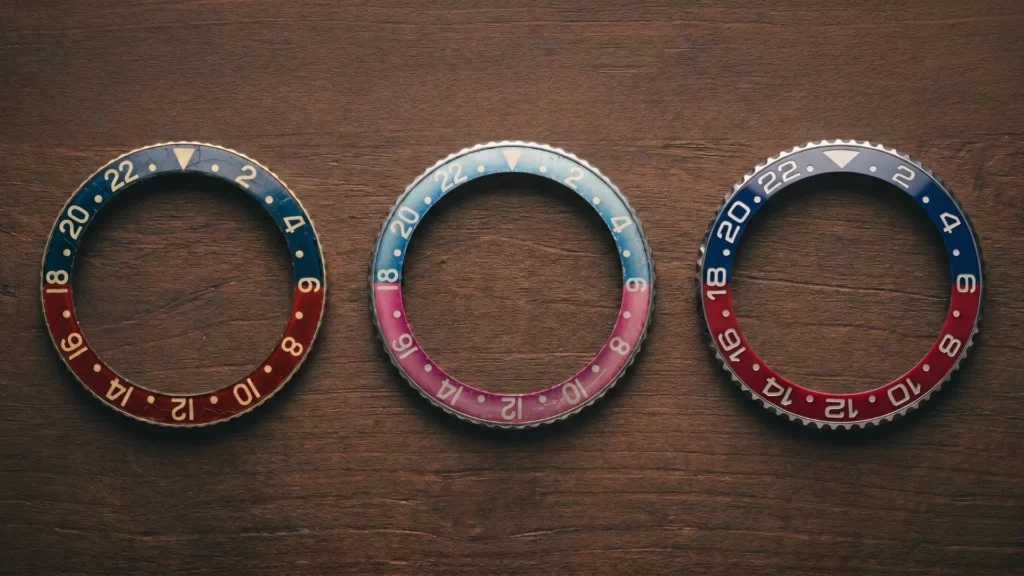
The Rolex Pepsi bezel went through three material changes over 70 years. It started with Bakelite plastic in 1955, moved to aluminum in 1956, and finally switched to Cerachrom ceramic in 2014. Each change affected how the watch looks, how it ages, and what it costs today.
Here is a breakdown of each Pepsi generation.
1. Bakelite Bezel: Ref. 6542 (1955–1959)
The first Pepsi used a Bakelite plastic bezel insert, an early form of hard plastic. It was fragile and prone to cracking in heat. Rolex switched to aluminum inserts as early as 1956, while the ref. 6542 was still in production. This is because the original Bakelite material contained radium, which the U.S. Atomic Energy Commission flagged as radioactive.
Surviving examples with original Bakelite bezels intact are extremely rare. This is a collector’s piece with limited practicality for most buyers reading this. Clean examples now trade between $40,000 and $80,000+ at auction, with provenance and original parts driving the upper end of that range.
2. Anodized Aluminum Bezel: Ref. 1675-Ref. 16710 (1959–2007)
The ref. 1675 launched in 1959 with the aluminum bezel. It stayed the standard on Pepsi models for nearly 50 years. The color fades over time, and collectors are split on it.
Some pay a premium for a “tropical” fade, where the red mellows into orange and the blue lightens. Others want the colors sharp and crisp. The debate plays out daily on forums like Rolex Forums and Reddit r/Watches, and the bezel’s condition can move a 1675’s price by $5,000 or more.
3. Cerachrom Ceramic Bezel: Ref. 116719BLRO and 126710BLRO (2014–2026)
Cerachrom is Rolex’s own ceramic material. It is highly scratch-resistant, UV-stable, and the color does not fade over time. The 24-hour markings are filled with a thin platinum coating applied through a process called PVD (physical vapor deposition).
This was the modern standard until April 14, 2026. The ceramic Pepsi is now a closed chapter in steel. Producing a clean two-color ceramic bezel with a stable red half was a documented manufacturing challenge for Rolex through the entire ceramic era, and it is part of why the reference is gone.
What Changed After the April 2026 Discontinuation
The Pepsi exit is the biggest GMT-Master shake-up in years. A few things shifted at once, and they all matter to anyone shopping a Pepsi right now.
No Coke Replacement Arrived
Most of the watch world expected a red-and-black Coke to fill the gap. Rolex filed US patent 12,428,335 B2 in 2022 describing a manufacturing process for a stable red-and-black ceramic insert. That patent pointed directly at a Coke return. It did not happen at Watches & Wonders 2026.
If you want the deeper comparison, we covered how a Coke would stack up against the Pepsi in a separate guide.
The remaining steel GMT-Master II lineup is now the Batman (black-blue Oyster), Batgirl (black-blue Jubilee), Bruce Wayne (grey-black), and Sprite (green-black, left-handed crown). None carry red.
Secondary Market Prices Surged
Pre-discontinuation premiums on the steel 126710BLRO sat in the 40-70% range over retail. Within hours of the April 14 catalog removal, asks moved sharply higher. Current ranges based on Chrono24 listings and WatchCharts data:
| Bracket | Price Range |
| Lightly worn watch-only | $22,000–$28,000 |
| Full set, pre-2024 | $26,000–$32,000 |
| Unworn 2026-dated full set | $38,000–$45,000+ |
The Jubilee bracelet trades at roughly a 5% premium over the Oyster on equivalent examples.
The Hulk Comparison Matters Here
The Submariner Hulk (ref. 116610LV) is the closest recent parallel. It was discontinued in 2020 at around $14,000 secondary and roughly doubled within two years. The Pepsi starts from a much higher base, and unlike the Hulk, it has no current-production successor in the same colorway. That changes the supply ceiling.
The pattern fits the broader story of Rolex models with the strongest value retention, which leans heavily on discontinuations.
The risk runs the other way too. If a ceramic Coke arrives at a future Watches & Wonders, the post-discontinuation premium on the Pepsi compresses. Anyone buying at the post-spike top is buying that risk.
Which Rolex Pepsi Reference Should You Buy?
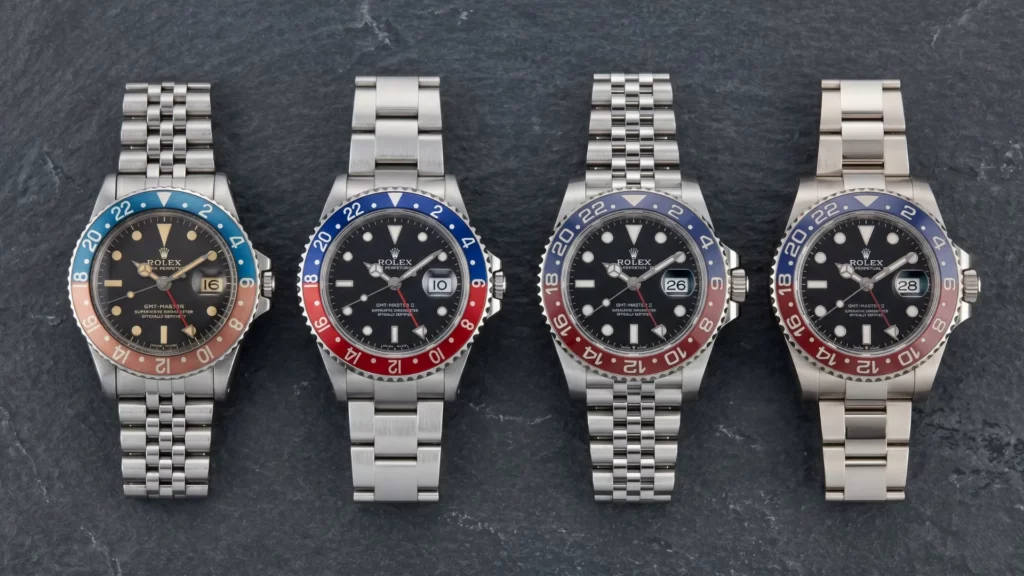
Four Rolex Pepsi GMT-Master references from vintage to modern laid side by side on slate surface showing bezel and bracelet evolution
The right Pepsi depends on your budget and how you plan to use it. Some references are better for daily wear, others are strictly for collectors. Here is a breakdown of every major option worth knowing.
1. Ref. 126710BLRO (2018–2026): The Modern Pepsi
The 126710BLRO is the watch most buyers searching for a “Rolex Pepsi” actually want. It is no longer in production, but it is the most recent and most practical for daily wear.


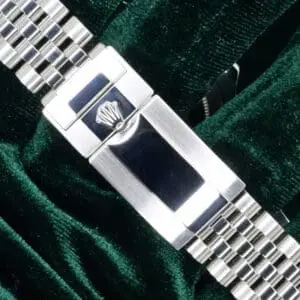
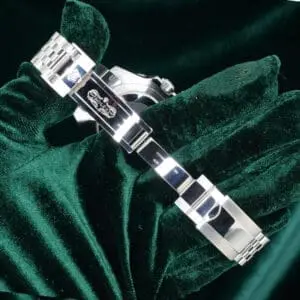
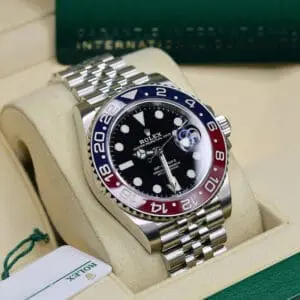
The movement inside is the Caliber 3285. It replaced the older Caliber 3186 and brought two meaningful upgrades. First, the power reserve jumped from 48 hours to 70 hours. That means if you take it off Friday night, it is still running Monday morning. Second, the Chronergy escapement is 15% more energy efficient, which contributes to that longer reserve.
The biggest practical upgrade is how you set local time. On the 3285, you can jump the local hour hand in one-hour increments using the crown without disrupting the running movement. The 3186 had the same independent hour hand, but the 3285 refined the mechanism and added improved shock and magnetic resistance.
The case is 40mm in diameter, made from Oystersteel (Rolex’s 904L stainless steel). Sapphire crystal, Chromalight lume on the hands and markers (glows blue), 48mm lug-to-lug. Worth measuring against your wrist before paying $25,000+ for one.
On the Bracelet: Jubilee or Oyster?
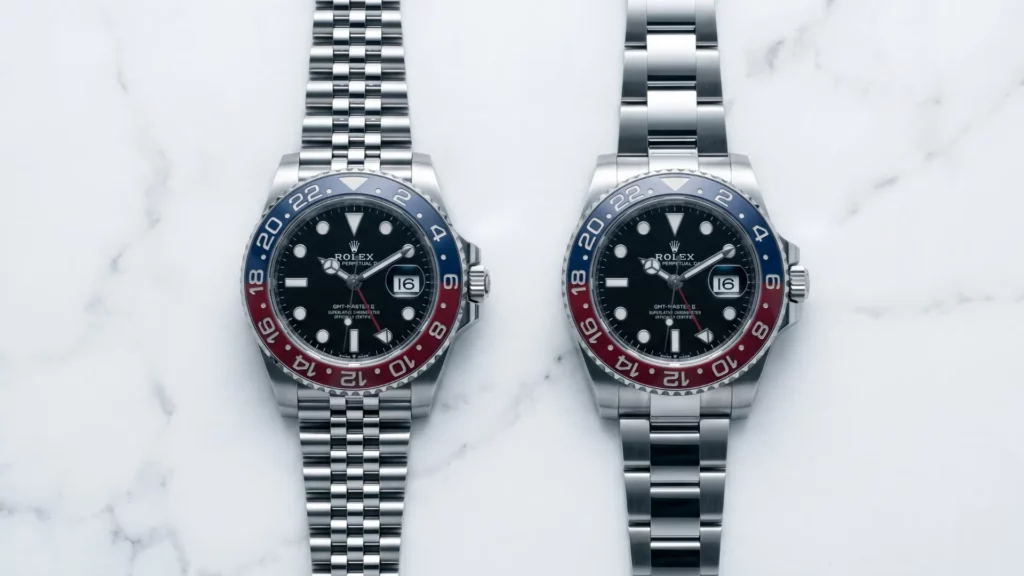
When the 126710BLRO launched at Baselworld 2018, it came on a Jubilee bracelet only. Rolex added the Oyster bracelet in 2021.
| Bracelet | Feel | Best For |
| Jubilee (5-link) | Dressy, flexible, softer on the wrist | Everyday wear, formal occasions, smaller wrists |
| Oyster (3-link) | Sporty, stiffer, more structured | Outdoor use, larger wrists, casual wear |
Both are excellent. Full-set Jubilee examples from 2018 to 2020 are becoming more collectible as the original configuration of the modern Pepsi. If long-term hold matters to you, a clean 2018–2019 Jubilee example with box and papers is the stronger play. If you’re still torn between the two, we walk through Jubilee vs Oyster in detail in a separate guide.
2. Ref. 16710 (1989–2007): Best Vintage Entry Point
The ref. 16710 is the most accessible vintage Pepsi, trading roughly $15,000 to $20,000+ on the secondary market in 2026 — up from $12,000-$17,000 a year ago as Pepsi demand spilled into the aluminum era. It ran on the Caliber 3185, with later examples using the updated Caliber 3186. Both are solid, COSC-certified movements with independently adjustable local hour hands.
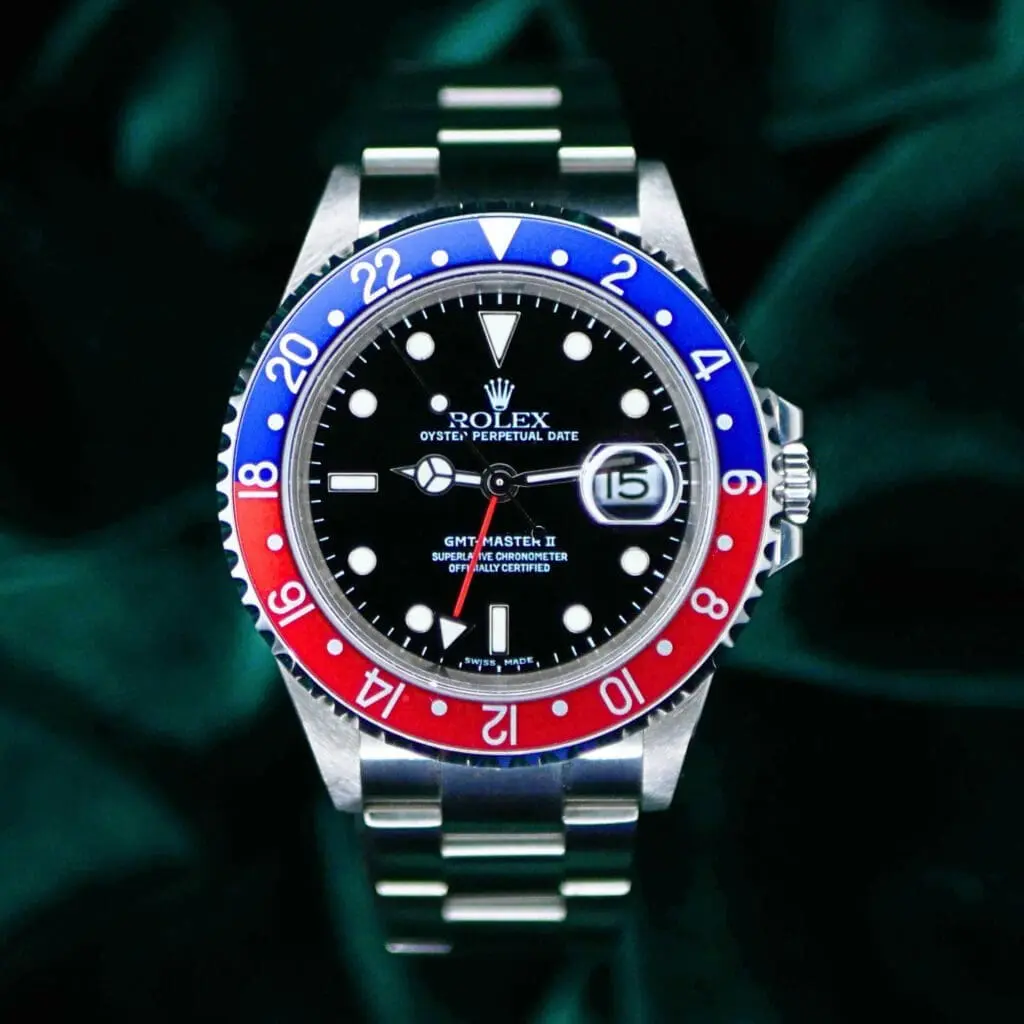
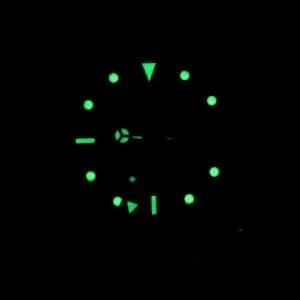
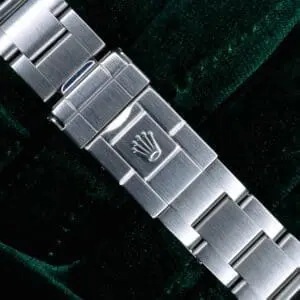

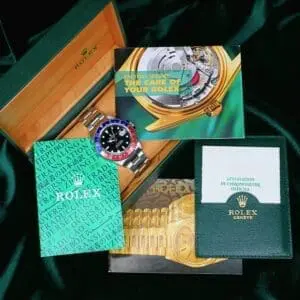
The 16710 uses a sapphire crystal, replacing the acrylic used on earlier models like the 1675. The aluminum bezel is the main reason collectors gravitate here. The aged red and blue look has a character the ceramic bezel cannot replicate.
The tradeoff is bezel condition. Consistent, even fading reads as honest aging. Blotchy or heavily worn sections read as damage, and that difference can shift value by $2,000–$4,000.
Before buying a 16710, check these four things:

- Bezel fade. Even and gradual, or patchy and uneven? Patchy reads as damage to most collectors.
- Case finish. Has it been polished? Original brushed finishing on the case flanks and lugs matters here. A mirror-polished case loses meaningful value.
- Dial originality. A repainted or refinished dial kills resale. Look for consistent aging, matching lume plots on the dial and hands, and no signs of restoration work.
- Service history. Most 16710s have no documentation. Budget an extra $500–$1,000 for a service when you buy.
3. Ref. 1675 (1959–1980): For Experienced Collectors Only
The ref. 1675 ran for 21 years, and a lot changed during that time. Prices range from roughly $24,000 for entry-level examples to $50,000+ for strong, original specimens with the right configuration.
Pointed crown guard (PCG) variants from early production fetch the highest prices. Gilt dials from the 1960s are worth more than the matte dials from the 1970s. The PCG variants were only produced in the first few years of the run, making them significantly rarer.
This is not a reference for first-time buyers. Fakes and frankenwatches (watches built from parts of different watches) are common at this price point. A trusted dealer and independent authentication are not optional here.
4. Ref. 126719BLRO (White Gold): Now Also Discontinued
The white gold Pepsi was also discontinued at Watches & Wonders 2026. Pre-discontinuation, retail sat at roughly $42,900. Secondary market prices now run $35,000 to $45,000+, with meteorite and midnight blue lacquer dial variants commanding the highest premiums.
The discontinuation pulled the meteorite and midnight blue lacquer dials out of production entirely. Those are the configurations to chase if you want the white gold and are willing to pay for the dial variants that no longer exist anywhere on the production line.
It runs the same Caliber 3285 in the same 40mm case as the steel version. The only differences are the 18k white gold case material and the dial options that were never available in steel. If the steel post-discontinuation premium is uncomfortable, the white gold is a less distorted entry into the modern ceramic Pepsi at a higher absolute number.
What Does Each Rolex Pepsi Cost in 2026?
Here is the full price picture across key references, based on secondary market data from Chrono24, WatchCharts, and dealer listings as of 2026. Prices vary depending on condition, bracelet type, and whether the watch comes with its original box and papers.
| Reference | Era | Original Retail | Secondary Market (2026) | Notes |
| 126710BLRO (Steel) | 2018–2026 | ~$11,800 | $22,000–$45,000+ | Discontinued April 2026 |
| 126719BLRO (White Gold) | 2018–2026 | ~$42,900 | $35,000–$45,000+ | Discontinued April 2026 |
| 116719BLRO (White Gold) | 2014–2018 | ~$39,650 | $33,000–$50,000 | First ceramic Pepsi |
| 16710 (Aluminum) | 1989–2007 | Discontinued | $15,000–$20,000+ | Last aluminum Pepsi |
| 16700 (Aluminum) | 1988–1999 | Discontinued | $12,000–$15,000 | Time + GMT only |
| 1675 (Vintage) | 1959–1980 | Discontinued | $24,000–$50,000+ | PCG variants top range |
| 6542 (Bakelite) | 1955–1959 | Discontinued | $40,000–$80,000+ | Bakelite intact = rare |
Box and papers on a modern reference typically add $1,500–$3,000 to the asking price. On vintage references, especially the 1675, original papers can shift value significantly more, sometimes $5,000 or higher.
The steel 126710BLRO now carries the highest premium over its old retail in the lineup. That is the cost of being the headline reference in a post-discontinuation news cycle.
Should You Buy the Rolex Pepsi Now or Wait?
The answer changed on April 14, 2026. Before the discontinuation, “wait” meant waiting for a possible new release that might soften prices. That path is closed now. There is no current-production Pepsi to wait for, and Rolex did not show a replacement at Watches & Wonders.
Here is how to think about it from where the market sits today.
Scenario 1: Buy now, but be selective. If you can find a clean 126710BLRO at a fair price relative to current secondary, buying now is reasonable. Patek’s discontinuation of the Nautilus 5711 in 2021 saw prices jump 25–49% within days and stay elevated. The Submariner Hulk roughly doubled in two years after its 2020 exit.
The Pepsi has more cultural weight than either. The risk: you are buying inside a post-discontinuation spike, and a future Coke release could compress the premium.
Scenario 2: Wait for the spike to settle. History on past Rolex discontinuations (the Hulk, the older Daytonas) shows an early sharp spike, a partial cooldown over six to twelve months, then a sustained premium above the pre-discontinuation baseline. If you can wait, the cooldown phase is usually the better entry.
Scenario 3: Go vintage. If current secondary market prices on the ceramic have priced you out, the ref. 16710 at $15,000–$20,000+ is the strongest alternative. The discontinuation has lifted vintage Pepsi prices too, but not at the same pace as the modern ceramic.
Anyone new to the vintage end of the market should start with our vintage Rolex buying guide before chasing a 16710 or 1675.
Scenario 4: Pivot to the Batman. If you mostly wanted the GMT-Master II case and the ceramic bezel and the red was secondary, the Batman is the closest in-production alternative: same case generation, same Caliber 3285, just black and blue instead of red and blue. Our full Pepsi vs Batman breakdown covers where the two actually differ.
The honest read: the watch is not getting cheaper anytime soon, but a discontinuation spike is the worst time to overpay for a weak example. Verify the watch before you verify the bezel color.
How to Spot a Fake Rolex Pepsi
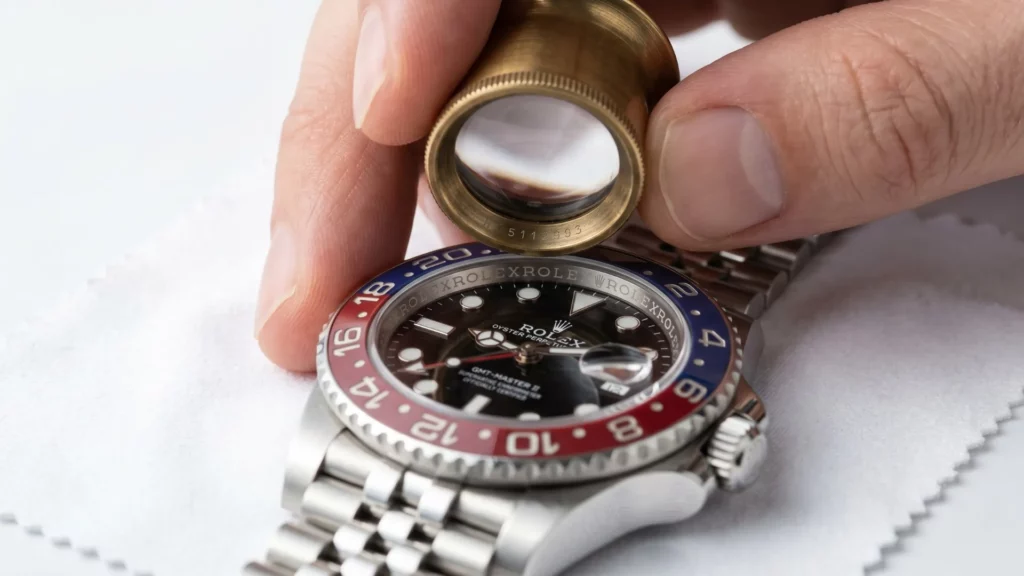
Counterfeits of the 126710BLRO have gotten much better over the years. Some fakes are convincing enough to fool a casual buyer, and the post-discontinuation premium gives counterfeiters more reason to invest in convincing builds.
The five tells below are GMT-Master II specific. For a deeper checklist that covers the full reference family, see our guide on how to spot a fake GMT-Master II.
Here are the five areas where they almost always give themselves away.
1. Cerachrom Bezel
The genuine bezel has a clean color transition from red to blue. The dividing line is crisp and consistent around the full ring. The 24-hour markers are filled with actual platinum via PVD coating, so they look precise and slightly raised. On fakes, the markers often look printed, flat, or slightly blurry up close.
2. Cyclops Lens
The Cyclops sits slightly above the sapphire crystal surface. Magnification is exactly 2.5x and the date should look sharp and centered with no distortion at the edges. On fakes, the lens often magnifies unevenly, the date looks off-center, or the protrusion looks misaligned when you view it from the side.
3. Rehaut Engraving
The rehaut is the inner ring that sits between the dial and the crystal. On a genuine 126710BLRO, it has laser-etched “ROLEX ROLEX ROLEX” text that is perfectly even in size and spacing all the way around. Under a loupe, each letter is sharp and clean. On fakes, the text is often shallow, smeared, or inconsistent in depth.
4. Caseback
All standard production 126710BLRO models have a smooth, plain caseback with no engravings on the outside. If you see text, logos, or decorative engravings on the caseback of a supposedly standard model, that is a clear red flag. Genuine Rolex casebacks are flat, brushed, and completely plain. Any deviation is worth walking away from.
5. Weight and Rotor
A genuine 126710BLRO feels solid and substantial in hand. The Caliber 3285 rotor moves with a smooth, weighted sweep when you tilt the watch. If the watch feels noticeably light or the rotor sounds rough and scratchy when you move it, that points to a cheap movement inside. Do not dismiss that feeling.
Where to Buy an Authentic Rolex Pepsi Online
There are a handful of legitimate online channels for buying a Rolex Pepsi. Chrono24 is the largest international marketplace for used watches and runs an Escrow program that holds the buyer’s funds until the watch is verified on arrival.
If you’ve never bought through the platform, our breakdown of what to watch for on Chrono24 covers the seller-rating signals worth checking before you commit.
eBay’s Authenticity Guarantee program inspects every watch over $2,000 through a third-party authenticator before the seller ships it to you. Grailzee runs auction-style listings with a more enthusiast-leaning crowd and can occasionally surface fairer prices on full sets.
Independent grey-market dealers and watch forums (Rolex Forums, WatchUSeek) are another category. Quality varies sharply, and pre-discontinuation reputation does not always carry over to a hot-market environment, so verify aggressively no matter who is listing the watch.
We also sell, buy, and trade luxury watches. And the reason clients work with us instead of going straight to a marketplace listing is the layered communication before you commit.
We send tour videos of the actual watch on camera, detailed condition notes on the bezel, dial, case finish, and any service history we have. You also talk to a real person who has handled the piece, not a stock photo and a contact form.
That is reflected in our 4.9-star Google rating, which comes from clients who appreciate knowing what they are buying before the wire goes out, especially on a reference where the post-discontinuation market is still in price discovery.
If you want that kind of walkthrough on a specific Pepsi reference (modern ceramic, vintage 16710, or vintage 1675), reach out and we will line up the options that fit your budget. We can also flag where the current asks sit relative to recent sold prices, which matters more than usual on a reference still in post-discontinuation price discovery.
Final Thoughts on Rolex Pepsi Buying Guide
This Rolex Pepsi buying guide comes down to picking the right reference for your budget after the April 2026 discontinuation. The 126710BLRO is the headline pick, but the post-discontinuation premium is real and condition matters more than ever before paying $25,000+ for one.
For most buyers, the 126710BLRO is the watch they want and the watch the market is talking about. If the secondary market price is uncomfortable, the ref. 16710 at $15,000–$20,000+ is a strong alternative with character the ceramic version cannot match. Skip the ref. 1675 unless you are an experienced collector who can verify originality.
If you’re widening the search beyond Pepsi, our broader Rolex GMT-Master II buying guide walks through the full family.
Two bonus tips before you buy. First, cross-reference any asking price on Chrono24 and WatchCharts before you commit; both update close to real time, and a $3,000 gap between a single listing and the broader market is common during a price discovery phase.
Second, if you are buying a vintage 16710 or 1675, have the watch pressure-tested for water resistance before wearing it daily. A 30-year-old Rolex with original gaskets is not a beach watch.
If you want to see what’s available right now, browse our current collection of authenticated Rolex and other luxury watches.
999+ Timepieces Available
Explore Our Timepieces
Authenticated, unworn, and ready to ship worldwide.
Rolex · Audemars Piguet · Patek Philippe · Omega · Cartier · Richard Mille · Hublot · Tudor
Newly Listed
Rolex Sea-Dweller "Red Letter" Black Dial Black Cerachrom Bezel Oyster Bracelet Stainless Steel 43mm MINT CONDITION COMPLETE SET 126600
$13,120.00
2026 NEW UNWORN Bvlgari Serpenti Tubogas Studs Capsule Limited Edition Green Dial Diamond Bezel Steel & 18k Yellow Gold 35mm COMPLETE SET 104360
$24,255.00
Vacheron Constantin Overseas Chronograph Blue Dial Blue Leather Strap Stainless Steel 42.5mm MINT CONDITION COMPLETE SET 5500V/110A-B148
$37,793.00
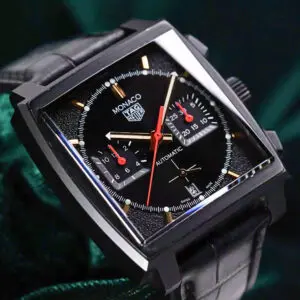
Tag Heuer Monaco Chronograph “Dark Lord” Special Edition Black Dial Black Leather Strap DLC Titanium 39mm MINT CONDITION COMPLETE SET CBL2180.FC6497
$8,135.00
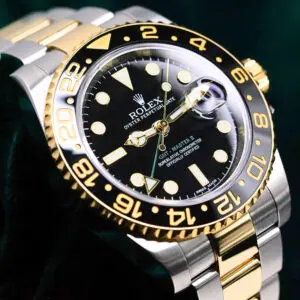
Rolex GMT-Master II “Green Arrow” Black Dial Black Ceramic Bezel Oyster Bracelet Two-Tone 18K Yellow Gold Stainless Steel 40mm MINT CONDITION COMPLETE SET 116713LN
$15,740.00
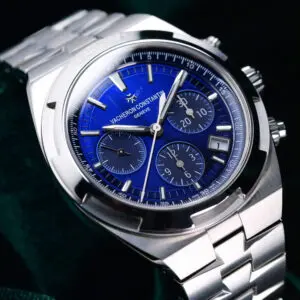
Vacheron Constantin Overseas Chronograph Blue Dial Stainless Steel 42.5mm MINT CONDITION COMPLETE SET 5500V/110A-B148
$37,793.00
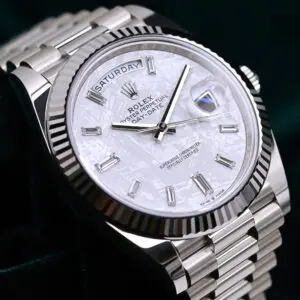
Rolex Day-Date Meteorite Baguette Diamond Dial Fluted Bezel President 18K White Gold 40mm MINT CONDITION COMPLETE SET 228239
$78,629.00
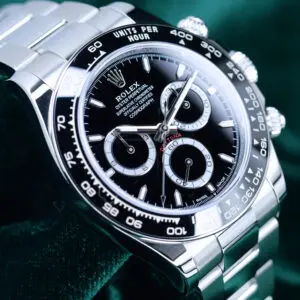
2026 Rolex Cosmograph Daytona Black Dial Black Ceramic Bezel Oyster Bracelet Stainless Steel 40mm MINT CONDITION COMPLETE SET 126500LN
$33,594.00
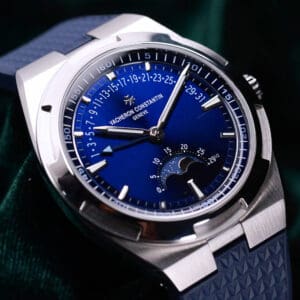
2025 Vacheron Constantin Overseas Moonphase Retrograde Date Blue Dial Blue Rubber Strap Stainless Steel 41mm MINT CONDITION COMPLETE SET 4000V/210A-B911
$52,800.00
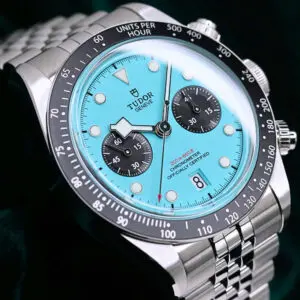
2025 Tudor Black Bay Chrono "Flamingo Blue" Turquoise Dial Black Bezel Stainless Steel 41mm MINT CONDITION COMPLETE SET 79360N-0024
$10,494.00
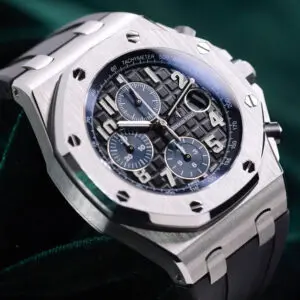
Audemars Piguet Royal Oak Offshore Chronograph "Batman" Black Dial Blue Accents Black Rubber Strap Stainless Steel 42mm MINT CONDITION COMPLETE SET 26470ST.OO.A028CR.01
$25,715.00
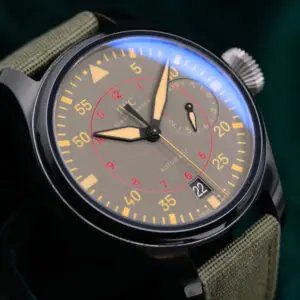
IWC Big Pilot's Watch Top Gun Miramar Grey Dial Green Textile Strap Black Ceramic 48mm MINT CONDITION COMPLETE SET IW501902
$7,240.00