Ever looked at two Omega GMT watches that seem almost identical, then wondered why one sells for a fraction of the price while the other holds strong value in the market?
The Omega GMT lineup spans nearly 30 years, covers four caliber generations, and stretches from under $3,000 to over $20,000 in the pre-owned market. That range alone creates confusion for many buyers who expect similar watches to behave the same in value and performance.
Most guides either break down a single reference or present brand-level information that doesn’t help you decide what actually deserves your money today. That gap leads to missed opportunities and costly mistakes.
This Omega GMT buying guide compares every important reference side by side. It explains how each movement changed the watch’s performance and breaks down current pre-owned pricing trends.
It also identifies the one model that consistently underperforms compared to its alternatives, based on real market activity tracked through Majestix Collection.
History of Omega GMT
The Omega GMT history begins with Omega itself, founded in 1848 in La Chaux-de-Fonds, Switzerland. The brand built its reputation on precision timekeeping long before GMT functionality entered the picture.
Decades later, as global travel expanded, Omega introduced its first GMT-equipped wristwatches to meet the growing need for dual-time tracking. Early Omega GMT models focused on function over complexity.
They allowed wearers to track a second time zone in a simple, practical format, which appealed to frequent travelers and professionals working across different regions. These early references established the foundation for Omega’s approach to GMT design, prioritizing readability and reliability.
As watchmaking advanced, Omega refined its GMT execution through improved movements and more efficient hand configurations. The design language also evolved, with clearer dial layouts that made dual-time tracking faster and more intuitive.
This stage marked a shift from purely functional travel watches to more versatile everyday timepieces.
Later generations introduced upgraded calibers with stronger accuracy, smoother GMT adjustments, and better long-term durability. These improvements helped certain references stand out in the pre-owned market, where demand began to separate high-performing models from less desirable ones.
The Omega GMT lineup reflects this long development path. Majestix Collection tracks how each generation performs in real market conditions, showing which references gained collector interest and which ones remain overlooked despite similar design intent.
For broader context on the rest of the catalog, our full Omega buying guide covers the wider lineup.
What Makes a Good Omega GMT for Most Buyers

Three factors separate an Omega GMT worth buying from one that becomes disappointing within months of ownership.
The first is true GMT functionality (flyer-style movement). This means the local hour hand jumps independently in one-hour increments, making time zone changes fast and practical.
Every modern Omega GMT we recommend uses this system because it reflects how travelers actually use the complication in real life.
The second is case size and wearability. The lineup ranges from the 41mm Seamaster Planet Ocean GMT to the larger 45.5mm Planet Ocean Dark Grey GMT. For most wrists between 6.5 and 7.5 inches, the 41mm to 43.5mm range delivers the most balanced fit without feeling oversized or top-heavy.
The third is movement generation. Master Chronometer references (Cal. 8906) bring METAS certification and strong resistance to magnetic fields up to 15,000 gauss, which adds reliability in daily use. Older Co-Axial GMT references (Cal. 8605/8615) still perform well, but they usually trade at lower prices in the pre-owned market.
Which Omega GMT Should You Buy
The right Omega GMT depends on wrist size, budget, and how often you actually travel across time zones. Each reference solves a slightly different need, from entry-level wear to high-end ceramic collectables.
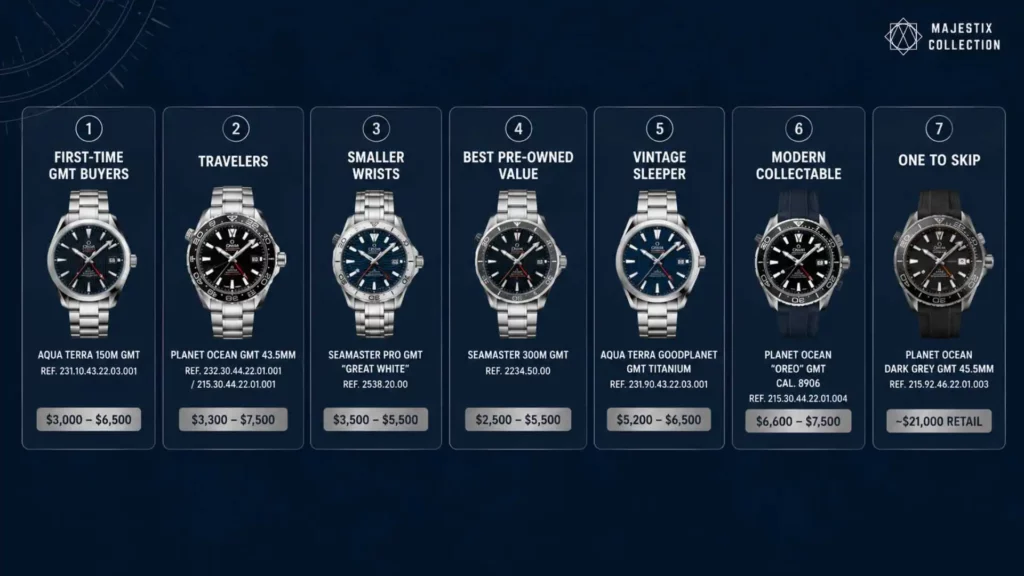
1. Best for First-Time GMT Buyers
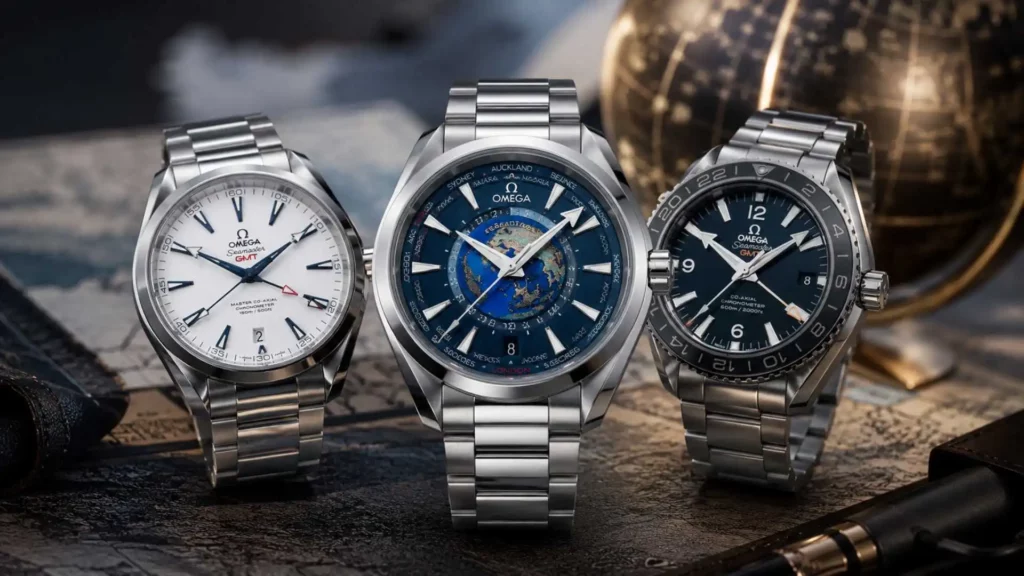
The Seamaster Aqua Terra 150M GMT (ref. 231.10.43.22.03.001 / 231.10.43.22.01.001) sits between $3,000 and $6,500 pre-owned. It works well as an entry GMT because it balances size, function, and everyday wear.
The 43mm case wears more comfortably than expected due to short lugs and a slim profile. The Cal. 8605 handles travel well with a true flyer GMT setup.
Key Specs
- Case: 43mm stainless steel
- Movement: Cal. 8605 flyer GMT
- Power reserve: 60 hours
- Water resistance: 150m
- Function: Independent jumping hour hand
2. Best for Travelers
The Seamaster Planet Ocean GMT 43.5mm (ref. 232.30.44.22.01.001 / 215.30.44.22.01.001) ranges from $3,300 to $7,500 pre-owned. It suits frequent travel and tougher environments.
The modern version adds METAS certification and stronger accuracy standards. It wears thick at 14.5mm, but delivers high tool-watch capability.
Key Specs
- Case: 43.5mm stainless steel
- Movement: Cal. 8605 or Cal. 8906 Master Chronometer
- Power reserve: 60 hours
- Water resistance: 600m
- Features: Helium escape valve, anti-magnetic (8906 up to 15,000 gauss)
3. Best for Smaller Wrists
The Seamaster Pro GMT “Great White” (ref. 2538.20.00) trades between $3,500 and $5,500 pre-owned and remains a collector favorite for smaller wrists. The slim case and clean dial make it highly wearable. The Cal. 1128 is reliable and easy to service.
The wider Seamaster line has plenty of related references worth knowing if this one feels close.
Key Specs
- Case: 41mm stainless steel
- Thickness: 13.5mm
- Movement: Cal. 1128 flyer GMT
- Power reserve: 44 hours
- Water resistance: 300m
4. Best Pre-Owned Value
The Seamaster 300M GMT (ref. 2234.50.00) sits around $2,400 to $3,500, making it one of the strongest value picks. It shares the same movement as the Great White but adds dive capability.
Key Specs
- Case: 41mm stainless steel
- Movement: Cal. 1128 flyer GMT
- Water resistance: 300m
- Features: Helium escape valve, rotating 24-hour bezel
- Dial: Black wave dial
5. Best Vintage Sleeper
The broader Cal. 1128 GMT family (1998–2007) ranges from $3,000 to $8,000+ depending on rarity. These models stay wearable and serviceable today. Trade-off: aging tritium components and servicing requirements on older pieces.
Key Specs
- Case: 41mm stainless steel
- Movement: Cal. 1128 flyer GMT
- Power reserve: 44 hours
- Water resistance: 300m (varies by reference)
- Variants: Limited and anniversary editions
6. Best Modern Collectable
The Planet Ocean Dark Grey GMT (ref. 215.92.46.22.99.001) retails around $21,000 with limited secondary market supply. This is a modern collectable with advanced materials.
Key Specs
- Case: 45.5mm silicon nitride ceramic
- Movement: Cal. 8906 Master Chronometer (Grade 5 titanium)
- Power reserve: 60 hours
- Water resistance: 600m
- Certification: METAS, anti-magnetic up to 15,000 gauss
7. The One to Skip
The Cal. 2628 Bond GMT trades between $3,000 and $4,500, but struggles in long-term demand. It combines a GMT hand with a diver layout, but legibility suffers. In the same price range, models like the 2234.50 or Great White offer stronger wearability and better market demand.
Key Specs
- Case: 41mm stainless steel (thicker profile)
- Movement: Cal. 2628 GMT
- Water resistance: 300m
- Layout: Diver-style GMT hybrid design
Current Omega GMT Pre-Owned Prices
The table below reflects Chrono24 and WatchCharts marketplace data as of May 2026. Prices move with currency shifts and supply changes. Seasonal demand also affects listings. Treat this as a market snapshot, not a fixed quote.
| Reference | Model | Production Years | Pre-Owned Range (May 2026) |
| 2538.20.00 | Seamaster GMT “Great White” | 1998–early 2000s | $3,500 – $5,500 |
| 2234.50.00 | Seamaster 300M GMT | 2003–2012 | $2,400 – $3,500 |
| 231.10.43.22.01.001 | Aqua Terra GMT (Black) | 2011–2017 | $3,000 – $5,500 |
| 231.10.43.22.03.001 | Aqua Terra GMT (Blue Teak) | 2011–2017 | $3,300 – $6,500 |
| 232.30.44.22.01.001 | Planet Ocean GMT 43.5mm (Cal. 8605) | 2013–2016 | $3,300 – $5,500 |
| 215.30.44.22.01.001 | Planet Ocean GMT “Oreo” (Cal. 8906) | 2017–Present | $6,600 – $7,500 |
| 232.30.44.22.04.001 | Aqua Terra GoodPlanet GMT (Titanium) | 2011–2018 | $5,200 – $6,500 |
| 215.92.46.22.99.001 | Planet Ocean Dark Grey GMT | 2024–Present | ~$21,000 (Retail) |
The Cal. 1128 references such as the Great White and 2234.50 show the most consistent performance over the past five years. Strong collector demand and strong wearability support their steady pricing.
The gap between Cal. 8605 Planet Ocean GMT models and Cal. 8906 Master Chronometer versions sits around $2,000 to $3,000. That difference positions the earlier generation as a practical choice if METAS certification and anti-magnetic resistance are not essential for daily use.
How to Choose the Right Omega GMT for You
Choosing between these Omega GMT references becomes easier when you follow a structured order instead of jumping straight into models. Each step filters out options that do not match your wrist, budget, or use case, which makes the final decision more precise and less subjective.
1. Decide Between New and Pre-Owned
Start by choosing how you want to enter the market, since this decision shapes everything that follows. Buying new from an authorized dealer gives you access to current-production Omega GMT models equipped with Master Chronometer certification (Cal. 8906), full factory warranty, and untouched service history.
This route appeals to buyers who value brand-new condition and long-term manufacturer support.
Pre-owned opens a wider and often more strategic selection. You gain access to discontinued references like the Great White (2538.20) and 2234.50, which are no longer in production but still widely traded.
These models often carry 20% to 40% lower entry prices, which reflects absorbed depreciation rather than reduced functionality. In many cases, pre-owned Omega GMT watches deliver stronger value retention because their pricing has already stabilized after early-market drop-off.
2. Match Case Size to Your Wrist
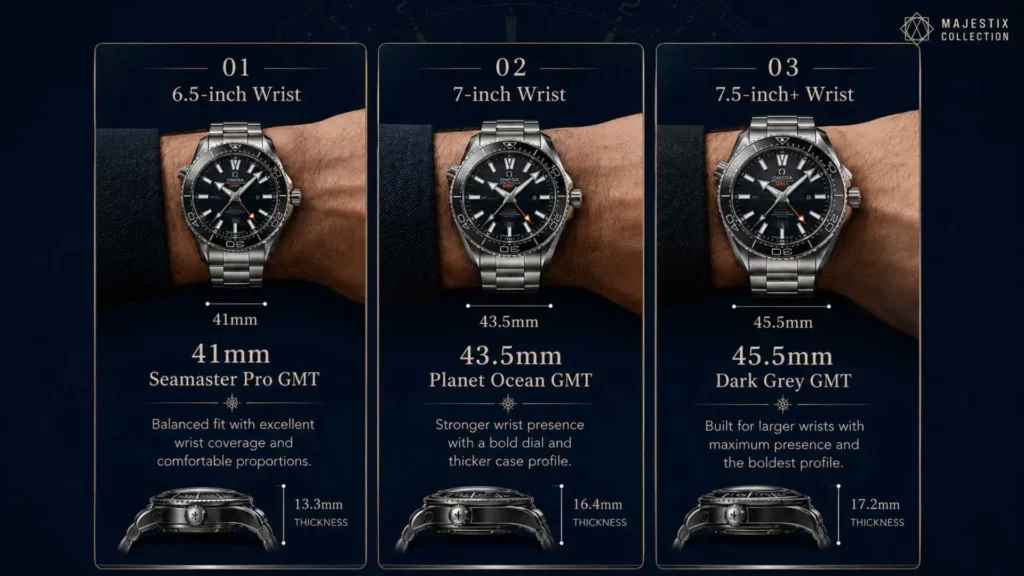
Case size directly affects comfort, balance, and how the watch sits during daily wear, so it should be evaluated before movement or aesthetics. A 6.5-inch wrist typically suits 41mm Seamaster Pro GMT models, where the shorter lug-to-lug distance prevents overhang and keeps the watch centered on the wrist.
A 7-inch wrist can comfortably handle larger proportions, including 43.5mm Planet Ocean GMT references, which introduce more wrist presence without becoming unstable. At this size, thickness begins to matter as much as diameter because the case height affects shirt cuff clearance and long-term comfort.
A 7.5-inch or larger wrist can support the 45.5mm Dark Grey GMT, but wearability depends heavily on lifestyle. The watch’s thickness and ceramic case construction create a more dominant wrist profile, especially under formal clothing.
Even within the same diameter range, the Planet Ocean line wears more substantial than Aqua Terra models due to case architecture.
3. Pick a Caliber Generation
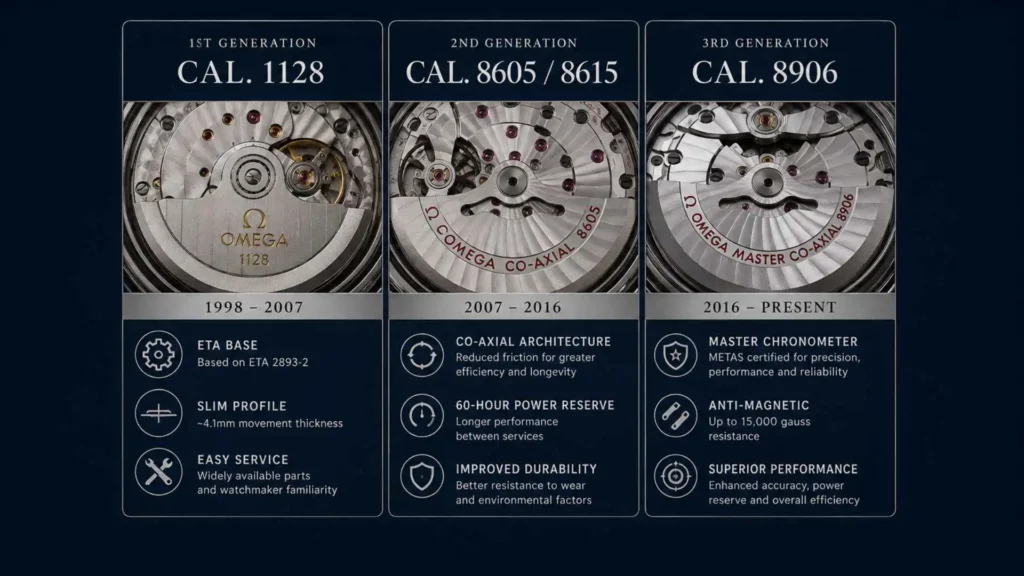
Movement generation defines accuracy standards, service behavior, and long-term ownership cost, making it one of the most important filters. The Cal. 1128 generation (1998–2007) uses an ETA base with Omega finishing, offering a slim profile, reliable performance, and widespread serviceability through independent watchmakers.
These models remain popular because they combine simplicity with durability rather than advanced technical features.
The Cal. 8605/8615 generation introduces Omega’s Co-Axial architecture, improving escapement efficiency and extending service intervals. These movements deliver a 60-hour power reserve and represent the transition period before full Master Chronometer certification.
They often trade lower than newer references even when case design remains similar, which creates a noticeable value gap in the pre-owned market.
The Cal. 8906 Master Chronometer generation represents Omega’s current standard, combining METAS certification, strong anti-magnetic resistance up to 15,000 gauss, and improved timing stability.
These movements are designed for modern environments with higher magnetic exposure, making them the most technically advanced option in the lineup, though not always necessary depending on usage.
4. Understand Flyer vs Caller GMT

Functionality matters more than terminology when choosing a GMT watch. All modern Omega GMT references in this guide use a flyer GMT system, where the local hour hand adjusts independently in one-hour increments.
This allows fast timezone changes without stopping the watch or disturbing the minute hand, which is particularly useful for frequent travelers moving across time zones. Some earlier or transitional configurations behave differently depending on the reference and production period.
Their adjustment logic feels less immediate compared to modern flyer GMT systems. This is why confirming the exact caliber behavior is important before purchase, especially in older Aqua Terra or early GMT models where execution varies slightly.
Flyer GMT remains the preferred setup for real-world travel use because it reduces adjustment time and keeps the timekeeping core uninterrupted during transitions.
5. Set Your Budget Against Market Reality
Budget planning should align with actual market behavior rather than retail expectations or listing extremes. The price ranges shown in the comparison table reflect current pre-owned market conditions, not aspirational or temporary listings, which helps set realistic buying boundaries.
A well-priced Omega GMT in 2026 typically sits slightly below listed averages for comparable condition, with 5% to 10% negotiation flexibility depending on service history, box-and-papers completeness, and seller type. Watches with full documentation often justify stronger pricing stability, while incomplete sets usually trade lower even if mechanically identical.
Avoid pricing extremes on both ends. Overpriced listings without servicing history tend to remain unsold for long periods, while unusually low prices often indicate missing service records or hidden issues.
A balanced purchase usually reflects condition transparency rather than maximum or minimum market pricing.
What to Inspect Before Buying a Pre-Owned Omega GMT

The pre-owned Omega GMT market requires close inspection because wear, servicing, and part replacements vary across references. Most issues are not obvious during a quick check, so focusing on key weak points helps avoid unexpected costs and incorrect listings.
A structured inspection protects both value and long-term reliability.
1. Sword Hand Alignment on Cal. 1128 References
The Omega GMT references 2538.20 “Great White” and 2234.50 Seamaster 300M GMT should show perfect GMT hand alignment with the 24-hour marker at 12:00. Any offset often points to incorrect servicing or improper movement reassembly.
Lume consistency also matters, since mismatched tritium and Super-LumiNova elements can indicate dial or hand replacement.
2. Helium Valve Gasket on Seamaster 300M GMT
The Omega GMT reference 2234.50 uses an HEV gasket that can degrade over time, reducing water resistance without visible signs. Older pieces without recent servicing are more vulnerable to this issue.
If service history is unclear, include a $400–$600 maintenance cost in your budget.
3. Bezel Inlay Moisture on Master Chronometer GMT
The Omega GMT reference 215.30.44.22.01.001 features a bi-ceramic bezel that should remain clean and uniform under light. Discoloration near the 6 and 18 markers can indicate moisture exposure or seal weakness.
This affects both condition grading and resale value in the pre-owned market.
4. Bracelet Stretch and Clasp Wear on Vintage Refs
The Cal. 1128 Omega GMT models can show bracelet stretch from long-term wear, especially early production examples. Visible separation when the bracelet hangs signals advanced wear and potential replacement needs.
A full Omega bracelet replacement can cost $1,500–$2,000, which should be reflected in any negotiation.
Omega GMT vs Rolex GMT-Master II: Which Is the Smarter Buy?
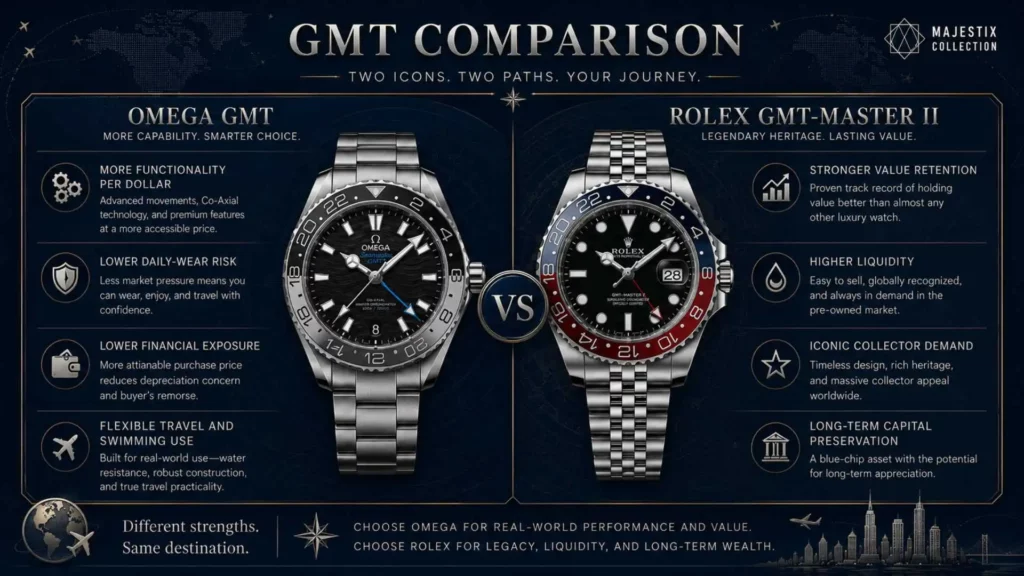
The real question behind most Omega GMT searches is simple: do you choose Omega or stretch the budget for a Rolex GMT-Master II?
The answer depends less on branding and more on how you plan to use the watch, the level of risk you accept, and whether you prioritize wearability or investment behavior. We go deeper on how the two GMTs compare in detail in a separate guide.
At dealer level, the gap becomes clearer once you strip away marketing and focus on real ownership outcomes.
Why Omega Wins on Risk and Real-World Wearability?
A pre-owned Omega Planet Ocean GMT around $5,000 sits at roughly one-quarter of a Rolex GMT-Master II Pepsi, which often trades above $20,000 on the secondary market. That difference directly changes how comfortable people feel wearing the watch daily.
- Lower visibility in high-risk environments like airports and major cities
- Lower financial exposure if the watch gets scratched or damaged
- Lower counterfeit pressure compared to Rolex-heavy demand segments
Omega also gives more flexibility in wear scenarios. The Planet Ocean GMT and Aqua Terra GMT handle travel, swimming, and daily rotation without the same hesitation that often comes with a high-value Rolex.
Why Does Rolex Still Win as an Investment Asset?
Rolex continues to dominate when the goal shifts toward value retention and long-term appreciation. The GMT-Master II Pepsi and Batman references have shown consistent demand strength across multiple market cycles, even when broader luxury prices soften.
- Strong secondary-market liquidity across regions
- Long track record of price stability and appreciation
- Higher collector demand for specific iconic references
Omega GMT models hold value well but rarely show the same upward momentum. The exception is select Cal. 1128 vintage references, which have developed steady collector interest, though still without Rolex-level acceleration.
The full picture on the resale value gap between Omega and Rolex is laid out in a separate breakdown.
The Verdict for Buyers Who Plan to Wear It
Omega delivers more functionality per dollar, especially with the Planet Ocean 600M GMT and Aqua Terra GMT. Rolex functions more as a store of value that happens to be wearable. Most buyers end up better served by choosing based on actual usage rather than brand positioning.
- Choose Omega GMT if you want a watch you can wear daily without hesitation
- Choose Rolex GMT-Master II if your priority is capital preservation and long-term value behavior
Where to Buy a Pre-Owned Omega GMT Safely?
The safest way to buy a pre-owned Omega GMT comes down to choosing the right seller and verifying how the watch is presented. Small details in listings often reveal more than the price itself.
If you want a wider view of the channels available, our guide to where to buy pre-owned watches covers each option in depth.
1. Buy From a Dealer With Verified Inventory and Track Record
A reliable dealer lists actual inventory, not placeholders, and provides consistent photography across listings. Majestix Collection follows this approach, with detailed images and clear condition grading that reflects what you will actually receive.
Pricing may sit slightly above random listings, but the difference reflects accuracy in representation, not just added margin.
2. Avoid First-Time Sellers on Open Marketplaces
New seller accounts with limited history create uncertainty, especially when listings appear under market range. These listings often lack depth in description and supporting details.
If you are considering a Chrono24 listing, our breakdown of how to safely buy a watch on Chrono24 walks through the warning signs in detail.
Watch for:
- Reused or inconsistent images across listings
- Missing reference numbers or incorrect specifications
- No clear ownership timeline
These gaps usually signal incomplete information rather than opportunity.
3. Verify Listing Quality Before Payment
Strong listings provide clear, close-up images of the dial, case, and movement area, along with consistent lighting and angles. This level of detail shows the seller understands the product and how to present it properly.
Listings without this level of clarity make it difficult to confirm conditions, which increases the chance of mismatch between expectation and actual watch.
Final Thoughts on the Omega GMT Buying Guide
The Omega GMT buying guide shows that this category offers more flexibility than most buyers expect. You are not locked into one type of watch or price level. You can prioritize wearability, technical performance, or budget and still end up with a GMT that performs well in real use.
The smarter approach is to think beyond reference numbers and focus on how the watch fits your routine. A GMT proves its value through daily wear and travel use, not through comparison with other brands or market hype.
The market will continue to shift, but the fundamentals remain consistent. Buy based on comfort, usability, and confidence in wearing it regularly. Majestix Collection is a practical place to start when exploring pre-owned Omega GMT options that match those priorities.
999+ Timepieces Available
Explore Our Timepieces
Authenticated, unworn, and ready to ship worldwide.
Rolex · Audemars Piguet · Patek Philippe · Omega · Cartier · Richard Mille · Hublot · Tudor
Newly Listed
Rolex Datejust White Dial Fluted Bezel Jubilee Bracelet Two-Tone 18K Yellow Gold Stainless Steel 36mm MINT CONDITION 16233
$8,663.00
Panerai Luminor Due Blue Dial Stainless Steel 42mm MINT CONDITION COMPLETE SET PAM01124
$7,681.00
Rolex Day-Date Champagne Dial Fluted Bezel President Bracelet 18k Yellow Gold 36mm MINT CONDITION 18038
$25,849.00
Panerai Luminor Marina 1950 3 Days Black Dial Black Rubber Strap Stainless Steel 44mm MINT CONDITION COMPLETE SET PAM01359
$6,353.00
Rolex Yacht-Master Rhodium Slate Dial Platinum Bezel Oyster Bracelet Stainless Steel 40mm MINT CONDITION COMPLETE SET 126622
$15,740.00
2025 Rolex Explorer Black Dial Oyster Bracelet Stainless Steel 40mm MINT CONDITION COMPLETE SET 224270
$10,495.00
Rolex Submariner Date "Starbucks" Black Dial Green Ceramic Bezel Oyster Bracelet Stainless Steel 41mm MINT CONDITION COMPLETE SET 126610LV-0002
$14,992.00
Rolex Datejust 36 Silver Anniversary Jubilee Diamond Dial Two-Tone 18K Yellow Gold Stainless Steel 36mm MINT CONDITION COMPLETE SET 16233
$10,739.00
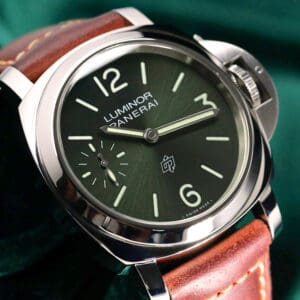
2025 Panerai Luminor Logo Green Dial Stainless Steel Brown Leather Strap 44mm MINT CONDITION COMPLETE SET PAM01624
$6,529.00
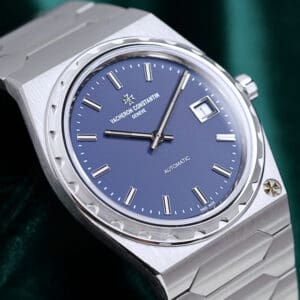
2026 NEW UNWORN Vacheron Constantin Historiques 222 "Jumbo" Blue Dial Stainless Steel 37mm COMPLETE SET 4200H/222A-B934
$60,895.00
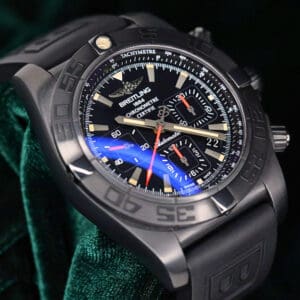
Breitling Chronomat 44 Blacksteel Black Dial Red Accents Black Rubber Strap Black DLC Stainless Steel 44mm MINT CONDITION COMPLETE SET MB0111C3/BE35
$6,526.00
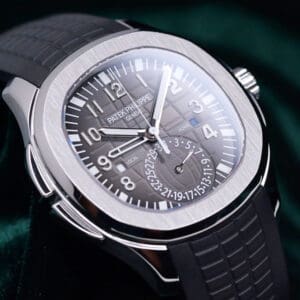
Patek Philippe Aquanaut Travel Time Black Dial Stainless Steel Black Rubber Strap 40.8mm Caliber 324 MINT CONDITION COMPLETE SET 5164A-001
$99,745.00