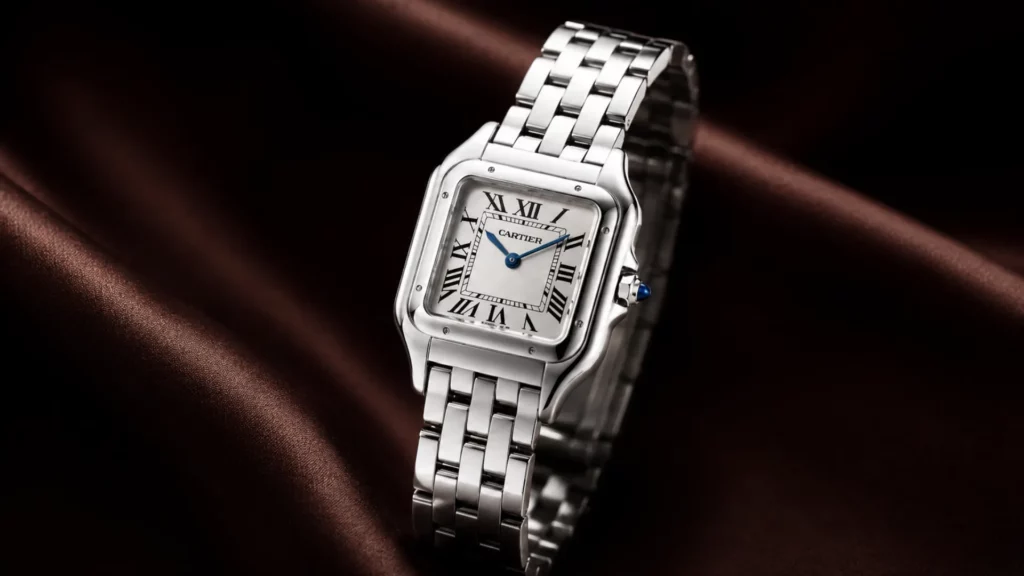
Most Cartier Panthere buying guides start with the 1983 launch, the panther bracelet inspiration, and the celebrity wrist shots. You already know that part. What you need is help deciding which configuration makes sense, what to pay, and whether to go new or pre-owned.
This guide skips the brand biography. The Panthere comes in two generations and four sizes. Prices run from around $4,300 new to over $40,000 in gold and diamonds. The right pick depends on three things: specific reference numbers, bracelet condition on vintage pieces, and the quartz question every serious buyer asks.
Here is everything you need before you buy.
Why the Panthere Is Worth Buying
No other watch at this price wears the way the Panthere does. That is the short version. The five-link bracelet drapes onto the wrist instead of sitting on top of it. As a result, the watch disappears into a stack while still reading as unmistakably Cartier.
That is what separates it from the rest of the catalog. The Tank sits flat and formal; we break down how it stacks up against the Panthere in a separate guide.
The Santos has exposed screws and a sportier read; if you’re weighing the two, our Santos vs Panthere comparison walks through the differences in detail.
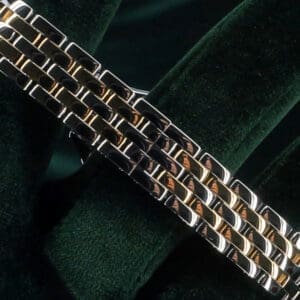
The Panthere is the Cartier where the bracelet is the design. Each link is independently hinged, which is why owners on Reddit r/Watches and Watchuseek often describe it as feeling like an extension of the wrist rather than something strapped to it.
The secondary market backs this up. The WSPN0013 trades at a market value of roughly $4,861 against a $4,950 retail price. That is only 1.8% below new. The number is unusual for a quartz jewelry watch. When buyers pay close to retail for a used model, they are usually paying for how the watch feels and performs on the wrist, not just thebrand (source).
The Panthere is also a quartz watch with a small case and no mechanical depth. There is no visible movement, no rotor sound, and no caseback worth opening. If any of that matters to you, this is not your watch.
Buyers who came in expecting movement depth tend to walk away disappointed. Buyers who treat the Panthere as a jewelry watch that happens to tell time exceptionally well tend to keep wearing it.
A quick note on the broader Cartier market: recent secondary-market data shows that popular Cartier models can hold value well in excellent condition. This is especially true for headline references from the Tank, Santos, and Crash lines.
The Panthère benefits from that wider Cartier brand strength, which our overview of the full Cartier lineup covers in more depth.
For the Cartier Panthère WSPN0013, the key takeaway is more specific: its ability to trade near retail confirms that demand remains strong for the small stainless steel model.
Cartier Panthere Generations Explained
The Panthere ran from 1983 to 2004. It sat out for thirteen years and returned at SIHH 2017. The two generations look nearly identical from a distance, but the differences matter once you start picking between them.

Gen 1 (1983–2004)
Gen 1 was offered in five sizes: Mini, Small, Medium, Large, and Jumbo. It was originally marketed to both men and women, with the Medium, Large, and Jumbo positioned as unisex or men’s pieces.
Some Gen 1 references also include a date function. Materials covered yellow gold, two-tone yellow gold and steel, white gold, and (from 1991 onward) all-steel.
Gen 1 has the clear advantage in configuration variety. It is the only route if you want a date function, an original yellow gold reference, or the larger Jumbo size.
Full-set examples also command premium pricing on Chrono24, especially when they include the original Cartier box, papers, intact crown, and a tight bracelet. Buyers pay more for these sets because Cartier no longer offers those exact configurations new.
The bracelet stretch issue is the Gen 1 caveat. Decades of daily wear loosen the link articulation, so the bracelet visibly droops over time. Before buying any pre-owned Gen 1 piece, hold the watch by the case and let the bracelet hang. Uneven sag or rattling links mean a bracelet service is coming, and you should factor that into your offer.
Gen 2 (2017–Present)
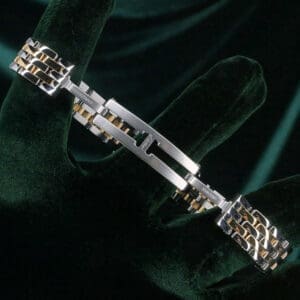
Gen 2 launched at SIHH 2017 with Mini, Small, and Medium in steel, two-tone, yellow gold, and white gold. The Large was reinstated later, which restored the unisex character of the line. Rose gold was added as a Gen 2 exclusive. The bracelet was reworked with heavier links and a redesigned hidden clasp, so the stretch problem is dramatically reduced.
Gen 2 also dropped the date function entirely. Some Gen 2 dials are new, including diagonal sunray patterns and color combinations the original lineup never offered.
If you want a daily wearer without bracelet anxiety, Gen 2 is the cleaner pick. If you want a date or a discontinued configuration, Gen 1 is the only route.

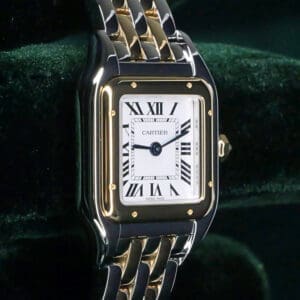
Cartier Panthere Sizes Explained
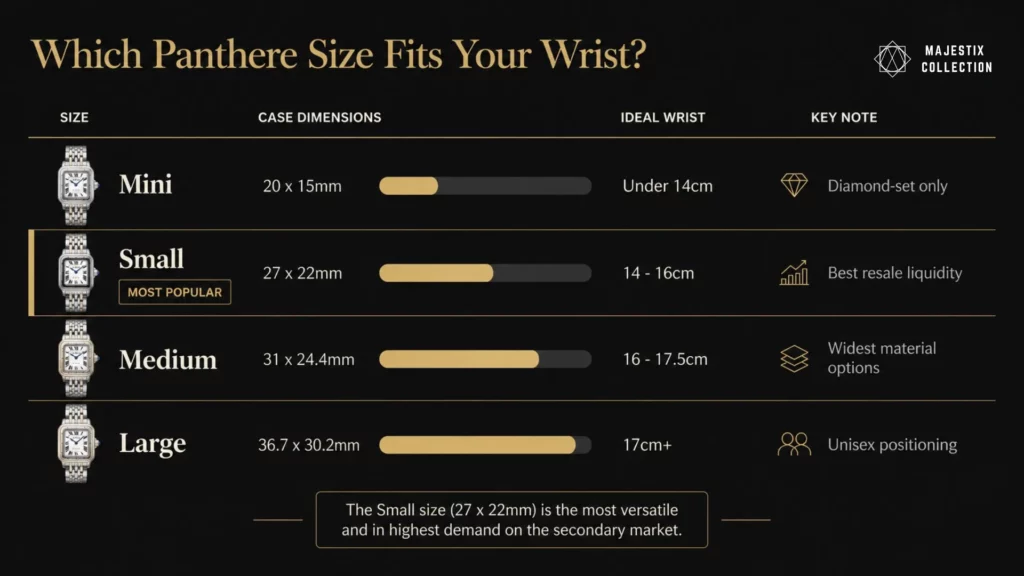
Four sizes exist in the current Gen 2 lineup. Case dimensions matter, but so does what each size unlocks in materials, references, and resale liquidity.
Mini Panthere
The Mini measures roughly 25 × 21mm and 6mm thick. The current steel reference is WSPN0019; the older WSPN0012 is listed at 25 × 19mm. Most buyers consider this size a jewelry-first piece for slim wrists under 14cm. There is a steel option around $4,300 retail, plus yellow gold, rose gold, and full diamond-set configurations that climb well into five figures.
Small Panthere
The Small measures 22 × 30mm and 6mm thick. Current references include the WSPN0006 and WSPN0013 in steel ($4,300–$4,950 retail), the W2PN0006 in two-tone, and gold versions including the rose gold WGPN0006.
This is where most secondary market activity happens. Small steel references are the quickest to price, the easiest to sell, and the most forgiving entry for a first Panthere.
Medium Panthere
The Medium measures 27 × 37mm and 6mm thick. Current references include the WSPN0015 in steel ($5,900 retail), the W2PN0007 in two-tone (~$10,000), and the WGPN0007 in rose gold (~$31,000).
The Medium offers the widest material and dial selection in the current lineup. It also reads as a more conventional watch footprint for buyers on larger wrists or anyone who wants more visual presence beyond what the bracelet alone provides.
Large Panthere
The Large measures 31 × 42mm and 6.71mm thick. The current steel reference is WSPN0016. The Large was absent from the 2017 relaunch and reinstated later, which restored the original unisex positioning of the collection. It is the practical pick for male buyers or anyone who wants a bolder wrist read.
Best Panthere Material for You
Three main material tiers. Each one carries different pricing, different resale behavior, and different ownership realities.
Stainless Steel: Best Value and Liquidity
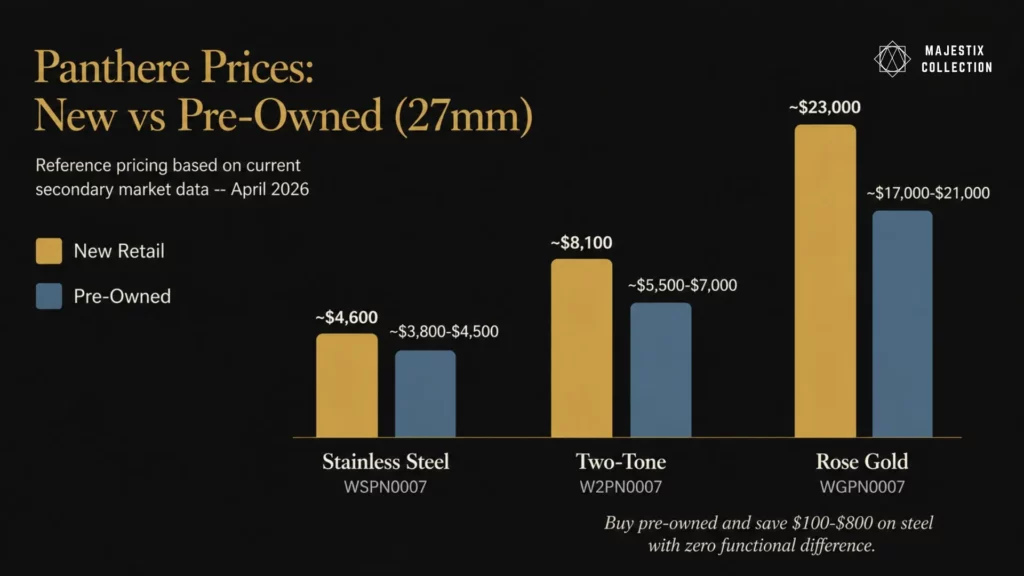
The Small steel WSPN0013 retails at $4,950 new, per Cartier US in April 2026. Pre-owned examples in excellent condition trade in the $4,200 to $4,800 range, which is a saving of $150 to $750 depending on condition and whether the piece comes with original box and papers.
Steel is the most liquid configuration on the secondary market. It sells fastest, holds price best, and attracts the widest pool of buyers.
Forum consensus on r/Watches and Watchuseek points to steel as the pick for daily wear, wrist stacking, and resale flexibility. Surface scratches are far less visible on steel than on polished gold, and the watch keeps a strong wrist presence regardless.
Two-Tone: Warmth Without the Upkeep
The Medium two-tone W2PN0007 retails at roughly $10,000 new. Pre-owned examples typically trade between $5,500 and $8,500 on Chrono24 depending on condition and year.
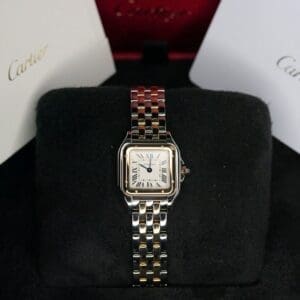
Two-tone reads warmer than steel without the maintenance demands of full gold. It photographs well and holds resale value reasonably. The trade-off is a narrower buyer pool, so two-tone listings tend to sit longer than equivalent steel.
Rose gold two-tone is exclusive to Gen 2 and has slightly softer secondary demand than yellow gold two-tone because it appeals to a narrower aesthetic profile.
Gold: Reserved for Condition Buyers
Rose gold Medium (WGPN0007) retails at $31,000 new. Yellow gold Small and Medium references run $20,000 to $32,000. White gold with diamonds starts above $25,000 and climbs from there.
Gen 1 yellow gold deserves its own note. Full-set examples in excellent condition, especially with the original Cartier box, papers, crown, and a tight bracelet, now trade at strong premiums on Chrono24. These exact configurations are no longer available new, and collector interest in vintage Cartier has grown since the Panthère’s 2017 revival.
The appeal is not just scarcity. Original yellow gold Panthère pieces also have a warmer vintage character that current production does not fully replicate.
Gold requires more care than steel. Polished surfaces show scratches immediately, and any polishing rounds the case edges and removes metal permanently. Buyers of gold Pantheres should budget for professional cleaning only, never DIY attempts.
Cartier Panthere Prices by Reference
Current retail and pre-owned data, verified against Cartier US and WatchCharts in April 2026:
| Reference | Size | Material | New Retail (USD) | Pre-Owned Range |
|---|---|---|---|---|
| WSPN0019 | Mini (25 × 21mm) | Steel | ~$4,300 | $3,200–$3,900 |
| WSPN0006 | Small (22 × 30mm) | Steel | ~$4,300 | $3,400–$4,100 |
| WSPN0013 | Small (22 × 30mm) | Steel | $4,950 | $4,200–$4,800 |
| WSPN0015 | Medium (27 × 37mm) | Steel | $5,900 | $4,500–$5,400 |
| WSPN0007 | Medium (27 × 37mm) | Steel (discontinued) | N/A | $5,000–$6,500 |
| W2PN0007 | Medium (27 × 37mm) | Two-tone | ~$10,000 | $5,500–$8,500 |
| WGPN0007 | Medium (27 × 37mm) | Rose gold | ~$31,000 | $24,000–$30,500 |
| Gen 1 yellow gold (Small) | 22 × 30mm | Yellow gold | N/A (discontinued) | $9,000–$18,000+ |
For current steel references, buying pre-owned saves $150 to $750 with no functional difference. The watch keeps time identically, wears identically, and Cartier’s service network handles pre-owned pieces the same as new. For Gen 1 yellow gold, pre-owned is the only path. Pricing moves significantly with bracelet condition, crown integrity, and matching papers.
If a specific reference in this table caught your eye, we can check whether we have one in stock, source it, or share recent comparable sales. Reach out with the reference number and your wrist size and we’ll go from there.
Buy New or Pre-Owned
For current steel references, pre-owned is the better value for most buyers. For Gen 1 yellow gold or any discontinued configuration, pre-owned is the only option, and condition research matters more here than with almost any other watch at this price.

When New From a Cartier Boutique Makes Sense
Buying new gives you a 2-year International Limited Warranty, full traceability, and a perfect piece. Cartier Care, which is a free registration program, extends what the manufacturer warranty covers to a total of 8 years and is transferable to subsequent owners. That is a real reason to register your piece, whether new or pre-owned, because it protects your future resale value.
You pay for that certainty. The premium typically runs $150 to $750 more than a pre-owned piece in excellent condition. If you are spending $4,950 on a watch and an extra $400 buys you a guaranteed-perfect example with a fresh 8-year warranty path, the math is reasonable.
When Pre-Owned Wins
Pre-owned wins on two fronts. The first is a lower price on current references, which is meaningful but not dramatic on steel. The second is access to discontinued configurations, and that one matters if you want a Gen 1 piece, the date function, or a yellow gold reference that no longer exists new.
Reliable platforms include Chrono24 (largest global volume), our walkthrough on buying through Chrono24 covers the seller verification and escrow steps to look for.
WatchCharts Marketplace offers price transparency and seller verification, alongside specialist pre-owned dealers. The trade-off between buying through a boutique versus the secondary market is something we unpack in detail in our AD vs grey market breakdown.
For eBay, only buy listings covered by eBay’s Authenticity Guarantee, which provides third-party authentication on Cartier pieces over $2,000.
What to Check on Any Pre-Owned Panthere
Four checks before you pay. For a more general framework that applies across brands, we have a full pre-purchase inspection guide that covers paperwork, condition, and provenance:

1. Bracelet drape. Hold the watch by the case and let the bracelet hang. Uneven sag or rattling links mean the bracelet has stretched and a service is needed.
2. Crown condition. The blue sapphire cabochon (or synthetic blue spinel on most steel references) chips and cracks with age. A damaged crown is expensive to replace with a genuine Cartier part.
3. Dial originality. The hidden Cartier signature sits within the Roman numeral X. If it is absent or applied rather than engraved, the dial may have been swapped.
4. Reference and papers match. The number on the caseback must match the papers exactly. Any discrepancy is a serious problem regardless of how the seller explains it.
Why the Panthere Is Quartz
The Panthere uses a quartz movement by design. For this watch, that is the right call. A mechanical movement would force a thicker case, and a thicker case would destroy the bracelet’s drape and the entire purpose of the design.
The current caliber keeps total thickness at 6mm across the Mini, Small, and Medium. A mechanical movement with even a basic self-winding rotor would push that past 9mm. At 9mm the bracelet stops draping and starts sitting. The watch becomes something else entirely.
Long-term ownership costs are modest. Cartier officially recommends battery service every 2 to 3 years, and a boutique service runs $300 to $600 because Cartier bundles a movement check with the battery change rather than swapping the cell alone.
A qualified independent watchmaker will swap the battery for $50 to $150, but that voids the manufacturer warranty if you are still inside it.
For comparison, a full mechanical service at this price tier typically runs $400 to $800 every five to seven years, and considerably more for complications. On total service spend across a decade, the quartz Panthere is the cheaper watch to own.

Owners on r/Watches and Watchuseek report the same experience. The quartz objection goes away the moment you put the watch on. The bracelet is the experience. Nobody buys a Panthere and spends the day wishing the second hand swept differently.
Is the Cartier Panthere a Good Investment
The Panthère holds its value well for a jewelry watch. The WSPN0013 currently trades about 1.8% below retail as of April 2026, according to market data from a third-party source. Cartier also remains strong as a brand, with popular models retaining around 87 to 99 percent of retail value in excellent condition.
You should still buy the Panthère because you plan to wear it, though. The value retention is a bonus, not the reason (source).
The Gen 1 yellow gold appreciation story is real, but it is not a guarantee going forward. Full-set vintage examples in excellent condition have sold strong as collector interest in the original lineup has grown since 2017. That window may close as more pieces enter the market or as average condition continues to decline.
What hurts Panthere resale more than buyers expect:
- Polished cases – The Panthere has crisp angular edges that define the silhouette. Polishing rounds them, and collectors spot it immediately.
- Replaced crowns – A non-original crown introduces a part swap into a watch where originality drives price.
- Stretched Gen 1 bracelets – A rattling bracelet means the next buyer absorbs a service cost before they can enjoy the watch.
- Missing box and papers – Cartier documentation carries more weight at this price tier than with many other brands. Missing papers cuts the sale price more than buyers expect.
Final Thoughts on the Cartier Panthere Buying Guide
The Panthere rewards buyers who know what they are getting. The bracelet is the experience, the quartz movement is correct for the design, and the Small steel (WSPN0013 or WSPN0006) is the most practical first buy. For a Gen 1 configuration or the date function, the secondary market is your only route, and a careful bracelet and crown check is not optional.
Two tips not covered above. Register the watch with Cartier Care, even if pre-owned, since the 8-year warranty transfers and protects future resale value. And when reviewing pre-owned listings, ask for close-up photos of the clasp underside and the crown specifically, since those are the two spots sellers tend to under-photograph when something is off.
Browse our current pre-owned Cartier Panthere listings, or message us directly if you’re hunting for something specific. That could be a Gen 1 yellow gold reference, a date-equipped piece, or a configuration that is no longer in production.
We’ll send wrist shots, condition notes on the bracelet and crown, and the original papers for any piece we’ve sourced before listing it.
999+ Timepieces Available
Explore Our Timepieces
Authenticated, unworn, and ready to ship worldwide.
Rolex · Audemars Piguet · Patek Philippe · Omega · Cartier · Richard Mille · Hublot · Tudor
Newly Listed
2026 NEW UNWORN Rolex Deepsea "James Cameron" D-Blue Black and Blue Dial Black Ceramic Bezel Stainless Steel 44mm COMPLETE SET 136660-0005
$20,208.00
Panerai Luminor Marina 1950 3 Days Limited Edition Black Sandwich Dial Stainless Steel Black Rubber Strap 47mm MINT COMPLETE SET PAM00422
$7,503.00
Panerai Luminor Marina 1950 3 Days Black Dial Stainless Steel Brown Leather Strap 47mm LIMITED EDITION MINT CONDITION COMPLETE SET PAM00422
$7,503.00
Cartier Santos-Dumont Micro-Rotor Skeleton Dial Black Alligator Strap 18k Rose Gold 43.5 x 31mm MINT CONDITION COMPLETE SET WHSA0030
$40,425.00
2026 Vacheron Constantin Overseas Blue Dial 18k Rose Gold 41mm MINT CONDITION COMPLETE SET 4520V/210R-B705
$72,764.00
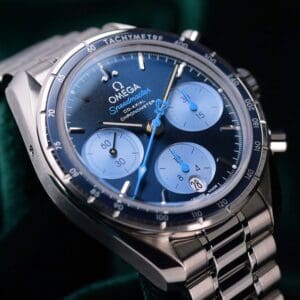
Omega Speedmaster 38 Orbis Edition Blue Dial Stainless Steel 38mm MINT CONDITION COMPLETE SET 324.30.38.50.03.002
$6,599.00
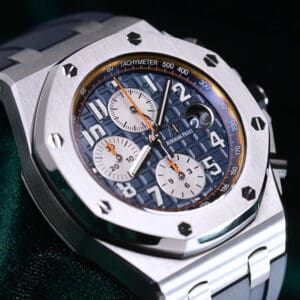
Audemars Piguet Royal Oak Offshore Chronograph “Navy” Blue Dial Orange Accents Blue Rubber Strap Stainless Steel 42mm MINT CONDITION COMPLETE SET 26470ST.OO.A027CA.01
$22,245.00
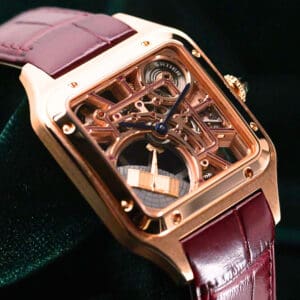
Cartier Santos-Dumont Micro-Rotor Skeleton Dial 18K Rose Gold Burgundy Alligator Strap 31mm MINT CONDITION COMPLETE SET WHSA0030
$40,425.00
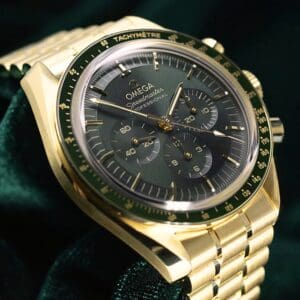
Omega Speedmaster Professional Moonwatch "Moonshine" Green Dial 18K Yellow Gold 42mm MINT CONDITION COMPLETE SET 310.60.42.50.10.001
$35,695.00
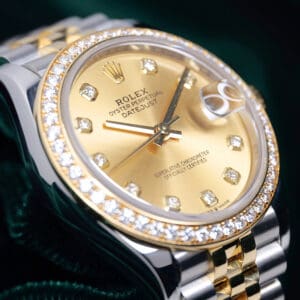
Rolex Datejust 31 Champagne Diamond Dial Diamond Bezel Jubilee Yellow Gold & Stainless Steel 31mm MINT CONDITION COMPLETE SET 278383RBR
$31,990.00
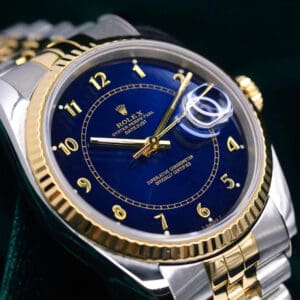
Rolex Datejust Blue Arabic Numeral Refinished Dial Fluted Bezel Jubilee Bracelet 18k Yellow Gold Stainless Steel 36mm MINT CONDITION 16233
$7,975.00
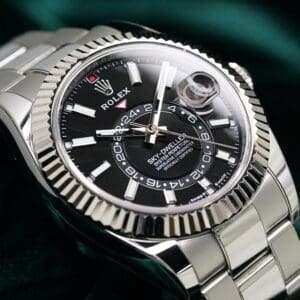
2025 Rolex Sky-Dweller Bright Black Dial 18k White Gold Fluted Bezel Stainless Steel Oyster Bracelet 42mm MINT CONDITION COMPLETE SET 336934
$22,895.00