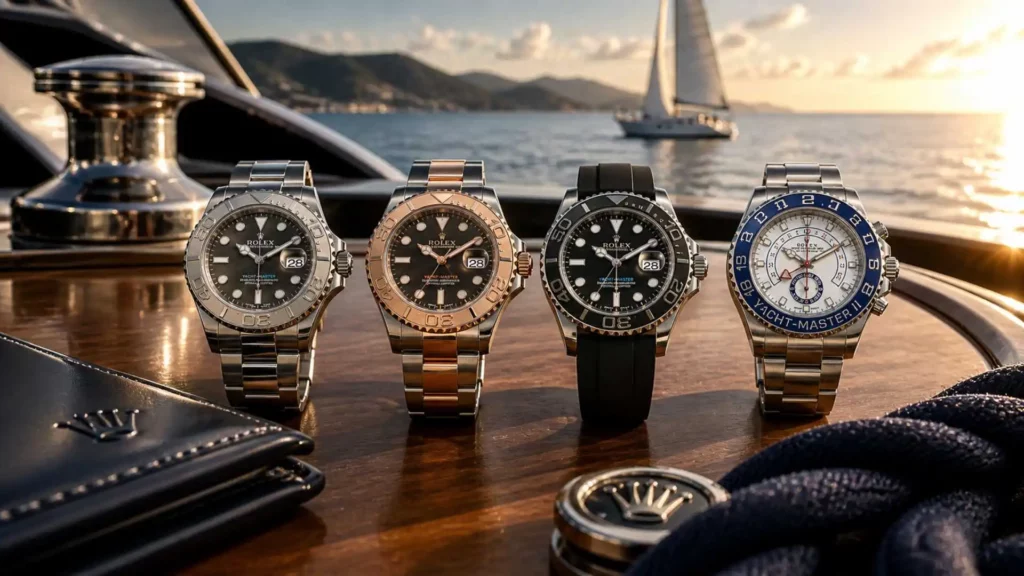
Are you about to spend five figures on a Rolex Yacht-Master and unsure if you’re picking the right one? That hesitation is fair. This is one of the few Rolex collections where pricing, demand, and model availability do not move in lockstep.
Some references trade below retail, some carry premiums, and the lineup itself shifted at Watches & Wonders 2026. This Rolex Yacht-Master buying guide exists for one reason: to help you avoid costly mistakes in a market that has changed fast.
Discontinued references are pulling collector attention; the Yacht-Master II just got a full reboot, and a few precious-metal models still sell for thousands under retail. At Majestix Collection, we have seen how the right Yacht-Master can hold value while the wrong one can cost you thousands before you even wear it.
Keep reading to understand which models make sense in 2026 and how to buy with confidence.
What Is the Rolex Yacht-Master?
The Rolex Yacht-Master is a luxury sport watch built around a bidirectional 60-minute rotating bezel, originally created for timing short intervals during sailing. It has since shifted into a versatile everyday watch worn far more for lifestyle than actual regatta timing.
The collection launched in 1992 and marked Rolex’s move toward a more refined sport watch category. It shares the Oyster case architecture, Mercedes hands, and waterproof construction of other Rolex sport models, but the design leans into elegance and material variety rather than pure tool-watch utility.
The Yacht-Master sits in an unusual spot in the Rolex lineup, between rugged tool watches and full precious-metal dress models. The result is a sports watch with a softer, more luxurious wrist presence than a Submariner or Explorer.
Before we get into model-by-model breakdowns, here’s the spec sheet shared across the collection:
- Case sizes: 37mm, 40mm, 42mm
- Water resistance: 100 meters (safe for swimming, not deep diving)
- Bezel: Bidirectional 60-minute rotating bezel
- Materials: Rolesium, Everose Rolesor, Everose gold, white gold, RLX titanium
- Movement: Modern Rolex automatic calibers (varies by reference and size)
Yacht-Master vs Yacht-Master II: Key Differences
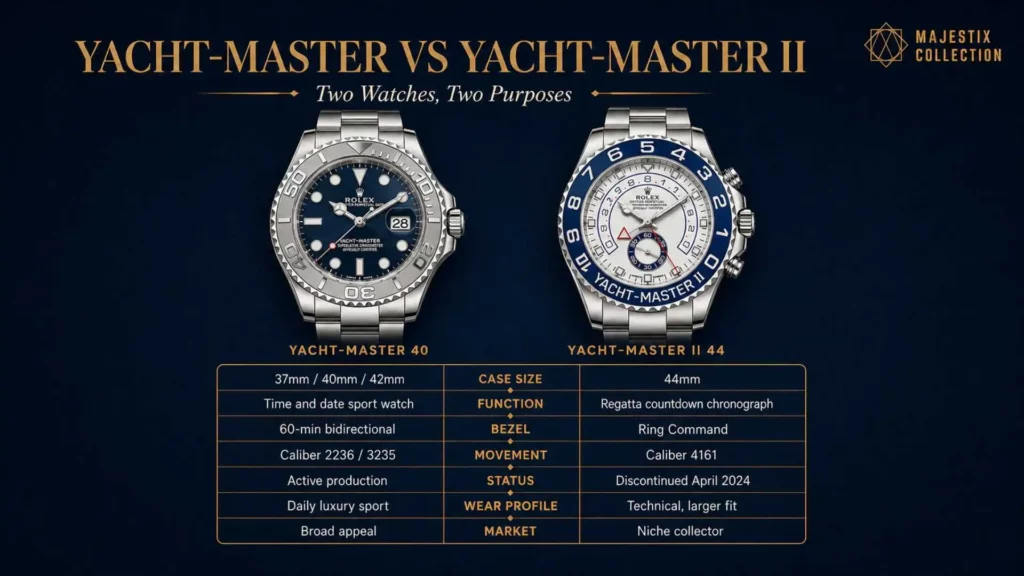
The Yacht-Master and Yacht-Master II often get mentioned together, but they serve completely different roles. One is a refined everyday sport watch. The other is a regatta countdown chronograph that just got a major redesign in 2026.
Here’s the comparison at a glance:
| Feature | Yacht-Master | Yacht-Master II |
| Case Size | 37mm, 40mm, 42mm | 44mm |
| Primary Function | Time-and-date sport watch | Regatta countdown chronograph |
| Bezel System | 60-minute bidirectional rotating bezel | Blue Cerachrom bezel (2nd gen) |
| Movement | Caliber 2236 / 3235 depending on size | Caliber 4162 (2nd gen, 2026) |
| Production Status | Active collection | First-gen discontinued in April 2024; second-gen launched 2026 |
| Wear Profile | Balanced sport watch for daily wear | Larger, technical, regatta-focused |
| Market Position | Broad appeal across Rolex sport buyers | Niche complication for collectors |
From a buying perspective, the Yacht-Master is the everyday-wear collection most buyers are shopping for. The Yacht-Master II is a specialist chronograph. The first generation (refs. 116680 and 116688) was discontinued in April 2024 and now trades only on the secondary market.
The second generation (refs. 126680 and 126688) launched at Watches & Wonders 2026. It features a redesigned dial, the new Caliber 4162, and a more legible countdown system.
If the regatta complication itself is unfamiliar, our beginner’s guide to the regatta countdown walks through the sequence in plain terms.
Current Rolex Yacht-Master Lineup and Pricing in 2026
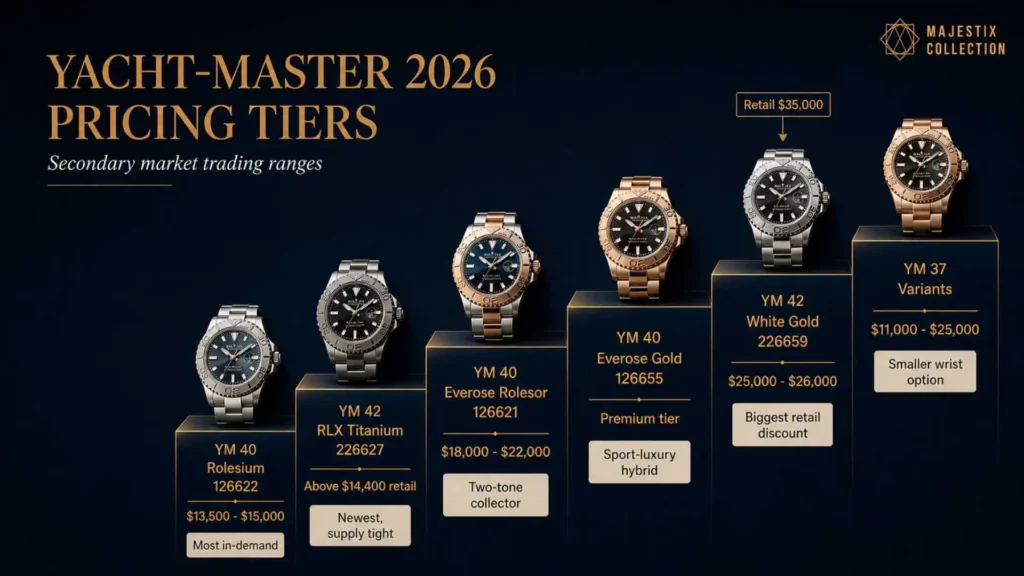
The Rolex Yacht-Master lineup in 2026 spans three case sizes and multiple active references across stainless steel, Rolesium, Everose gold, white gold, and RLX titanium. Each model sits in a different pricing tier, and the secondary market shows a clear split between references trading near retail and those carrying either premiums or discounts.
One quick note on movements: every current 40mm and 42mm Yacht-Master uses Rolex’s caliber 3235 with a 70-hour power reserve, Chronergy escapement, and Parachrom hairspring. The 37mm models use the smaller caliber 2236 with the silicon Syloxi hairspring and a 55-hour power reserve. We won’t repeat that for every reference below — only the differences are worth flagging.
1. Rolex Yacht-Master 37
The Yacht-Master 37 is the smallest current model in the collection. Its 37mm case works well for smaller wrists or anyone after a more discreet luxury sport watch, and the Syloxi silicon hairspring inside the 2236 movement gives it strong magnetic resistance.
Key specs
- Case size: 37mm
- Movement: Caliber 2236 (55-hour power reserve, Syloxi hairspring)
- Water resistance: 100 meters
- Materials: Everose Rolesor, solid Everose gold
- Active references: 268621 (Everose Rolesor), 268622 (Rolesium), 268655 (solid Everose gold)
In 2026, pricing typically ranges from $11,000 to $25,000 depending on configuration, with the two-tone 268621 sitting at the lower end and the solid Everose 268655 at the top.
2. Rolex Yacht-Master 40 Rolesium (Ref. 126622)
The 126622 is the most in-demand model in the current lineup. It pairs an Oystersteel case with a 950 platinum bezel, a material combination Rolex calls Rolesium and reserves exclusively for the Yacht-Master collection.
Key specs
- Case size: 40mm
- Bezel: 950 platinum
- Bracelet: Oystersteel Oyster bracelet
- Water resistance: 100 meters
In 2026, the 126622 traded around$13,500 to$15,000, staying close to retail but remaining hard to source through authorized dealers because of allocation priorities. If the AD route feels stalled, our breakdown of authorized dealers vs the grey market covers what changes when you skip the waitlist.
3. Rolex Yacht-Master 40 Everose Rolesor (Ref. 126621)
The 126621 blends Oystersteel with Everose gold across the bezel, crown, and center bracelet links. The result is a warmer, more visually expressive take on the same 40mm case.
Key specs
- Case size: 40mm
- Materials: Oystersteel and 18k Everose gold
- Bracelet: Rolesor Oyster bracelet
- Water resistance: 100 meters
Secondary market pricing in 2026 sits around $18,000 to $22,000. Turnover is slower than the 126622 because the two-tone aesthetic appeals to a more specific buyer.
4. Rolex Yacht-Master 40 Everose Gold (Ref. 126655)
The 126655 is the most luxury-leaning model in the 40mm lineup. It’s crafted in solid 18k Everose gold and paired with an Oysterflex rubber strap — sport-luxury in the most literal sense.
Key specs
- Case size: 40mm
- Material: Solid 18k Everose gold
- Bracelet: Oysterflex
- Water resistance: 100 meters
In 2026, the 126655 typically trades in the high $20,000s to low $30,000s on the secondary market, with full-set examples and unworn pieces commanding premiums.
5. Rolex Yacht-Master 42 White Gold (Ref. 226659)
The 226659 is one of the most price-inefficient models in the lineup from a retail-to-market perspective. It’s solid 18k white gold on an Oysterflex bracelet, visually quiet, materially heavy.
Key specs
- Case size: 42mm
- Material: 18k white gold
- Bracelet: Oysterflex
- Water resistance: 100 meters
In 2026, the 226659 traded around $28,000 to $34,000 on the secondary market against a US retail of approximately $38,100. That gap makes it one of the widest “below retail” deals in the Rolex sport catalog partly because solid white gold flies under the radar visually, and partly because demand for 42mm precious-metal sport watches is thinner than steel demand.
For a wider view of where Rolex retail sits versus secondary market reality, our full Rolex pricing breakdown maps the gaps across the lineup.
6. Rolex Yacht-Master 42 Titanium (Ref. 226627)
The 226627 is the newest evolution of the collection, introduced at Watches and Wonders 2023. It’s made from RLX titanium, Rolex’s proprietary Grade 5 titanium alloy, and is roughly 30% lighter on the wrist than its steel and gold siblings.
Key specs
- Case size: 42mm
- Material: RLX titanium
- Bracelet: Fully brushed integrated titanium Oyster bracelet
- Water resistance: 100 meters
In 2026, the 226627 still trades slightly above its $14,400 retail price because demand outpaces supply. Pricing should stabilize as Rolex increases titanium production over the next few years.
Discontinued Rolex Yacht-Master References Worth Considering in 2026
Some of the most interesting Yacht-Master opportunities sit outside the current catalog. Discontinued references trade on rarity, condition, and collector demand not retail pricing which makes them attractive for buyers focused on long-term value or entry-level pricing into the lineup.
1. Rolex Yacht-Master 16622 Rolesium (1999–2012)
The 16622 is the original modern Rolesium reference and one of the most collectable Yacht-Masters available. It’s a 40mm Oystersteel case paired with a 950 platinum bezel and a platinum dial, powered by the long-running caliber 3135.
Key specs
- Case size: 40mm
- Movement: Caliber 3135 (~48-hour power reserve)
- Bezel: Bidirectional platinum bezel
- Water resistance: 100 meters
This reference typically trades between $9,000 and $13,000 depending on condition and completeness. Early models with tritium dials (used on Rolex sport watches before the late 1990s switch to Luminova) and full original sets are increasingly sought after, with collector premiums climbing steadily over the past decade.
2. Rolex Yacht-Master II Steel (Ref. 116680, 2013–2024)
The first-generation Yacht-Master II in steel was discontinued in April 2024 and is now only available on the secondary market. It’s a 44mm Oystersteel chronograph powered by caliber 4161 with a programmable Ring Command countdown bezel, one of Rolex’s most mechanically complex sport watches ever produced.
Key specs
- Case size: 44mm
- Movement: Caliber 4161
- Function: Programmable regatta countdown
- Water resistance: 100 meters
In 2026, the 116680 traded around $16,000 to $19,000 on the secondary market. Liquidity is lower than mainstream Rolex sport models because the buyer pool is narrower, but the discontinuation has put a floor under prices.
One important note: Rolex launched a second-generation Yacht-Master II at Watches & Wonders 2026 (ref. 126680) with a redesigned dial, a new blue Cerachrom bezel, and the updated caliber 4162.
If you’re shopping the 116680, you’re now choosing between a discontinued first-gen with the original Ring Command system and a brand-new second-gen with a more legible countdown layout.
3. Rolex Yacht-Master II Yellow Gold (Ref. 116688, 2007–2024)
The 116688 is the most materially heavy first-gen Yacht-Master II solid 18k yellow gold pairing luxury construction with the same caliber 4161 regatta movement as the steel version.
Key specs
- Case size: 44mm
- Material: 18k yellow gold
- Bezel: Cerachrom with platinum-filled numerals
- Water resistance: 100 meters
In 2026, the 116688 ranged from $36,000 to $42,000, driven primarily by gold content and collector interest rather than mass-market demand. Intrinsic metal value provides a structural price floor even in softer markets.
4. Rolex Yacht-Master 16628 Solid Yellow Gold (1992–Early 2000s)
The 16628 is the original solid gold reference that launched the collection in 1992, the first Yacht-Master ever produced. It’s a 40mm 18k yellow gold Oyster case paired with the caliber 3135.
Key specs
- Case size: 40mm
- Movement: Caliber 3135
- Material: 18k yellow gold
- Bezel: Solid gold bidirectional bezel
- Water resistance: 100 meters
In 2026, this reference trades between $20,000 and $32,000, with stronger premiums for tritium dials, original bracelets, and full sets. Its value is driven more by historical significance than daily wearability, this is a collector’s piece first.
Which Rolex Yacht-Master Should You Buy in 2026?
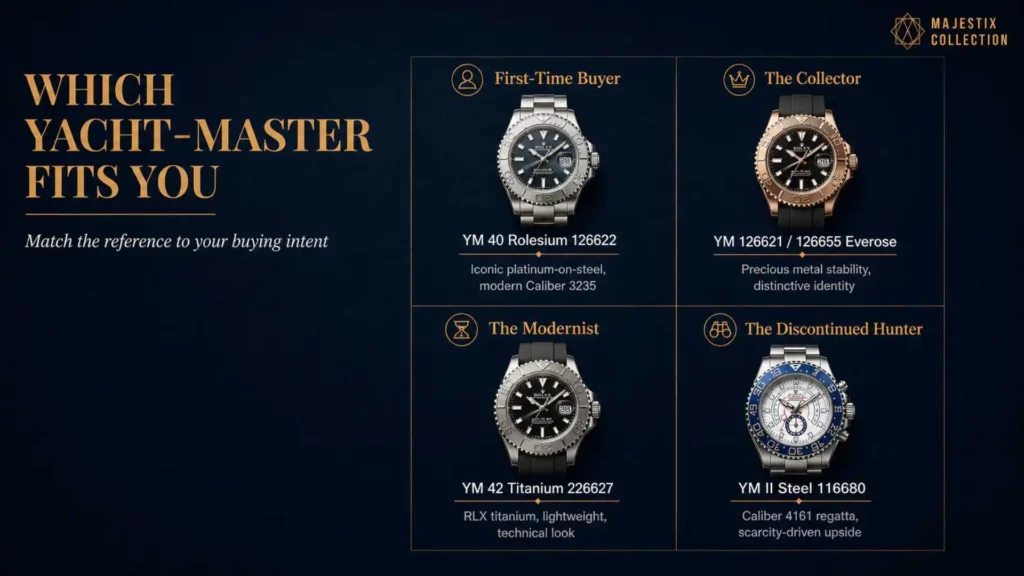
There is no single best Yacht-Master in 2026. Each reference serves a different buying intent — first-time entry, collector diversification, modern tool watch, or vintage discontinued pickup. The picks below are organized by buyer type, not by lineup position.
1. Best First Rolex for Most Buyers: Yacht-Master 40 Rolesium 126622
The 126622 covered above is the cleanest entry into Yacht-Master ownership. The Rolesium combination of Oystersteel and a 950 platinum bezel is unique to the collection, the wrist presence is balanced, and it’s widely available on the secondary market without long allocation delays.
If the Submariner has also been on your shortlist, our full Yacht-Master vs Submariner breakdown walks through how the two diverge on wrist feel, water rating, and resale.
2. Best for Collectors Diversifying Beyond Steel:Yacht-Master 126621 and 126655
Both Everose references make sense for buyers expanding past standard steel sport watches. The 126621 brings the warmer two-tone Everose Rolesor look at a more accessible price, while the 126655 in solid Everose with Oysterflex pushes the Yacht-Master fully into precious-metal sport-luxury territory.
Demand for these is more selective than the Rolesium 126622, but precious-metal construction provides stronger long-term value stability than steel-heavy references.
3. Best for Modern Tool-Watch Buyers: Yacht-Master 42 Titanium 226627
The 226627 is the most modern Yacht-Master Rolex makes. The fully brushed RLX titanium case and bracelet drop the wrist weight noticeably, and the technical, tool-oriented finishing reads very differently from the polished gold and steel models.
Demand still outpaces supply at retail, so secondary-market pricing tracks allocation access more than production cost. Expect that to soften over the next 12–24 months as production catches up.
4. Best for Collectors Wanting Discontinued Complexity: Yacht-Master II Steel 116680
The 116680 makes sense for buyers who want the most mechanically complex first-gen Yacht-Master II at the lowest entry point. The caliber 4161 with its Ring Command programmable countdown is a genuine horological feat and now that Rolex has replaced the Ring Command system with a simpler interface on the 2026 second-gen, the original mechanism becomes more interesting from a collector standpoint, not less.
The trade-off is liquidity. The 116680 sells more slowly than mainstream Yacht-Masters, so plan to hold rather than flip.
How to Spot a Fake Rolex Yacht-Master in 2026
Most Yacht-Master fakes fail on a handful of consistent details, incorrect reference coding, wrong materials, or mismatched movements. Focus on those areas first and you’ll catch most counterfeits before any deeper inspection.
We’ve covered the full counterfeit checklist for the Yacht-Master line in a dedicated guide, but the essentials below are enough for most pre-purchase inspections.
1. Decode the Reference Number First
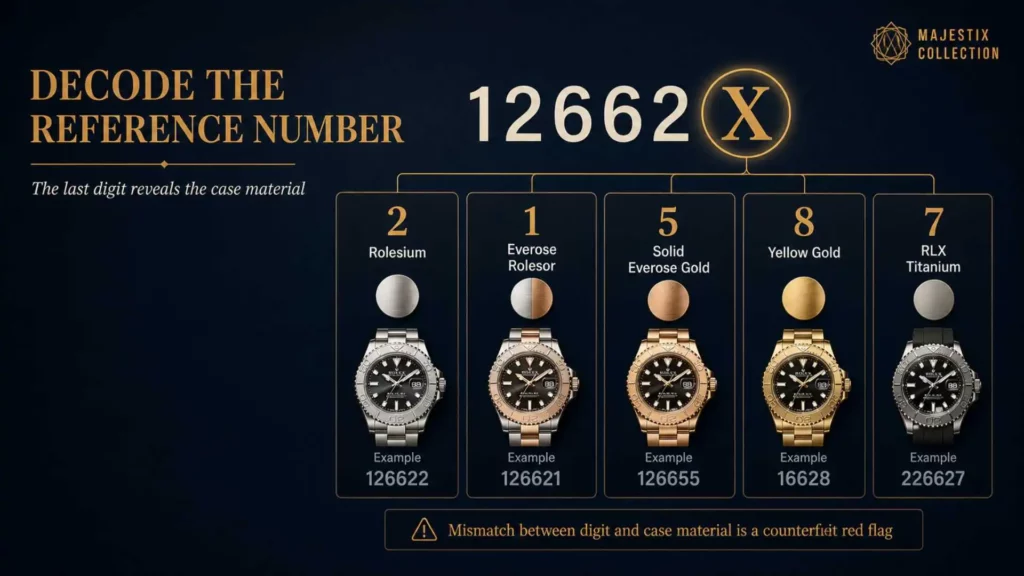
The final digit of a Yacht-Master reference indicates the case material. A “2” means Rolesium, “1” means Everose Rolesor, “5” means solid Everose gold, “8” means yellow gold, and “7” applies to the RLX titanium 226627.
Any mismatch between the reference number and the watch in front of you is a hard red flag.
2. Inspect the Bezel Material and Construction
The bezel is one of the easiest places to spot a fake. Rolesium versions use a 950 platinum bezel that feels weighty and reads cool and silvery in the metal. Oysterflex models use a Cerachrom ceramic bezel known for its sharp, even finishing. Light-feeling bezels, uneven engraving, or off-color numerals usually signal a replica.
3. Match the Movement to the Reference
Each Yacht-Master reference is paired with a specific movement, and the pairing must be exact. The 126622 uses caliber 3235, the 16622 uses caliber 3135, all 37mm models use caliber 2236 with the Syloxi hairspring, the first-gen Yacht-Master II uses caliber 4161, and the new 2026 second-gen Yacht-Master II uses caliber 4162.
Any mismatch between movement and reference is one of the strongest fake indicators.
4. Evaluate Build Quality Details
A genuine Yacht-Master should feel solid and balanced on the wrist. The second hand should sweep smoothly without ticking, the sapphire crystal should be perfectly clear, and the lume should glow evenly across all markers. Inconsistencies in weight, finishing, or illumination are common fake tells.
5. Confirm Authentication Through Professional Inspection
For any pre-owned Yacht-Master above $10,000, get final verification through an authorized Rolex service center or a trusted independent expert. Cross-checking the case-back engraving against what each section of a Rolex serial number means is also a useful early step before any in-person inspection.
This step confirms both movement authenticity and overall originality, the highest level of certainty before completing a high-value purchase.
What Affects Rolex Yacht-Master Resale Value in 2026
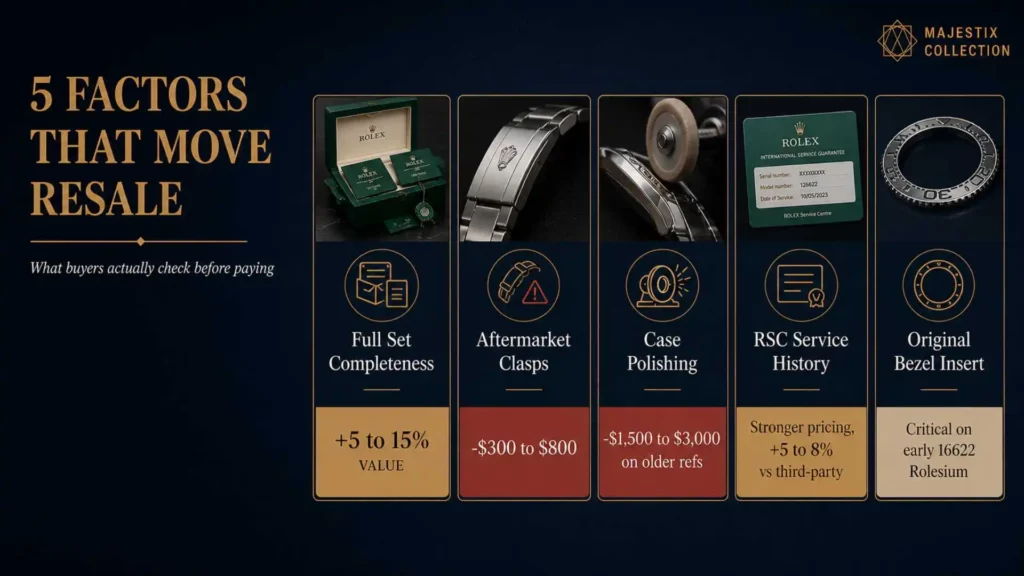
Yacht-Master resale value depends on more than the reference and condition. Buyers in the secondary market check completeness, originality, service history, and component integrity and each one moves pricing meaningfully.
1. Full Set Completeness
A complete set with the original box, warranty card, and service documents lifts resale value by 5–15% over a watch-only listing. On expensive references like the 126622 and the 16628, that gap can mean several thousand dollars.
Buyers verify provenance before they commit, so full sets build trust faster and improve liquidity. If you’re weighing a deal where the papers are missing, our take on whether buying a Rolex without box and papers is ever worth it covers when to walk and when the discount actually justifies it.
2. Aftermarket Clasps
A replaced clasp on an Oyster bracelet Yacht-Master typically reduces resale value by $300–$800, depending on the reference and condition. Even genuine Rolex replacement clasps can affect pricing if the seller can’t document where the replacement came from.
On Oysterflex models, buyers spot non-original parts quickly because Rolex-specific markings and texture are distinctive. Keep original components when you can.
3. Case Polishing
Heavy polishing reduces value on pre-2010 Yacht-Masters because it removes sharp lug edges and original factory finishing that collectors expect. The trade-off between keeping a Rolex polished or leaving it untouched plays out clearly in resale pricing.
Modern references like the 126622 hold up better in the secondary market. Older models like the 16622 and 16628 often lose $1,500–$3,000 when polishing alters the case geometry.
4. Service History
A Rolex Service Center (RSC) record confirms official maintenance and authenticity, and sellers with a green RSC card typically get stronger pricing. Third-party service records hesitate buyers and tend to reduce offers by 5–8%.
For high-value Yacht-Masters, owners who plan to resell usually stick with RSC servicing, even though the cost of a full Rolex service is something to factor into total ownership.
5. Bezel Integrity
Some early 16622 Rolesium examples have replaced platinum bezel inserts, which hurts originality and market value. Buyers check bezel reflectivity, weight, and engraving quality to confirm originality.
Aftermarket inserts rarely match Rolex finishing standards, so a service center inspection becomes essential when evaluating older Rolesium pieces.
Final Thoughts on the Rolex Yacht-Master Buying Guide
Choosing a Rolex Yacht-Master comes down to which reference matches how you’ll actually wear it and how it’ll perform after a few years on the wrist. Each path has trade-offs: the 126622 Rolesium for first-time entry, the Everose references for collector diversification, the 226627 titanium for modern tool-watch buyers, and the discontinued first-gen Yacht-Master II for collectors chasing complexity at the lowest entry price.
What this guide shows is that confident decisions come from comparing ownership experience rather than focusing only on retail pricing or aesthetics. The 2026 lineup is wider than ever and with Rolex bringing the Yacht-Master II back as a second generation, there’s more to weigh than there was even a year ago.
If you want to zoom out further across the Rolex catalog, our full Rolex buying guide covers how the rest of the lineup compares.
Two quick tips before you buy: First, if you’re cross-shopping the 126622 against a Submariner, handle both in person if you can. The platinum bezel changes how the Yacht-Master reads under different light, and pictures rarely do it justice.
Second, on any discontinued reference, prioritize service history over cosmetic condition. A polished case can be lived with; a movement opened by an unknown watchmaker is a deeper hole to climb out of.
At Majestix Collection, the focus stays on helping you match the reference to your long-term intent so the watch feels right beyond the purchase moment. When you’re ready to see what’s actually available, browse our current Rolex collection for models we’ve authenticated and are ready to ship.
999+ Timepieces Available
Explore Our Timepieces
Authenticated, unworn, and ready to ship worldwide.
Rolex · Audemars Piguet · Patek Philippe · Omega · Cartier · Richard Mille · Hublot · Tudor
Newly Listed
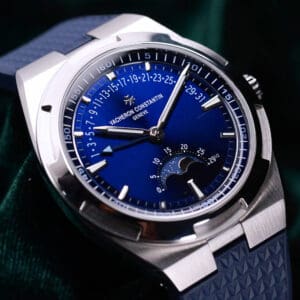
2025 Vacheron Constantin Overseas Moonphase Retrograde Date Blue Dial Blue Rubber Strap Stainless Steel 41mm MINT CONDITION COMPLETE SET 4000V/210A-B911
$52,800.00
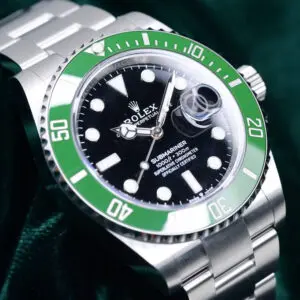
2026 NEW UNWORN Rolex Submariner Date Starbucks Black Dial Green Ceramic Bezel Stainless Steel 41mm COMPLETE SET 126610LV-0002
$17,214.00
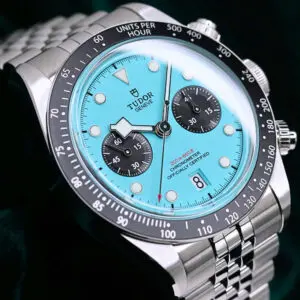
2025 Tudor Black Bay Chrono "Flamingo Blue" Turquoise Dial Black Bezel Stainless Steel 41mm MINT CONDITION COMPLETE SET 79360N-0024
$10,494.00
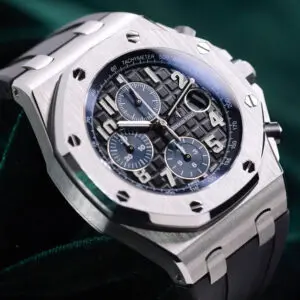
Audemars Piguet Royal Oak Offshore Chronograph "Batman" Black Dial Blue Accents Black Rubber Strap Stainless Steel 42mm MINT CONDITION COMPLETE SET 26470ST.OO.A028CR.01
$25,715.00
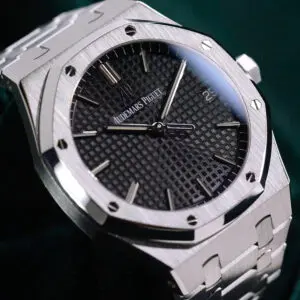
Audemars Piguet Royal Oak Black Dial Stainless Steel 41mm MINT CONDITION COMPLETE SET 15500ST.OO.1220ST.03
$47,245.00
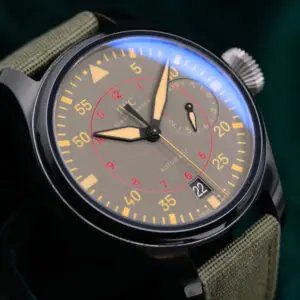
IWC Big Pilot's Watch Top Gun Miramar Grey Dial Green Textile Strap Black Ceramic 48mm MINT CONDITION COMPLETE SET IW501902
$7,240.00
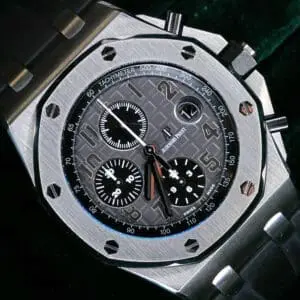
Audemars Piguet Royal Oak Offshore Chronograph "Elephant" Gray Dial Stainless Steel Rubber Strap 42mm 26470ST.OO.A104CR.01
$23,974.50
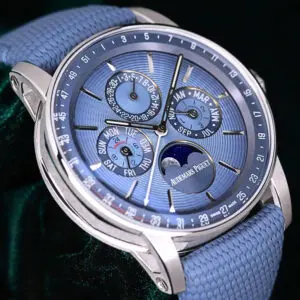
Audemars Piguet Code 11.59 Perpetual Calendar Smoked Blue Dial Blue Rubber Strap 18K White Gold 41mm MINT CONDITION COMPLETE SET 26494BC.OO.D350KB.01
$179,025.00
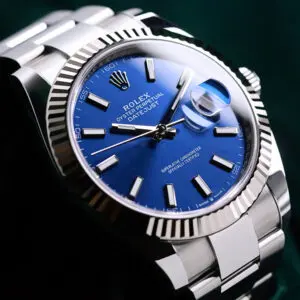
2026 NEW UNWORN Rolex Datejust Blue Dial 18K White Gold Fluted Bezel Oyster Bracelet Stainless Steel 41mm COMPLETE SET 126334
$16,892.00
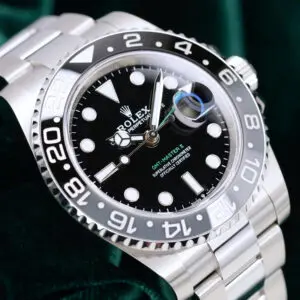
2026 NEW UNWORN Rolex GMT-Master II Bruce Wayne Black Dial Grey and Black Ceramic Bezel Stainless Steel Oyster Bracelet 40mm COMPLETE SET 126710GRNR-0004
$21,851.00
Rolex Submariner Date Black Dial Black Ceramic Bezel Oyster Bracelet Stainless Steel 41mm MINT CONDITION COMPLETE SET 126610LN
$15,692.00
Audemars Piguet Royal Oak Offshore Chronograph "Panda" White Dial Black Subdials Steel Bezel Stainless Steel 42mm MINT CONDITION COMPLETE SET 26170ST.OO.1000ST.01
$27,726.00