
IWC’s Spitfire and the Mark XX sit in the same Pilot’s Watch family and cost about the same at retail. So why do so many buyers get stuck choosing between them? Put them side by side and they tell different stories. For buyers comparing the IWC Spitfire with the modern Mark line, “Mark 20” is a common search term, while Mark XX is the official IWC model name.
One is built around heritage and a vintage look, the other for everyday flexibility. This IWC Spitfire vs Mark 20 comparison breaks down every real difference, from case size and water resistance to bracelets, lume, and pricing.
Specs look close on paper, but the two feel different to live with. By the end, you’ll know which one belongs on your wrist.
IWC Spitfire Background

Image courtesy of IWC Official Website (source)
IWC named the Spitfire after the Supermarine Spitfire, the British fighter that flew in World War II. Its pilot-watch roots go back even further, to the late 1940s.
IWC has used the Spitfire name on its pilot’s watches since the early 2000s. Buyers comparing against the Mark XX are looking at the Spitfire Automatic, which debuted at the 2019 Geneva watch show (then called SIHH). It was the first IWC watch to use the brand’s new in-house 32000 caliber family.
At 39mm, this Spitfire wears smaller than most modern IWC pilot watches, much like the original Mark 11 built for the Royal Air Force in 1948. A faux-patina dial and an optional bronze case give it a warm, vintage feel. Plenty of collectors call it the “purist’s choice” in the lineup.
Notable references of the IWC Spitfire:
- IW326801
- IW326802
- IW326803
IWC Mark XX Background

Image courtesy of IWC Official Website (source)
Mark watches have defined IWC’s pilot line for decades. Every model, from the Mark XII through the XV, XVI, XVII, XVIII, and now the XX, traces back to one watch: the Mark 11 navigation watch IWC built for the British RAF in 1948.
IWC introduced the Mark XX in mid-2022 to replace the Mark XVIII, and it fixed the two biggest complaints about the older model. Lug-to-lug dropped from 51mm to 49.2mm, and the date window moved for better dial balance.
It brought in the same IWC-manufactured caliber the Spitfire had debuted three years earlier. That gave the Mark series a five-day power reserve for the first time.
IWC positions the Mark XX as the most flexible watch in its entry-level range. It comes in four dial colors (black, blue, green, white), on a strap or a bracelet, and with 100-meter water resistance. For a lot of first-time buyers, it’s the one that makes the most practical sense straight out of the box. If you’re shopping at this level, it stacks up well against other entry-level luxury watches worth a look.
Notable references of the IWC Mark XX:
- IW328201
- IW328203
- IW328208
IWC Spitfire vs Mark XX: Most Notable Differences
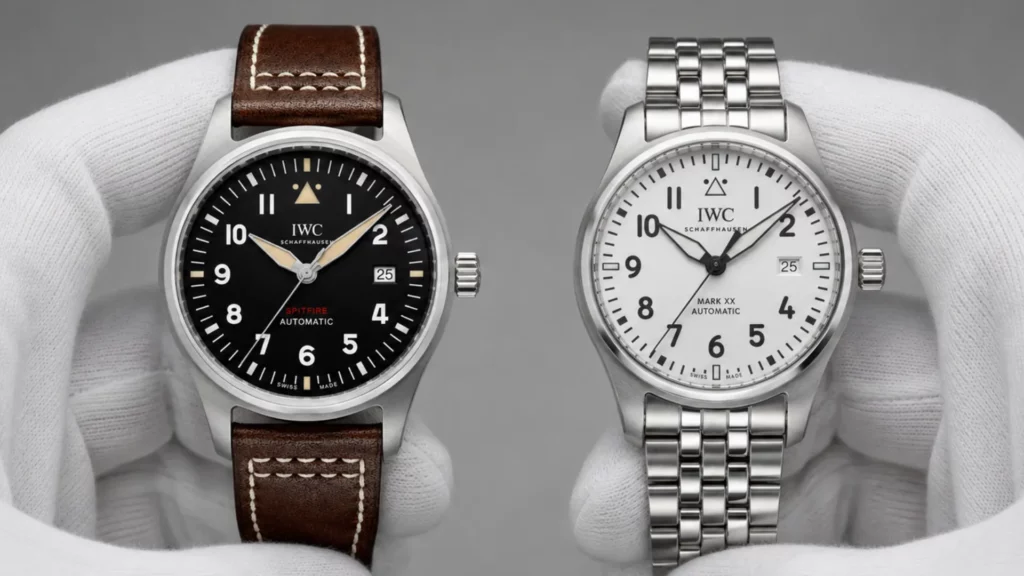
These six areas are where the Spitfire and Mark XX really differ in daily wear. Each one comes down to specs you can check, not personal taste.
1. Case Dimensions
On the Spitfire Automatic, you get a 39mm case, a lug-to-lug of about 49.6mm, 10.8mm thickness, and a 20mm lug width. Its thin-bezel, all-dial face reads larger than 39mm suggests, and the lugs reach far enough that smaller wrists can feel the overhang.
Mark XX buyers get a 40mm case, a 49.2mm lug-to-lug, and the same 10.8mm thickness and 20mm lug width. IWC reworked the lugs over the longer-wearing Mark XVIII, so it sits more contained, though it still wears long for 40mm. Both sit within half a millimeter lug-to-lug, so fit comes down to your wrist more than the spec sheet.
2. Water Resistance
Rated to 60 meters (6 bar), the Spitfire handles handwashing, rain, and accidental splashes. Most watchmakers advise against swimming with a 60-meter watch, so it works best as a dry-wear tool watch. That lower number fits its heritage, dry-wear purpose. It isn’t a sign of weak build.
At 100 meters (10 bar), the Mark XX is rated for swimming, light water sports, and everyday wear in any weather. Both watches use a screw-in crown and a pressure-secured sapphire crystal, so construction is similar. IWC just sealed the Mark XX tighter, which removes a real barrier for buyers who want one watch for everything.
3. Power Reserve
How long the Spitfire runs depends on the reference. Early ones (IW326801, IW326802, IW326803) use the 72-hour Caliber 32110, while later ones (IW326805, IW326806) use the 120-hour Caliber 32111. So confirm the caliber before buying a used Spitfire.
Every Mark XX uses the Caliber 32111 with 120 hours, with no variant-by-variant guessing. Both calibers are IWC-manufactured and run at 28,800 vph (4Hz) with 21 jewels. So a Cal. 32111 Spitfire and any Mark XX are mechanically identical in output, while a Cal. 32110 Spitfire gives you 48 fewer hours off the wrist.
4. Bracelet Access
Spitfire Automatics shipped on straps only, either Santoni calfskin leather with a deployant or pin buckle, or a green textile strap. No factory bracelet exists, and without IWC’s EasX-CHANGE quick-release system, swapping straps means using spring bar tools. Some owners fit Mark-series bracelets since both use 20mm lugs, but that isn’t official.
Mark XX buyers can choose IWC’s 5-link H-link steel bracelet with micro-adjust in the clasp and the EasX-CHANGE system on the end-links. Every variant, including strap models, has EasX-CHANGE built in, so swaps between bracelet and leather take seconds. Choosing the bracelet adds roughly $900 at retail, and sourcing it separately later costs significantly more.
5. Case Materials
Bronze sets the Spitfire apart in this comparison. Its bronze variants (IW326802, IW326806) use an alloy that develops patina over time, shifting from warm gold toward a deeper, mottled brown-green, and each piece ages a little differently depending on skin chemistry and environment. Steel Spitfires use standard stainless steel with brushed and polished finishing.
Mark XX buyers get stainless steel and nothing else, with no bronze, titanium, or ceramic in the lineup. Its finishing is clean, with brushed surfaces and polished beveled edges on the case. If you want a watch that looks the same on day one as on day 1,000, that steel is predictable and low-maintenance.
6. Dial and Lume
Faux-patina Super-LumiNova defines the Spitfire’s hands and markers. Cream and tan tones mimic aged tritium lume from vintage military watches, the hands carry that same warm coloring, and the numerals are printed. Color choice stays narrow: black dial on steel, green dial on bronze. Overall it reads nostalgic, like a watch that has already seen some life.
Rhodium-plated hands and standard white Super-LumiNova give the Mark XX a crisper look, sharper contrast, and slightly faster legibility in dim light. IWC offers four dial colors here: black, sunray-brushed blue, green, and white/silver.
Price and Market Demand
Pricing splits the Spitfire and Mark XX into two very different markets. Now, under IWC’s past collections, the Spitfire has a fixed supply and stable prices, while the Mark XX still ships from boutiques.
On the secondary market, Cal. 32110 steel (IW326801, IW326803) trades around $3,000 to $3,800 for a full set, and the updated Cal. 32111 steel (IW326805) runs $3,500 to $4,600. Bronze (IW326802, IW326806) lands between $3,800 and $5,000 depending on patina. IW326801 is the most traded, so a clean one is easy to find.
Mark XX retails at $5,250 on leather and $6,150 on the steel bracelet. Pre-owned, strap versions run $4,000 to $4,800 and bracelet versions $4,500 to $5,500, roughly 25 to 30% below retail and typical for an in-production IWC pilot watch. Blue dials (IW328203) hold a slight premium over black.
On the Spitfire, caliber (32110 vs 32111) drives price most; on the Mark XX, bracelet versus strap does. Either way, a full set with box, papers, and active warranty resells best.
At Majestix Collection, we see the same split. Spitfire buyers get a lower entry price for the same core movement, while Mark XX buyers pay more but get more choice in dials, straps, and bracelets.
Notable IWC Spitfire References

Image courtesy of IWC Official Website
IW326801: [source]
IW326802: [source]
IW326803: [source]
This lineup is small, just a few references. Here are the ones worth knowing if you’re comparing against the Mark XX.
1. IWC Spitfire IW326801
A black dial and green textile strap made this the launch reference for the modern Spitfire in 2019. As noted earlier, it was the first IWC watch to carry a movement from the 32000 family.
Buyers who value that “first of its kind” status gravitate here. That textile strap reads sharp in casual settings, and because it’s the most commonly traded Spitfire, finding a clean one is straightforward.
- Case size: 39mm, 10.8mm thick
- Material: Stainless steel
- Movement: Caliber 32110 (72-hour power reserve)
- Water resistance: 60 meters
- Typical market range: $3,000 to $3,800
2. IWC Spitfire IW326802
A green dial and brown calfskin strap make this the most distinctive Spitfire to look at. Green-on-bronze is a rare color pairing for IWC, and as covered in the materials section, the bronze builds a patina unique to each owner.
Buyers who want a watch that changes over time land here. Its patina makes each piece look a little different, and because bronze is uncommon in IWC’s pilot line, it holds value well. If the bronze is the draw, it’s worth seeing the best bronze watches beyond IWC’s lineup.
- Case size: 39mm, 10.8mm thick
- Material: Bronze
- Movement: Caliber 32110 (72-hour power reserve)
- Water resistance: 60 meters
- Typical market range: $3,800 to $5,000
3. IWC Spitfire IW326803
Mechanically the same watch as the IW326801, this reference swaps the textile strap for brown Santoni calfskin leather and a deployant clasp. That leather gives the Spitfire a dressier personality suited to business-casual settings where textile might feel too relaxed.
It fits buyers who plan to wear their Spitfire in more polished environments. A deployant clasp also sits more securely than a pin buckle, which suits that dressier use.
- Case size: 39mm, 10.8mm thick
- Material: Stainless steel
- Movement: Caliber 32110 (72-hour power reserve)
- Water resistance: 60 meters
- Typical market range: $3,000 to $3,800
Notable IWC Mark XX References

Image courtesy of IWC Official Website
IW328201: [source]
IW328203: [source]
IW328208: [source]
This lineup is wider, with more dial and strap choices. Here are the three worth knowing if you’re comparing against the Spitfire.
1. IWC Mark XX IW328201
A black dial on a black leather strap makes this the baseline entry reference and the most popular configuration. White markers and rhodium-plated hands give it the highest contrast, most legible combination in the lineup.
It works as a no-overthinking purchase. Black pairs with everything, EasX-CHANGE lets you add a bracelet later, and you never have to baby it around water.
- Case size: 40mm, 10.8mm thick, 49.2mm lug-to-lug
- Material: Stainless steel
- Movement: Caliber 32111 (120-hour power reserve)
- Water resistance: 100 meters
- Typical market range: $4,000 to $4,800
2. IWC Mark XX IW328203
Sunray-brushed blue on a blue leather strap is the most popular pick after the standard black. In sunlight it brightens from deep navy to a steel blue, which photos rarely capture.
Blue examples tend to hold a slight secondary-market premium. They add personality while still reading as a clean tool watch, and they photograph well.
- Case size: 40mm, 10.8mm thick, 49.2mm lug-to-lug
- Material: Stainless steel
- Movement: Caliber 32111 (120-hour power reserve)
- Water resistance: 100 meters
- Typical market range: $4,100 to $4,900
3. IWC Mark XX IW328208
A white/silver dial on the 5-link bracelet sits at the top of the Mark XX range. On white, the black hands and markers read sharper and dressier than the standard black, and the bracelet’s micro-adjust clasp and EasX-CHANGE end-links would cost meaningfully more to add later.
This is the closest thing to a do-it-all Mark XX. Run the bracelet on weekdays, swap to leather on the weekend, and you effectively own two watches.
- Case size: 40mm, 10.8mm thick, 49.2mm lug-to-lug
- Material: Stainless steel
- Movement: Caliber 32111 (120-hour power reserve)
- Water resistance: 100 meters
- Retail price: $6,150
Which IWC Pilot’s Watch Should You Choose?
Both watches share the same movement family and pilot-watch heritage. Your choice comes down to how each one wears and what you need it to do. If you want the wider view first, our IWC buying guide maps out where the pilot line sits among the brand’s other families.
Choose the IWC Spitfire if:
- You want the smaller 39mm case and a more understated, vintage look.
- You love the warm, aged look of its faux-patina lume.
- You like a bronze case that builds its own patina over time.
- You only wear straps and never need a factory bracelet.
- You like that it’s discontinued, with a fixed supply and stable pricing.
- You want to own the reference that debuted IWC’s 32000 caliber family.
Choose the IWC Mark XX if:
- You want IWC’s H-link bracelet with micro-adjust and tool-free strap swaps.
- You need 100-meter water resistance for everyday wear and swimming.
- You like having four dial colors to choose from instead of one.
- You want current production backed by a full factory warranty.
- You prefer a clean, modern dial over the Spitfire’s vintage lume.
- You value the convenience of the EasX-CHANGE quick-swap system.
Where to Buy Authentic IWC Watches
Since the Spitfire is discontinued, the secondary market is your main route to one, while the Mark XX is still sold new and pre-owned. Big marketplaces like Chrono24, eBay, and Grailzee list plenty of both, though on those platforms you carry the work of vetting each seller and confirming the watch is genuine. If Chrono24 is where you’re looking, our guide to buying safely on Chrono24 covers the seller checks that matter.
Whatever the source, ask for a full set with box, papers, and the warranty card, then check that the serial and reference match the watch. On a used Spitfire, confirm the caliber (32110 vs 32111), since the dials look identical. Clear photos and an easy return policy go a long way. For the full pre-purchase checklist, here’s what to check before buying any watch.
If you’d rather skip the vetting, buying from a dealer that inspects and authenticates each piece takes that risk off your plate. There’s more than one route worth knowing, and our guide on where to buy a pre-owned watch runs through the trustworthy ones. That’s the part we handle at Majestix Collection, so you can focus on which watch is right for you.
Final Thoughts on IWC Spitfire vs Mark 20
IWC Spitfire vs Mark 20 isn’t really a spec decision. Both share the same movement family, a 10.8mm thickness, and the Mark 11 lineage, so identity is the real question. Spitfire buyers want something personal, tied to a specific chapter of aviation history. Mark XX buyers want one watch that handles everything, from the pool to the office.
If you go bronze, the patina isn’t permanent, since a gentle clean brings back the original tone whenever you want a reset. And whichever model you choose, ask for the original purchase date, because IWC’s extended 8-year warranty can still have years left on a recent pre-owned piece. It helps to know what a watch warranty actually covers before you lean on it.
Either way, you end up with a well-made IWC pilot’s watch. If you’ve settled on a discontinued Spitfire reference, we can help you track one down. Majestix Collection is here when you’re ready to move forward.