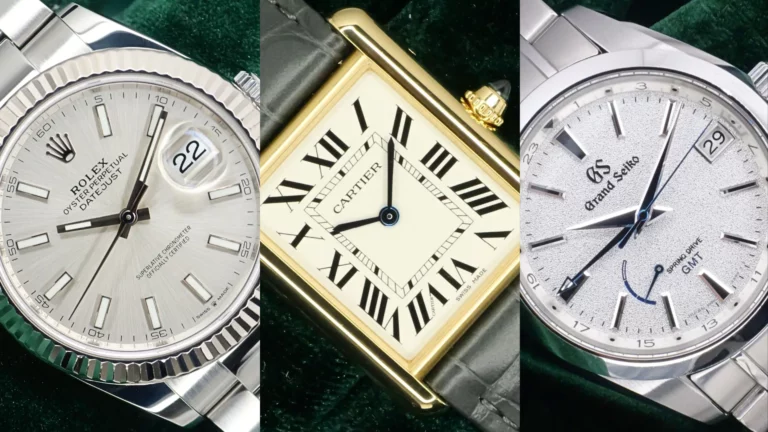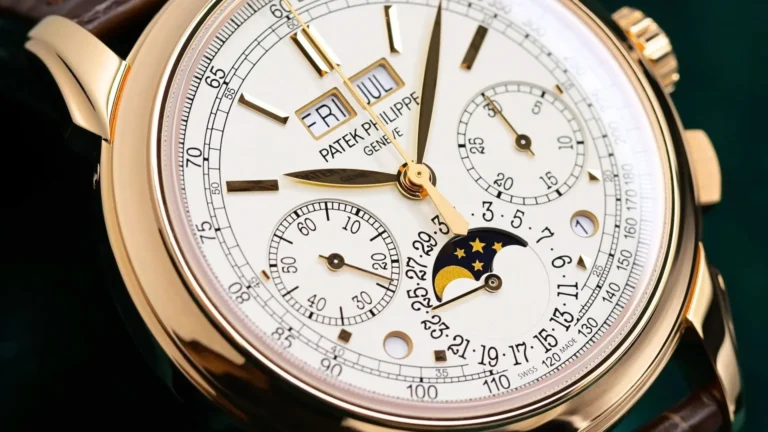
A watch’s parts tell you its history, and that history decides what a luxury watch is worth.
If you own a serious watch or plan to buy one, the names of its parts matter more than you might think. The parts of a watch show its originality and condition before you ever check the paperwork.
We inspect every watch that comes through Majestix part by part, from the bezel insert to the spring bars. A refinished dial or an over-polished case can change a price faster than almost anything else on the watch.
This guide walks through the case, dial, movement, and bracelet. You’ll learn what each part does and which ones matter most when a watch changes hands.
The 4 Main Parts of a Watch
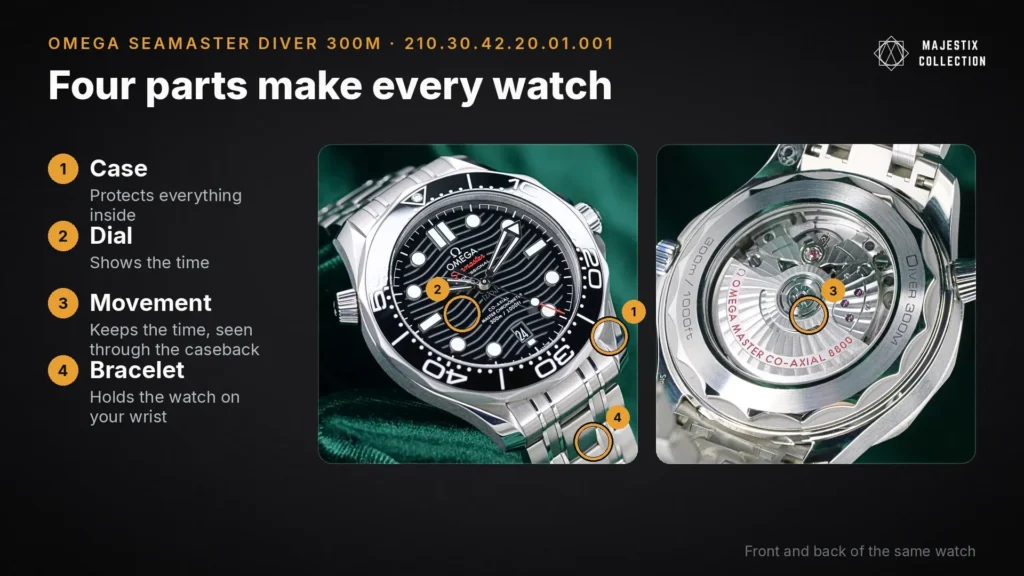
The four main parts of a watch are the case, the dial, the movement, and the bracelet or strap. The case protects everything inside. The dial shows the time, and the movement keeps it. The bracelet or strap holds the watch on your wrist.
Most people already know these parts by other names. The table below matches everyday words to the terms dealers and watchmakers use.
| What People Call It | Correct Term |
| Face | Dial |
| Glass | Crystal |
| Back | Caseback |
| Knob, winder, or the twisty thing | Crown |
| Ring around the glass | Bezel |
| Free loop | Keeper |
| Metal band | Bracelet |
| Leather, rubber, or fabric band | Strap |
7 Parts of a Watch Case and Exterior
The case and everything fixed to it form the outer shell of the watch. You touch these parts every day, and a buyer sees them first.
1. Case and Caseback
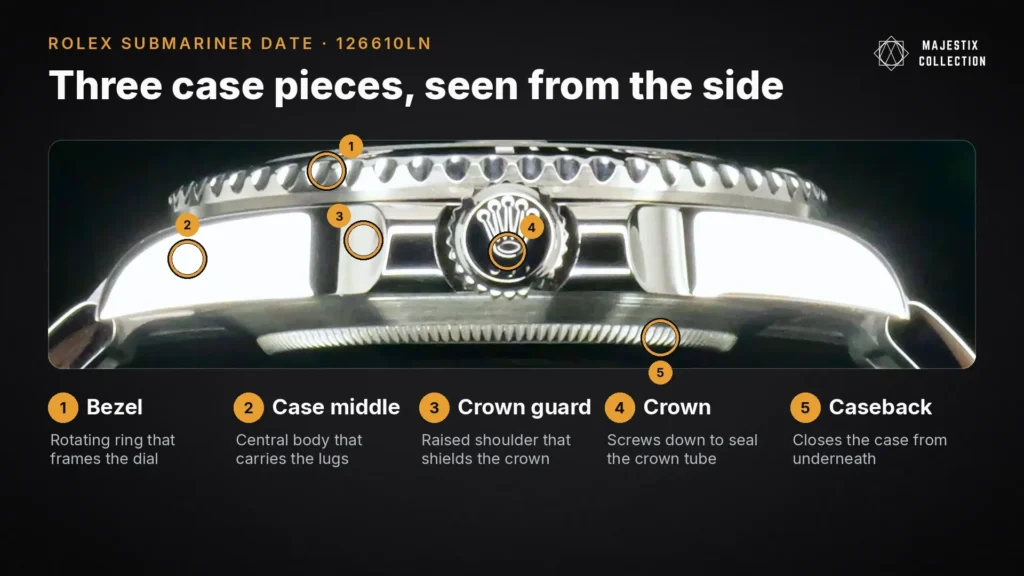
The case holds the dial and movement. Most luxury cases have three main pieces. The case middle is the central body that carries the lugs, the bezel sits on top, and the caseback closes the bottom.
A few designs are monobloc, meaning the middle and back are one piece and the movement loads through the front. Casebacks are either solid metal or exhibition backs with a sapphire window. Either type can screw down for better water resistance or press in. Press-in backs are more common on thin dress watches.
The case is also where polishing shows first. Each polish removes metal, softens sharp edges, and thins the lugs. That metal can’t be put back, so we check case lines closely on every pre-owned watch.
2. Bezel and Bezel Insert
The bezel is the ring around the crystal. It holds the crystal in place and frames the dial. On many sports watches, the bezel carries an insert, which is a separate ring printed or engraved with a scale. The insert can be replaced on its own.
Dive watches use a one-way rotating bezel. The ISO 6425 dive watch standard requires the timing bezel to be protected against accidental turning and marked at least every 5 minutes. Because the bezel only turns one way, a knock can only make a diver surface early, never late. If you’ve never used one, our guide to using a dive bezel walks through it step by step.
Rolex moved its inserts from aluminum to Cerachrom ceramic in 2005, starting with the GMT-Master II. On older watches, we check that the insert matches the reference and production year. A bright replacement insert is easy to spot next to an aged dial.
3. Crystal
The crystal protects the dial from dust and water. Luxury watches use synthetic sapphire, which rates 9 on the Mohs hardness scale. Mineral glass rates around 5 to 6, and acrylic is much softer.
Sapphire resists scratches from almost anything you touch during the day, though it can chip on a hard edge. Acrylic scratches easily, but the scratches polish out just as easily. Omega still fits a hesalite (acrylic) crystal to the version of the Speedmaster Moonwatch closest to the 1960s original.
Rolex also adds a cyclops lens, which is a small magnifier set over the date window.
4. Crown, Crown Tube, and Crown Guards
The crown is the small knob on the side of the case. It winds the movement and sets the time and date. A thin rod called the stem connects the crown to the movement through a crown tube fitted into the case.
Pulling the crown out to different positions switches between winding, setting the date, and setting the time. A set of small levers and wheels called the keyless works handles that switch. A screw-down crown threads onto the tube to seal it, which is why dive watches use one.
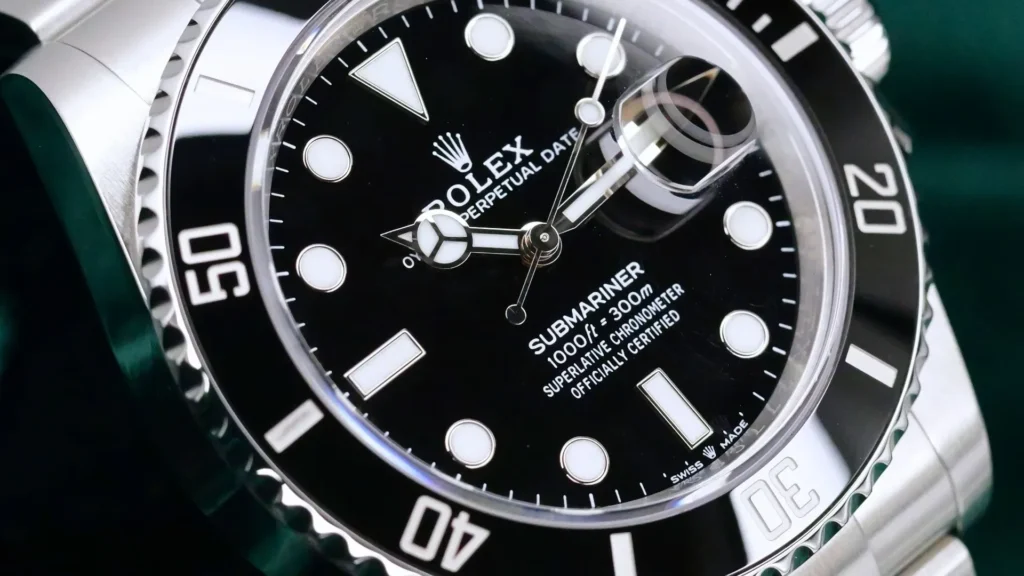
Many sports watches also have crown guards. These are raised shoulders on the case that protect the crown from knocks, as seen on the Rolex Submariner. Panerai’s Luminor goes further with a locking lever that covers the crown.
5. Pushers
Pushers are the buttons on the side of the case that run the functions the crown doesn’t handle. On a chronograph, the upper pusher starts and stops the timer, and the lower pusher resets it.
Calendar watches often use recessed correctors instead. These sit flush with the case, and you press them with a small stylus to adjust the date or moon phase.
6. Lugs
Lugs are the extensions at the top and bottom of the case where the strap or bracelet attaches. The distance between them is the lug width, which sets the strap size that fits. On men’s watches, the most common lug widths are 18, 20, and 22mm.
Integrated designs like the Audemars Piguet Royal Oak and Patek Philippe Nautilus run the bracelet straight out of the case instead of using standard lugs.
7. Gaskets and Helium Escape Valve
Gaskets are rubber or synthetic rings that seal the caseback, crown, and crystal against water. Gaskets harden with age, which is the most common reason an older watch loses its water resistance.
Professional dive watches like the Rolex Sea-Dweller and Omega Seamaster Diver 300M add a helium escape valve. It lets helium out of the case during decompression after saturation diving, so the built-up pressure doesn’t push the crystal off.
6 Parts of a Watch Dial and Hands
Everything you read the time from sits under the crystal. When we inspect a watch, the dial and hands get the closest look, because these are the parts collectors most expect to be original.
1. Dial
The dial is the plate under the crystal that displays the time. It’s usually a thin brass disc held to the movement by small pins called dial feet.
At the luxury level, the finish carries much of the design. Sunburst, lacquer, grand feu enamel, guilloché (engraved patterns cut by machine or by hand) all start from the same basic plate. Some dials go further and use a thin slice of stone or meteorite instead of a metal surface..
2. Rehaut and Chapter Ring
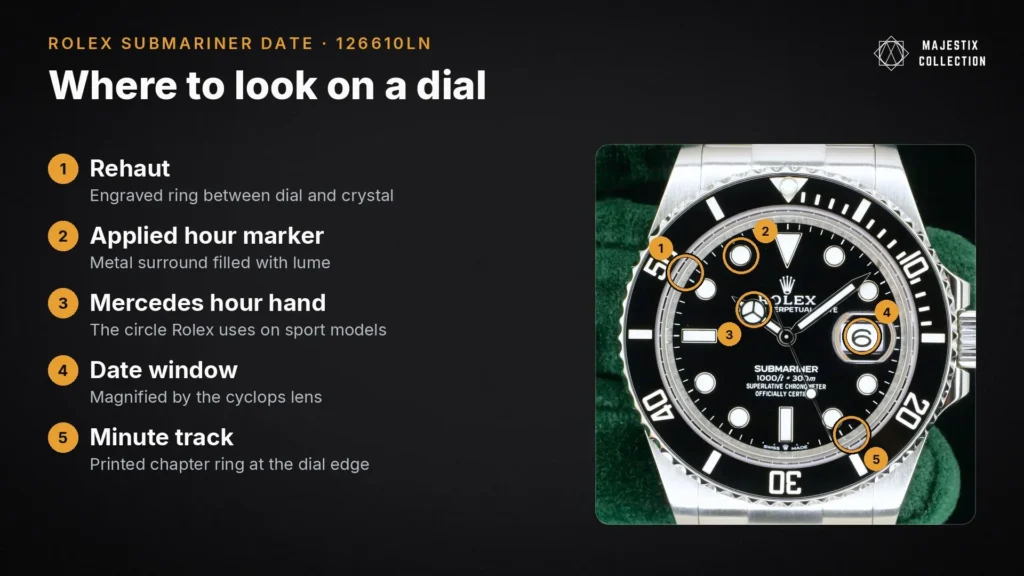
The rehaut is the angled inner ring between the edge of the dial and the crystal. Some people call it the flange. Rolex engraves its name around the rehaut on current models, with the serial number at 6 o’clock, as an anti-counterfeiting detail.
The chapter ring is the minute track around the outer edge of the dial. On some watches, it’s printed on the rehaut itself.
3. Hour Markers
Hour markers, also called indices, mark the hours instead of numerals or alongside them. Printed markers are ink on the dial. Applied markers are separate pieces of metal fixed to the dial with tiny feet, and luxury brands often make them from 18k gold.
Applied markers catch the light and add depth, which is why they’re standard at this level.
4. Hands
Most watches have an hour hand, a minute hand, and a central seconds hand. Together they’re called the handset. A GMT hand tracks a second time zone, and chronograph hands record elapsed time.
Collectors refer to hand shapes by name. Dauphine hands are faceted triangles. Mercedes hands have a circle with a three-pointed star inside, as seen on Rolex sport watch hour hands. Breguet hands are slim with a hollow moon near the tip, and sword hands taper to a point. The short tail on the seconds hand is the counterweight.
5. Subdials and Date Window
Subdials, also called registers or counters, are the small dials set into the main dial. They show running seconds or chronograph minutes and hours. A chronograph with two subdials is called bicompax, and one with three is called tricompax.
The date shows through a window, usually at 3 o’clock. It’s printed on a disc that turns under the dial.
6. Lume
Lume is the glow-in-the-dark material on the hands, markers, and sometimes the bezel. Most modern watches use Super-LumiNova or a brand’s own compound, like Rolex’s Chromalight. These materials charge in light and glow for hours afterward.
Vintage watches used tritium, which glows on its own but has a half-life of 12.3 years. Most tritium dials barely glow now. They’ve aged to a cream or brown tone that collectors call patina.
On a vintage watch, the hands and dial should show the same aged lume tone. Bright, fresh lume on the hands next to a creamy dial usually means the hands were replaced or relumed.
Parts of a Mechanical Watch Movement
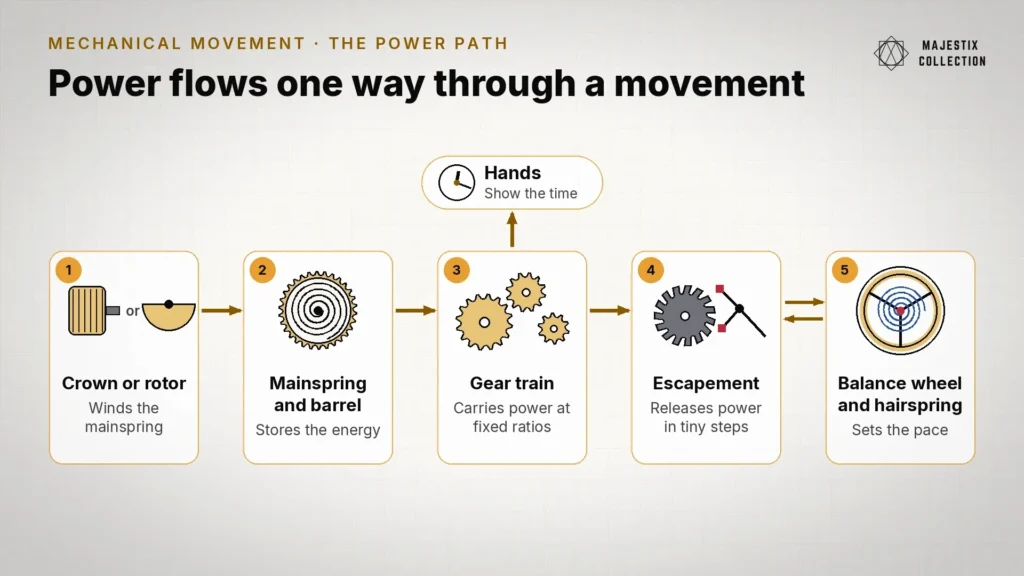
A watch movement, also called a caliber, is the engine that powers the watch and drives the hands. In a mechanical movement, energy flows one way, from the mainspring through the gear train to the escapement and balance wheel. The escapement and balance wheel release the energy in small, even steps.
1. Mainplate and Bridges
The mainplate is the base of the movement. It’s usually brass and drilled to hold every other part. Bridges are the plates screwed on top that hold the wheels in place from above.
Bridge finishing is where luxury calibers separate from standard ones. Look for Geneva stripes (parallel waves), perlage (overlapping circles), and anglage (polished bevels along each edge). On the finest movements, this finishing is done by hand.
2. Mainspring and Barrel
The mainspring is a long, thin coiled strip of metal that stores the watch’s energy. It sits inside a toothed drum called the barrel.
As the spring unwinds, the barrel turns and feeds power into the movement. The time a full wind lasts is called the power reserve.
3. Gear Train
The gear train, or wheel train, is the chain of wheels that carries power from the barrel to the escapement. Each wheel turns at a fixed ratio to the next one. That’s how a single spring drives the hour, minute, and seconds hands at their correct speeds.
4. Escapement
The escapement turns steady spring pressure into the tick. An escape wheel pushes against a small lever called the pallet fork. The pallet fork locks and releases the wheel in tiny steps and gives the balance wheel a push on each swing.
Omega’s Co-Axial escapement is the best-known alternative design. English watchmaker George Daniels invented it to reduce friction where the escape wheel meets the pallet fork, and Omega brought it into series production in 1999.
5. Balance Wheel and Hairspring
The balance wheel swings back and forth at a fixed rate, and that rate decides how accurate the watch is. A fine coiled spring called the hairspring, or balance spring, controls each swing.
Many modern luxury calibers beat at 4 Hz, or 28,800 vibrations per hour. Brands also make their own versions of both parts. Patek Philippe, for example, pairs its Gyromax balance with a Spiromax hairspring.
Most calibers protect the balance with a shock absorber, because its pivots are the most fragile in the movement. Incabloc is the most common system, and Rolex uses its own Paraflex.
6. Jewels
Jewels are synthetic rubies set at the movement’s pivot points to reduce friction and wear. They’re lab-grown and add no value as gemstones.
A higher jewel count usually means a more complex movement, but jewel count tells you nothing about finishing or quality.
7. Rotor
The rotor is the half-moon weight that spins as your wrist moves, winding the mainspring on an automatic watch. Manual-wind watches don’t have one.
Luxury calibers often use solid gold rotors, because the extra weight winds the mainspring more efficiently. Many very thin watches use a micro-rotor, which is a smaller weight set into the movement to save height.
Movement Part Counts by Complication
Every complication adds parts to a movement. Patek Philippe publishes the part and jewel counts for each of its calibers, so the jump is easy to see.
| Caliber | Function | Parts | Jewels |
| Patek Philippe 26-330 S C | Time and date | 207 to 215 | 30 |
| Patek Philippe 26-330 S C J SE | Weekly calendar | 304 | 50 |
| Patek Philippe CH 28-520 C/522 | Flyback chronograph with date | 327 | 35 |
| Patek Philippe 26-330 S QA LU 24H | Annual calendar with moon phase | 339 | 34 |
At the extreme, Patek’s Calibre 89 packs 33 complications into 1,728 parts (Source).
5 Parts of a Watch Band and Bracelet
A metal band is called a bracelet, and a leather, rubber, or fabric band is called a strap. Both attach at the lugs, and each has its own named parts.
1. End Links
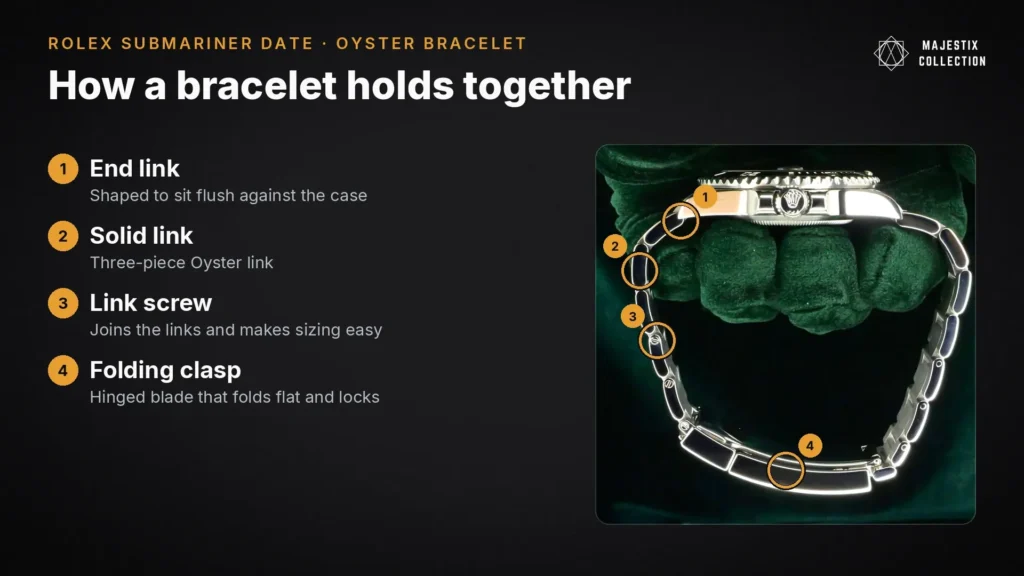
End links are the first links on each side of a bracelet. They’re shaped to sit flush against the case between the lugs. Solid end links are machined from one piece of metal. Hollow end links, common on older bracelets, are folded from sheet metal and can rattle.
Each end link is cut to fit one case shape, so a bracelet from one reference rarely fits another cleanly. A gap or a mismatched end link is one of the quickest signs that a bracelet didn’t originally come with the watch.
2. Links and Link Pins
Bracelet links are either solid or folded from sheet metal. Solid links are standard on luxury bracelets, and they feel heavier and tighter on the wrist.
Links join with screws or friction pins. Screws are the norm at this level because they make sizing easier. Rolex’s three-piece flat-link Oyster and five-piece Jubilee are two of the best-known bracelet designs. If you’re choosing between the two, our Jubilee vs Oyster comparison goes deeper.
3. Clasp
The clasp closes the bracelet around your wrist. Most luxury bracelets use a folding clasp, also called a deployant. It’s a hinged blade that folds flat and locks, often under a safety catch.
Better clasps let you adjust the fit without tools. Micro-adjust holes on the sides of the clasp shift the fit by a few millimeters. Rolex’s Glidelock slides out in small steps, so the bracelet can fit over a wetsuit. Our Glidelock vs Easylink breakdown covers how Rolex’s two systems differ.
4. Spring Bars
Spring bars are the spring-loaded pins between the lugs that hold a strap or end link in place. They compress to slide in, then spring out into the lug holes to lock.
Spring bars are small and cheap, but a worn one can drop a watch off your wrist. Replace them whenever you change the strap.
5. Strap, Buckle, and Keeper
Straps come in leather, rubber, fabric, or a mix of materials. They fasten with a tang buckle, which is a classic pin through a hole, or with a folding clasp like a bracelet’s. The loose end tucks under the keeper.
Alligator leather is the traditional choice for dress watches. Rubber and fabric straps suit sports and dive watches, where sweat and water would wear out leather quickly.
Which Watch Parts Affect Resale Value Most
The dial, hands, bezel insert, and case affect resale value the most, because collectors expect them to be original. Other parts get replaced during normal service, and some are expected to show wear.
We sort the parts of a watch into three grades when we inspect one. Value-critical parts should be original. Service-normal parts are routinely replaced, and wear-expected parts are judged on condition.
| Part | Grade | Replaced at Service? | What We Check |
| Dial | Value-critical | Rarely on modern pieces | Even printing, original lume, no refinishing |
| Hands | Value-critical | Sometimes | Lume that matches the dial in color and age |
| Bezel insert | Value-critical | Sometimes | Correct type for the reference and year |
| Case | Value-critical | No, but often polished | Sharp edges and chamfers, full lug shape |
| Crown | Service-normal | Often | Correct signed crown for the reference |
| Crystal | Service-normal | If damaged | Correct type, cyclops aligned over the date |
| Gaskets | Service-normal | At every full service | Water resistance tested after service |
| Mainspring | Service-normal | Often | Power reserve runs to spec |
| Bracelet and end links | Wear-expected | Rarely | Stretch between links, end links that fit the case |
| Clasp | Wear-expected | Rarely | Blade scratches, a catch that closes firmly |
A brand service that fits a correct new crown or crystal is routine and doesn’t hurt value. What hurts value is a value-critical part that has been swapped or refinished without disclosure.
Frequently Asked Questions About the Parts of a Watch
Why is the crown on the right side of a watch?
The crown sits on the right because most people wear a watch on the left wrist and wind it with the right hand. That placement lets you set the time without taking the watch off. Left-handed models move the crown to the left side, and Panerai’s Luminor Destro is the best-known example.
Is a service dial bad on a vintage watch?
A service dial lowers a vintage watch’s value compared to an original dial, but it isn’t automatically a bad buy. On vintage Rolex and Omega pieces, the original dial and its aged tritium carry much of the price. Buyers price a brand-issued service dial as a replacement, not as part of the watch’s history.
If you want a vintage watch to wear every day without paying for originality, a service dial can be a fair way in. If you’re buying as a collector, we’d wait for an original.
Should I keep the old parts after a watch service?
We’d keep them. A service can replace the crown, hands, or bezel insert, and those originals can matter when you sell, especially on vintage pieces. A bag of original parts with the service paperwork shows the next buyer exactly what changed.
Not every service center returns replaced parts, so ask before you hand the watch over. Plenty of owners skip this step on modern watches, and that’s a reasonable choice too.
Do quartz watches have the same parts?
Quartz watches have the same exterior parts, but the movement inside works differently. A quartz movement has no mainspring, escapement, or balance wheel. Instead, it uses a battery, a tiny quartz crystal that vibrates 32,768 times per second, and a circuit that drives a small stepping motor.
Where to Buy a Luxury Watch With Original Parts
Most of what decides a pre-owned watch’s value sits in parts you can’t judge from a listing photo. Polishing, relumed hands, and replaced inserts rarely show up clearly on a screen. That’s why where you buy matters as much as which reference you buy.
Every watch we sell is inspected in person before it’s listed, and the condition notes state which parts are original and which have been serviced. We also film a tour video of the actual watch, so you can see the dial, case lines, and bracelet before you commit.
If you have a reference or a shortlist in mind, send it to us. We’ll tell you what we have and walk you through the dial, hands, bezel insert, and case on each one. You’ll talk directly with someone who has handled the watch, and there’s no pressure to buy.
Final Thoughts on the Parts of a Watch
The parts of a watch come down to four groups: the case, the dial, the movement, and the bracelet or strap. Knowing their names helps you talk about a watch. Knowing which parts carry value (mainly the dial, hands, bezel insert, and case) helps you buy one.
Before you buy, check the bracelet reference stamped inside the clasp or on the end links, and confirm it belongs with the watch’s reference. After you buy, photograph the caseback, clasp, and movement so you have a record of every original part before any future service.
999+ Timepieces Available
Explore Our Timepieces
Authenticated, unworn, and ready to ship worldwide.
Rolex · Audemars Piguet · Patek Philippe · Omega · Cartier · Richard Mille · Hublot · Tudor
Newly Listed
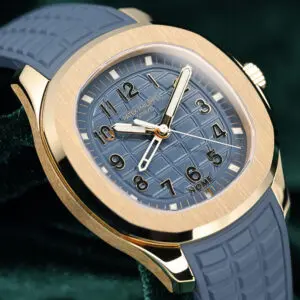
2026 NEW UNWORN Patek Philippe Aquanaut Travel Time Blue-Grey Dial Blue-Grey Composite Strap 18K Rose Gold 38.8mm COMPLETE SET 5269R-001
$85,250.00
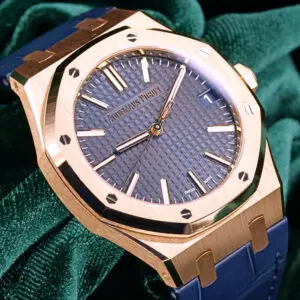
2026 NEW UNWORN Audemars Piguet Royal Oak Selfwinding Blue Grande Tapisserie Dial Blue Alligator Strap 18K Rose Gold 41mm COMPLETE SET 15510OR.OO.D315CR.02
$87,759.00
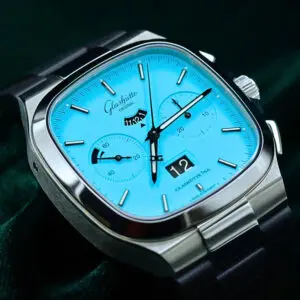
Glashütte Original Seventies Chronograph Panorama Date “Disco Blue” Black Rubber Strap Stainless Steel 40mm MINT CONDITION COMPLETE SET 1-37-02-10-02-63
$19,493.00
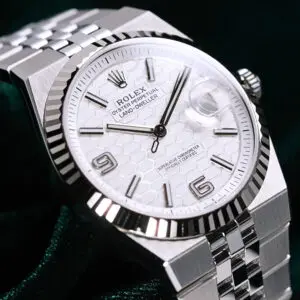
2026 Rolex Land-Dweller White Honeycomb Motif Dial 18K White Gold Fluted Bezel Flat Jubilee Bracelet Stainless Steel 40mm MINT CONDITION COMPLETE SET 127334-0001
$26,035.00
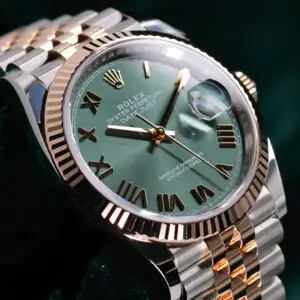
2026 NEW UNWORN Rolex Datejust Green Roman Dial 18K Rose Gold Fluted Bezel Two Tone Jubilee 36mm COMPLETE SET 126231-0051
$21,230.00
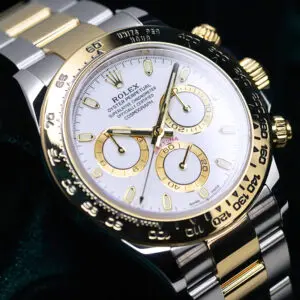
2022 Rolex Cosmograph Daytona White Dial Two-Tone 18K Yellow Gold Stainless Steel 40mm MINT CONDITION COMPLETE SET 116503-0001
$26,245.00
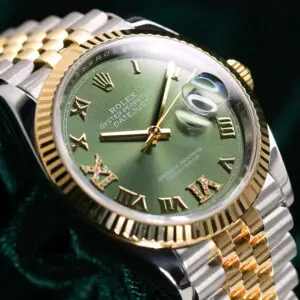
Rolex Datejust Olive Green Roman Diamond VI & IX Dial Fluted Bezel Jubilee Bracelet Yellow Gold & Stainless Steel 36mm MINT CONDITION COMPLETE SET 126233
$20,695.00
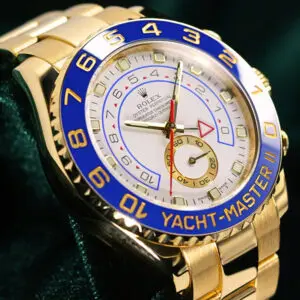
Rolex Yacht-Master II White Dial Blue Ceramic Bezel Oyster Bracelet 18K Yellow Gold 44mm MINT CONDITION COMPLETE SET 116688
$41,990.00
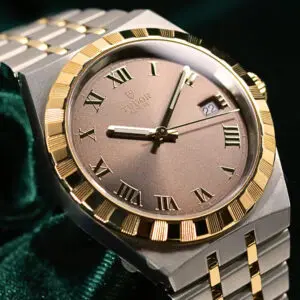
2026 NEW UNWORN Tudor Royal Chocolate Roman Dial Two-Tone Yellow Gold Steel 38mm COMPLETE SET 28503-0007
$4,503.00
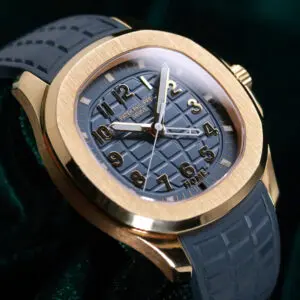
Patek Philippe Aquanaut Travel Time Opaline Blue-Gray Dial Blue-Gray Composite Strap 18K Rose Gold 38.8mm MINT CONDITION COMPLETE SET 5269R-001
$103,950.00
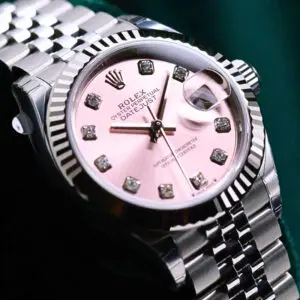
2026 NEW UNWORN Rolex Lady-Datejust Pink Dial Diamond Markers 18k White Gold Fluted Bezel Jubilee Stainless Steel 28mm COMPLETE SET 279174
$19,768.00
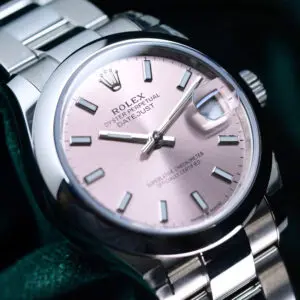
2026 NEW UNWORN Rolex Datejust 31 Pink Dial Oyster Bracelet Stainless Steel 31mm COMPLETE SET 278240
$13,046.00