
Spotting a fake Rolex can feel overwhelming, especially with how convincing super-clone replicas have become. Many watches look right at first glance but fall apart once you check their build, movement behavior, or engraving details. This guide breaks down exactly how to spot a fake Rolex using clear visual and functional checks anyone can learn.
You’ll see what real features look like, what red flags to watch for, and how to confirm authenticity without specialist tools. If you want to feel confident before buying or evaluating a Rolex, keep reading. This walkthrough will help you protect your money and avoid counterfeits.
How to Spot a Fake Rolex (Step-by-Step Visual and Functional Checks)
A fake Rolex becomes much easier to spot when you know exactly which areas counterfeiters struggle to replicate. This section shows you the most reliable visual and functional checks so you can evaluate any watch with confidence.
1. Examine Overall Build Quality
Start with the general feel of the watch. A genuine Rolex has crisp case lines, even brushing, and polished surfaces with no soft edges. The weight should feel dense because Rolex uses 904L Oystersteel, solid links, and quality components. A fake often feels lighter, has uneven finishing, or shows sloppy transitions between brushed and polished areas.
If the shape looks slightly off — such as lugs that are too curved or a case that feels bulky — that’s usually a sign of poor machining rather than true Rolex craftsmanship.
2. Inspect the Dial and Hands
Dials reveal many fakes quickly. Rolex printing is sharply defined, with clean edges and perfect spacing under magnification. Hour markers sit evenly, and lume is neatly applied without overflow. The Rolex coronet logo at 12 o’clock should be symmetrical with precise detailing.
On many fakes, applied markers tilt, spacing looks irregular, or the coronet appears thick or uneven. Hands on authentic models — like Mercedes hands on a Submariner or baton hands on a Datejust — move smoothly and have consistent finishing without discoloration or rough edges.
3. Check Crystal and Rehaut Details
Modern Rolex models include a tiny laser-etched crown at the 6 o’clock position on the sapphire crystal. It’s subtle and difficult to see unless light hits at an angle. On counterfeit pieces, the crown may appear oversized, cloudy, or too easy to spot. The rehaut (the inner engraved ring) should show perfectly aligned ROLEX engravings, matching the 12 o’clock coronet.
Misaligned, shallow, or repeating engravings signal a replica. Even spacing and mirror-like sharpness are reliable indicators of authenticity.
4. Evaluate the Date Window and Cyclops Magnification
The date window on genuine Rolex watches is cut cleanly with sharp edges. The cyclops lens should deliver true 2.5x magnification, making the date fill most of the window. Many replicas fail here. Their magnification is weak, or the date font looks thin, misaligned, or low-quality.
On models like the Submariner Date or Datejust 41, the date should snap crisply at midnight. If the date appears small or sits off-center, it’s worth questioning the watch.
5. Assess Bezel Quality and Rotation (Submariner/GMT Models)
Rolex bezels are known for precise action. A Submariner’s 120-click unidirectional bezel should rotate with firm, smooth, well-defined clicks. A GMT-Master II’s 24-hour bezel rotates bidirectionally with a solid, refined feel. Inserts should match the model — Cerachrom ceramic for modern versions and aluminum for older references.
Fakes may feel loose, gritty, or too stiff when turning. Colors on ceramic inserts should be rich and consistent, not faded or blotchy.
6. Review Bracelet and Clasp Construction
Rolex bracelets are a major giveaway. Solid end links fit tightly with no gaps. Modern Oyster and Jubilee bracelets use solid links and precise tolerances. The clasp should close firmly with a quality click, and features like the Glidelock (Submariner) or Easylink (Datejust, Oyster Perpetual) should function smoothly.
Counterfeit bracelets often rattle, have hollow-sounding center links, or feel overly light. Misaligned end links and poor clasp engraving are also common issues.
7. Test Crown Operation and Movement Behavior
A real Rolex crown screws down smoothly thanks to its Twinlock or Triplock system. Unscrewing should feel controlled, without grinding or resistance. When adjusting the hands, movement should feel stable and refined. If the crown wobbles, slips, or feels gritty, that’s a problem.
The seconds hand on an authentic mechanical Rolex sweeps consistently, not in noticeable jumps. Large stutters or ticking motions suggest a non-Rolex movement.
8. Verify Serial Number and Reference Number Against Official Specs
Rolex engraves serial and reference numbers with extreme precision. The font is sharp, evenly cut, and located in the correct position depending on the era — between the lugs on older models or on the rehaut for newer ones. Many fakes use generic or repeated numbers, and their engraving often looks shallow or sloppy.
Cross-checking numbers against known production years and specifications helps catch mismatches. If the numbers don’t align with the case style or model era, the watch may not be real.

Key Physical Details Real Rolex Watches Should Have
Every authentic Rolex carries physical traits that stay consistent across models and generations. This section highlights those core details so you can quickly notice mismatches that fakes often reveal.
Case and Crown Construction (Twinlock vs. Triplock by Model)
Rolex uses two main crown systems, and the right one depends on the model. Twinlock crowns are found on everyday models like the Datejust, Oyster Perpetual, and Explorer. Triplock crowns, identified by three dots under the Rolex coronet, are used on professional dive and sport models such as the Submariner, Sea-Dweller, and many GMT-Master II watches.
When you screw the crown in or out, it should feel smooth and secure — no wobbling, grinding, or resistance. If the dot pattern, crown feel, or overall design doesn’t match what the specific model is supposed to have, it can be a sign that the watch isn’t authentic.
Correct Bezel Type and Insert Material
The bezel style and material must match the reference and its production era. Modern Submariner, GMT-Master II, Yacht-Master, and Daytona models use Cerachrom ceramic inserts, while older versions rely on aluminum with different fonts and color tones.
Bezel function is also specific, such as unidirectional rotation for the Submariner and bidirectional 24-hour movement for the GMT-Master II. Each should rotate with crisp, precise clicks that feel refined. If the material, color, numerals, or rotation don’t match what is documented for the reference, that’s a strong indication the bezel isn’t genuine.
Bracelet Type and End Link Construction
Every Rolex reference pairs with a designated bracelet type, such as the Oyster, Jubilee, or President. Modern bracelets use solid links and solid end links, while many vintage models include hollow link structures that feel lighter.
An authentic bracelet should feel dense and balanced on the wrist, with minimal rattling or looseness. End links must sit tightly against the case without gaps, uneven angles, or overhang. If the construction style, overall feel, or end link fit doesn’t match the expected generation of the watch, authenticity becomes questionable.
Engravings, Hallmarks, and Inside-Clasp Codes
Rolex engravings are sharp, consistent, and deeply cut, never shallow or uneven. Inside the clasp, you should see clear reference codes, logos, and manufacturing marks that match known Rolex formatting.
Lettering should have precise edges and uniform spacing that reflects high-quality metalwork. Precious metal models also include hallmarks that must appear in the correct locations with proper shaping. If engraving looks sloppy, inconsistent, or misaligned with the bracelet’s production era, it often indicates a counterfeit or mismatched component.
Solid Caseback vs. Display Back When Exceptions Apply
Authentic Rolex watches almost always feature a solid caseback with clean brushing or polishing and no decorative artwork. Transparent display backs are extremely rare and mostly limited to certain vintage Cellini pieces or specially modified exhibition watches.
A modern Rolex with a sapphire or mineral glass display back is usually a fake or has been modified inappropriately. Casebacks should also avoid logos, large engravings, or ornate designs not used by Rolex. When you see a clear or overly decorative caseback, treat it as a significant red flag and investigate further.
Movement and Functional Clues That Reveal a Fake Rolex
A counterfeit Rolex almost always exposes itself through its movement behavior and functional quirks. Here, you’ll see how real Rolex calibers act compared to the shortcuts found in replica movements.
Seconds-Hand Sweep vs. Stuttering or Quartz Tick
A genuine Rolex mechanical movement produces a smooth, continuous sweep powered by calibers like the 3135, 3235, and 3285. While not perfectly “gliding,” the motion is consistent and refined with no large jumps.
Fakes often use cheaper mechanical or quartz movements that create noticeable stuttering or a clear tick. Even super-clone movements can’t match the precise rhythm and stability of authentic Rolex calibers. If the hand hesitates or jerks, it’s usually a giveaway.
True Quickset Date vs. Incorrect Date-Change Behavior
Models with quickset functions should let you adjust the date independently with a clean, instantaneous jump. A real Rolex also snaps the date at midnight, not gradually over several hours.
Counterfeit movements often show slow, drifting date changes or misaligned date wheels. Some replicas claim to have quickset but still change the date incorrectly or inconsistently. When the date doesn’t behave the way the reference should, the movement deserves scrutiny.
GMT and Chronograph Functions Operating as Designed
Rolex complications follow strict mechanical behavior. On a GMT-Master II, the 24-hour hand must adjust independently in one-hour increments while the bezel changes the second timezone.
On a Daytona, chronograph seconds, minutes, and hours must run smoothly and reset precisely to zero. Replicas frequently include nonworking subdials, incorrect hand functions, or sloppy chronograph resets. Any unusual behavior in complications is a strong authenticity red flag.
Winding Feel, Rotor Sound, and Power Reserve Consistency
Winding a real Rolex feels smooth, controlled, and free of grinding because of its precise crown and movement architecture. The rotor inside the case should be nearly silent, with only a faint, muted sound when it spins. Many fakes use rough winding mechanisms or loud rotors that wobble or rattle.
Power reserve on a genuine Rolex remains consistent with the model’s expected runtime. When a watch winds roughly, runs short, or has an unusually noisy rotor, it likely doesn’t house a real Rolex caliber.
Difference of Cheap Clone Movements Against Rolex Caliber Families
Low-cost clone movements, like Miyota or Seagull, tend to expose themselves through loud ticking, visibly uneven seconds-hand movement, and lower quality hand stacks. They often place hands at incorrect heights or use crown positions that don’t match Rolex layouts.
These movements also struggle with accuracy, torque, and long-term reliability when compared to Rolex 31xx or 32xx calibers. Even super-clone movements can’t replicate the exact feel, architecture, or durability of the originals. If the movement’s behavior or structure seems off, it’s likely not authentic.
Model-Specific Red Flags on a Fake Rolex
Different Rolex models have their own signature traits, and counterfeiters often get these wrong. This section breaks down the most common red flags for each popular reference so you know exactly what to look for:
- Rolex Submariner – Counterfeit Submariners often get the bezel, dial text, and lume wrong. The bezel should rotate with confident, crisp clicks, not feel mushy or loose. Many fakes use weak cyclops magnification, making the date appear too small. Lume plots on replicas are frequently uneven or poorly centered. If the dial text lacks sharpness or the ceramic bezel color looks dull, the watch likely isn’t genuine.
- Rolex Datejust and Datejust 41 – Datejust replicas usually struggle with dial finishing and marker alignment. The Roman numerals, fluted bezel proportions, and Jubilee bracelet quality are common problem areas. Cyclops magnification often falls short of 2.5x, and the date wheel font may appear thin or misaligned.
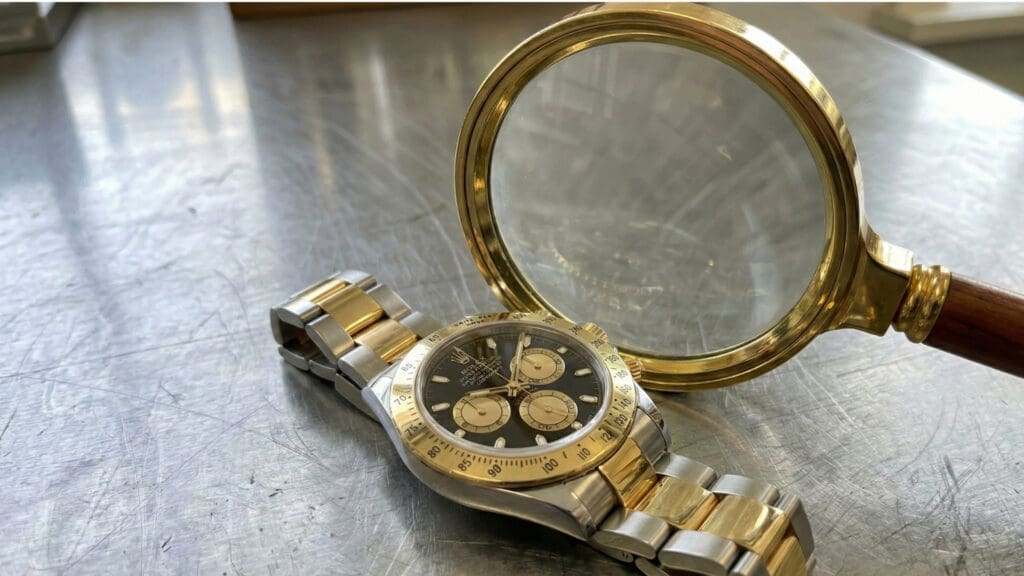
- Rolex Daytona (Zenith vs. In-House) – Daytona replicas frequently show incorrect subdial spacing, especially when mimicking the in-house 4130 movement. Subdials often sit too far apart or too high on the dial due to movement limitations in replicas. Chronograph pushers may feel loose or inconsistent, and the tachymeter font on the bezel often appears too thick.
- Rolex GMT-Master II – GMT-Master II replicas often struggle with the bezel colors and 24-hour function. Two-tone Cerachrom inserts like the “Pepsi” or “Batman” frequently look off in shade or transition. Many fakes don’t allow independent adjustment of the 24-hour hand, which is a defining feature of the real movement. The bezel should rotate bidirectionally with firm clicks, not loosely.
- Rolex Day-Date and President Bracelet – Counterfeit Day-Date models usually reveal themselves through bracelet quality and dial details. The President bracelet should feel solid and fluid, not hollow or tinny. Many fakes use incorrect day-wheel fonts or misaligned windows at 12 o’clock. Gold-tone replicas often have plating that appears too yellow or uneven.
How to Use Serial Numbers, Papers, and Service History
A Rolex’s paperwork and serial details should always match the watch’s story. The information below explains how numbers, cards, and service records confirm the authenticity of your Rolex.
1. Checking Serial and Reference Against Known Production Ranges
Serial and reference numbers must align with documented Rolex production periods. Older models feature serials between the lugs, while modern references place them on the rehaut. Each number should be sharply engraved, with consistent depth and font. If the serial falls outside the expected range for the reference, that’s a clear warning sign.
A mismatch between production year and model configuration often indicates swapped parts or a counterfeit case.
2. Matching Papers, Box, and Tags to the Actual Watch
Authentic Rolex sets follow strict formatting, including warranty cards, booklets, and model-specific tags. The reference number on the card must match the watch exactly, including dial variant and bracelet type. Modern warranty cards show specific layouts and holographic elements that fakes rarely replicate flawlessly.
Boxes and accessories should also align with the production era. When paperwork looks generic or mismatched, the watch deserves deeper scrutiny.
3. Interpreting Service Cards, Caseback Marks, and Polishing History
Service records help confirm the watch’s maintenance trail and authenticity. Rolex Service Center cards include clear dealer information, dates, and specific service details. Caseback or bracelet marks may indicate past polishing or repairs, which should match the watch’s age and wear.
Too many unexplained marks or inconsistent service entries can signal issues. A watch with no service history at all for many years may also warrant caution.
4. Using Reputable Dealers and Independent Verification Services
Buying through established dealers helps reduce risk because they authenticate watches using tools and experience most buyers don’t have. Many shops also use third-party verification, such as independent watchmakers or platforms like WatchCSA. These experts check movement internals, pressure tests, and component originality.
When a seller refuses authentication or discourages professional inspection, consider it a serious red flag. Verification protects both your investment and peace of mind.
When to Walk Away from a Suspicious Rolex
Some deals come with warning signs you should never ignore. This section helps you recognize the moments when stepping away saves you from wasting money or getting caught in a bad situation.
- Price Too Good to Be True for the Reference – A suspiciously low price is one of the strongest signals something’s wrong. Rolex values remain stable, especially for popular models like the Submariner, Daytona, and GMT-Master II. When the price drops far below market averages, the watch is often fake, stolen, or heavily modified.
- Seller Avoids Detailed Photos or In-Person Inspection – Legitimate sellers are willing to provide high-quality photos, videos, and opportunities for physical inspection. A seller who sends blurry photos, refuses macro shots, or avoids meeting in person is hiding something. Lack of transparency almost always points to a problem.
- Inconsistent Story, Missing Papers, or Unverifiable Provenance – A real seller should have a clear explanation of how they acquired the watch. Vague stories, missing paperwork, and unverifiable past ownership are major red flags. While some older watches may legitimately lack papers, the seller should still offer a believable history.
- Watch Fails Multiple Basic Visual or Functional Checks – Even high-quality replicas show multiple small errors across the dial, case, bracelet, and movement behavior. If you notice repeated inconsistencies — weak cyclops magnification, sloppy engravings, misaligned markers, or poor crown operation — those details add up quickly.
Final Thoughts on How to Spot a Fake Rolex
Spotting a fake Rolex can feel intimidating, but you’re in a much stronger position now. When you trust your eyes, pay attention to the small things, and check the watch’s story as carefully as its parts, you protect yourself from getting burned. And remember, you never need to rush into a purchase.
Take your time, ask for better photos, bring a friend who knows watches, or step away if something doesn’t sit right with you. The right Rolex will hold up under every check you make; you deserve the confidence that comes with buying the real thing.
FAQs About How to Spot a Fake Rolex
What is the quickest way to spot a fake Rolex at a glance?
The fastest check is dial quality. Look for sharp printing, consistent markers, and proper coronet shape. Fakes often show uneven text, sloppy lume, or misaligned details. A quick bezel and crown check can also confirm whether the watch matches its reference.
Are super-clone Rolex replicas easy to detect?
Super-clones can look convincing, but they still miss key elements like perfect rehaut alignment, true 2.5x magnification, correct crown operation, and proper movement behavior. Under closer inspection, these small inaccuracies stack up quickly. A trained eye can usually identify them with a few targeted checks.
Can I confirm a Rolex is real without opening the caseback?
Yes. You can rely on serial alignment, dial accuracy, bezel action, crown feel, and date-change behavior. These factors reveal most fakes without exposing the movement. If doubts remain, a professional watchmaker can verify authenticity with pressure testing and external diagnostics.
Should I buy a pre-owned Rolex without papers if it passes my checks?
It’s possible, but you should be cautious. A watch without papers needs stronger visual, functional, and serial verification. Buying through reputable dealers or requesting independent authentication helps reduce risk. If the price seems low or the history feels unclear, it’s safer to walk away.