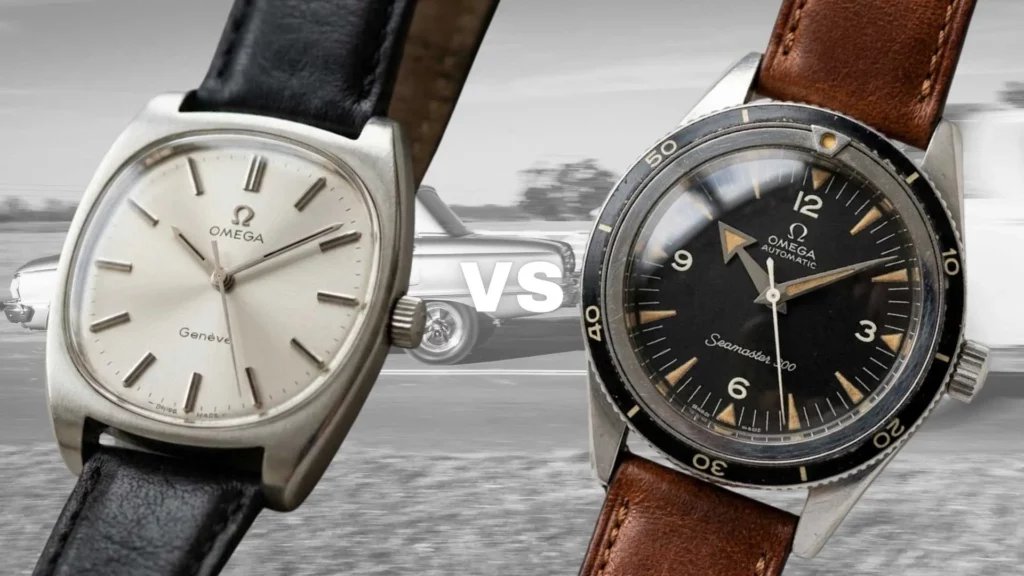
If you are researching the Omega Geneve vs Seamaster, you have probably noticed they are priced differently, carry different reputations, and yet often share the exact same movement. That gap confuses a lot of first-time vintage buyers.
This article cuts through it. You will get the background of each line, a detailed look at where they genuinely differ, key references worth knowing, and a clear guide to help you choose.
Omega Geneve Background
The Omega Genève name first appeared on dials around 1952–1953 as a tribute to Omega’s 30 mm calibers that won precision trials at the Geneva Observatory. At the time, the Genève sat near the top of Omega’s lineup, just below the Constellation.
Early models reflected that position. Cases often featured chamfered lugs, gold applied indices, and clean dress-watch proportions. In its early years, the Genève was positioned as a refined Omega dress watch rather than a budget model.
The direction changed after 1967. As the Seamaster and Speedmaster gained popularity, Omega repositioned the Genève as a higher volume and more affordable line. Cases became simpler, dial finishing more restrained, and overall pricing more accessible.
The collection was eventually discontinued in 1979. One factor behind the name’s disappearance was Swiss trademark law, which required a brand to maintain a presence in Geneva, while Omega had closed its Geneva factory years earlier.
For collectors today, the Genève remains appealing because many models use the same in-house Omega calibers found in Seamaster watches but come in simpler cases at lower prices.
Within the lineup, the Genève Dynamic stands out as the most design-forward variant, thanks to its distinctive oval case and bold 1970s styling.
Notable references of the Omega Geneve:
- Ref. 135.041 (Cal. 601, manual wind, tonneau case)
- Ref. 166.041 (Cal. 565, automatic)
- Ref. 166.0117 (Cal. 1022, automatic, day-date)
- Ref. 166.0168 (Cal. 1012, automatic)
- Ref. 135.033 Dynamic (Cal. 601, oval case)
- Ref. 137.0001 Chronometer (Cal. 602, rare)
Omega Seamaster Background
The Omega Seamaster launched in 1948 during Omega’s centenary year and was inspired by waterproof watches supplied to the British military in World War II. A key innovation was the use of an O-ring gasket system, which provided reliable water resistance from the beginning.
This engineering approach made the Seamaster different from many dress watches of the era. The design focused on durability and everyday reliability while still maintaining a refined appearance.
A major milestone arrived in 1957 with the Seamaster 300, a purpose-built professional dive watch. It introduced a rotating bezel and around 200 meters of water resistance, establishing the Seamaster as a true tool watch for underwater use.
Over time, the collection expanded beyond dive watches. Omega introduced dress-oriented models, sport chronographs, and professional diving references, allowing the Seamaster line to cover a wide range of uses.
Unlike the Genève line, the Seamaster has remained in continuous production since its launch. Vintage models from the 1950s through the 1970s are especially collectible today.
Among them, 1960s Seamaster 300 references are considered some of the most desirable vintage Omega dive watches on the market. These pieces combine strong tool-watch history with classic mid-century design.
Notable references of the Omega Seamaster:
- Ref. CK 2913 / CK 14755 (first-gen Seamaster 300, Cal. 501/552)
- Ref. ST 165.024 (Seamaster 300, sword hands, Cal. 552/565)
- Ref. 165.024 (Seamaster 300, Cal. 565)
- Ref. 166.077 (Seamaster 600 Ploprof)
- Ref. 145.012 (Seamaster Bullhead chronograph)
- Ref. CK 2576 (early dress Seamaster, Cal. 342)
Omega Geneve vs Seamaster: Most Notable Differences
The movement overlap makes this comparison tricky. Both lines share the same Omega calibers, but the case engineering, finishing, and intended use are genuinely different.
Here is where the two collections actually separate.
1. Water Resistance

The Seamaster was built around an O-ring gasket system from launch in 1948. Early dress references were tested to 60 meters of water resistance. The Seamaster 300 pushed that to 200–300 meters using a screw-down caseback and the Naiad crown seal.
Omega later extended this engineering further with the Seamaster Ploprof, which reached 600 meters. Water resistance was not a marketing claim. It was the engineering foundation of the entire line.
The Geneve carried “waterproof” labeling on some references, but it lacked a dedicated sealing system. No screw-down crown, no dive bezel, and no specialized case architecture were used.
On vintage examples of either line, gaskets should always be assumed degraded unless recently serviced. The difference is that the Seamaster was engineered to be sealed. The Geneve was not.
2. Case and Bezel Design

Seamaster cases from the 1960s show more detailed finishing. Lugs feature chamfered edges with polished and brushed contrasts, and applied markers add depth to the dial. Geneve cases after 1967 tend to use a fully brushed finish with simpler lug shaping. Decorative elements are reduced and surface contrast is minimal.
Early Geneve references from before 1967 are the exception. Those models often include chamfered lugs and gold applied indices, bringing them closer to Seamaster finishing quality.The bezel design also reflects the different purposes of each line. Seamaster dive references such as the Seamaster 300 use a rotating bezel for measuring elapsed time underwater. Vintage inserts are aluminum or plastic with a luminous triangle at 12.
The Geneve uses a fixed bezel across all references. It serves a purely aesthetic role and was never designed for dive timing.
3. Movement

Both lines draw from the same Omega caliber families. Movements such as Cal. 552, 565, 1010, 1012, and 1022 appear across Geneve, Seamaster, De Ville, and Constellation references produced in the same years.
A Cal. 565 inside a Geneve ref. 166.041 is mechanically identical to the movement inside a Seamaster from the same era. There is no difference in mechanical quality between them. The distinction lies in how the movements were housed. Seamaster dive references placed them in tool-watch cases designed for water sealing.
Some Geneve references used manual-wind movements such as Cal. 601 and Cal. 613, which offer around 48 hours of power reserve. These calibers are simple, durable, and highly respected by independent watchmakers.
4. Dial and Case Design Range
The Geneve line absorbed many of Omega’s experimental designs. Models such as the Dynamic with its oval case and the Chronostop with its single pusher were introduced under the Geneve name.
Dial finishes also varied widely. Electric blue, matte black, and mosaic textures appeared across different references. Omega used the Geneve line to explore shapes and dial treatments that the Seamaster never adopted.
The Seamaster followed a more disciplined design language. Dress references focused on clean legibility, while dive models emphasized contrast and lume coverage.
That consistency is part of why the Seamaster ages well and reads as a serious watch even to someone unfamiliar with the specific references.
5. Production Status

The Seamaster remains in production today. Omega actively markets modern references, which keeps the name visible and relevant in the watch market.
Vintage Seamasters benefit from that ongoing brand recognition. Buyers who are not deep collectors often recognize the name immediately. The Geneve was discontinued in 1979 and has never been revived. It exists only in the secondary market.
Without a modern counterpart keeping the name visible, the Geneve relies entirely on vintage collector interest. This affects resale visibility and how quickly casual buyers recognize the watch.
Price and Market Demand

These two lines cost different amounts. And the gap reflects real differences in collector demand, heritage, and name recognition.
Omega Geneve: Discontinued Value
The Geneve is one of the most accessible entry points in the vintage Omega market. Late-era references (post-1967) with Cal. 565 or Cal. 1022 typically trade in the $250 to $800 range. Early-era references (pre-1967) with better finishing and gold applied indices push to $700 to $1,500+ in clean condition. Rare dial colors (electric blue, matte black) and the Dynamic oval case can exceed that ceiling, but remain low relative to the Seamaster.
What moves the price? Original dial is the single biggest factor. A confirmed non-repaints dial adds a meaningful premium. Unpolished case matters. The Geneve dynamic and Chronostop references carry premiums over standard references. Rare dial finishes can push values 30 to 50 percent above standard examples.
Demand moves more slowly. The Geneve sells to a specific buyer. It moves on Chrono24, OmegaForums, and specialist vintage dealers, but it takes longer to sell than a Seamaster of equivalent condition.
Omega Seamaster: Multi-Tier Market
Vintage Seamaster dress Watches from the 1950s and 1960s trade between $500 and $2,000, depending on their reference, dial condition, and caseback originality. That range overlaps with the Geneve at the entry level.
Vintage Omega Seamaster prices vary widely depending on the reference and condition. Many vintage dress Seamasters trade at the lower end of the market. For example, a model like the Seamaster Ref. 165.001 has an estimated market range of roughly $290 to $1,306, depending on condition and originality (source).
More collectible dive references command significantly higher prices. The Seamaster 300 Ref. 165.024, one of the most recognized vintage dive models, has a current estimated market value of around $6,000, with listings commonly appearing in the $5,000 to $7,000+ range depending on condition and configuration (source).
Condition and originality strongly affect value. On Seamaster 300 models, the bezel and correct hand style are closely checked, and incorrect parts can lower the price. Original box and papers are rare but can add a premium.
Market demand is generally strong. The Seamaster name attracts a broad group of buyers, so well-preserved Seamaster 300 examples often sell faster than comparable vintage Genève models.
Notable Omega Geneve References

These are the five references most relevant to the Omega Geneve vs Seamaster comparison.
1. Ref. 135.041
The 135.041 is the most commonly encountered late-era Geneve. It appeared in 1968 and sums up what the line was about: a clean tonneau case, sunburst dial, and a manual-wind Cal. 601 at a price point almost anyone can justify. It suits a first-time vintage buyer who wants a genuine Omega on the wrist without a significant financial commitment.
- Case size: 35mm
- Material: Stainless steel
- Movement: Cal. 601, manual wind, ~48-hour power reserve
- Crystal: Acrylic hesalite
- Price range: $250 to $600
2. Ref. 166.041
The 166.041 is the automatic version of the standard late Geneve. The Cal. 565 gives it the convenience of no daily winding. The case and dial are plain, brushed, and minimal. It sits close to the wrist, disappears under a shirt cuff, and does not call attention to itself. That restraint is exactly what some buyers want.
- Case size: ~35mm
- Material: Stainless steel
- Movement: Cal. 565, automatic
- Crystal: Acrylic hesalite
- Price range: $350 to $800
3. Ref. 135.033 Dynamic
The Dynamic is the Geneve you buy when you want something that does not look like every other 1960s Swiss watch. The oval case was bold when it launched in 1969 and it still reads as a design object today. The Cal. 601 inside is the same movement as the 135.041, but the case makes it a completely different conversation. Collectors who care about unusual vintage case shapes come back to this one regularly.
- Case size: ~38mm lug-to-lug, oval profile
- Material: Stainless steel
- Movement: Cal. 601, manual wind
- Crystal: Acrylic hesalite
- Price range: $500 to $1,200
4. Ref. 166.0117
This reference comes from the Geneve International Collection of the early-to-mid 1970s and runs the Cal. 1022 with a day-date complication and quick-set function. The day and date are set at 12 and 6 o’clock respectively, a layout that looks unusual compared to standard date-at-three configurations. It suits the buyer who wants a practical complication in a slim, unfussy package.
- Case size: 34mm
- Material: Stainless steel
- Movement: Cal. 1022, automatic, day-date
- Crystal: Acrylic hesalite with Omega logo
- Price range: $400 to $900
5. Ref. 166.041 Gold-Plated Variant
Some Geneve references came in gold-plated cases stamped “Plaque Or G 40 Microns” on the inner caseback. This adds visual warmth without the weight or price of solid gold. Plating shows wear at the lugs over time, so condition is more critical here than on steel. A clean example with intact plating at the lug edges is a genuinely attractive vintage watch.
- Case size: ~35mm
- Material: Gold-plated (40 micron) over stainless steel
- Movement: Cal. 565, automatic
- Crystal: Acrylic hesalite
- Price range: $300 to $750
Notable Omega Seamaster References

1. Ref. ST 165.024 (Sword Hands)
The asymmetrical case and sword-shaped handset are what define this reference. The case notch protects the crown. The hands taper from a broad base to a fine point. The Cal. 552 or Cal. 565 sits behind a screw-down caseback stamped “Certified High Pressure Waterproof Seamaster.” This is the most collected vintage Seamaster 300, and the most scrutinized for originality.
The bezel is the most common problem on the secondary market. Incorrect bezels appear frequently in this reference and reduce value considerably. Correct hands (sword, not broad-arrow) are reference-specific.
- Case size: ~39mm
- Material: Stainless steel
- Movement: Cal. 552 or Cal. 565, automatic
- Water resistance: 300m rated
- Price range: $4,000 to $12,000+
2. Ref. CK 2576 (Early Dress Seamaster)
The pie-pan dial slopes at the edges, catching light in a way flat dials do not. This is a 1950s dress Seamaster, closer to a refined Swiss dress piece than a tool watch. The 34mm stainless steel case keeps the lugs from overhanging on a smaller wrist. Applied triangular indices and a silver-plated dial give it a cleanliness that holds up across decades.
The Cal. 342 is a manual-wind movement from the era when Omega’s 30mm calibers were setting observatory precision records. Not complicated. Not oversized. Just a very good watch.
- Case size: 34mm
- Material: Stainless steel
- Movement: Cal. 342, manual wind
- Crystal: Acrylic hesalite
- Price range: $500 to $1,800
3. Ref. CK 2913 / CK 14755 (First-Gen Seamaster 300)
The broad-arrow handset and symmetrical case indicate this is the original Seamaster 300 configuration, before Omega shifted to the asymmetrical design. The thick, angular broad-arrow hands were built for legibility at depth. The Cal. 501 or early Cal. 552 runs inside, behind an early screw-down caseback.
First-generation examples in fully original condition are increasingly hard to find. Lume originality (intact tritium plots that have patinated naturally rather than been replaced) is the most examined factor at this price level.
- Case size: ~38-39mm
- Material: Stainless steel
- Movement: Cal. 501 or Cal. 552, automatic
- Water resistance: 200m (tested to 300m)
- Price range: $5,000 to $15,000+
4. Ref. 165.020 / 166.020 (Seamaster De Ville)
The caseback carries the Seamaster seahorse, but the dial and case are dressed for the city. The Seamaster De Ville occupied a specific transitional moment: it shared the Seamaster engineering foundation while presenting in a thinner, more formal profile. Cal. 552 or Cal. 565 inside, a gently sloped dial, and a case designed to sit flat under a cuff.
The dual-branded “Seamaster De Ville” examples are documented transitional references, produced before the De Ville was spun off as its own line in 1967. A clean example in steel or gold-plated case is one of the more affordable ways to own a genuine 1960s Seamaster.
- Case size: ~34mm
- Material: Stainless steel or gold-plated
- Movement: Cal. 552 or Cal. 565, automatic
- Crystal: Acrylic hesalite
- Price range: $700 to $2,000
5. Ref. 166.077 (Seamaster 600 Ploprof)
The 600-meter depth rating and locking bezel system are what set the Ploprof apart from everything else in the Omega lineup. The case measures 54 x 45mm, the crown is hidden under a hinged guard at 10 o’clock, and a dedicated button rotates the bezel. This was not a fashion piece. It was built for saturation divers on professional underwater assignments.
It does not suit daily wear in any conventional sense. It suits a collector who wants a genuine tool watch with real engineering credentials and a design that reads as nothing else. The Ploprof has cult status for a specific reason: Omega built exactly this watch and then stopped.
- Case size: 54 x 45mm
- Material: Stainless steel
- Movement: Cal. 1002 (varies by year), automatic
- Water resistance: 600m
- Price range: $7,000 to $12,000+
Which Omega Should You Choose?
Choosing between the Omega Genève and Seamaster comes down to how you plan to use the watch and what matters more to you day to day. One leans simple and vintage, the other offers more capability and broader appeal.
Choose the Omega Geneve if:
- You want a genuine Omega with in-house movements at the lowest possible entry price
- A slim, low-profile dress watch that sits flat under a shirt cuff suits your daily wear
- The Dynamic’s oval case or unusual dial colors (electric blue, matte black) appeal to you more than a conventional round watch
- You understand that the Cal. 565 is the same regardless of what the dial says, and value the movement over the name
- Resale speed is not a priority for you
- You are a first-time vintage buyer and want to learn the market without a large financial commitment
Choose the Omega Seamaster if:
- Even moderate water resistance matters to you, or you want a watch built to handle it
- Case finishing and lug detail are things you notice and care about when you hold a watch
- The Seamaster 300 with a rotating bezel and high-visibility dial suits your taste
- You plan to resell at some point and want a name with stronger market liquidity
- The institutional heritage (military history, dive records, Olympic timing) is part of why you want the watch
- You want a watch that communicates immediately to almost any observer without explanation
Final Thoughts on Omega Geneve vs Seamaster
The Omega Geneve vs Seamaster decision usually comes down to what you want your money to buy. If your priority is stronger case engineering, better-known heritage, and easier resale, the Seamaster is the safer pick. The name carries real weight, and the line was built with a clearer purpose, especially once water resistance and tool-watch credibility became central to its identity.
The Geneve makes sense for a different kind of buyer. It gives you access to many of the same respected Omega calibers without asking you to pay for the Seamaster name on the dial. If you care more about movement quality, vintage charm, and value per dollar, the Geneve can be the smarter and more satisfying choice.In practical terms, the Seamaster usually suits the buyer who wants broader recognition and a stronger all-around ownership profile. The Geneve suits the buyer who enjoys finding substance where the wider market is not looking first. Neither is the “better” watch in every situation. The better watch is the one that fits how you wear, collect, and think about vintage Omega.