
Two chronographs, two completely different reasons to exist. One went to the Moon, the other earned its keep in the cockpit and still looks right in the boardroom an hour later.
Picking between the Omega Speedmaster and the Breitling Chronomat trips up a lot of buyers, and for good reason. Both are serious watches with real history, yet they solve different problems on the wrist.
This guide walks through what sets them apart in 2026: the specs, the prices, a recent Chronomat redesign that changes the math, and who each one is really for.
Omega Speedmaster Overview


Omega launched the Speedmaster in 1957 as a motorsport chronograph. Its tachymeter scale sits on the bezel rather than an inner ring, so a driver could read average speed at a glance.
NASA qualification in 1965 rewrote the story. Astronauts wore the Speedmaster on the lunar surface in 1969, and the Moonwatch nickname has stuck ever since.
What keeps collectors loyal is how little has changed. Hand-winding, a three-register dial, that asymmetric case. You wind it every morning, and that small ritual is part of why people buy one.
Current Moonwatches run the Caliber 3861, a Co-Axial Master Chronometer certified by METAS for 0 to +5 seconds a day and resistance to 15,000 gauss. You pick hesalite or sapphire crystal depending on how vintage you want it to feel. For how it fits among the brand’s other models, we map out the full Omega catalog separately.
Breitling Chronomat Overview


Breitling’s Chronomat name dates to the 1940s and combines “chronograph” and “automatic.” Early versions carried a slide-rule bezel that let pilots and engineers run quick calculations on fuel burn or speed.
Its modern life began in 1984, when Breitling relaunched the Chronomat for the brand’s centenary alongside the Frecce Tricolori, Italy’s air force aerobatic team. That partnership gave the watch its signature rider tabs and unmistakable profile.
Today’s Chronomat runs the in-house Breitling Caliber 01, a COSC-certified automatic chronograph with a 70-hour power reserve. Steel, two-tone, and full-gold versions all exist, on either the Rouleaux bracelet or a rubber strap. For how it sits beside the brand’s other lines, we cover the full Breitling catalog separately.
What Changed for the Chronomat in 2026
In May 2026, Breitling relaunched the entire Chronomat line with 22 new references and a noticeably slimmer, more integrated design. If you compared these two watches a year ago, the Chronomat side of the equation has shifted.
Biggest change is the case. Breitling cut the B01 42 from 15.1mm down to 13.77mm thick. On the wrist that reads as a different watch: easier to slide under a cuff and far less top-heavy than the old version.
Its bracelet is now fully integrated into the case, with a micro-adjust system hidden in the folding clasp. Breitling also simplified the bezel into a single piece, shrank the crown guards, and dropped the 1/100 scale from the rehaut for cleaner legibility.
Two new sizes joined the range: a 40mm time-only Automatic B31 with a 78-hour reserve at just 10.99mm thick, plus a compact Automatic 36. New retail runs from $5,950 for a steel 36mm up to $49,900 for the gold B01 42.
Omega Speedmaster vs Breitling Chronomat: Key Differences

Omega Speedmaster vs Breitling Chronomat: Key Differences
Strip away the heritage stories and these two split on a handful of practical points. Here is where it matters once you are choosing with your own money.
| Spec | Omega Speedmaster Moonwatch | Breitling Chronomat B01 42 |
| Case size | 42mm | 42mm |
| Thickness | ~13.2mm | 13.77mm (2026), was 15.1mm |
| Movement | Caliber 3861, manual wind | Caliber 01, automatic |
| Power reserve | ~50 hours | 70 hours |
| Water resistance | 50m | 200m |
| Crystal | Hesalite or sapphire | Sapphire |
| Bracelet | Tapering steel or strap | Integrated Rouleaux or rubber |
| Pre-owned (2026) | ~$6,000–$7,000 current | ~$5,000–$8,500 |
Heritage and Intended Purpose
Speedmaster’s story is space. NASA testing, the Moon landing, decades on astronaut wrists. Buying one means buying into that history more than any single feature.
Chronomat’s story is aviation and all-day toughness. Built for cockpit use, then refined into a go-anywhere sports chronograph. Its appeal is utility wrapped in bold styling rather than one famous mission.
Case Size and Daily Wearability
Both sit at 42mm, so diameter is a wash. Thickness used to be where they split hard. Older Chronomats wore tall near 15.1mm, while the Moonwatch has always stayed relatively flat around 13.2mm.
After the 2026 update, that gap basically closes. A 13.77mm Chronomat now wears close to the Speedmaster, which removes one of the old reasons buyers reached for the Omega purely on comfort.
Related Models from Majestix

Breitling Chronomat 44 Blacksteel Black Dial Red Accents Black Rubber Strap Black DLC Stainless Steel 44mm MINT CONDITION COMPLETE SET MB0111C3/BE35

Breitling Super Chronomat B01 44 Blue Dial Blue Ceramic Bezel Blue Rubber Strap MINT CONDITION COMPLETE SET AB0136
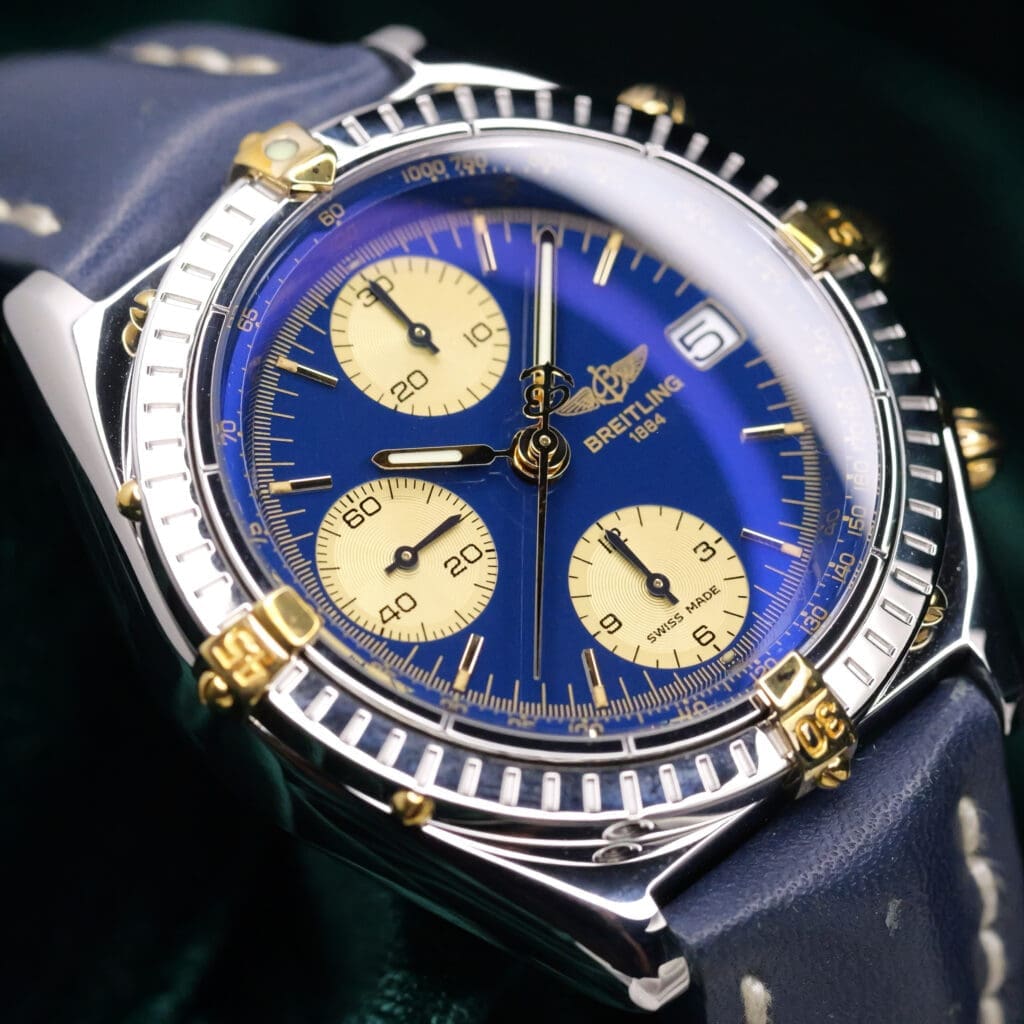
Breitling Chronomat Blue Dial Champagne Subdials Blue Leather Strap Two-Tone 18k Yellow Gold Stainless Steel 39mm MINT CONDITION B13050
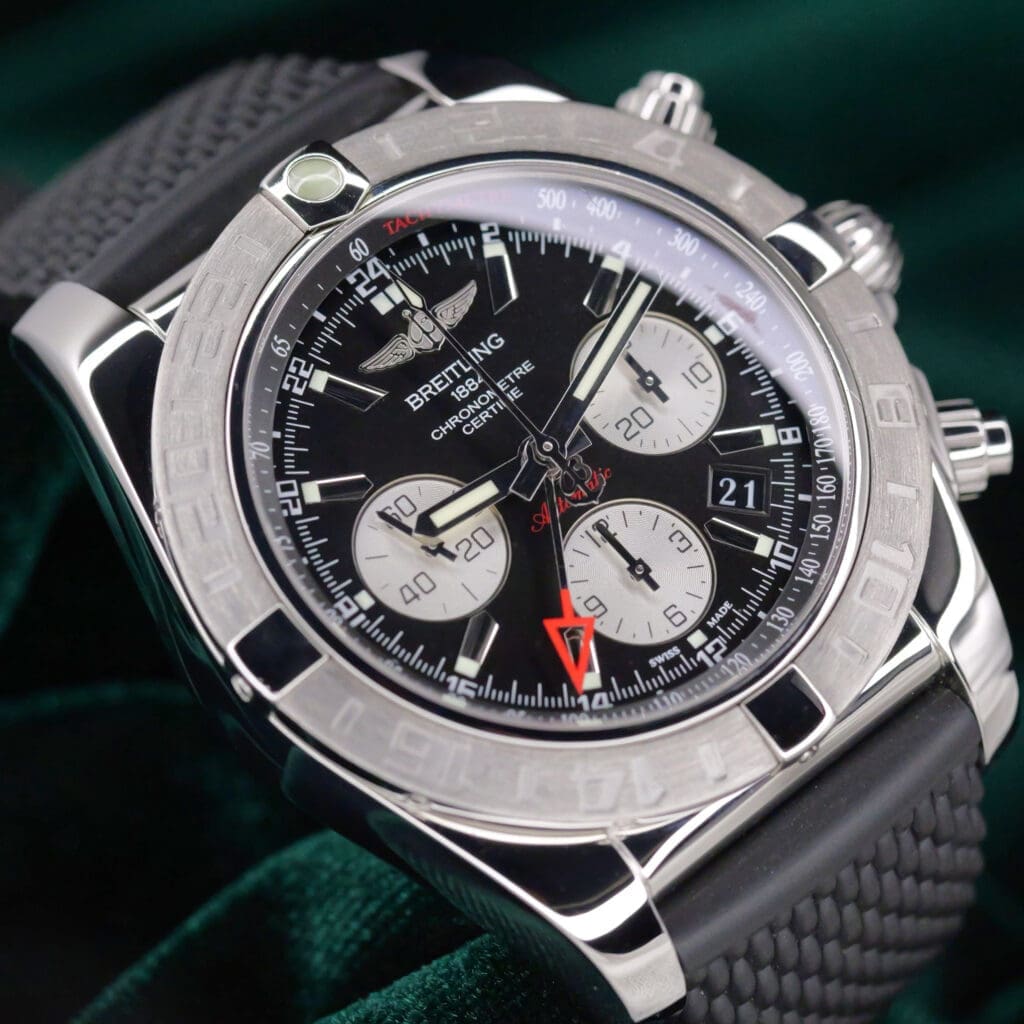
Breitling Chronomat 44 GMT Stainless Steel Black Dial Black Rubber Strap 44mm MINT CONDITION AB0420

Breitling Chronomat B01 42 Green Dial Two-Tone Stainless Steel 18K Rose Gold Green Rubber Strap 42mm MINT CONDITION COMPLETE SET UB0134131L1S1

Breitling Chronomat 42 Blue Dial Two-Tone 18K Rose Gold Stainless Steel MINT CONDITION COMPLETE SET UB0134
Movement: Manual Wind vs Automatic
This is the cleanest dividing line. Speedmaster makes you wind it by hand every day or two. Some people love the ritual. Others find it a chore.
Chronomat winds itself off your wrist and holds 70 hours of reserve against the Speedmaster’s roughly 50. If you rotate watches or hate resetting the time, the automatic wins on convenience. If you want the closest thing to the watch NASA qualified, the hand-wound movement is the whole point.
Water Resistance and Real-World Use
Speedmaster Moonwatch is rated to 50m. Chronomat is rated to 200m.
Fifty meters covers handwashing and rain, not a confident swim. Two hundred meters means you can dive into a pool or snorkel without a second thought. If the watch needs to handle water as part of normal life, the Chronomat is the safer everyday tool.
Price and Resale Value
Pricing ages faster than anything else in a comparison, so here are 2026 figures. Entry Speedmasters like the Date or Reduced trade around $2,500 to $3,500 pre-owned. A current Moonwatch sits closer to $6,000 to $7,000, and previous-generation Caliber 1861 examples run roughly $3,500 to $4,500.
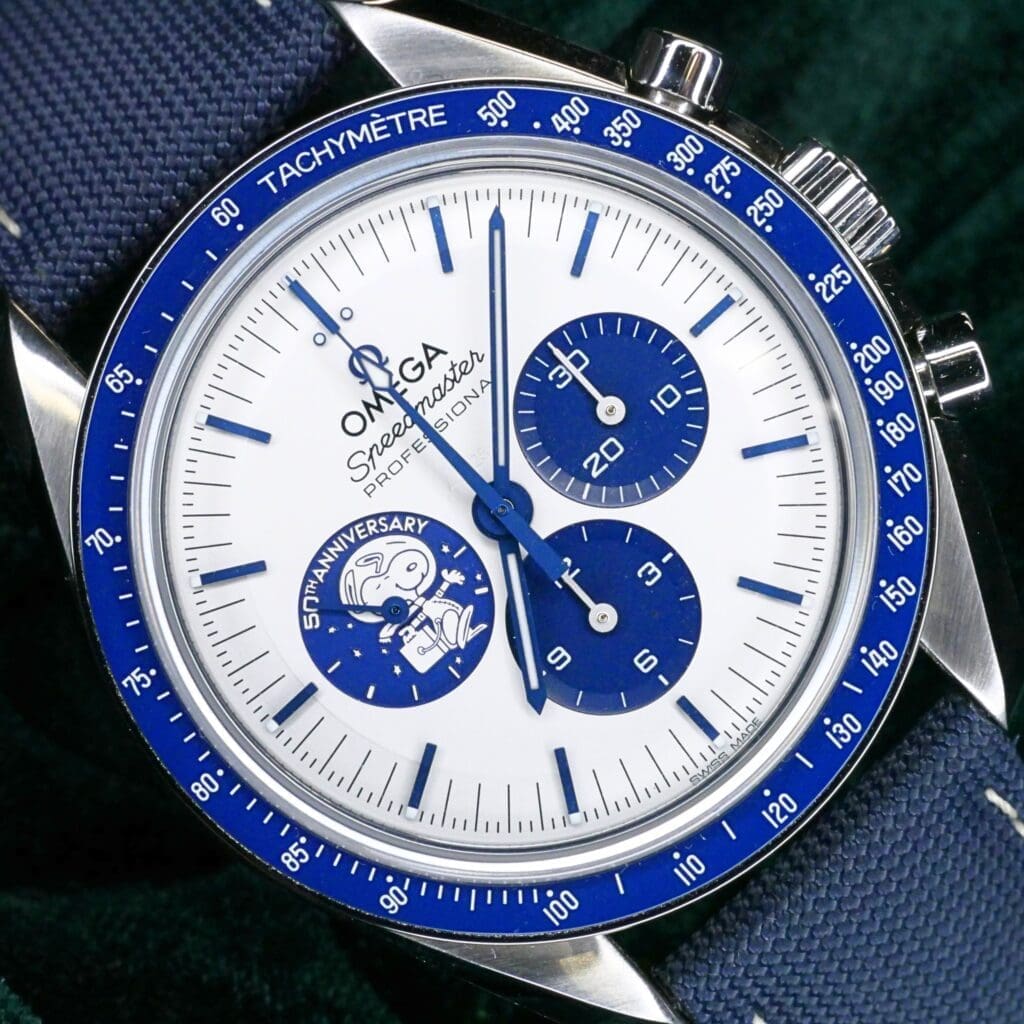
Vintage and special editions are a different world. A 321 “Ed White” clears well past $15,000, and Silver Snoopy editions trade into the tens of thousands.
Related Models from Majestix
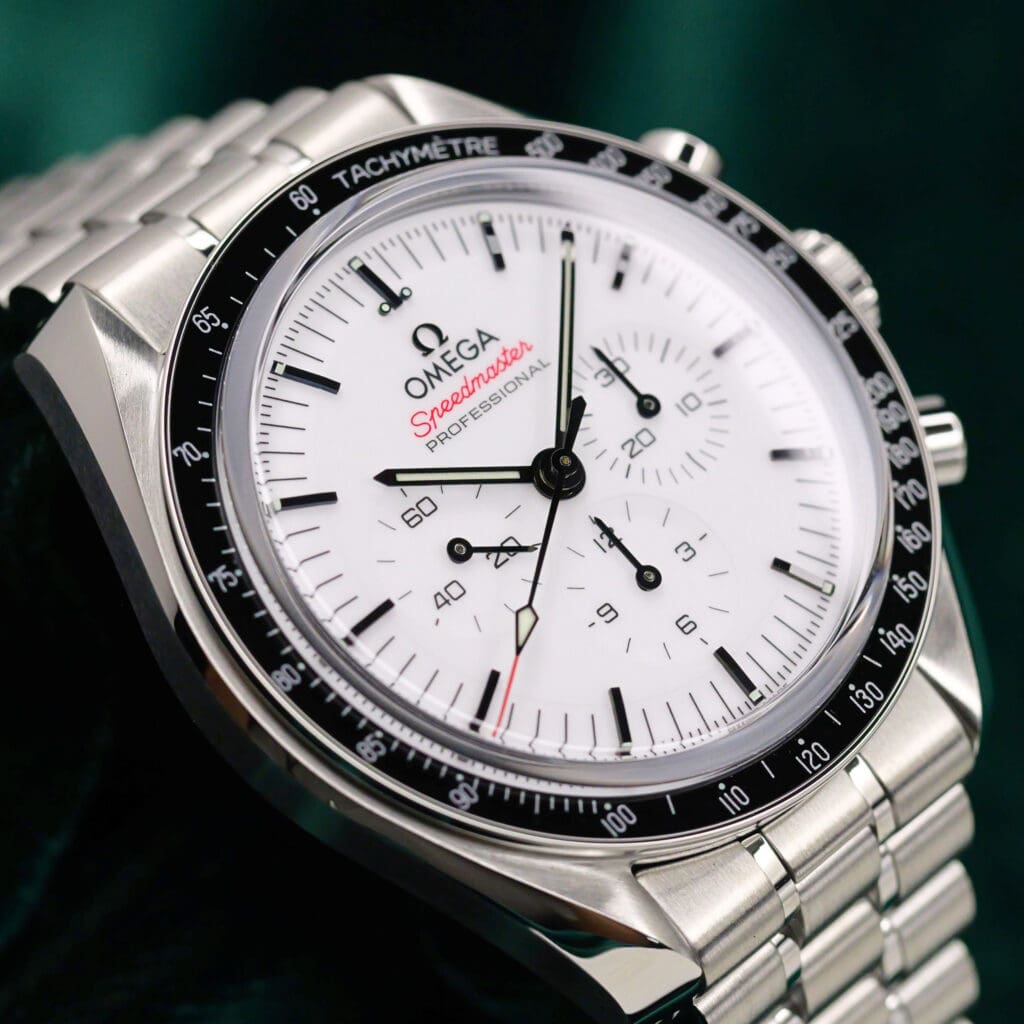
2026 NEW UNWORN Omega Speedmaster Moonwatch Professional White Dial Stainless Steel 42mm COMPLETE SET 310.30.42.50.04.001
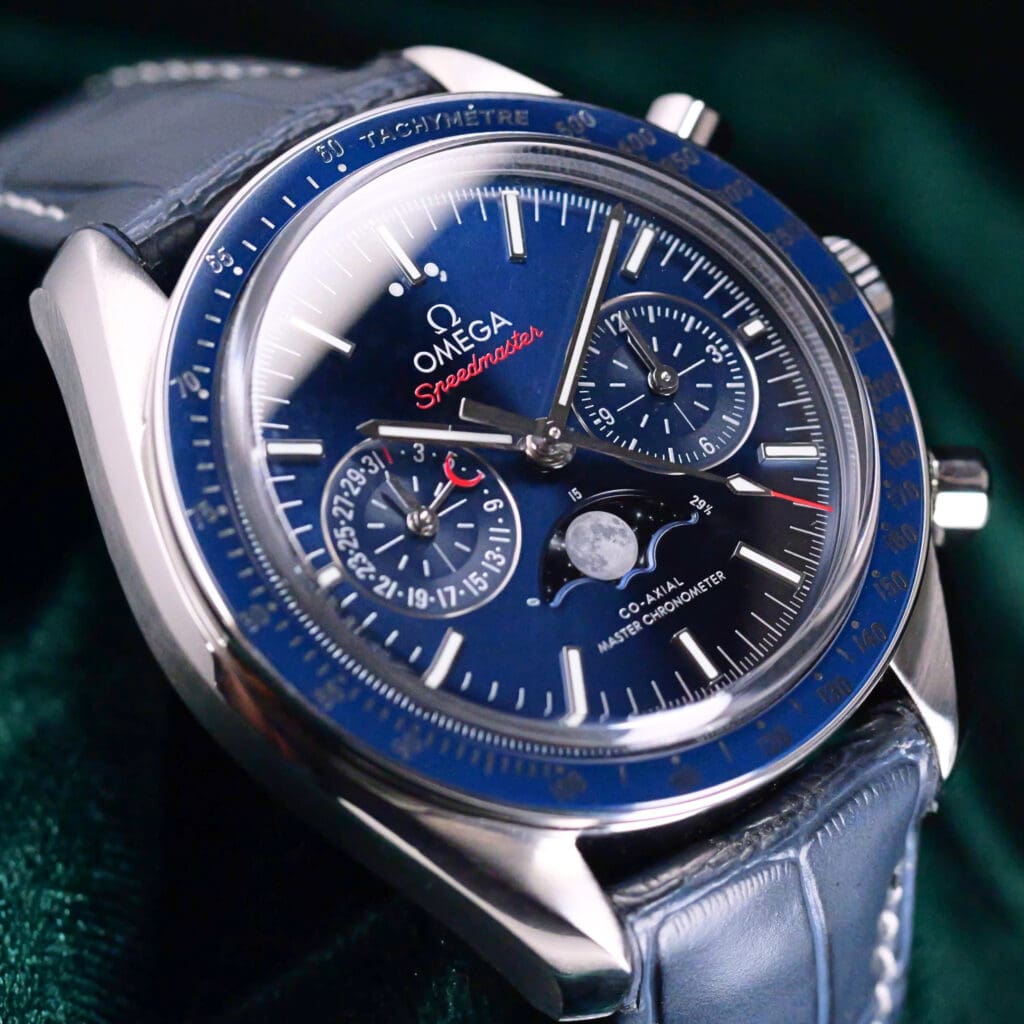
Omega Speedmaster Moonphase Blue Dial Blue Leather Strap Stainless Steel 44.25mm MINT CONDITION COMPLETE SET 304.33.44.52.03.001

Omega Speedmaster "Orbis Edition" 38mm Blue Dial Blue Bezel Stainless Steel Bracelet MINT COMPLETE SET 324.30.38.50.03.002
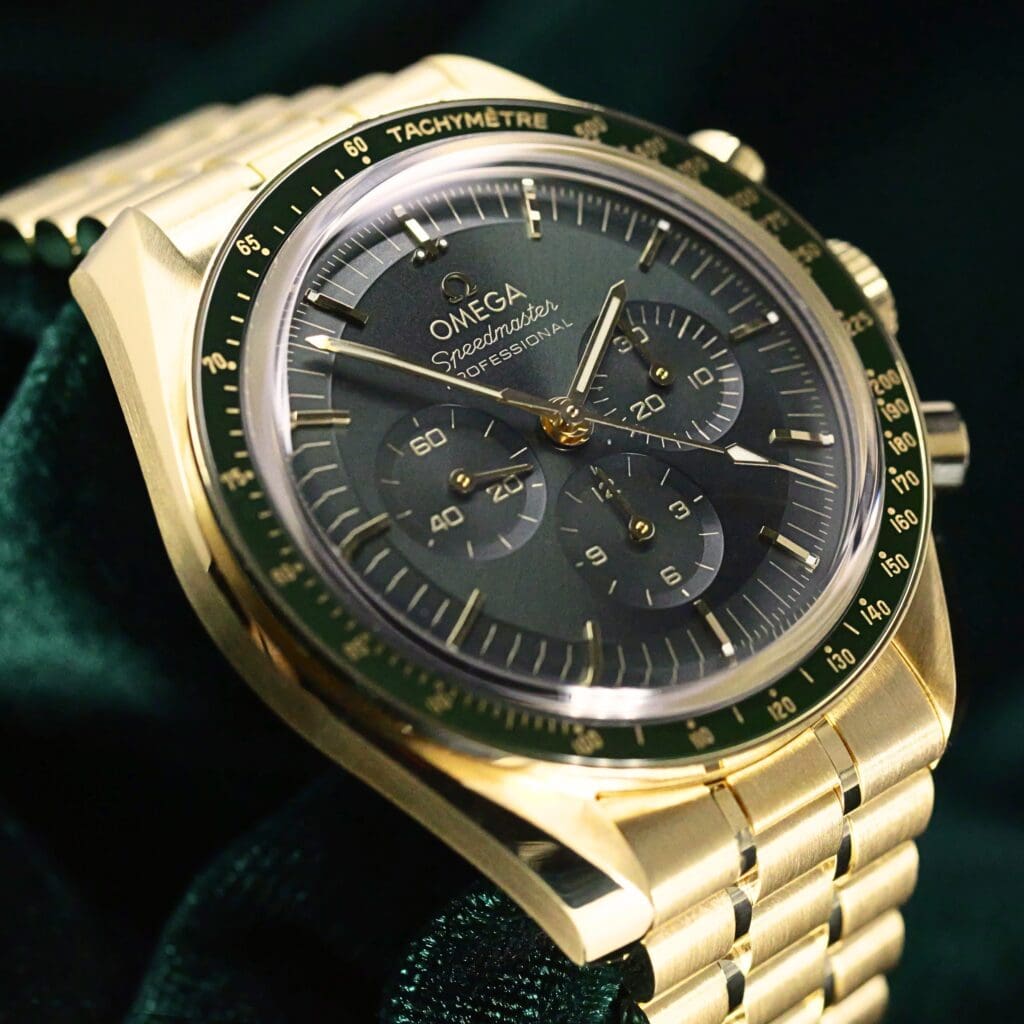
Omega Speedmaster Professional Moonwatch "Moonshine" Green Dial 18K Yellow Gold 42mm MINT CONDITION COMPLETE SET 310.60.42.50.10.001
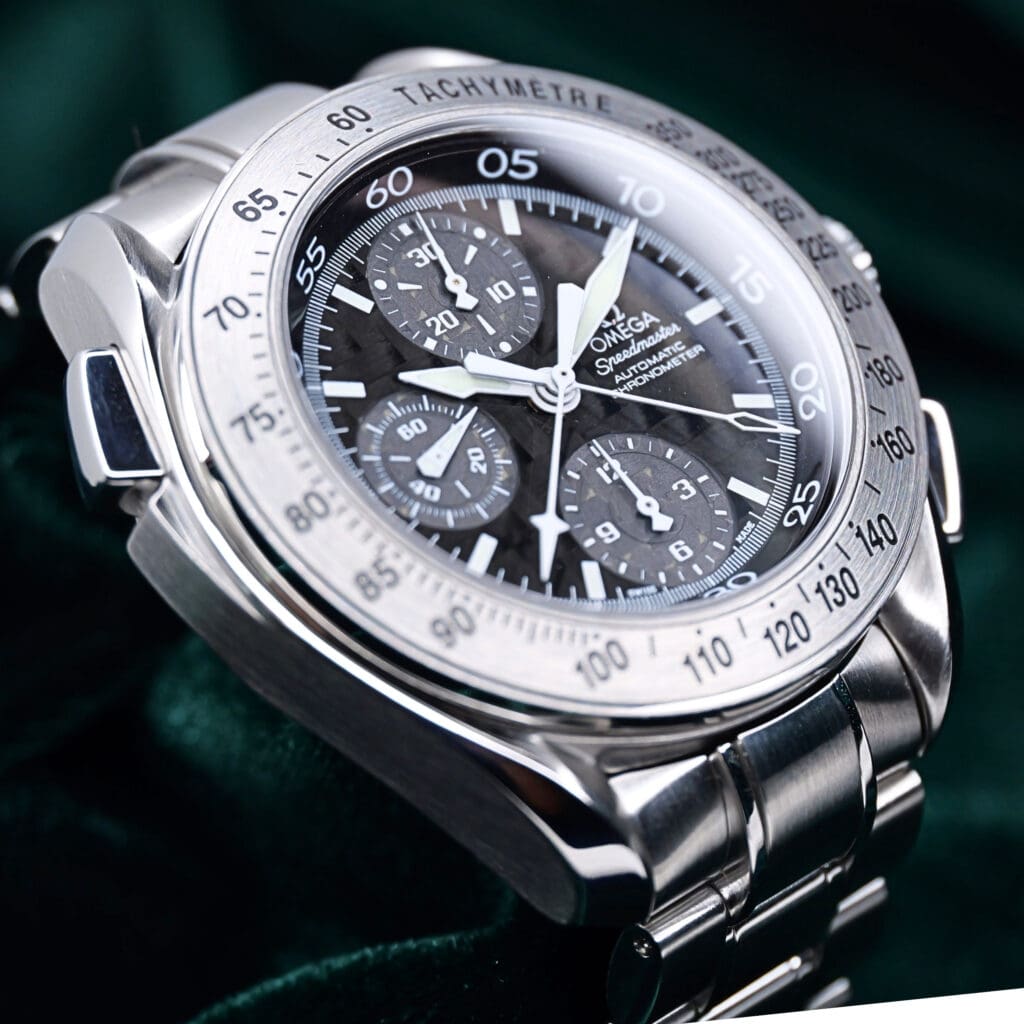
Omega Speedmaster Split-Seconds "Rattrapante" Black Carbon Fiber Dial Stainless Steel 42mm MINT CONDITION 3540.50
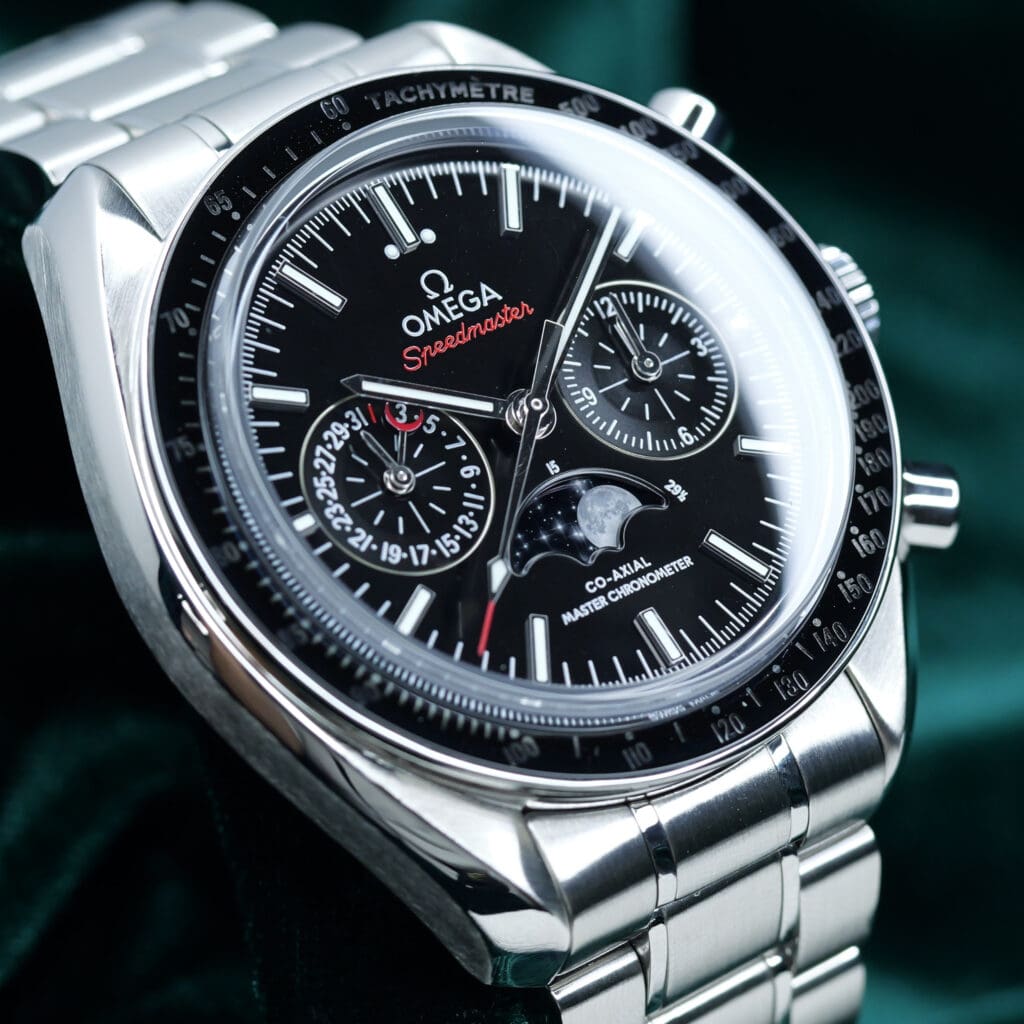
Omega Speedmaster Moonphase Co-Axial Master Chronometer Chronograph Black Dial Stainless Steel 44.25mm MINT CONDITION COMPLETE SET 304.30.44.52.01.001
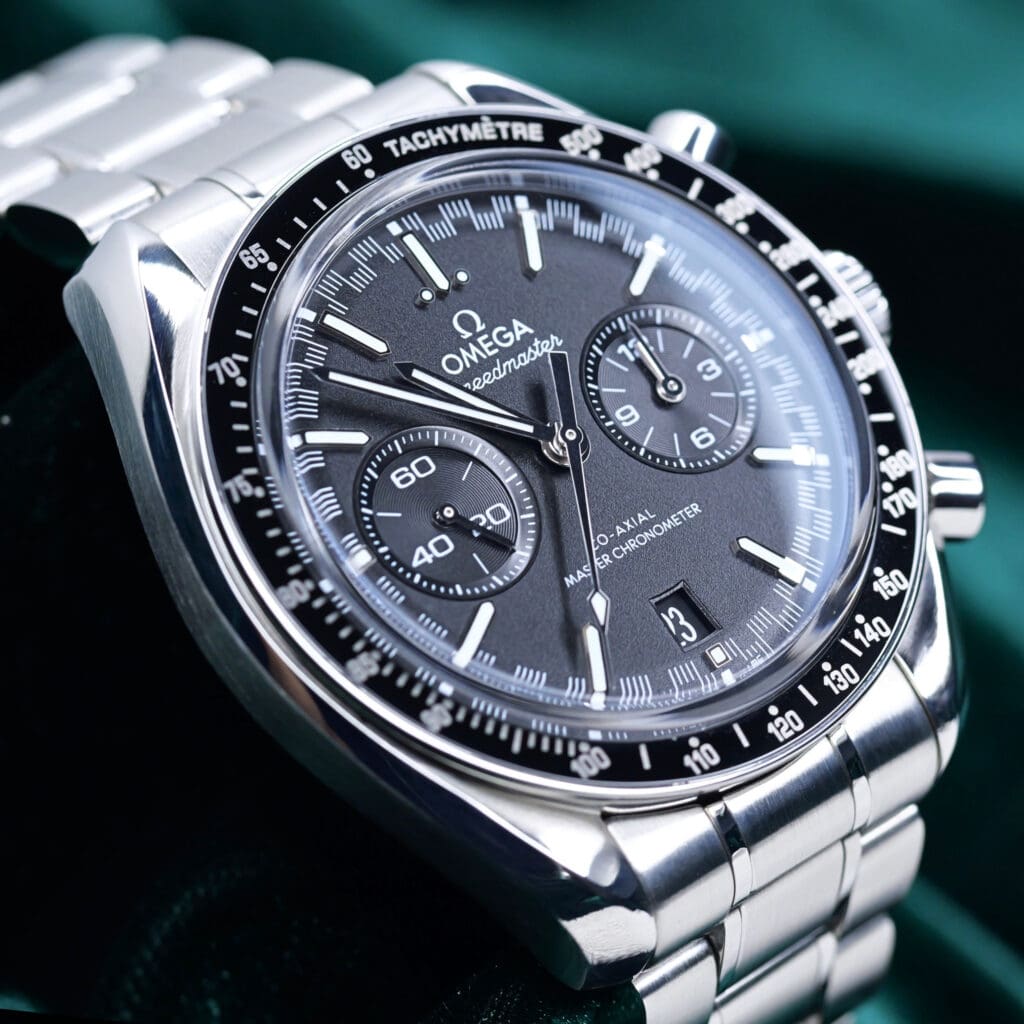
Omega Speedmaster Racing Co-Axial Master Chronometer Black Dial Stainless Steel 44.25mm MINT CONDITION COMPLETE SET 329.30.44.51.01.001
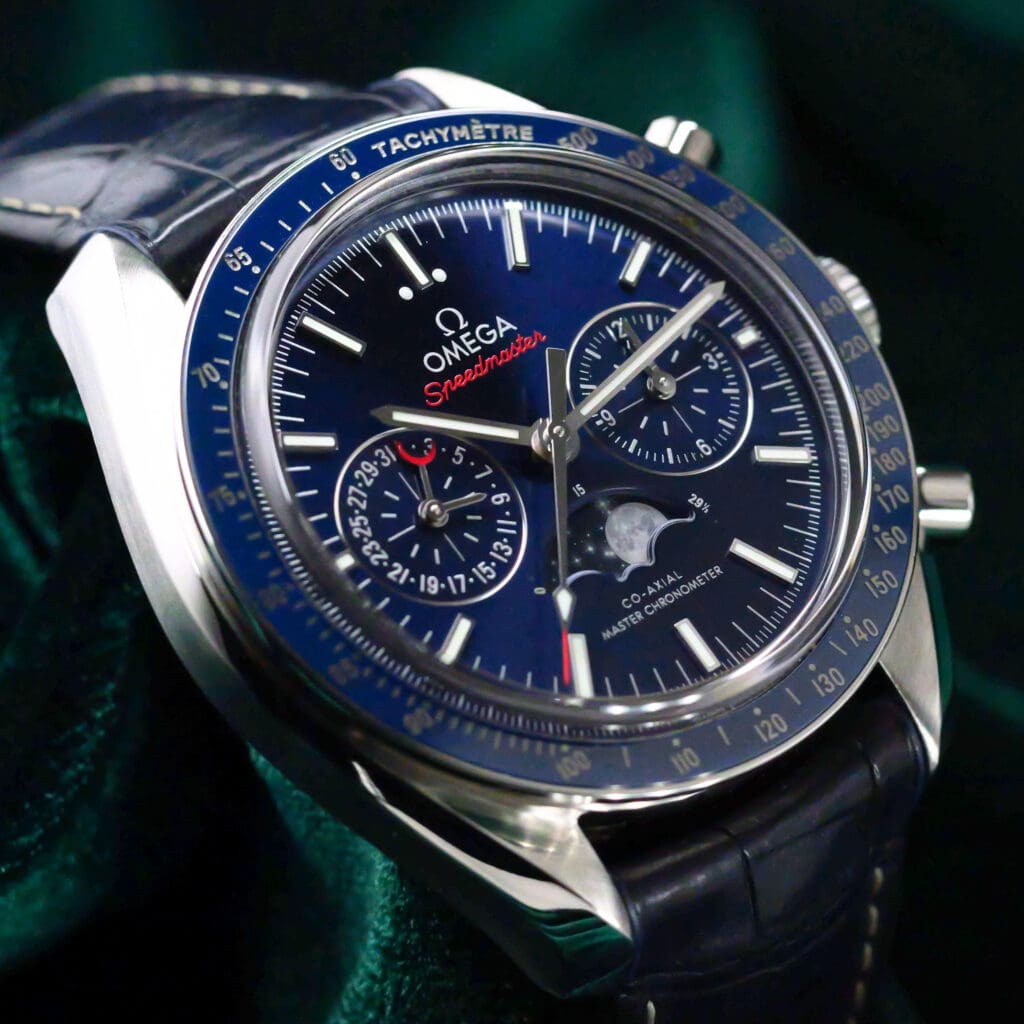
Omega Speedmaster Moonphase Blue Dial Blue Ceramic Bezel Blue Leather Strap Stainless Steel 44.25mm MINT CONDITION COMPLETE SET 304.33.44.52.03.001
Chronomat B01 42 steel models run about $5,000 to $8,500 pre-owned, with the 2026 versions sitting at the top of that band. Older Chronomats turn up from $1,900 to $3,000, and limited Super Chronomat pieces climb past $17,000.
On resale, Omega tends to hold value a touch better over the long run, helped by Speedmaster collectibility. Breitling holds up well on core lines like the Chronomat but can soften outside them. Figures here track Chrono24 and WatchCharts marketplace data and move with demand
Notable Omega Speedmaster References

Decades of production give the Speedmaster a deep reference list. These four mark the milestones collectors chase, from early NASA history to the current Master Chronometer era. Our full Speedmaster buying guide walks the wider lineup if you want more than these four.
Omega Speedmaster Ref. 105.003 — “Ed White”
Astronaut Ed White wore the 105.003 during America’s first spacewalk in 1965, and it was among the first Speedmasters NASA certified for missions. Collectors prize its clean early-Speedmaster looks.
Key Specs
- Production Years: 1963–1965
- Case Size: 39mm
- Movement: Caliber 321, manual-wind chronograph
- Crystal Type: Hesalite
- Notable Feature: Asymmetrical case with straight lugs and no crown guards
Omega Speedmaster Ref. 145.022 — Classic Moonwatch
Many enthusiasts treat the 145.022 as the definitive Moonwatch. It introduced the Caliber 861, simpler to service than the 321, and stayed in the lineup for two decades.
Key Specs
- Production Years: Late 1960s to late 1980s
- Case Size: 42mm
- Movement: Caliber 861, manual-wind chronograph
- Crystal Type: Hesalite
- Notable Feature: Classic tri-compax dial and proven Moonwatch build
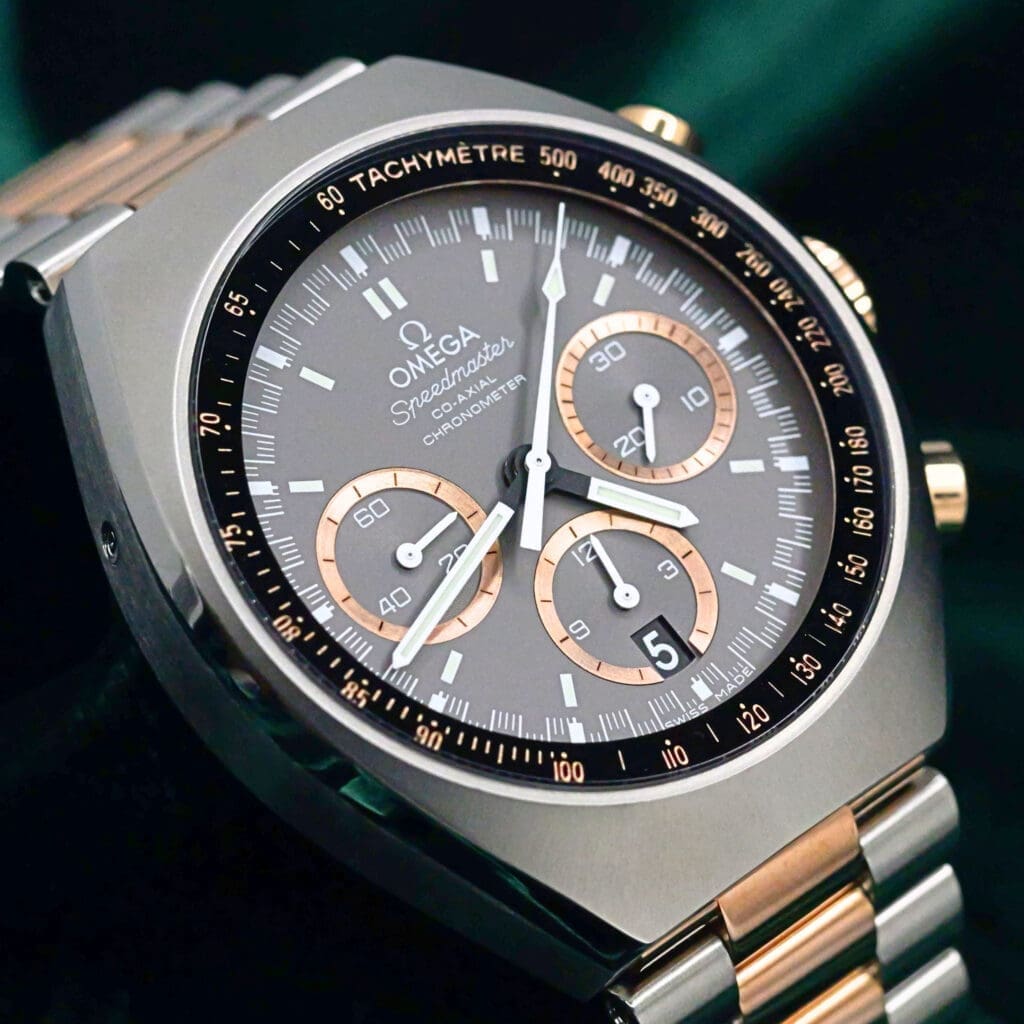
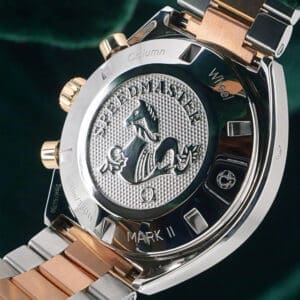
Omega Speedmaster Ref. 311.30.42.30.01.005 — Hesalite Moonwatch (Cal. 1861)
This was the long-running hesalite Moonwatch built around the Caliber 1861, the workhorse movement that powered the Speedmaster from 1996 until the 2021 changeover to the 3861. Omega discontinued it in 2021, which is exactly why it has become a strong pre-owned value pick.
Key Specs
- Production Years: Until 2021 (discontinued)
- Case Size: 42mm
- Movement: Caliber 1861, manual-wind chronograph
- Crystal Type: Hesalite
- Notable Feature: Final generation of the classic 1861 Moonwatch
Omega Speedmaster Ref. 310.30.42.50.01.001 — Master Chronometer Moonwatch (Cal. 3861)
Current hesalite Moonwatch and Omega’s most accurate version of the icon. METAS certification, a co-axial escapement, and anti-magnetism to 15,000 gauss bring the Speedmaster up to modern standards without changing the look.
Key Specs
- Production Years: 2021–present
- Case Size: 42mm
- Movement: Caliber 3861, manual-wind Master Chronometer
- Crystal Type: Hesalite
- Notable Feature: METAS Master Chronometer with hacking seconds
Notable Breitling Chronomat References

Chronomat history splits cleanly into the 1980s revival, the 1990s refinements, and the in-house B01 era. These four references trace that arc. Our complete Chronomat buying guide covers the full range beyond these four.
Breitling Chronomat Ref. 81950 — The 1984 Original
Arguably the single most important watch in Breitling’s modern history. Launched in 1984 for the centenary, the 81950 ditched the old slide rule for the now-iconic rider-tab bezel and helped carry mechanical chronographs through the quartz crisis.
Key Specs
- Production Years: 1984–1990
- Case Size: 39mm
- Movement: Automatic, Valjoux 7750 base
- Bezel Type: Rider-tab bezel
- Notable Feature: Introduced the rider tabs that define the Chronomat to this day
Breitling Chronomat Ref. A13050 — 1990s Chronomat
A 1990s evolution of the 81950 that kept the formula and tidied up the details. Same rider tabs, same Valjoux-based engine, with refreshed dials and improved legibility for daily wear.
Key Specs
- Production Years: 1990s
- Case Size: 39–40mm
- Movement: Automatic Caliber 13 (Valjoux 7750 base)
- Bezel Type: Rider-tab bezel
- Notable Feature: Cleaner dial layouts that broadened its appeal
Breitling Chronomat Ref. AB0110 — First In-House Chronomat
Marks the moment Breitling put its own Caliber B01 inside the Chronomat. In-house engineering, a column-wheel chronograph, and a 70-hour reserve gave the line real technical credibility.
Key Specs
- Production Years: 2009–2016
- Case Size: 41mm
- Movement: Breitling B01, automatic chronograph
- Bezel Type: Unidirectional rider-tab bezel
- Notable Feature: First Chronomat with the in-house B01 and 70-hour reserve
Breitling Chronomat Ref. AB0134101B1A1 — 2020 Redesign B01 42
Flagship of the 2020 redesign that brought back the integrated Rouleaux bracelet and locked in the modern 42mm proportions. This is the reference the slimmer 2026 update builds on, so it now sits as the outgoing generation on the pre-owned market.
Key Specs
- Production Years: 2020 redesign onward
- Case Size: 42mm
- Movement: Breitling B01, automatic chronograph
- Bezel Type: Polished rider-tab bezel
- Notable Feature: Reintroduced the Rouleaux bracelet and COSC certification
Which Watch Should You Choose?
Choosing between the Omega Speedmaster and Breitling Chronomat comes down to how you plan to wear it. Run through your priorities and the answer usually shows up fast.
Choose the Omega Speedmaster if:
- You want genuine NASA and space history on your wrist
- You enjoy hand-winding and a thinner, classic profile
- You lean toward long-term collectibility and resale strength
Choose the Breitling Chronomat if:
- You want a self-winding watch with a longer power reserve
- You need real water resistance for swimming or daily knockabout use
- You like bold styling and want the latest, slimmer 2026 design
Still cross-shopping Breitling’s chronographs? Our Speedmaster vs Navitimer breakdown covers that other matchup.
Omega Speedmaster vs Breitling Chronomat FAQWhich is better for daily wear?
For most people, the Chronomat is the easier daily watch. It winds itself, holds 200m water resistance, and the 2026 slimming makes it comfortable. A Speedmaster wins for someone who likes a thinner case and does not mind the hand-winding routine.
Can you swim with an Omega Speedmaster?
Briefly, but it isn’t built for it. At 50m the Moonwatch shrugs off rain and a quick splash, not laps or diving, and hesalite-crystal versions scratch more easily around water and sand. If you want a chronograph you can swim in without a second thought, the 200m Chronomat is the better pick.
Which holds its value better?
Vintage and special-edition Speedmasters hold value best of all. A 321 “Ed White” or a Silver Snoopy tends to climb over time, while standard modern Moonwatches stay fairly steady. On the Breitling side, in-house B01 references hold up better than older pre-2009 or quartz Chronomats. For pure resale resilience, a collectible Speedmaster is the safer bet.



Where to Buy Authentic Watches Online
A few legitimate online channels cover both of these watches. Chrono24 aggregates listings from dealers and private sellers worldwide with buyer protection on escrow orders. eBay’s Authenticity Guarantee program inspects watches above a price threshold before they reach you. Grailzee runs enthusiast-focused auctions where pre-owned chronographs like these show up regularly. Our guide on where to buy a pre-owned watch breaks down each channel in more depth.
999+ Timepieces Available
Explore Our Timepieces
Authenticated, unworn, and ready to ship worldwide.
Rolex · Audemars Piguet · Patek Philippe · Omega · Cartier · Richard Mille · Hublot · Tudor
Newly Listed
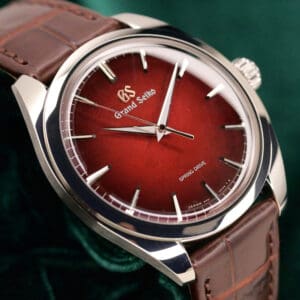
2026 NEW UNWORN Grand Seiko Elegance "Morning Glow" Limited Edition Red Dial Crocodile Strap 38.5mm COMPLETE SET SBGY035G
$9,816.00
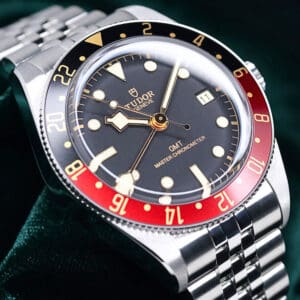
2026 NEW UNWORN Tudor Black Bay 58 GMT "Coke" Black Dial Black Burgundy Red Bezel Five-Link Stainless Steel Bracelet 39mm COMPLETE SET 7939G1A0NRU-0003
$7,385.00
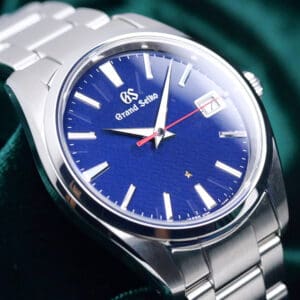
Grand Seiko Heritage 60th Anniversary Limited Edition Blue Dial Stainless Steel 40mm MINT CONDITION COMPLETE SET SBGP007G
$4,268.00
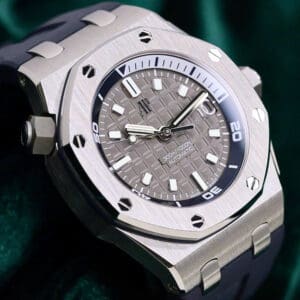
Audemars Piguet Royal Oak Offshore Diver Grey Dial Blue Rubber Strap Stainless Steel 42mm MINT CONDITION COMPLETE SET 15720ST.OO.A009CA.01
$27,788.00
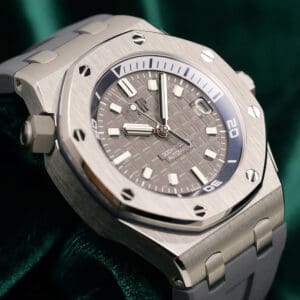
Audemars Piguet Royal Oak Offshore Diver Grey Dial Blue Inner Bezel Grey Rubber Strap Stainless Steel 42mm MINT CONDITION COMPLETE SET 15720ST.OO.A009CA.01
$27,788.00
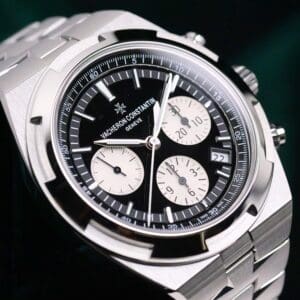
Vacheron Constantin Overseas Chronograph "Reverse Panda" Black Dial Silver Subdials Stainless Steel 42.5mm MINT CONDITION COMPLETE SET 5500V/110A-B481
$34,095.00

Rolex Sky-Dweller Black Dial 18K White Gold Fluted Bezel Oyster Bracelet Stainless Steel 42mm MINT CONDITION COMPLETE SET 336934-0007
$21,945.00

2026 Rolex Datejust Green Ombre Dial Smooth Bezel Jubilee Bracelet Stainless Steel 41mm MINT CONDITION COMPLETE SET 126300
$16,480.00

2026 NEW UNWORN Cartier Santos-Dumont Silver Dial Platinum Mesh Bracelet Platinum 31mm COMPLETE SET WGSA0124
$64,790.00

2026 Tudor Black Bay 58 Black Dial Jubilee Bracelet Stainless Steel 39mm MINT CONDITION COMPLETE SET 7939A1A0NU
$5,717.00

NEW UNWORN Rolex Submariner Date “Sub Date” Black Dial Black Ceramic Bezel Oyster Bracelet Stainless Steel 41mm COMPLETE SET 126610LN
$15,595.00
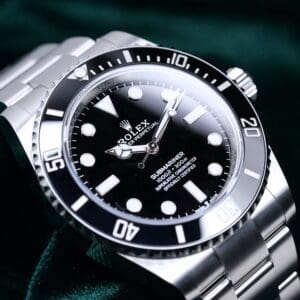
2026 NEW UNWORN Rolex Submariner No Date Black Dial Black Ceramic Bezel Oyster Bracelet Stainless Steel 41mm COMPLETE SET 124060
$15,219.00
We also sell, buy, and trade luxury watches, and the reason clients work with us instead of a faceless marketplace is the conversation before the sale. You can browse our current collection to see what’s in stock. You get layered communication, tour videos of the actual watch on hand rather than stock photos, and honest condition notes from someone who has inspected the piece in person.
That approach is reflected in our 4.9-star Google rating, which comes from buyers who wanted to know exactly what they were getting before committing.
If you’re weighing a specific Speedmaster or Chronomat and want that kind of walkthrough before you decide, reach out and we’ll line up the options that match what you’re after.
Final Thoughts on Omega Speedmaster vs Breitling Chronomat
These two chronographs pull in different directions. Speedmaster leans on space heritage and a hand-wound, thin-cased character. Chronomat counters with modern automatic convenience, real water resistance, and a 2026 redesign that finally trimmed its bulk.
Both are well-built and proven. Your call comes down to manual versus automatic, history versus everyday toughness, and which one you reach for day to day.
Two quick tips before you buy: try both on in person if you can, because the Speedmaster’s thin case and the Chronomat’s wrist presence feel very different in the metal. And if you’re eyeing a Speedmaster on a budget, the discontinued Caliber 1861 references are the smart-money entry into the icon.