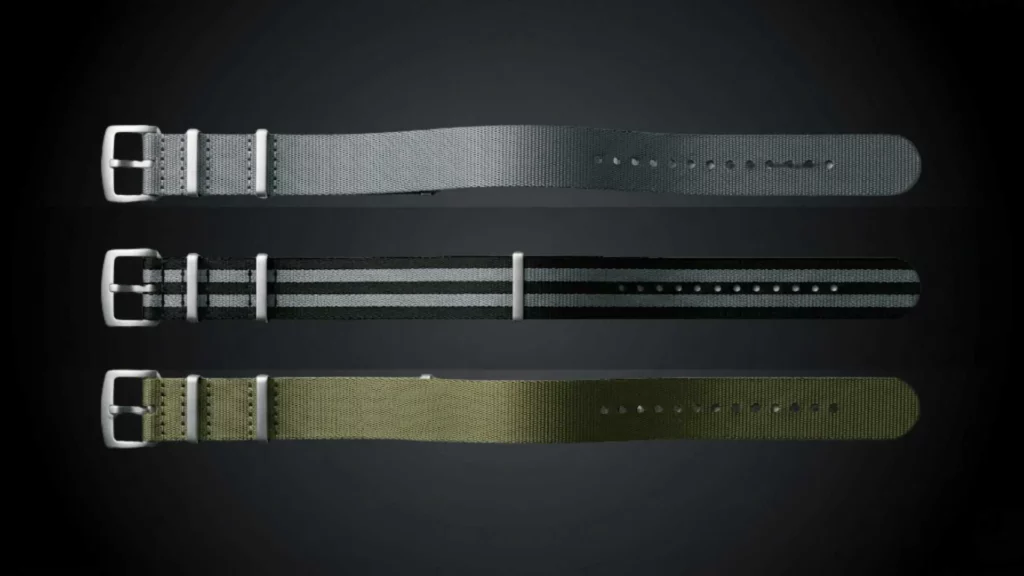
Most watch straps are designed to do one job: hold your watch on your wrist. How about the NATO watch strap? A NATO watch strap is designed to keep doing that job even after something breaks.
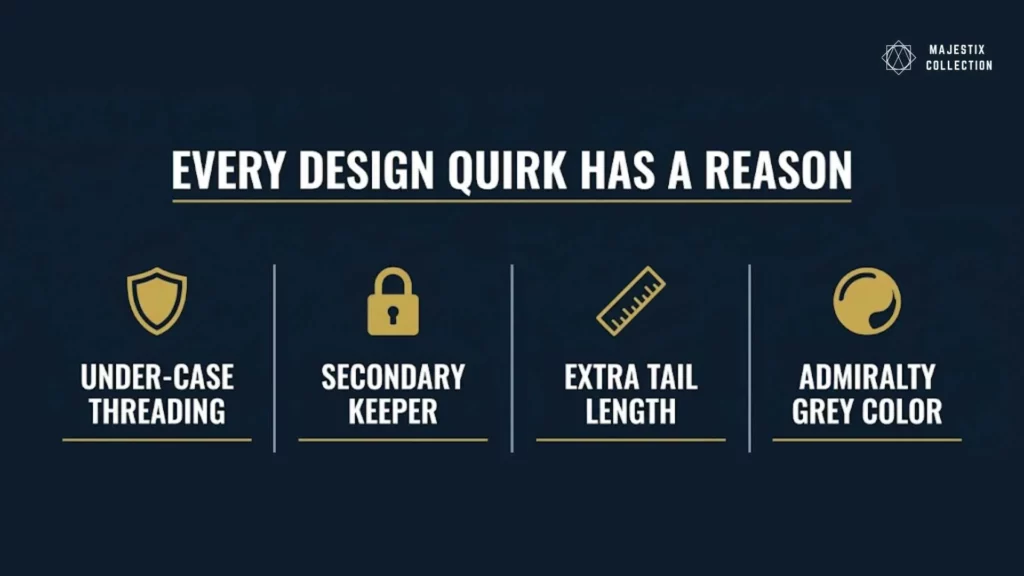
The NATO strap is not just a piece of nylon with a military backstory. It’s the only watch strap ever built around the assumption that hardware will fail. Every part of its design, the extra layer under the case, the secondary keeper, the long tail, exists for a specific reason rooted in that idea.
You’ll know in the next sections what a NATO strap is, how it works, where the name originated, and what to look for when you buy one.
Why the NATO Watch Strap Is Built This Way
A NATO watch strap is a single-piece strap that threads through both spring bars, runs under the watch case, and wraps around your wrist. It is designed for security first, not style, which is why its construction looks different from standard two-piece straps.
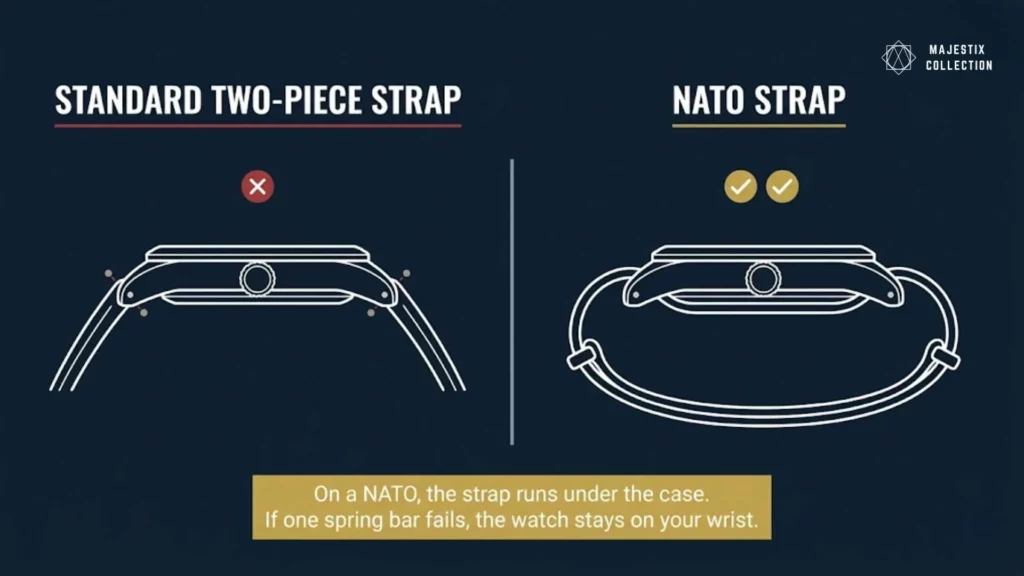
Instead of attaching directly to each lug like leather or rubber straps, a NATO passes underneath the case. This creates a backup system. If one spring bar fails, the watch stays attached because the strap still holds it in place.
That design did not come from fashion trends. It came from military use. The British Ministry of Defence (MoD) built this strap to stay secure in real-world conditions where failure was not an option. To understand why it works so well, you need to look at each part of the design.
How Secure Are NATO Straps?
On a standard strap, your watch depends entirely on two spring bars. If one fails, the watch can fall off immediately. A NATO strap solves this by running underneath the case. Even if one spring bar breaks, the watch stays suspended on the strap. It may shift slightly, but it will not drop off your wrist.
This is the main reason NATO straps are trusted by divers, hikers, and anyone who wears a watch in rough conditions.
Why Do NATO Straps Have an Extra Layer?
That extra piece of nylon near the buckle is not decorative. It creates a loop that locks the watch head in place. Without it, the case would slide up and down the strap every time you move your wrist. This is a real issue with simple single-pass straps.
The second layer keeps the watch stable. It also creates the raised feel on the wrist, which some people like and others do not. But it serves a clear purpose.
Why NATO Straps Are So Long
NATO straps were originally made to fit over military uniforms. The extra length allowed soldiers to wear their watches over thick sleeves. That is why you often have an excess strap to tuck away on a normal wrist. Modern versions are sometimes shorter, but the original design was built for function, not convenience.
Why Admiralty Grey Was the Original NATO Strap Color
The original NATO strap came in one color: Admiralty Grey. This was chosen to reduce visibility in the field. Bright or reflective colors could draw attention, which is a risk in military situations.
All the colors and patterns you see today are modern adaptations. The original design had no focus on style at all.
Where Does the Name “NATO Strap” Come From?
The NATO strap is named after the NATO Stocking Number (NSN) system, not the North Atlantic Treaty Organization military alliance. It was a British-only invention, first standardized in 1973 under DefStan 66-15 by the British Ministry of Defence.
Many people assume the strap was issued widely to NATO forces across Europe and North America. In reality, that was not the case.
The British MoD catalogued all military equipment using NATO Stocking Numbers, a shared administrative system used across member nations to track supplies. This strap’s official NSN is what gave it the name that stuck. Two NSNs were assigned: 6645-99-124-2986 for army and navy personnel, and 6645-99-527-7059 for the air force.
Soldiers who wanted one had to fill out a form called the G-1098, which is why collectors and military insiders still call it the G10 strap. The form, not the organization, was the nickname.In 1978, a company called Phoenix Straps Ltd took over production of MoD-spec G10 straps. These original Phoenix-made straps are the ones serious collectors seek out today.
Original NATO Strap Specifications
The first G10 strap wasn’t some rough prototype. It had tight, specific requirements. Here’s what the British MoD originally mandated:
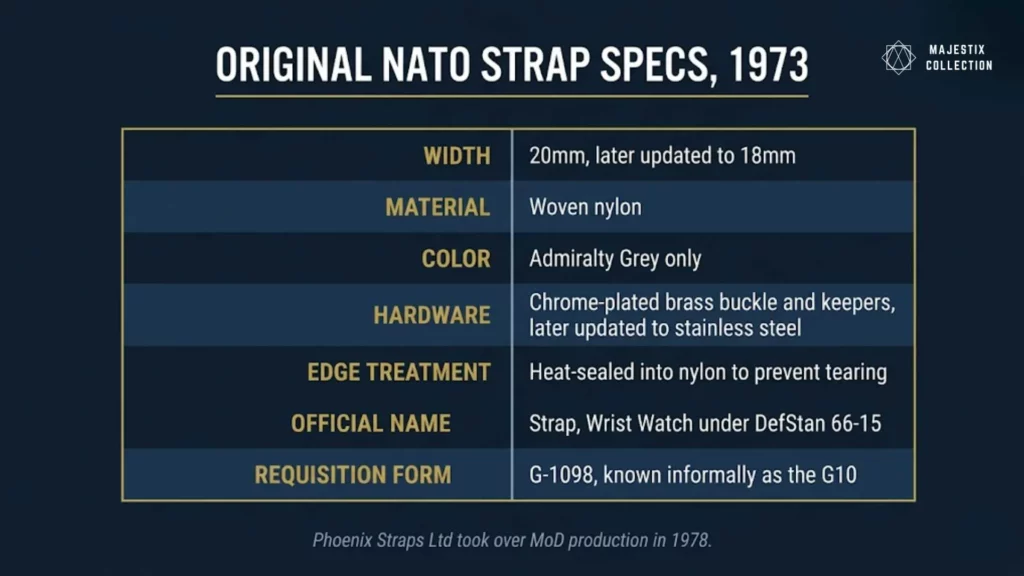
The reason 20mm remains the most common NATO width today is that it was the original MoD standard. Stainless steel hardware is the quality benchmark because the military upgraded from chrome-plated brass.
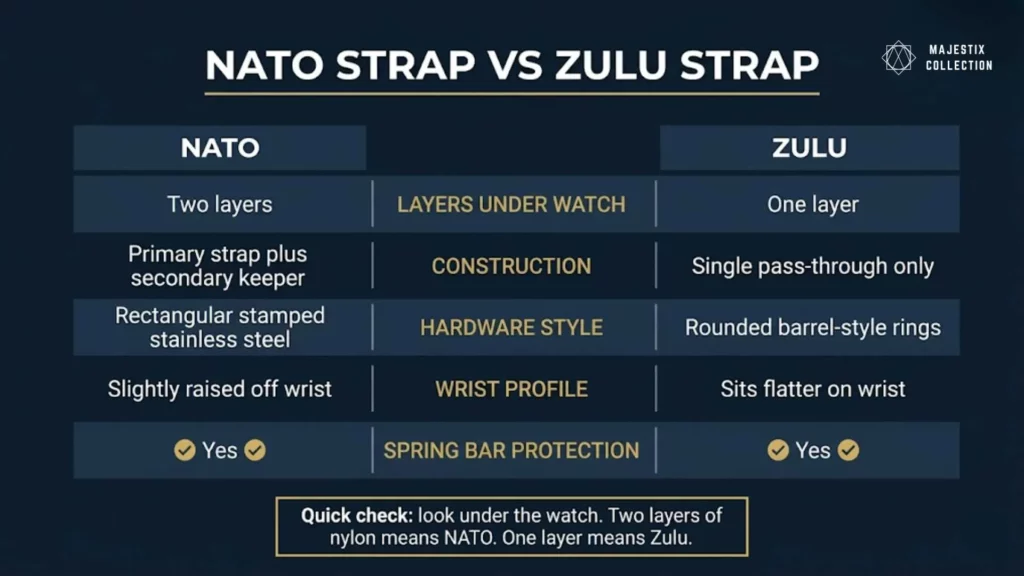
NATO Strap vs Zulu Strap (A Quick Glance)
A NATO strap has two pieces of nylon; a long primary strap and a shorter secondary keeper strap sewn near the buckle. A Zulu strap is a single piece of nylon with no secondary keeper.
Both straps offer spring bar failure protection because both threads are under the watch case. The practical difference is feel. A Zulu sits a bit flatter. NATO holds the watch more firmly in place.
The confusion happens because most people call any pass-through nylon strap a “NATO” regardless of construction. At street level, the terms are used interchangeably. But at a collector level, the distinction matters.
Did James Bond Wear a NATO Strap in Goldfinger?
Technically, no. Sean Connery wore a striped nylon pass-through strap on a Rolex Submariner ref. 6538 in the 1964 film Goldfinger, but the official NATO strap wasn’t created until 1973. What Bond wore was the design ancestor of the NATO, not the NATO itself.
The strap Connery wore on set was reportedly borrowed from a crew member at the last minute. It was also the wrong size; too narrow for the Submariner’s lug width, which is why there are visible gaps between the strap and the case.
Despite that, the image stuck. Bond, Rolex, striped nylon. That visual became one of the most referenced moments in watch culture.
When the British MoD formally standardized the G10 strap in 1973, it was building on a design that had existed informally in military and aviation circles for years. The pre-NATO single-pass strap Connery wore was part of that lineage.
So the clean version is that Bond didn’t wear a NATO strap. But he wore the thing that NATO became.
Things to Know Before Buying a NATO Strap
Before choosing a NATO strap, you should understand two key things: the correct size for your watch and the signs of good strap quality.
1. Find the Right Size NATO Strap
Match the strap width to your watch’s lug width. The lug width is the gap between the two lugs on the case, not the width of the strap currently on it.
The most common sizes are 18mm, 20mm, and 22mm. A 20mm strap covers the majority of sport and dress watches. If you’re unsure, check your watch’s model page or measure the gap directly with a ruler. Getting the width wrong means the strap won’t sit flush with the case.
2. Recognize a Quality NATO Strap
Not all NATO straps are the same. The name is now used generically, and quality varies a lot.
Here’s what to look at:
- Nylon weave density: A tighter weave is stiffer out of the box but lasts longer and resists fraying. Loose weaves feel softer immediately but wear out faster.
- Edge finishing: Look for ultrasonically sealed or stitched edges. Raw-cut edges fray quickly with regular use.
- Hardware material: Solid 316L stainless steel is the standard to look for. Chrome-plated brass is acceptable. Lightweight hollow hardware is not.
- Construction method: Both stitching and ultrasonic welding are valid. Welded construction handles water better.
A basic NATO strap can cost only a few dollars, but well-made nylon versions typically range from about $20 to $45, depending on the weave quality, thickness of the nylon, and the type of stainless steel hardware used.
Higher quality straps usually feature tighter ballistic nylon weaving, reinforced stitching, and more durable buckles or keepers designed for long-term wear.
Final Thoughts on NATO Straps
The double-layer construction, extended tail, secondary keeper, and original grey color may look unusual at first. In reality, each feature serves a practical purpose. NATO straps were designed with a military mindset that prioritizes reliability. Because the strap passes under the watch and through both spring bars, the watch can remain attached even if one spring bar fails.
This design is what makes NATO straps useful today. They offer a secure way to wear a watch, especially for sports or outdoor use. The trade-off is extra material under the case, which adds thickness.
If you prefer a strap that sits flatter on the wrist, a standard two-piece strap may be a better option. NATO straps remain popular because they are simple, durable, and easy to replace.