The Rolex Submariner 5513 is a no-date dive watch introduced in 1962 as the non-chronometer counterpart to the reference 5512. The two references shared the same 40 mm crown-guard Oyster case and were built alongside each other for years, the 5512 carrying a chronometer-certified movement and four lines of dial text, the 5513 carrying a non-certified movement and two lines.
The 5513 succeeded the reference 5508 and remained in the catalogue until 1989, a production run of roughly 27 years, the longest of any Submariner reference. Over that run the watch moved through gilt gloss dials, matte tritium dials, and finally gloss dials with white gold surrounds, while the core format never changed: black dial, black rotating dive bezel, no date, acrylic crystal.
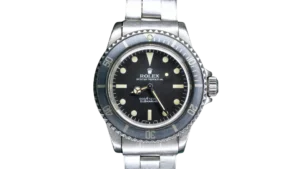
A 1977 example such as this one sits in the matte-dial, feet-first era. The dial reads 660ft = 200m above SUBMARINER, the crown is the Triplock type adopted on the reference in 1972, and the movement is the caliber 1520. The grey bezel insert on this example is an aged black aluminium insert whose anodised colour has faded, the configuration the trade calls a ghost bezel.
Browse Our Rolex Collection
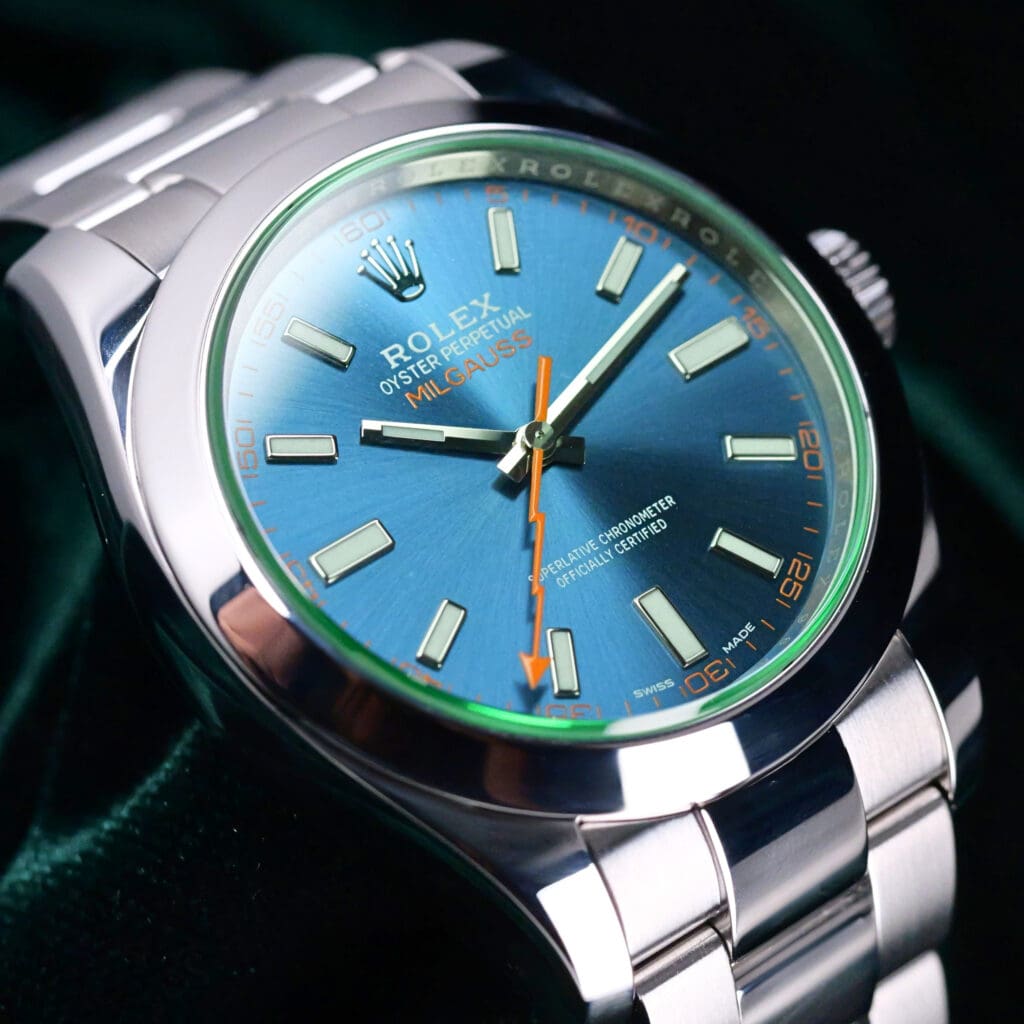
Rolex Milgauss "Z-Blue" Blue Dial Green Sapphire Crystal Smooth Bezel Oyster Bracelet Stainless Steel 40mm MINT CONDITION COMPLETE SET 116400GV-0002
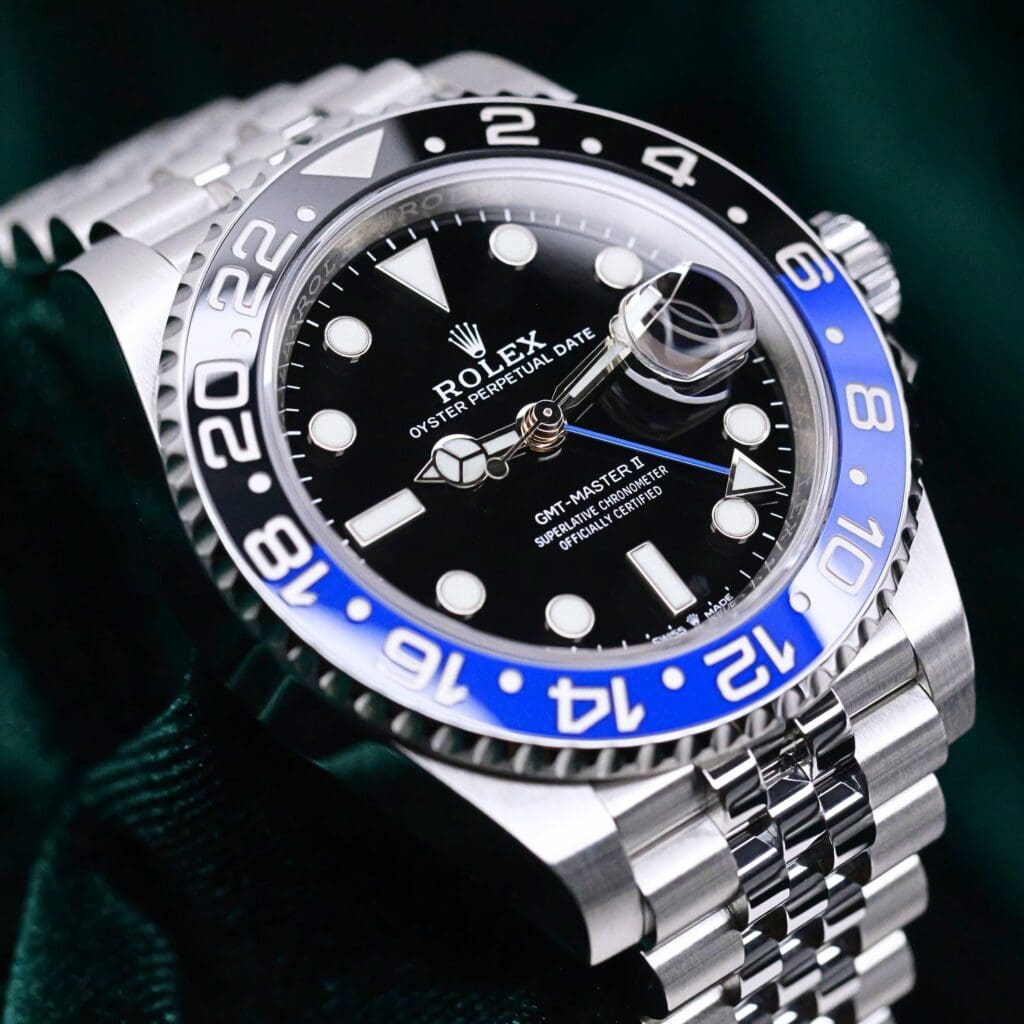
Rolex GMT-Master II "Batgirl" Black Dial Black Blue Ceramic Bezel Jubilee Bracelet Stainless Steel 40mm MINT CONDITION COMPLETE SET 126710BLNR
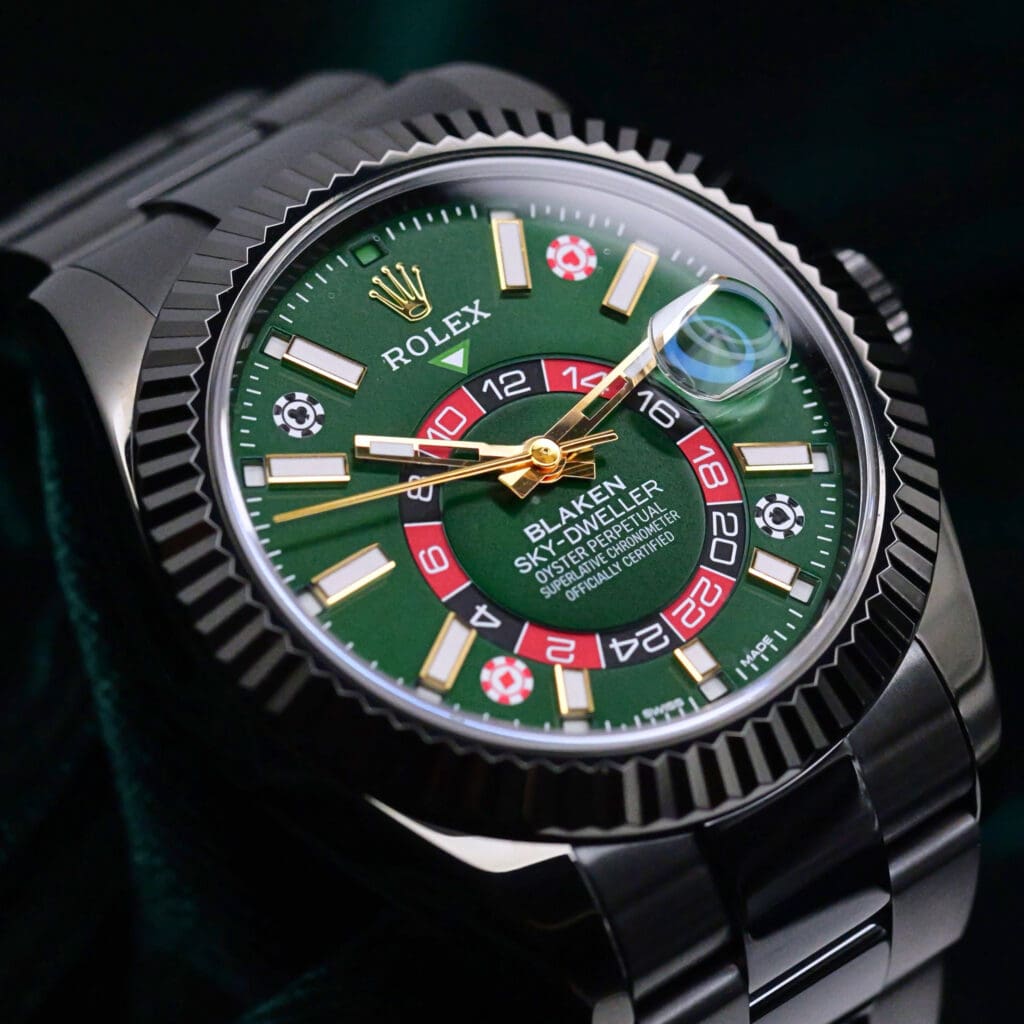
Rolex Sky-Dweller "Casino" Blaken Green Dial Black DLC Stainless Steel Oyster Bracelet 42mm MINT CONDITION COMPLETE SET 326934
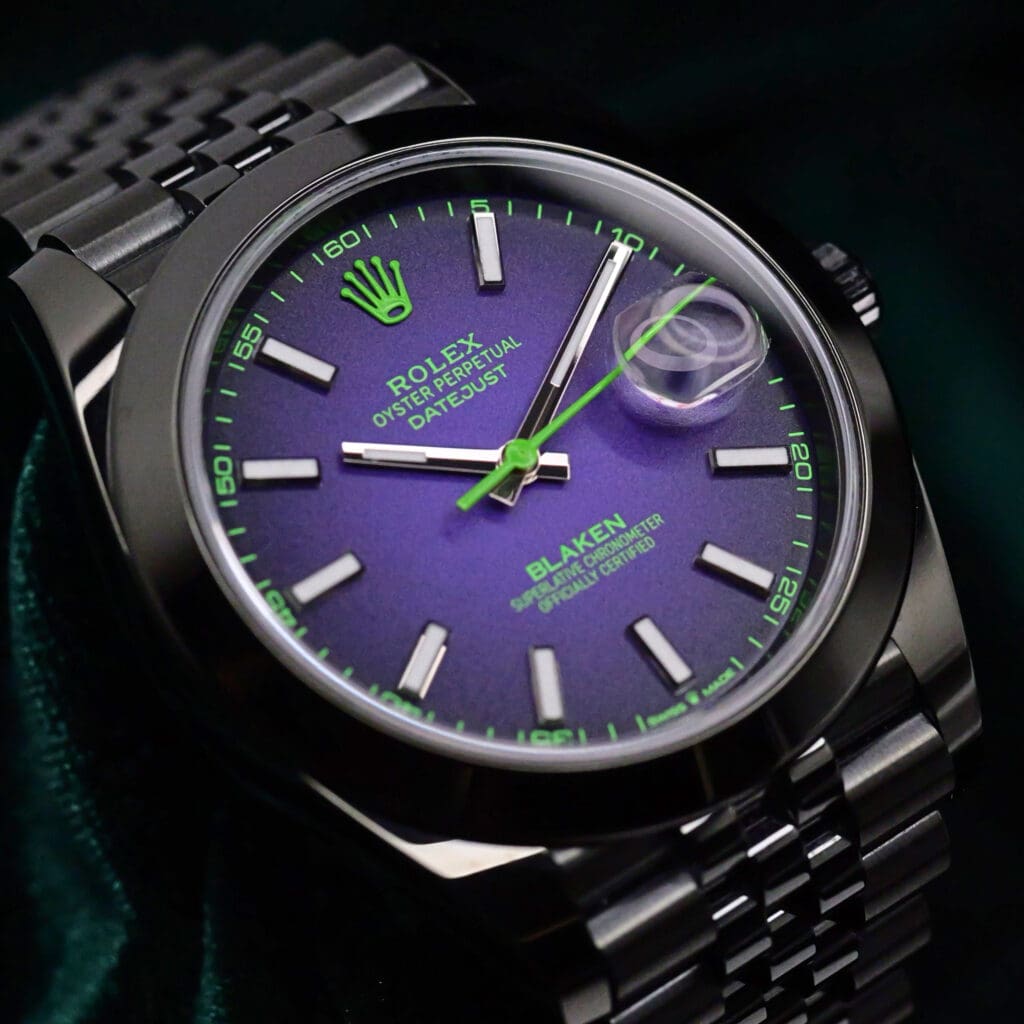
2025 Rolex Datejust "Joker" Blaken Purple Dial Green Accents Smooth Bezel Jubilee Bracelet Black DLC Stainless Steel 41mm MINT CONDITION COMPLETE SET 126300
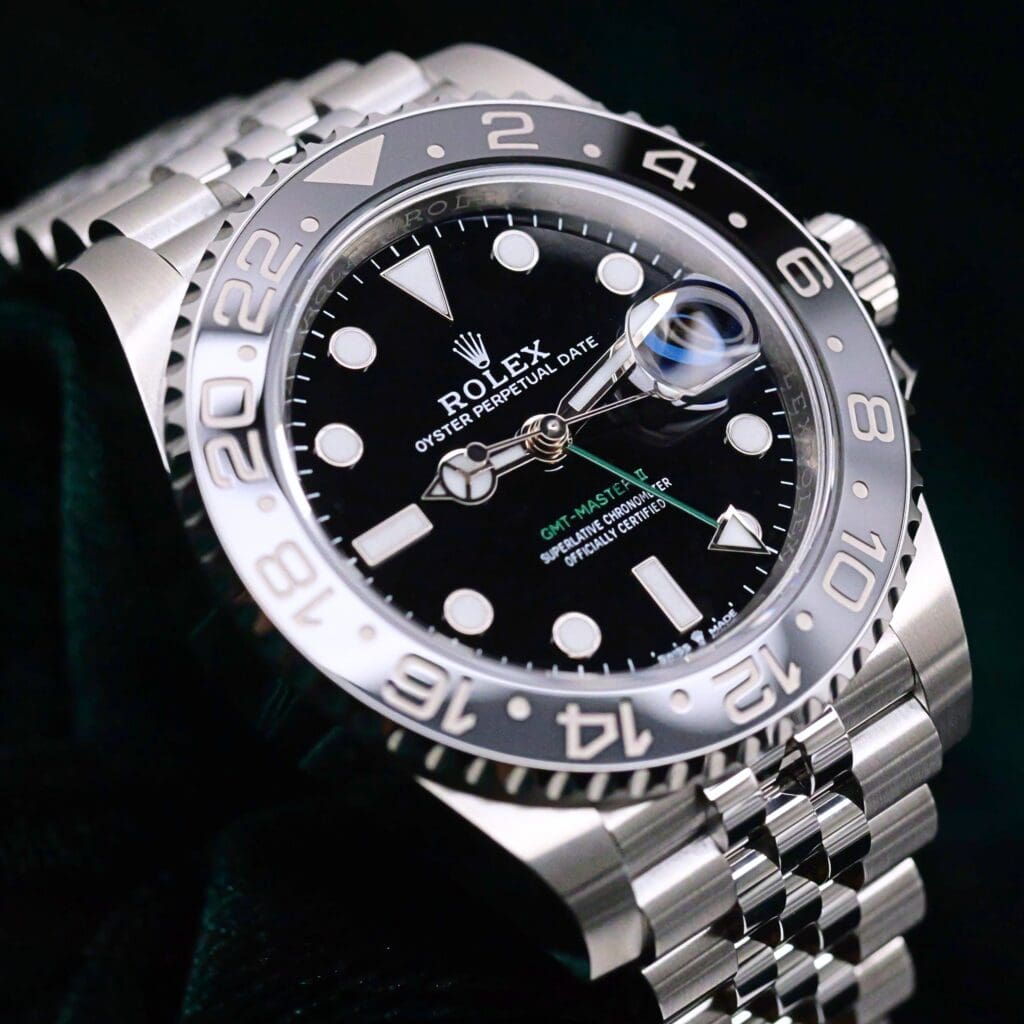
2026 NEW UNWORN Rolex GMT-Master II "Bruce Wayne" Black Dial Black Grey Ceramic Bezel Jubilee Bracelet Stainless Steel 40mm COMPLETE SET 126710GRNR-0003
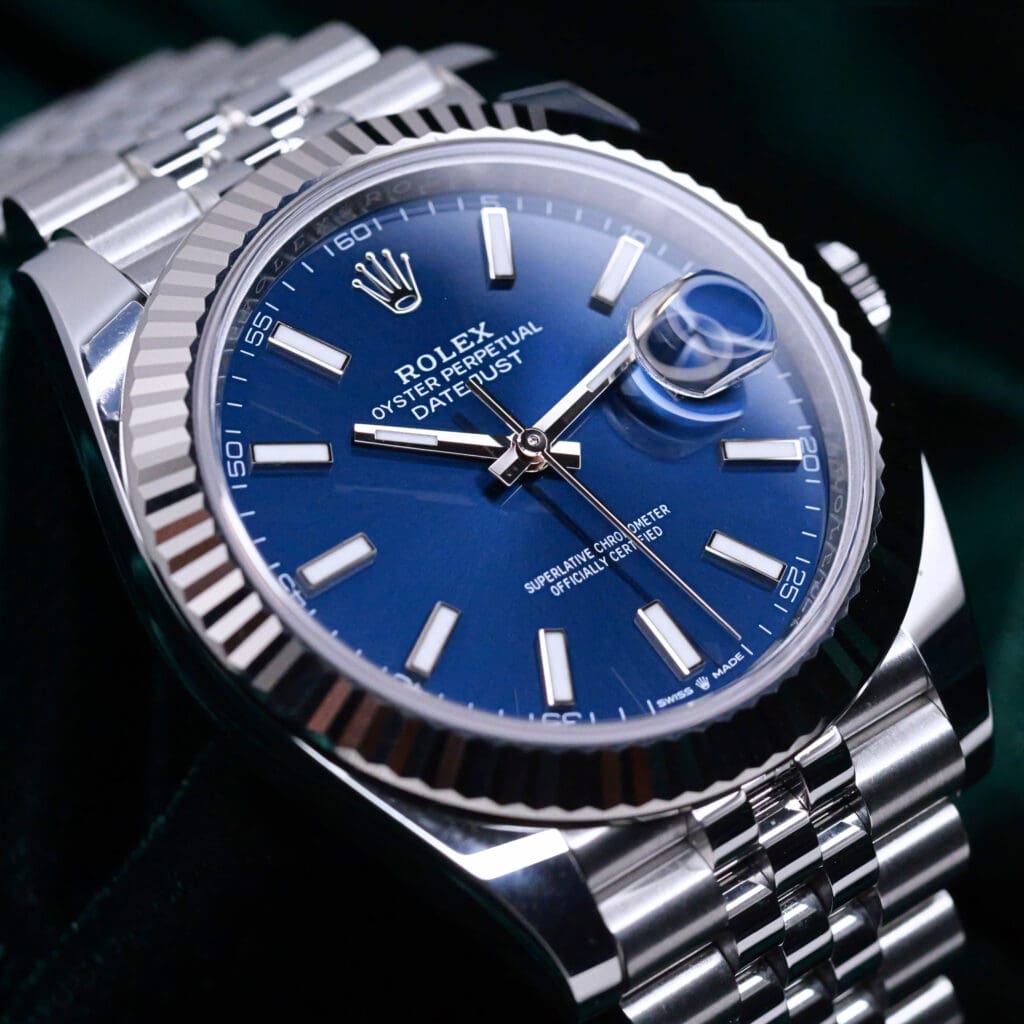
2026 NEW UNWORN Rolex Datejust 41 Blue Dial Fluted Bezel Jubilee Bracelet Stainless Steel 41mm . COMPLETE SET 126334-0002
Dial and Face Design
The dial is matte black with painted tritium luminous plots: round dots at most hours, batons at 3, 6, and 9, and an inverted triangle at 12. There are no applied metal surrounds in this era; the lume is applied directly to the dial surface, and on surviving examples it has typically aged to cream or yellow tones.

Two lines of text sit under the coronet at 12: ROLEX and OYSTER PERPETUAL. Above 6 sit the depth rating and model name, 660ft = 200m over SUBMARINER, the feet-first format used from 1969 onward. SWISS – T < 25 is printed at the base of the dial, marking the tritium lume. The 1977 serial window also produced the dial the trade calls Pre-Comex, identified by its open 6s in the depth rating and fonts shared with the Comex-issued reference 5514.
The handset is the Mercedes type in steel: Mercedes hour hand, straight minute hand, and a sweep seconds hand with a luminous dot, all lumed with tritium to match the dial. There is no date and no cyclops, which gives the dial a symmetrical layout unique among Submariner variants of the period.
Case and Bezel
The case is the 40 mm stainless steel Oyster with crown guards, brushed on the lug tops and case flanks with chamfered lug bevels on unpolished examples. The lugs are drilled through, so spring bars can be pushed out from the outside. Case thickness varies across the production run, measured at roughly 13 mm to 14.5 mm depending on era.

The crystal is domed acrylic, which rises above the bezel and remained on the 5513 to the end of production; the reference never received sapphire. The screw-down crown on a 1977 example is the Triplock type, fitted to the reference from 1972 in place of the earlier Twinlock. The caseback is solid stainless steel, screw-down and unmarked outside, with the reference stamped on the inside. Water resistance is rated to 200 m (660 ft).
The bezel rotates bidirectionally and carries a black anodised aluminium insert with a 60-minute dive scale: individual minute graduations over the first 15 minutes, then markings at five-minute intervals, with a luminous pearl at 12. The diver sets the pearl against the minute hand and reads elapsed time off the scale. The 5513 was the last no-date Submariner with a bidirectional bezel and the last with a luminous pearl of this construction; on aged examples the insert’s black dye can fade to grey, the ghost bezel configuration this example carries.
Bracelet and Clasp
Period-correct 1977 examples are found on two stainless steel Oyster bracelets. The folded-link reference 9315 uses 380 or 280 end links and a Fliplock clasp with a fold-out diver’s extension for wear over a wetsuit. The solid-link reference 93150 uses 580 end links with the same Fliplock clasp layout and a more substantial feel in hand; both bracelets appear on documented 1977 watches, with the 93150 becoming standard as production moved into the 1980s.

Both bracelets are three-link Oyster designs in brushed stainless steel with a 20 mm lug width. Clasp inner blades carry a date-code letter, with B corresponding to 1977, a detail used to match a bracelet to the watch’s production year.
Documented 1977 full-set examples on both the 9315 and the 93150 carry 11 links as sized. The removed links from original sizing are part of a complete set.
Movement and Functionality
The 5513 of this era runs the Rolex caliber 1520, a self-winding movement with bidirectional rotor winding from the 1500 series, the first movement family Rolex built entirely in-house. Early 5513s used the caliber 1530; the 1520 powered the reference for the balance of the run.
The caliber 1520 beats at 19,800 vph with a power reserve of approximately 42 hours. It was produced in 26-jewel form for most markets and in a 17-jewel version for the United States, a configuration driven by import tariffs of the period. It uses a Swiss lever escapement with a flat hairspring and an index regulator.
The movement was never submitted for chronometer certification, which is why the dial carries two lines of text where the 5512 carries four. Functions are hours, minutes, and sweep seconds. Operation is simple: unscrew the crown to its first position to wind, pull to the outer position to set the time, and screw the crown back down against the case tube to restore water resistance. Elapsed dive time is tracked on the bezel rather than through any movement complication.
Materials of the Watch
The case, bracelet, and clasp are stainless steel throughout, brushed on the visible surfaces. Steel suits the watch’s tool purpose: it resists corrosion in seawater and takes refinishing well.
The crystal is acrylic, domed above the bezel line. Acrylic scratches more readily than sapphire but resists shattering and can be polished clear by hand, which is why it remained on dive watches of this era.
The bezel insert is anodised aluminium with the scale in silver against black. The anodised dye layer is light-sensitive over decades, which is what produces the faded grey ghost inserts seen on examples like this one. The dial furniture is painted tritium lume rather than applied metal, and the hands are steel with tritium infill.
The material character of the watch is plain working steel and aluminium with an acrylic crystal, a tool specification with nothing decorative added.
Box and Papers
A full set for a 1977 example includes:
- Rolex presentation box of the era, inner box with outer card sleeve
- Guarantee paper completed by the selling dealer, punched or handwritten with the serial
- Rolex wallet for the papers
- Instruction booklet and brochure of the era
- Red Submariner 200m anchor hang tag
- Green Triplock crown hang tag
- Dealer purchase receipt and price list where retained
- Bracelet links removed at original sizing
Box Variations
Older version
- Generation 1, approximately 1962 to 1966: early green asymmetrical or pyramid presentation box, wood interior with a faux-leather exterior, gilt Rolex branding, and a removable velvet-covered cuff
- Generation 2, approximately 1967 to 1972: green symmetrical hard-shell or soft-top sports box, faux-leather exterior, gilt branding, and a removable velvet insert or metal cuff, with several market-specific constructions overlapping
- Generation 3, approximately 1973 to 1979: larger rectangular green presentation boxes, commonly with faux-wood inner surfaces or soft-top Bukfor construction and a movable bracelet cuff; late examples transitioned toward the darker green sports-box format
Newer version
- Generation 4, approximately 1980 to 1989: dark-green coded sports presentation boxes, including the collector-described Moon Crater era, with gilt logo or piping, a beige or tan velvet cuff or raised display platform, usually paired with a green-and-gold outer carton
- Examples returned from Rolex service in later decades are often housed in the modern green Rolex service or presentation box, which carries no era-correct model sticker or 1970s accessories
The 5513’s run spans all four factory box generations, so the correct box for any example is the one matching its sale year, not the reference as a whole. A 1977 example belongs to Generation 3, the larger rectangular green presentation box of 1973 to 1979. A Generation 4 sports box, and any modern green box, indicates later-sold stock or replacement packaging on a 1977 watch, which matters when a listing is judged as a full set.
Original Warranty
The guarantee of the era ran one year from the date of sale. A 1977 example falls in the second warranty-paper generation, the multi-language booklet-style warranty used from the mid 1970s to the early 1980s, completed by the selling dealer. Through the 1970s the serial was most often punched into the paper with a perforating machine, though handwritten serials also occur; the punched format is the harder to falsify and is the one the trade prizes. There was no card or digital record: the completed booklet, stamped and dated by the dealer, was the entire warranty document.
Warranty Variations
Older version
- Generation 1, 1960s to early 1970s: single folded certificate in the early Rolex logo style
- Generation 2, mid 1970s to early 1980s: multi-language booklet-style warranty, the era-correct format for a 1977 example
- Serial number punched through the paper in the dominant 1960s and 1970s practice, with handwritten serials appearing on some examples
- Dealer stamp and sale date entered on the document, held in the Rolex wallet with the booklets
Newer version
- Generation 3, mid 1980s to 1989: larger papers, with a credit-card style certificate emerging in the late 1980s
- United States dealers moved from punched to typewritten serials around 1979 to 1980, while punched papers continued in other markets
- Examples serviced by Rolex in later decades carry Rolex service papers issued at the time of service, separate from the original guarantee
- The original one-year guarantee has expired on every example
The original guarantee period lapsed decades ago on all examples, so the paper’s value today is documentary rather than contractual. A stamped, dated, dealer-completed Generation 2 booklet with a punched serial matching the case is the strongest single piece of provenance a 1977 5513 can carry, and it separates a true full set from a watch with assembled accessories. A single folded certificate or a late-1980s format on a 1977 watch is wrong-era paper, and blank or serial-mismatched documents do not document the watch.
Production and Discontinuation Status
- Currently in production: No
- Year introduced: 1962
- Year discontinued: 1989
- Approximate production run length: 27 years
The 5513 was replaced in the catalogue by the reference 14060, the first no-date Submariner with a sapphire crystal and a unidirectional bezel. The companion reference 5512 had already ended production in 1978, leaving the 5513 as the only no-date Submariner for its final decade.
On-Wrist Feel
At 40 mm across with a 20 mm lug width, the 5513 wears like a classic sports watch rather than a modern dive watch. Measured case thickness across the run sits roughly between 13 mm and 14.5 mm, and the domed acrylic crystal adds visual height without adding bulk at the caseband, so the watch slips under a cuff more easily than its dive rating suggests.

The no-date dial keeps the face symmetrical and easy to read at a glance, and the matte surface kills reflections in a way gloss dials do not. On the Oyster bracelet the watch is light by modern standards, especially on the folded-link 9315, which flexes and drapes closely over the wrist; the solid-link 93150 adds weight and a firmer feel.
The proportions suit a wide range of wrists, and the watch works equally as a daily wearer or as a collection piece worn on rotation. It fits a wearer who wants the original dive-watch format, black dial, black bezel, no date, without modern case thickness.
Variations
Every 5513 shares the same constants: a 40 mm stainless steel Oyster case with crown guards, a black dial, a black bidirectional dive bezel, an acrylic crystal, no date, and a non-chronometer self-winding movement. Around those constants the reference changed continuously across 27 years, and the dial generation is the primary way examples are dated and valued.
Dials
- Gilt gloss dials with gold text, 1962 to around 1966, with the depth rating in meters-first format
- Early examples to around 1965 with Explorer-style dials carrying Arabic numerals at 3, 6, and 9
- Matte meters-first dials, 200m = 660ft, from around 1966 to 1969
- Matte feet-first dials, 660ft = 200m, from 1969, produced in serif and non-serif text executions
- The Pre-Comex dial in the 5 million serial range around 1977, identified by open 6s in the depth rating and fonts shared with the Comex reference 5514
- Maxi dials with enlarged luminous plots, in five sequential executions Mk I through Mk V; sources place the start of the Mk I between 1974 and 1976, and the Mk V ran to mid-1984. From the second execution onward SUBMARINER moved above the depth rating
- Gloss dials with white gold surrounds on the hour markers from 1984 to the end of production, including examples whose lacquer developed the crackled effect the trade calls a spider dial
Movements
- Caliber 1530 in early production
- Caliber 1520 for the balance of the run, in 26-jewel form for most markets and 17-jewel form for the United States
Crystal and crown
- Twinlock screw-down crown to 1972, Triplock from 1972 onward
Bracelets and straps
- Riveted Oyster reference 7206 on early examples
- Folded-link Oyster reference 9315 with 280 or 380 end links and Fliplock clasp
- Solid-link Oyster reference 93150 with 580 end links and Fliplock clasp, overlapping the 9315 in the late 1970s and standard through the 1980s
Bezels and bezel inserts
- Black anodised aluminium inserts with silver graduations throughout, produced with font changes across the run, including the wider fat-font executions of the 1970s
- Grey ghost inserts are aged black inserts whose anodised dye has faded, a state of individual examples rather than a factory colour
Separate references confused with the 5513
- Reference 5512: the chronometer-certified sibling with four lines of dial text, discontinued 1978
- Reference 5514: the Comex-issued version fitted with a helium escape valve
- Reference 5513/0 and reference 5517: military-issue versions for the British Ministry of Defence with fixed lug bars, sword hands, circled T dials, and fully graduated bezels
These are distinct references whose specifications do not carry across to the standard 5513.