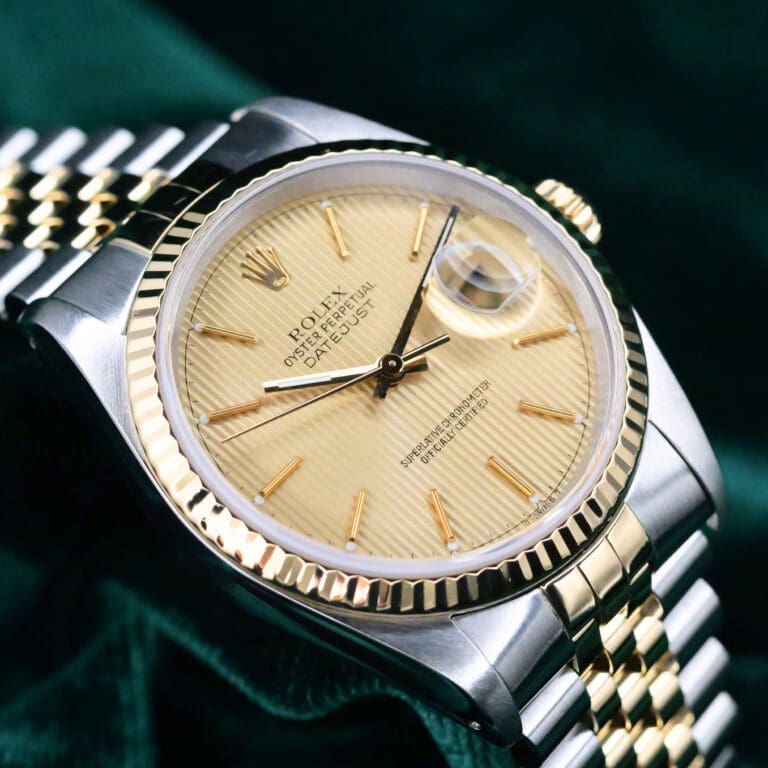

The Rolex Datejust 36 reference 16233 is the two-tone, fluted-bezel version of the five-digit Datejust generation, produced from 1988 to approximately 2005. It combines a 36 mm stainless steel Oyster case with 18k yellow gold on the bezel, winding crown, and bracelet center links, a pairing Rolex calls Yellow Rolesor.
The 16233 replaced the reference 16013 and introduced three meaningful updates to the two-tone Datejust formula: a scratch-resistant sapphire crystal in place of acrylic, the then-new Caliber 3135 automatic movement, and the upgraded Twinlock winding crown. It belongs to the Datejust line, the collection built around the automatically changing date window that Rolex introduced in 1945.
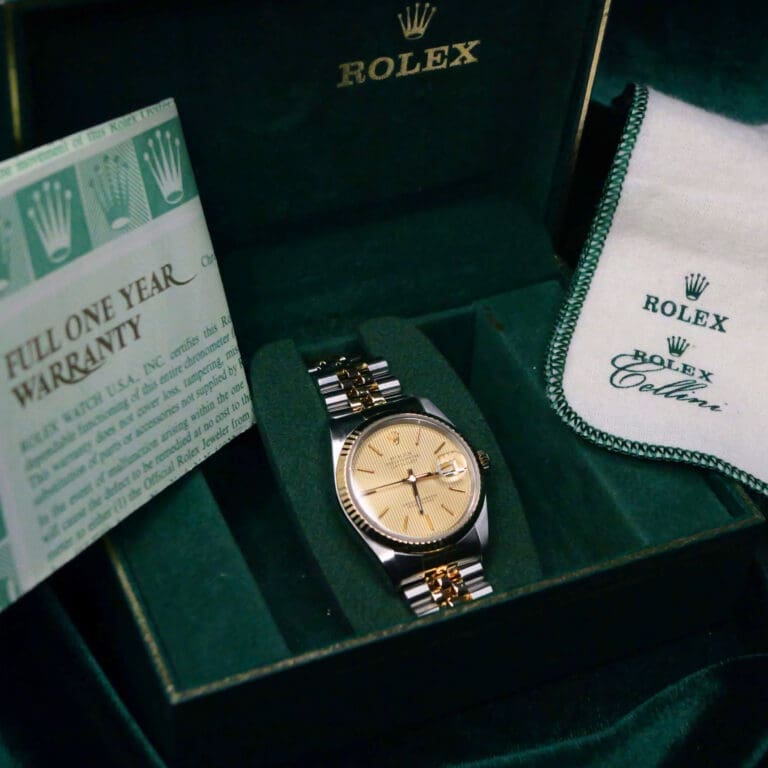
This page covers the champagne tapestry dial configuration. The tapestry dial is a textured dial motif of the five-digit era, with fine vertical ridges cut into the dial surface. It was discontinued when the five-digit Datejust series ended production, so the motif does not appear on the six-digit references that followed.
Within the Rolex catalog of its time, the 16233 sat in the core of the Datejust range: a regular-production dress watch positioned between the all-steel references and the solid gold models, and one of the highest-volume configurations of the entire five-digit generation.
Dial and Face Design
The dial is champagne colored with a tapestry finish: thin vertical ridges machined across the full dial surface. The ridged texture catches light directionally, so the dial reads brighter or darker depending on viewing angle, which distinguishes it from the flat and sunburst champagne dials offered on the same reference.
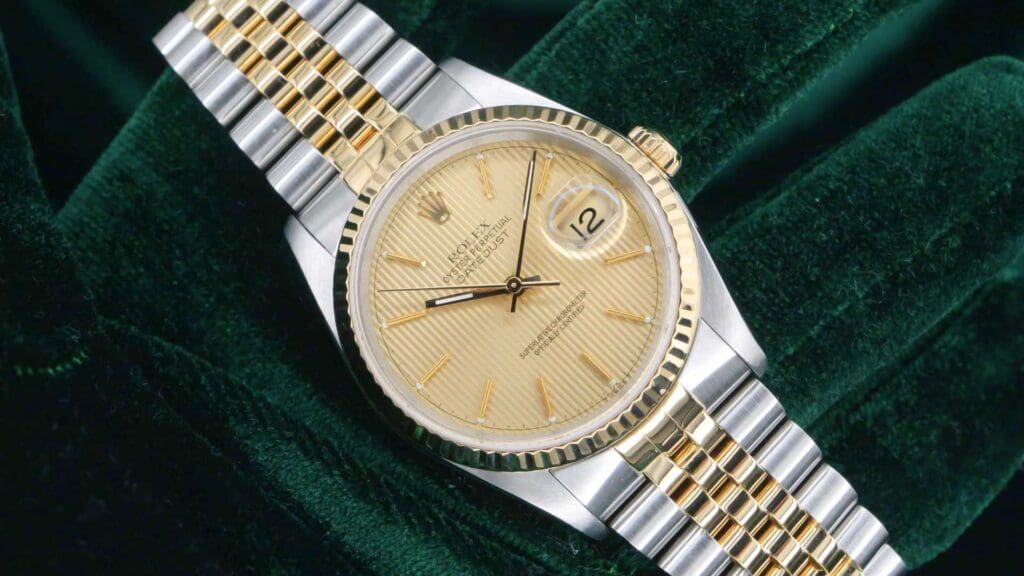
Hour markers are applied gold batons with luminous plots at their outer ends. Hands are gold-toned baton style with luminous fill, plus a slim center seconds hand. On a 1990 example the luminous material is tritium, consistent with Rolex production of that era; later examples of the reference moved to non-radioactive luminous material in the late 1990s.
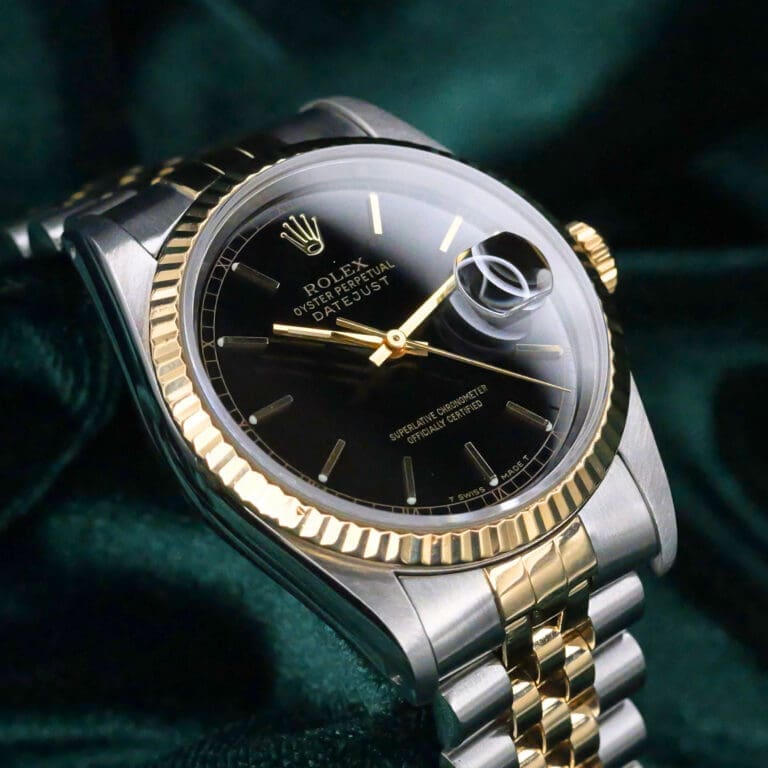
The date is displayed in a window at 3 o’clock and is magnified 2.5x by the Cyclops lens on the crystal. Dial text reads ROLEX, OYSTER PERPETUAL, DATEJUST below the coronet at 12 o’clock, and SUPERLATIVE CHRONOMETER OFFICIALLY CERTIFIED above 6 o’clock.
Related Models from Majestix
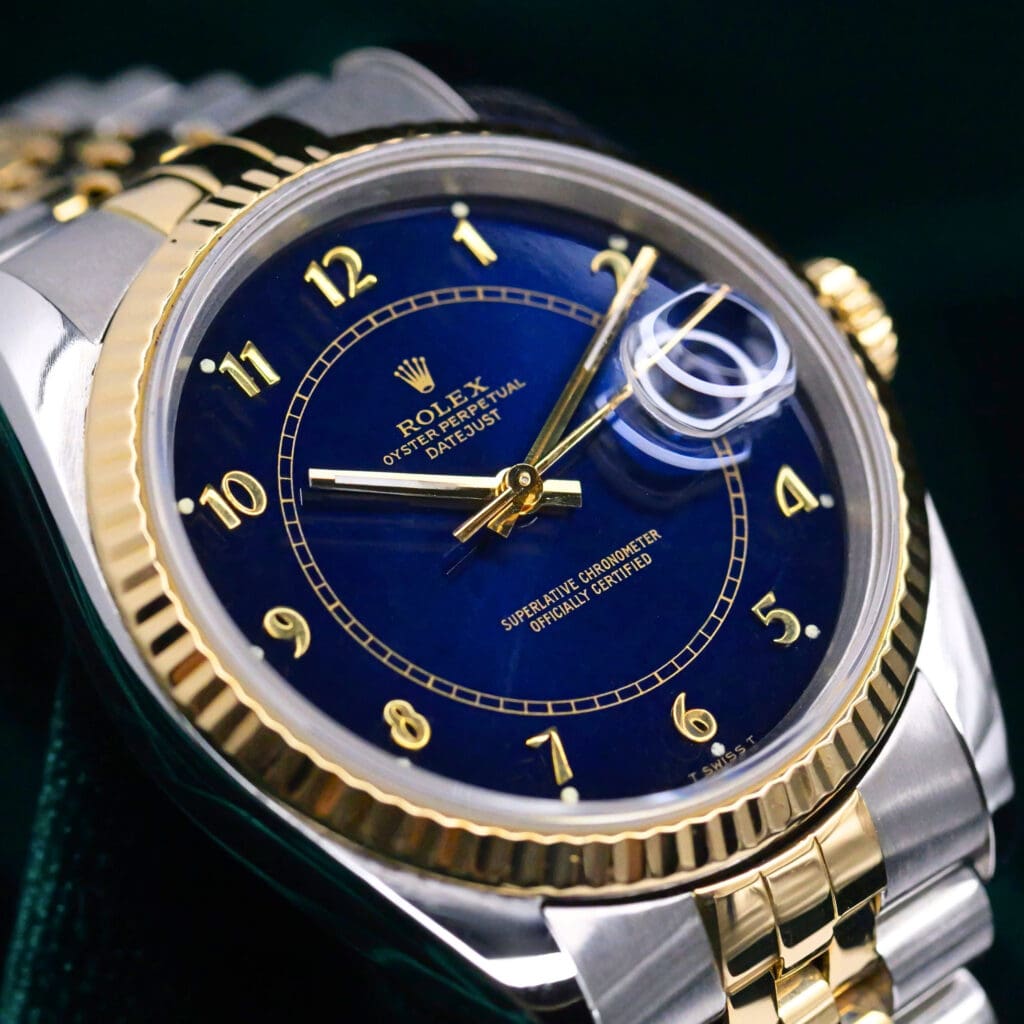
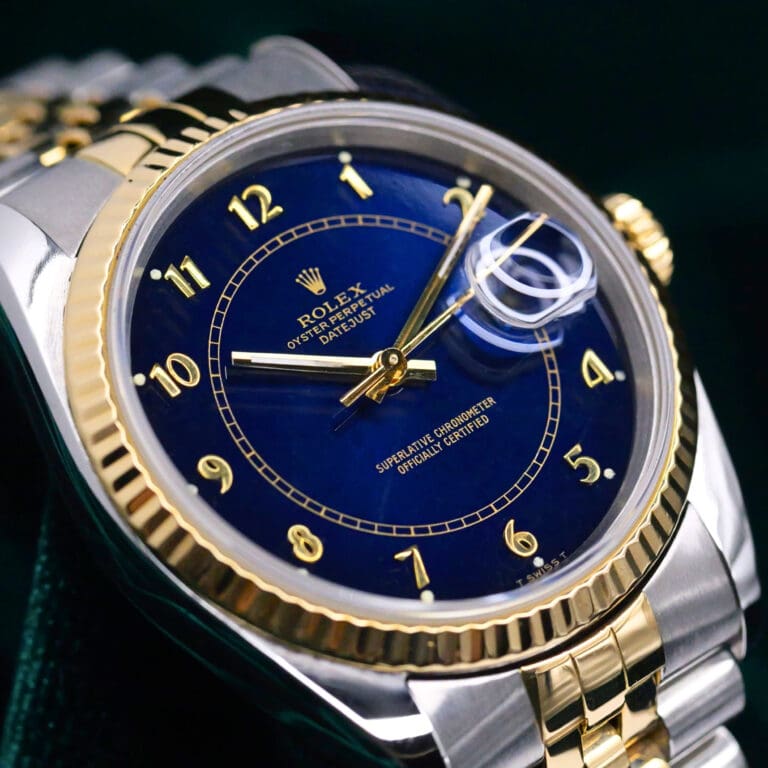
Rolex Datejust Blue Arabic Numeral Refinished Dial Fluted Bezel Jubilee Bracelet 18k Yellow Gold Stainless Steel 36mm MINT CONDITION 16233

2026 NEW UNWORN Rolex Datejust 36 Silver Dial Diamond VI & IX (6-9) Roman Numerals Fluted Bezel Jubilee Bracelet Two-Tone Yellow Rolesor Stainless Steel 18k Yellow Gold 36mm COMPLETE SET 126233-0031
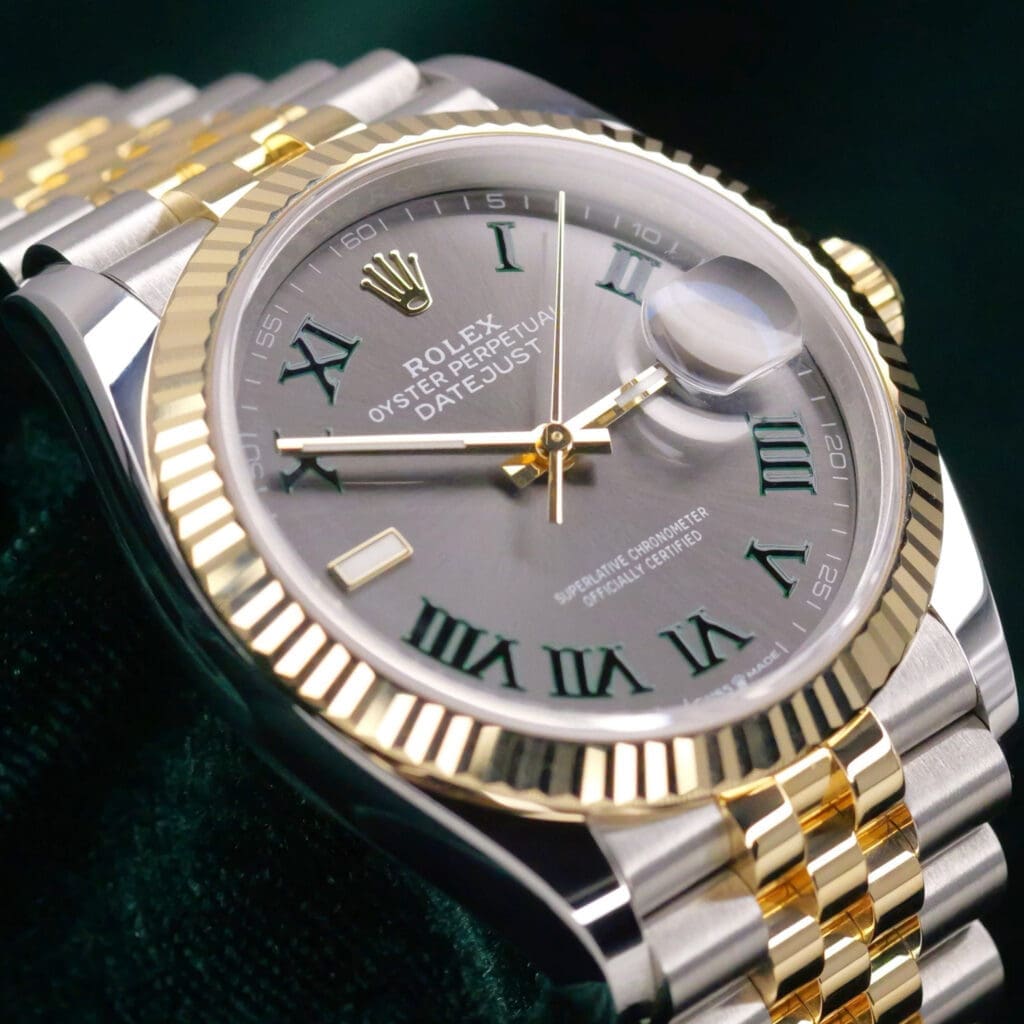
2025 NEW UNWORN Rolex Datejust 36 "Wimbledon" Slate Grey Dial Green Roman Markers Fluted Bezel Jubilee Bracelet Two-Tone 18k Yellow Gold Stainless Steel 36mm COMPLETE SET 126233-0035
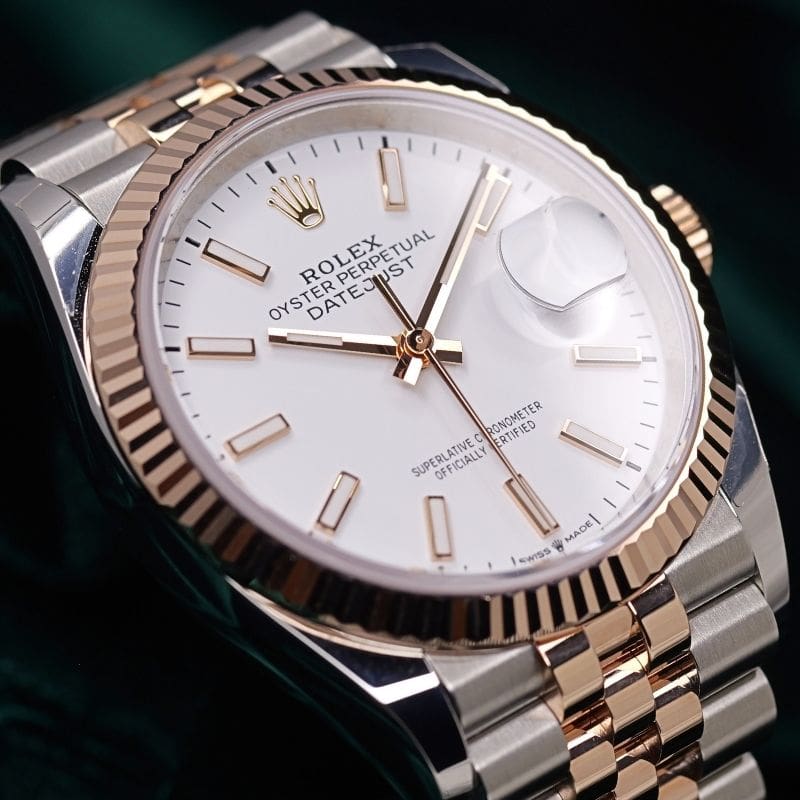
2026 NEW UNWORN Rolex Datejust 36 White Dial Rose Gold Fluted Bezel Jubilee Bracelet Two-Tone 18k Rose Gold Stainless Steel 36mm COMPLETE SET 126231-0017
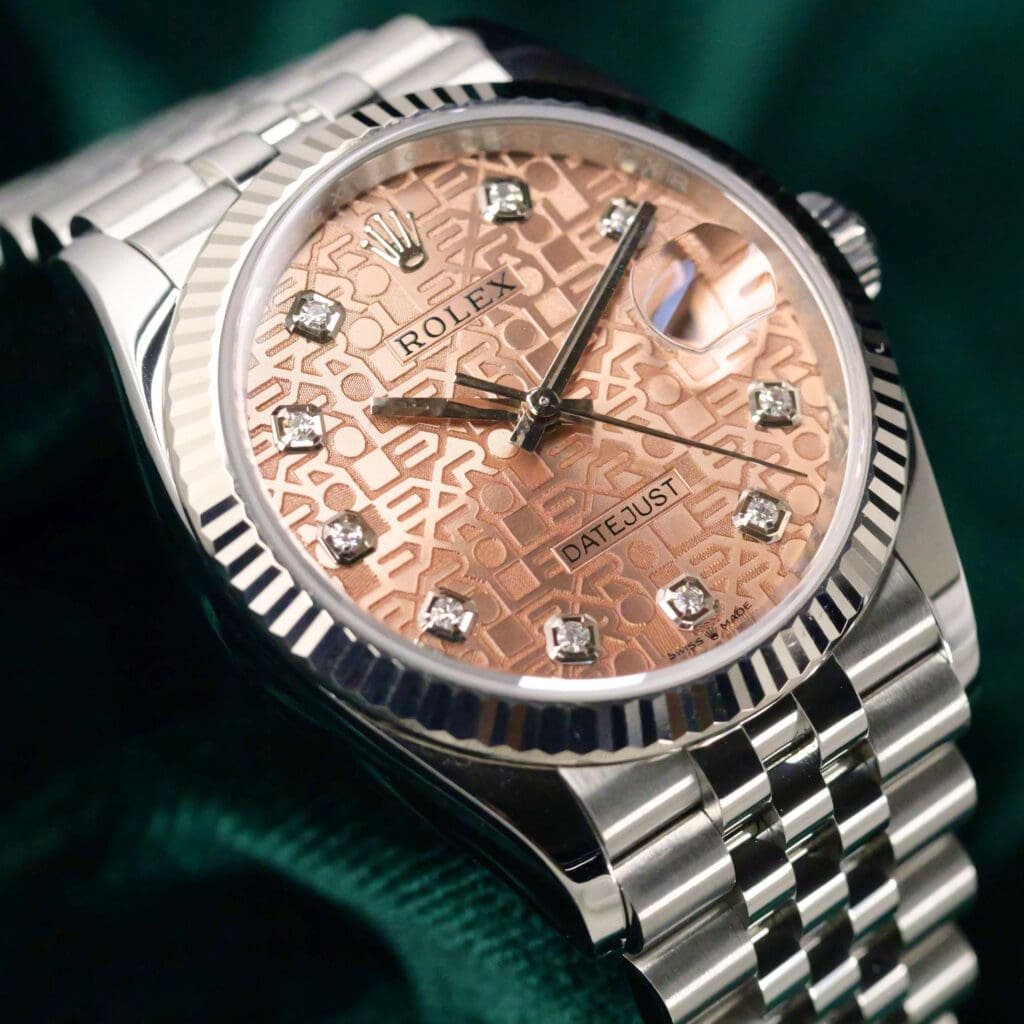
Rolex Datejust Anniversary Pink Dial Diamond Markers 18k White Gold Fluted Bezel Jubilee Bracelet Stainless Steel 36mm MINT CONDITION COMPLETE SET 126234
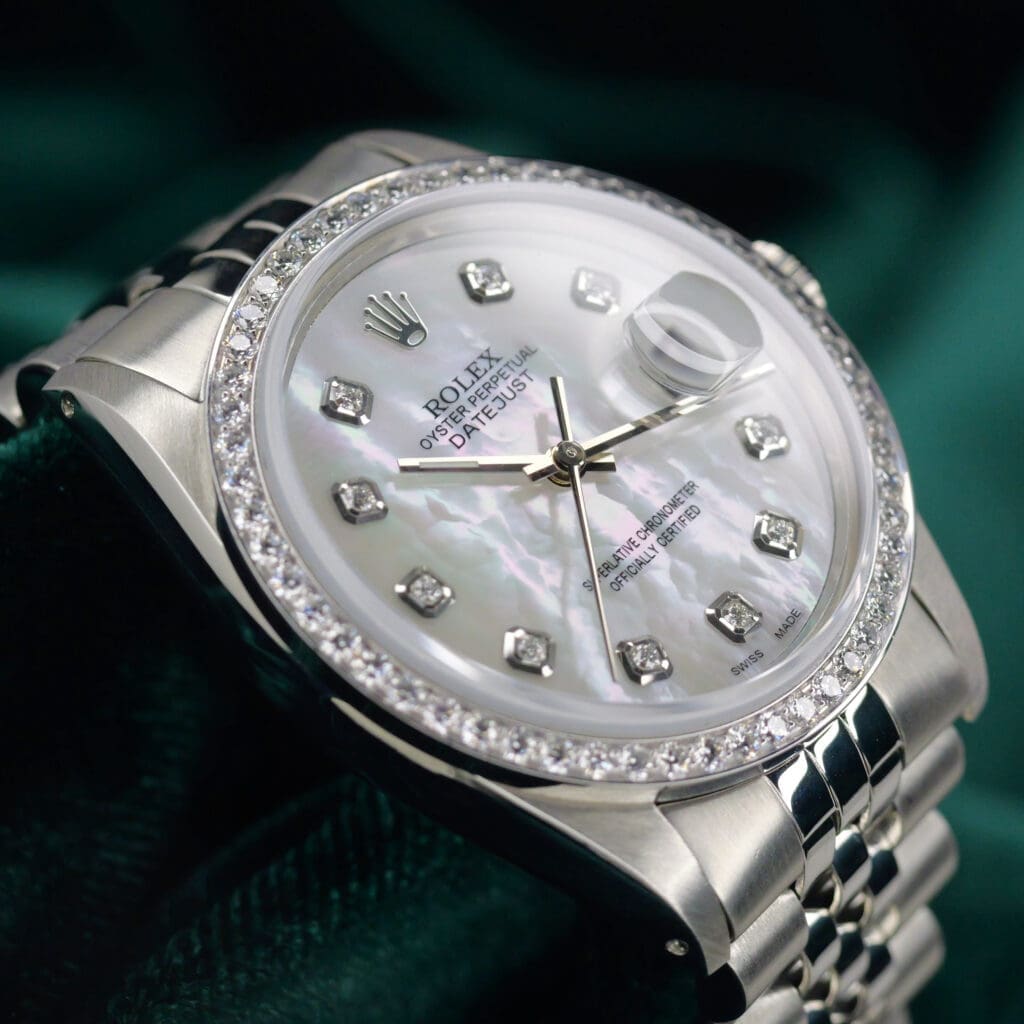
Rolex Datejust 36 AM Mother of Pearl Dial AM Natural Diamond Bezel Jubilee Bracelet Stainless Steel MINT CONDITION 16030
Case and Bezel
The case is the round 36 mm Oyster case in stainless steel, with brushed lug tops and case flanks and polished case sides typical of the five-digit Datejust. A 1990-production example has drilled lug holes; the no-holes case appeared only late in the reference’s run. Thickness and lug-to-lug are not officially published for this reference, so they are not stated here.
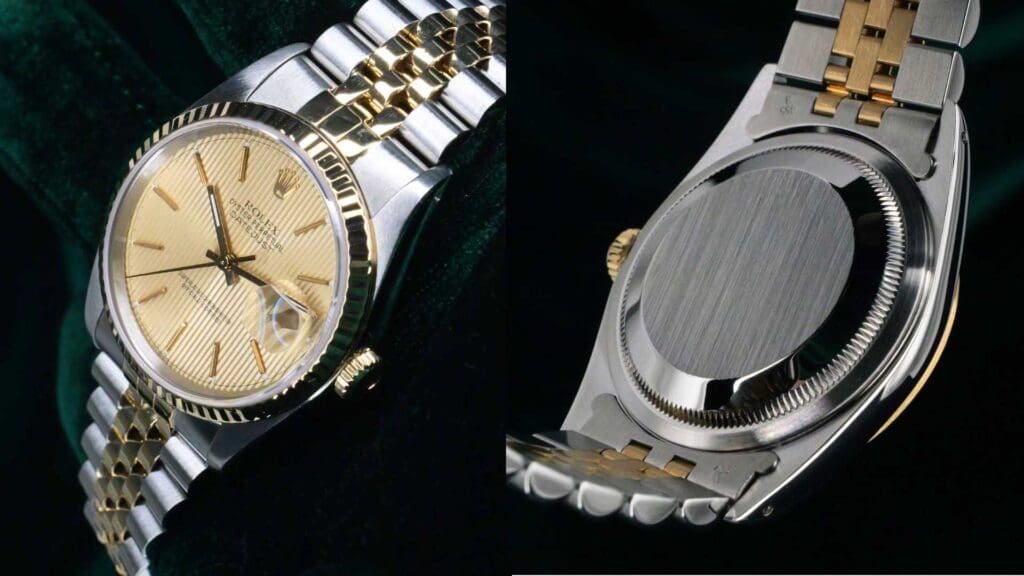
The crystal is flat sapphire with the Cyclops date magnifier. The winding crown is 18k yellow gold and uses the screw-down Twinlock system, a double-gasket sealing arrangement. There are no crown guards. The caseback is a solid, smooth, screw-down steel back with no engraving on the outer surface.
Water resistance is 100 meters (10 ATM), the standard rating for the Oyster case in this configuration.
The bezel is 18k yellow gold with a fluted profile. It is fixed and purely decorative: the fluting is a design signature carried over from the era when the bezel’s knurling was used to screw it onto the case, and it serves no timing or measuring function on this reference.
Bracelet and Clasp
This configuration wears the two-tone Jubilee bracelet, reference 62523H 18, in stainless steel with 18k yellow gold center links. The Jubilee is a five-link design with narrow center links flanked by wider outer links; on this bracelet the gold center links are polished and the steel outer links are brushed.
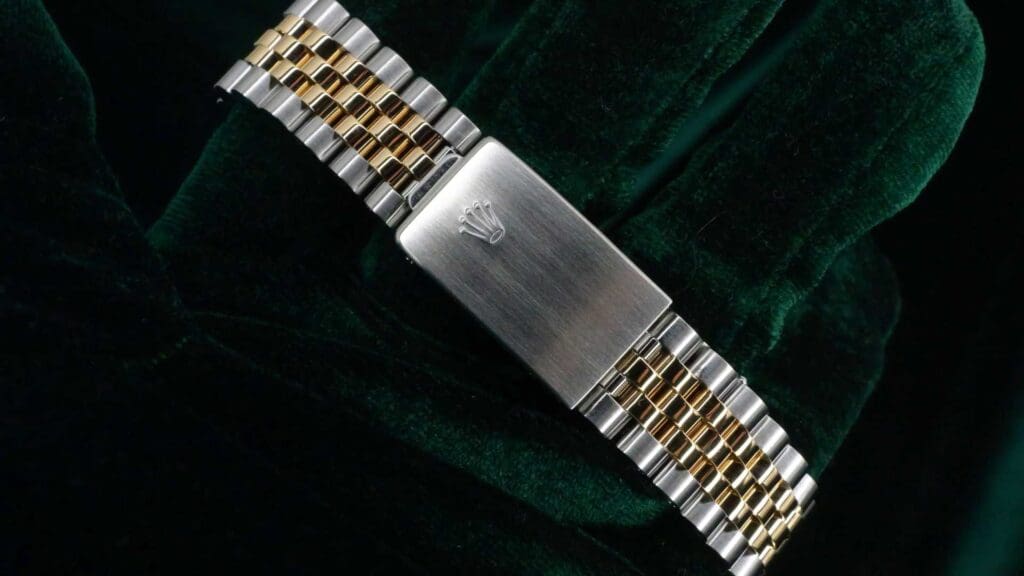
Construction of the era uses hollow folded outer links and hollow end links stamped 455 or 455B, fitted to the 20 mm lug width. The bracelet closes with a stamped folding clasp signed with the Rolex coronet. There is no on-the-fly extension or micro-adjust system; sizing is done by link removal.
The 16233 was also offered on the three-link Oyster bracelet as a factory alternative. The Jubilee is the configuration shown here and is the bracelet most closely associated with the Datejust line.
Movement and Functionality
The watch is powered by the Rolex Caliber 3135, an in-house automatic movement introduced in 1988, the same year this reference launched. It carries 31 jewels, runs at 28,800 vph (4 Hz), and delivers approximately 48 hours of power reserve. It is a COSC-certified chronometer, adjusted in five positions and for temperature.
The 3135 winds bidirectionally through a Perpetual rotor and includes a hacking seconds function, so the seconds hand stops when the crown is pulled to the time-setting position. A 1990-production 3135 uses the standard balance hairspring of the era; the Parachrom hairspring appeared in this caliber only in the 2000s.
Functions are hours, minutes, center seconds, and the instantaneous date. Operation: unscrew the crown to position 1 for manual winding; pull to position 2 and turn to quickset the date independently of the hands; pull to position 3 to set the time with the seconds hand hacked. Screw the crown back down fully to restore water resistance.
Materials of the Watch
The case middle and caseback are stainless steel, providing the structural body of the watch. Rolex marketing of this era describes the two-tone combination as Rolesor: steel for the case, 18k yellow gold for the bezel, winding crown, and bracelet center links.
The bezel and crown are 18k yellow gold, as are the bracelet center links; the outer bracelet links and clasp are stainless steel. The crystal is sapphire, with the Cyclops magnifier over the date.
The dial carries applied gold-toned baton markers and gold-toned hands, with tritium luminous plots on a 1990 example. The champagne dial surface is finished with the machined tapestry ridging rather than a flat lacquer or sunburst.
Overall material character: a steel-bodied everyday watch with solid 18k yellow gold at every visible accent point, giving gold warmth without a full gold case’s weight or cost.
Box and Papers
A typical full set for a 1990-sold 16233 includes:
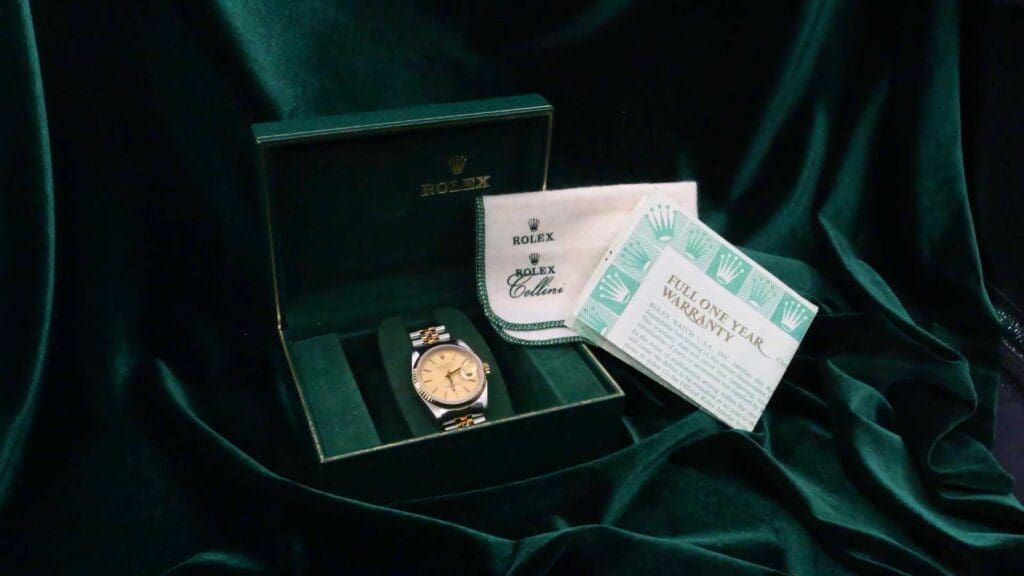
- Rolex presentation box of the era (inner box with outer card box)
- Punched paper Guarantee certificate, dealer-stamped and dated
- Green leather or leatherette papers wallet holding the certificate
- Rolex instruction and translation booklets of the era
- Red chronometer hang tag and green crown hang tag
- Any dealer-supplied purchase documents (receipt, service history if later serviced)
There are no reference-specific extras for this configuration: no additional strap, tools, or numbered certificate. Completeness for a full set rests on the era-correct box, punched guarantee paper, wallet, booklets, and tags.
Box and Papers
A typical full set for a 1990-sold 16233 includes:
- Rolex presentation box of the era (inner box with outer card box)
- Punched paper Guarantee certificate, dealer-stamped and dated
- Green leather or leatherette papers wallet holding the certificate
- Rolex instruction and translation booklets of the era
- Red chronometer hang tag and green crown hang tag
- Any dealer-supplied purchase documents (receipt, service history if later serviced)
There are no reference-specific extras for this configuration: no additional strap, tools, or numbered certificate. Completeness for a full set rests on the era-correct box, punched guarantee paper, wallet, booklets, and tags.
Box Variations
The 16233’s long production run spans three box generations:
Gen 1 (approximately 1988 to early 1990s)
- Dark-green textured presentation box, frequently with a cream or tan interior
- Paired with a green-and-gold or patterned outer carton
- Early sets can vary considerably by market
Gen 2 (approximately early/mid-1990s to late 1990s)
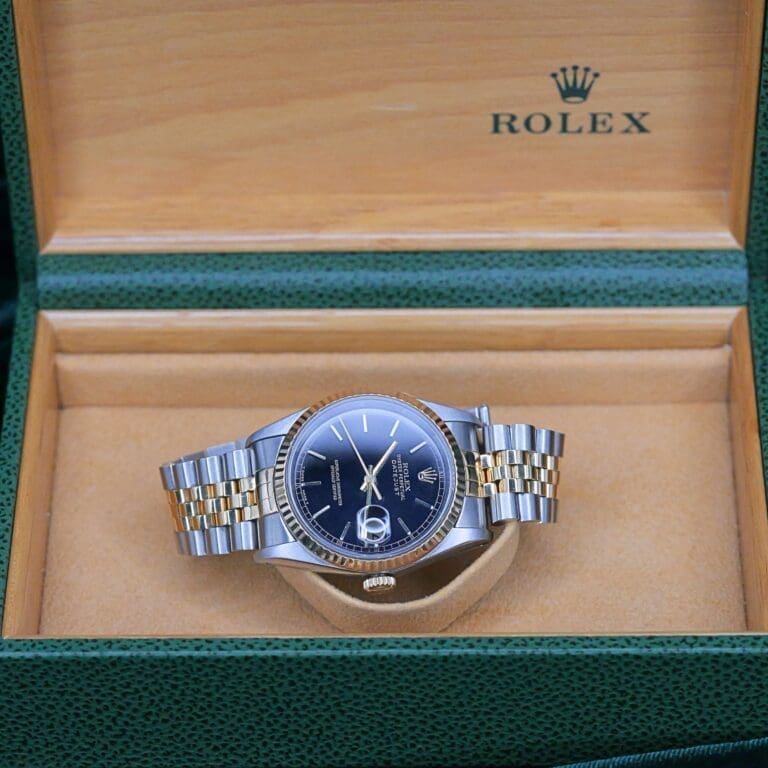
- Green leatherette rectangular box with a varnished wood inner lid and tan cushion/interior
- Usually accompanied by the marble-patterned Rolex outer box
- Documented 1990 and 1996 sets show this general configuration
Gen 3 (approximately late 1990s to 2005)
- Later green presentation-box family with updated exterior texture, interior fittings, booklet wallet and outer packaging
- Exact box size and code depended on the supplying market and retailer
Hang tags of the era (a red Superlative Chronometer tag and a green crown tag) accompanied the watch at delivery across these generations. A 1990-sold example sits at the Gen 1 to Gen 2 transition, so either configuration can be period-plausible depending on market and sale date.
Examples returned from later Rolex service, or sold late in the run, may instead sit in the green wave-style box introduced around 2005. A wave box paired with a 1990 watch indicates a replacement or service box, not the original packaging. For a “full set” listing, a box from the wrong generation should be described as a later or replacement Rolex box rather than the original, and box details that cannot be tied to the specific sale year should be described generically.
Original Warranty
A 16233 sold new in 1990 carried the Rolex international guarantee of the era, honored through the authorized dealer network worldwide. The guarantee document of this period is the punched paper Guarantee certificate: a paper certificate carrying the watch’s serial and reference in punched-hole form, completed, stamped, and dated by the authorized dealer at sale. Rolex’s guarantee term before the July 2015 extension was two years, and the credit-card-style guarantee card did not exist in this era; paper certificates remained in use until the mid-2000s.
Warranty Variations
The 16233’s guarantee papers fall into two paper generations, and the reference never shipped with a card:
Gen 1 (approximately 1988 to mid-1990s)
- Large paper guarantee/certificate, generally punched or typed with the reference and serial number
- Layout, language and country code varied by market
- Green papers wallet and era instruction booklets accompanying the certificate
Gen 2 (approximately mid-1990s to 2005)
- Revised paper guarantee/certificate with updated printing and security/layout details
- Still a paper document rather than the later credit-card-style warranty
- Two-year international guarantee term applicable across both paper generations, well before the five-year term introduced for purchases from July 2015
Plastic warranty card
- Generally not correct as the original sales warranty for a 16233; Rolex introduced card-style guarantees around the transition to later six-digit models
- A plastic card found with a 16233 is commonly a later service guarantee, not the original warranty document; one photographed 16233 set, for example, contains a later international service guarantee
- Examples serviced by Rolex after purchase receive a Rolex service guarantee (currently two years on a full service) documented on service paperwork, separate from the original certificate
The original factory guarantee has long expired on every example of this reference. Current warranty coverage on a pre-owned example comes either from a Rolex service guarantee following an official service or from the seller’s own guarantee. For full-set valuation, the punched paper certificate is the primary authenticity document: a stamped, dated certificate whose punched serial matches the case adds materially to the set, while a blank, photocopied, or mismatched certificate is a red flag.
Variations
The 16233 itself is defined by two constants: the Yellow Rolesor case construction and the 18k yellow gold fluted bezel. Within those constants it was produced across a wide range of factory configurations:
- Dial colors including champagne, silver, white, black, blue, and slate
- Dial finishes including flat, sunburst, and textured motifs such as tapestry, linen, and jubilee-pattern dials
- Marker styles including baton indices, Roman numerals, Arabic numerals, and factory diamond settings
- Bracelet options: Jubilee (as on this configuration) or Oyster
- Running production changes across 1988 to approximately 2005, including the move from tritium to non-radioactive lume in the late 1990s and the no-holes case late in the run
Sister references in the five-digit Datejust 36 family use different bezel and metal combinations under their own reference numbers, including the 16234 (steel case with 18k white gold fluted bezel) and the 16200 (all steel with smooth bezel). The champagne tapestry dial shown here is one dial configuration of the 16233, not a separate reference.
Production and Discontinuation Status
- Currently in production: No
- Year introduced: 1988
- Year discontinued: approximately 2005
- Production run length: approximately 17 years
The 16233 was one of the highest-volume Datejust references of its generation and was succeeded in the catalog by the six-digit two-tone Datejust 36, reference 116233, which retained the Caliber 3135 and fluted gold bezel with updated case and bracelet construction. The tapestry dial motif ended with the five-digit series and was not carried over.
On-Wrist Feel
At 36 mm with a 20 mm lug width, the 16233 wears as a classic mid-size watch by current standards. The fluted bezel and bright gold accents give it more visual presence than the diameter suggests, while the slim Oyster case profile keeps it comfortable under a shirt cuff.
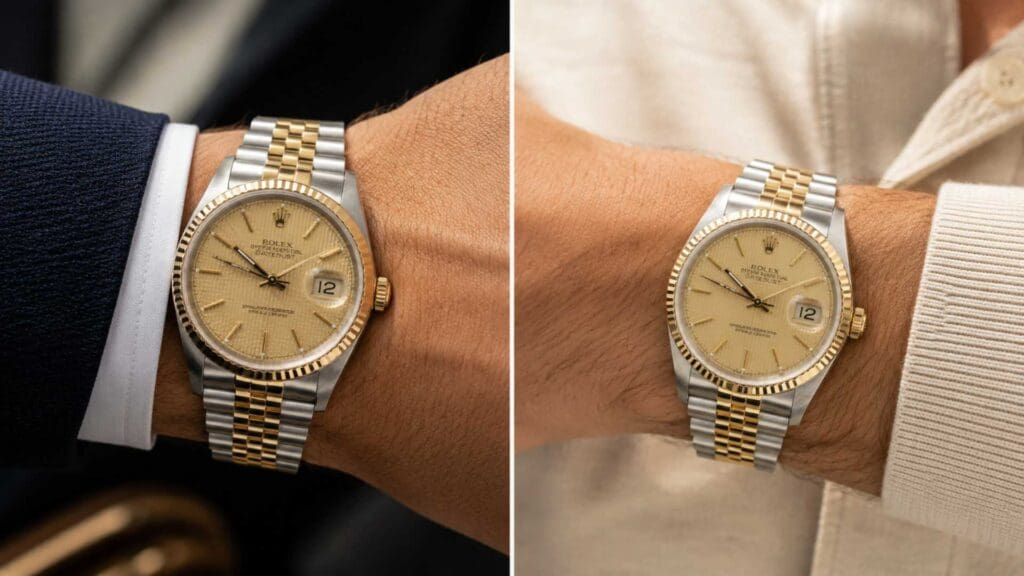
The Jubilee bracelet is the main comfort story. Its five-link construction with hollow links of the era is light and drapes closely around the wrist, noticeably more supple than the Oyster bracelet alternative. The trade-off of the hollow-link construction is that older bracelets can develop stretch between links, which is a condition point on any example of this age.
The 36 mm case suits a wide band of wrist sizes and works for wearers of any gender. The champagne tapestry configuration leans dressier than the silver or white dial versions, and the watch fits office wear, formal settings, and everyday use in the way the Datejust line was designed to.