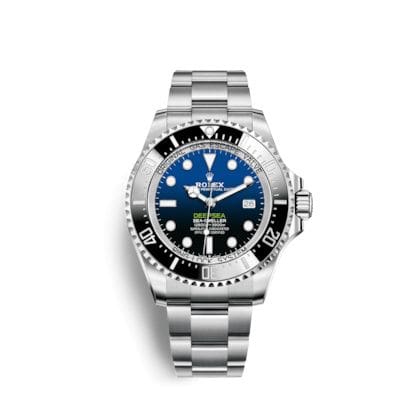
When Rolex unveiled the Deepsea Sea-Dweller with the D-Blue dial, it was telling the story of the Sea-Dweller Deepsea James Cameron 136660 – a watch that celebrates a milestone in exploration: where filmmaker and ocean explorer James Cameron’s 2012 solo descent to the bottom of the Mariana Trench. More than 35,000 feet beneath the ocean’s surface, this feat highlighted the kind of engineering few watches can truly lay claim to.
This watch is built to function at extreme depths, rated to 3,900 meters, but it also captures attention above sea level with a dial that fades from vivid blue to deep black, symbolizing Cameron’s journey from surface light into the ocean’s abyss. Over time, the model has become a favorite among collectors who appreciate what it represents: a return to a tool-watch heritage, made for those who push boundaries.
To understand how this modern reference came to be, it helps to first look back at the Sea-Dweller’s origins, and how it evolved to this standout model.
Watch our tour video about the Rolex 136660-0005 Deepsea James Cameron

Rolex has long been associated with exploration, from mountain peaks to the depths of the ocean. That spirit of reliability came into sharp focus in 1967, when the brand introduced the Sea-Dweller — a dive watch created specifically for saturation divers working at extreme depths.
Over the decades, the Sea-Dweller continued to evolve. References like the 1665, 16660, and 16600 pushed depth ratings and durability further, each building on the last. In 2008, Rolex took things even deeper with the launch of the Deepsea 116660, featuring a newly engineered Ring Lock System capable of handling pressures at nearly 13,000 feet below sea level.

Then came a moment that perfectly tied its dive-watch legacy with modern exploration. In 2012, filmmaker and explorer James Cameron made a solo dive to the bottom of the Mariana Trench – the deepest known point in Earth’s oceans. Rolex developed a special Deepsea model for the mission, and in 2014, released the D-Blue edition as a tribute. The unique gradient dial, transitioning from blue to black, echoed Cameron’s descent from surface light into total darkness, turning a technical dive watch into a visual story.

By 2022, Rolex had made a number of subtle but thoughtful updates to the model, launching the current 136660 reference. While it retains the 44mm size and engineering of the original, the details were refined to improve both aesthetics and usability.
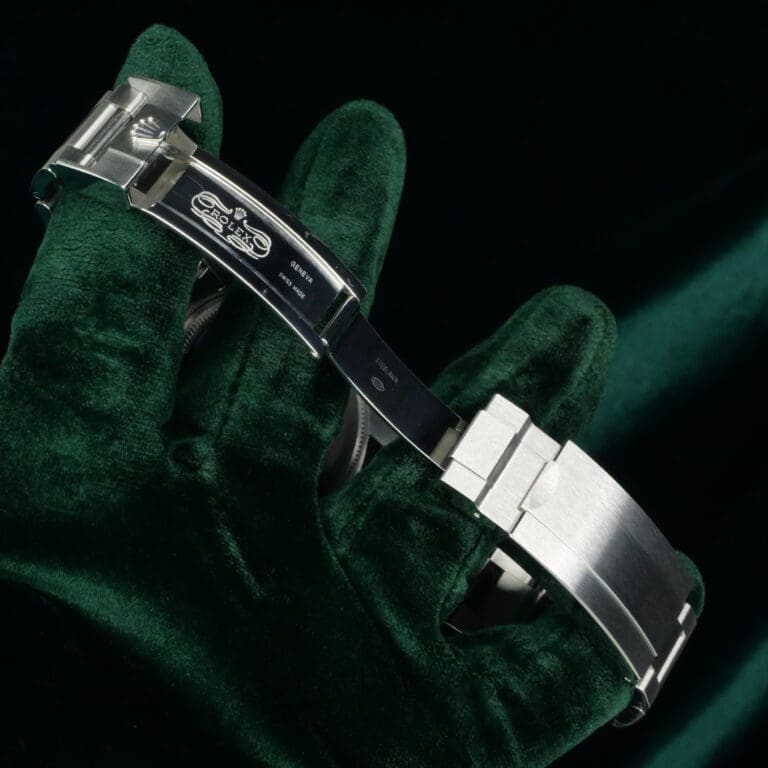
The bezel was slimmed down slightly, and the sapphire crystal was reshaped with a subtle angled edge to sit more cleanly on the case. Rolex also increased the date aperture by 8%, improving legibility without altering the core identity of the watch. One of the more noticeable tweaks was the removal of the Fliplock wetsuit extension, previously built into the clasp. In its place, Rolex now equips the bracelet with a more streamlined Glidelock system, allowing easy micro-adjustments up to 20mm in 2mm increments.
The titanium caseback – part of the core Ring Lock System – was also given a name of its own: Rolex Titanium, a small branding change that reflects the material’s lightness and strength.
These updates may seem minor on paper, but they represent the ongoing commitment to functional design. And to fully appreciate how these changes impact the watch’s feel and structure, we need to look closer at the case and strap construction.
With all the updates made to the 136660, what hasn’t changed is the Deepsea’s focus on durability. These refinements were made to support one of the most engineered cases in its catalog – a design that prioritizes performance in extreme environments.
At the heart of the structure is the Ring Lock System, a patented case architecture designed to handle the intense pressure of deep-sea diving. The 44mm Oystersteel case is paired with a Rolex Titanium caseback, chosen for its strength-to-weight ratio and corrosion resistance. Sitting above it all is a 5.5mm domed sapphire crystal, supported by an inner steel compression ring that reinforces the case from the inside out. Together, these components allow the watch to achieve its 3,900-meter water resistance, while maintaining structural integrity under pressure.
Despite its size, the case has a balanced wrist presence thanks to the solid Oyster bracelet, which was widened in past revisions to better match the case dimensions. The sides of the case are fully polished, contrasting against the brushed finish of the bracelet for added visual texture. At 17.7mm thick, the Deepsea has undeniable weight, but Rolex manages the weight through careful distribution – especially with the removal of the Fliplock and inclusion of the Glidelock system, which offers easy, tool-free micro-adjustments for comfort and wetsuit compatibility.
While the case may impress with its engineering, the dial is where the James Cameron edition really starts to set itself apart.

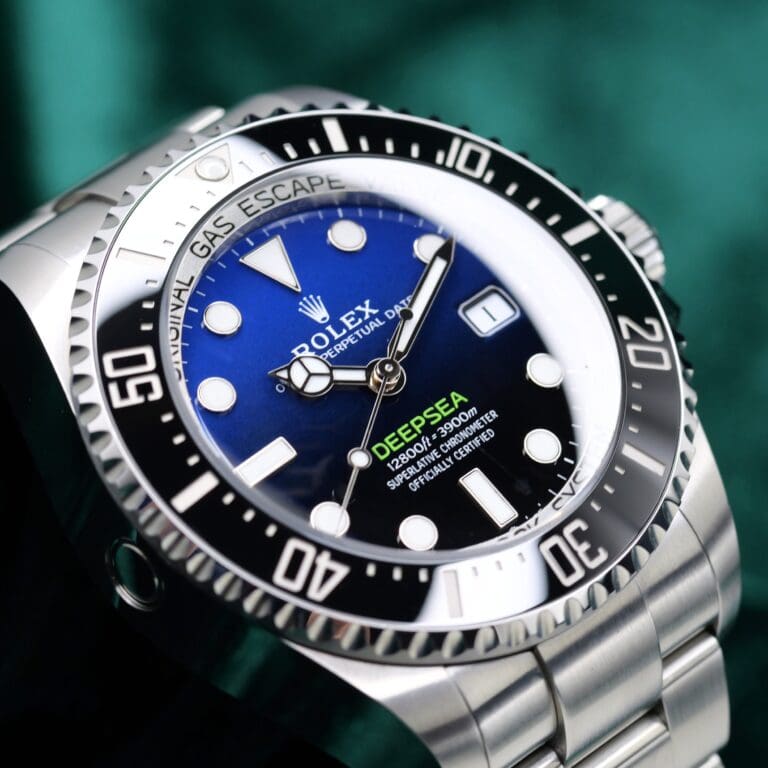
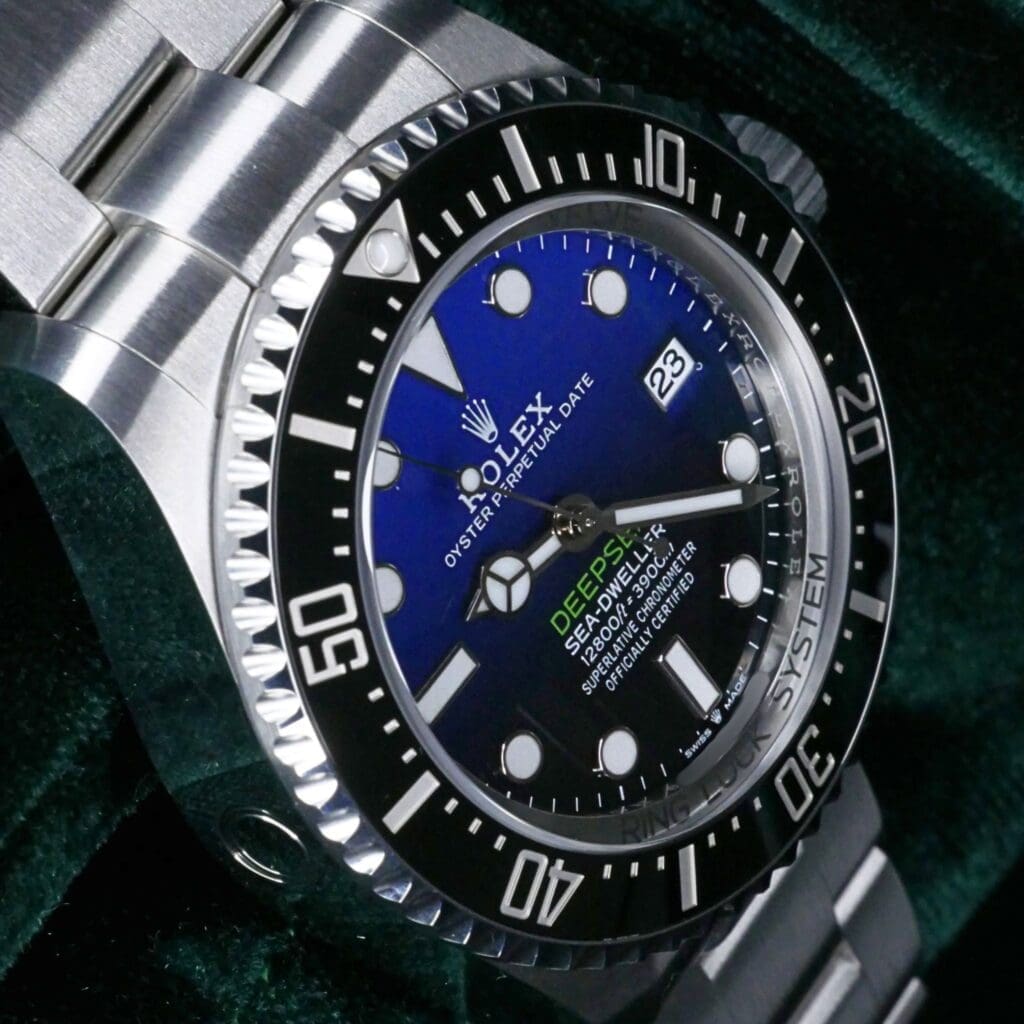
For all the engineering that goes into Deepsea’s case, the D-Blue dial is what makes this model instantly stand out. Introduced in 2014 to commemorate James Cameron’s historic dive, the gradient dial fades from bright blue at the top to deep black at the bottom – symbolizing his descent from the ocean’s surface into the pitch-black depths of the Mariana Trench. The green “DEEPSEA” text at 6 o’clock mirrors the color of Cameron’s submersible, adding a distinct visual cue tied to the story behind the watch.
Surrounding the dial is a chapter ring engraved with the words Original Gas Escape Valve Ring Lock System, a reminder of the technical architecture encasing the movement. While the outer dial brings in symbolic storytelling, the inner components stay focused on clarity and performance.

Hour markers and hands are made of 18ct white gold, chosen for its resistance to tarnish, and filled with Chromalight, a proprietary luminescent material. The blue glow it emits in the dark is not only easy to read, it also lasts longer than traditional lume.
Notably, the date window at 3 o’clock does not include a Cyclops magnifier, but this isn’t a design omission. The crystal’s thickness – over 5mm – simply doesn’t allow for the Cyclops feature. Instead, the updated 136660 reference increases the size of the date aperture and numerals by 8% to enhance legibility.
Behind the dial’s gradient beauty and clear display is a movement designed to match Deepsea’s technical expectations, and that’s where the next evolution becomes clear.

The dial might tell the story of James Cameron’s dive, but it’s what powers the Deepsea that ensures this watch performs long after the story fades. Behind the gradient display is the Rolex caliber 3235, a movement that represents a major leap from its predecessor, the 3135.
The 3235 is also fitted with a Parachrom hairspring, crafted from a niobium-zirconium alloy that offers strong resistance to temperature fluctuations and magnetic interference – both important for reliability in extreme environments. The movement operates at 28,800 vibrations per hour (4 Hz) and is fitted with a bi-directional winding rotor, keeping the power reserve full with regular wrist movement.
Additional features include:
Every caliber 3235 is also subjected to the Superlative Chronometer certification, meaning the fully cased watch is tested to an accuracy standard of +2/-2 seconds per day – tighter than standard COSC chronometer ratings.
It’s a movement built for serious use and one that aligns with Deepsea’s reputation as a high-performance tool. Of course, all that engineering only matters if the watch actually works on the wrist – and that’s where wearability becomes part of the conversation.
| Section | Key Highlights |
| Origins | Introduced in 1967 with a helium escape valve for saturation diving; 2014 D-Blue edition honors James Cameron’s 2012 Mariana Trench dive. |
| Design Evolution | Launched in 2022; slimmer bezel, angled crystal, larger date windowFliplock removed and replaced with Glidelock Rolex Titanium caseback branding |
| Case & Strap | Features a 44mm Oystersteel case with brushed top surface and smooth sides, Rolex Titanium caseback, and 5.5mm sapphire crystal Solid Oyster bracelet with Glidelock Polished sides and 17.7mm thickness. |
| Dial Design | D-Blue gradient dial from blue to blackGreen ‘DEEPSEA’ textChromalight lume on 18ct white gold markersEnlarged date aperture without Cyclops |
| Movement & Functionality | Caliber 3235 with 70-hour power reserve Chronergy escapement Parachrom hairspring Quickset date Hacking seconds+2/-2 sec/day Superlative Chronometer certified. |
| How It Wears | Despite large size, improved wearability with better lug profile and bracelet integrationGlidelock allows for fine adjustment Favored for its unique story and purpose-built engineering |

With everything packed into the Deepsea – its pressure-tested case, movement enhancements, and symbolic dial – one of the most common questions becomes: How does it actually wear on the wrist?
The 44mm case diameter and 17.7mm thickness certainly give the watch a strong presence. But thanks to the updates in the 136660 – particularly the revised lug profile and better bracelet integration – many owners find that it wears more comfortably than the original 116660. The bracelet now tapers more naturally, helping distribute the weight more evenly across the wrist. The Glidelock clasp also plays a big role here, allowing precise adjustments throughout the day without needing any tools.
That said, this is not a watch that tucks quietly under a shirt cuff. It’s tall, wide, and built with purpose. But for those with medium to large wrists – or for anyone who appreciates a watch that feels secure and substantial – the Deepsea delivers. It’s a timepiece that doesn’t just sit on your wrist; it anchors itself with presence.
And that presence is a big part of why collectors seek it out. The James Cameron Deepsea isn’t meant to be everyone’s go-to daily piece. It’s more like a statement item – the equivalent of a high-clearance SUV that’s just as comfortable off-road as it is in the city. While most owners won’t ever dive to 3,900 meters, they still appreciate the idea that their watch is built to go that far.
Collectors drawn to this model often resonate with its backstory and overbuilt nature. It is for those who want more than just a diver – they want something with heritage, utility, and a connection to real-world exploration. And while it might overlap with other professional models like the Submariner, the Deepsea occupies a very different lane. It’s not trying to be versatile – it is trying to be exceptional at one thing: extreme underwater endurance.