
Ever wonder why some Zenith buying guide articles leave you impressed but still unsure which watch is right for you? Most buyers face the same issue. You compare models, sometimes even across other collections like the Majestix Collection, read specs, and still cannot clearly see which Zenith watch fits your wrist, budget, and purpose.
This guide makes that decision simple. We break down the real differences between Zenith models, explain the El Primero movement in plain language, and show you how pricing changes across new and pre-owned markets.
Instead of guessing, you will understand exactly what you are paying for and which watch gives you the best value. If you are ready to choose the right Zenith watch with confidence, let’s break it down.
Is Zenith a Good Watch Brand Worth Buying?
Yes, Zenith is a strong Swiss watch brand worth buying, especially known for its in-house movements and long-standing heritage from the Zenith Manufacture Le Locle. The brand was founded in 1865 in Switzerland, giving it a deep history in traditional Swiss watchmaking.
Unlike many brands in its price range, Zenith does not rely on outsourced calibers, which gives you direct access to true manufacture-level watchmaking. Zenith stands out because it builds its reputation on technical performance and precision engineering rather than marketing volume.
The brand has earned 2,333 chronometry prizes, which reflects consistent accuracy testing across its history. This is important if you want a watch supported by measurable performance standards rather than one chosen purely for its design.
As part of the LVMH group, Zenith benefits from global service coverage and stable distribution networks. This makes long-term ownership more practical because you can access servicing and parts support in multiple regions without difficulty. It adds reliability beyond the initial purchase.
Zenith also holds a unique position in the luxury segment. It delivers high-level movement quality at a lower price point than more mainstream luxury brands, mainly because it has lower brand-driven demand. This gives you stronger technical value per dollar if your focus is craftsmanship rather than brand status or resale hype.
Why Does the El Primero Movement Matter So Much?

The El Primero movement is the defining innovation of Zenith Manufacture Le Locle, and it matters because it delivers high-frequency chronograph precision at 36,000 vph with true in-house engineering. This makes it one of the most important automatic chronograph movements in Swiss watchmaking history.
The El Primero is also known for one of the most important survival stories in modern watchmaking.
During the quartz crisis of the 1970s, Zenith was ordered to stop mechanical production and destroy its tooling. A watchmaker named Charles Vermot secretly preserved the El Primero blueprints and machinery inside the manufacture attic, protecting the movement from extinction.
When mechanical watches returned in the 1980s, Zenith was immediately able to restart production. The movement was so respected that Rolex used a modified El Primero (Caliber 4030) in the Daytona from 1988 to 2000, which remains one of the strongest third-party validations in Swiss watchmaking history.
Modern Evolution: El Primero 3600

The current-generation movement improves usability without losing its identity:
- 60-hour power reserve for longer daily wear
- Stop-seconds function for precise time setting
- Improved regulation for better stability
- Retains the original high-frequency chronograph architecture
This makes it more practical for everyday use while preserving the signature El Primero character that defines Zenith’s identity.
The combination of technical precision, historical survival, and modern refinement is what makes the El Primero movement central to understanding Zenith as a brand.
Which Zenith Watch Should You Buy?

Most Zenith watches look impressive on paper, but they serve very different purposes once you understand how they are designed for real use. Each collection reflects a different wearing style, from heritage-inspired chronographs to modern everyday sports watches.
Breaking them down by category makes it much easier to match a model to your wrist, lifestyle, and expectations.
| Category | Heritage-Focused | Modern/Tech-Focused |
| Chronograph | Chronomaster Original | Chronomaster Sport |
| Everyday/Sport | Pilot Type 20 | Defy Skyline |
| Dress/Formal | Elite Moonphase | Elite Automatic |
1. Chronomaster Original
The Chronomaster Original by Zenith Manufacture Le Locle recreates the 1969 A386 El Primero with strong historical design accuracy. The Chronomaster Original focuses on preserving Zenith’s classic chronograph identity through faithful design choices inspired by the original 1969 A386 El Primero reference.
It avoids modern redesign trends and instead prioritizes proportions and details that reflect the brand’s historical watchmaking direction.
Its design includes tricolor subdials in silver, blue, and grey, compact case proportions, and traditional chronograph pushers that mirror the original model’s functional layout. The overall case profile stays slim and balanced, giving it a refined presence on the wrist without modern bulk.
Key specs
- Case: 38mm stainless steel with compact vintage proportions
- Movement: El Primero 3600 high-frequency automatic chronograph
- Chronograph system: Column wheel mechanism for precise pusher response
- Design focus: Faithful A386-inspired execution with minimal modern alteration
- Wrist profile: Designed for a balanced, classic fit suitable for everyday wear
This watch is ideal for buyers who value historical authenticity and mechanical heritage. It stays true to Zenith’s original chronograph philosophy and avoids shifting into modern sports watch styling.
2. Chronomaster Sport
The Chronomaster Sport from Zenith Manufacture Le Locle transforms the El Primero chronograph into a modern sports watch for everyday wear. This model shifts away from vintage inspiration and focuses on a contemporary sports watch identity.
It features a ceramic bezel, integrated bracelet, and bold 41mm proportions, giving it a more assertive wrist presence and a stronger daily-wear character. The design is intended for frequent use, making it suitable for situations where a more delicate, heritage-styled chronograph would feel less practical.
Key specs
- Case: 41mm stainless steel, approx. 50mm lug-to-lug
- Movement: El Primero 3600 high-frequency automatic chronograph
- Architecture: Column wheel chronograph system for precise actuation
- Design focus: Modern sports execution with integrated bracelet construction
- Wrist profile: More prominent presence compared to classic chronograph proportions
Compared to other chronographs in its category, it positions itself as a performance-focused option. The Omega Speedmaster leans more toward heritage recognition and broader mainstream appeal.
The Tudor Black Bay Chrono emphasizes brand familiarity and traditional sports styling. The Chronomaster Sport instead prioritizes movement performance and technical refinement within a modern case design.
This model fits buyers who want a single high-performance chronograph that transitions easily between daily use, casual environments, and more refined settings without needing a change in watch.
3. Defy Skyline
The Defy Skyline from Zenith Manufacture Le Locle focuses on bold modern design, architectural case work, and strong contemporary wrist presence. It stands apart from Zenith’s heritage-inspired models by prioritizing visual identity over vintage reference points.
Its faceted case, star-pattern dial, and sharp proportions create a more geometric and modern aesthetic that clearly separates it from traditional chronograph styling. This makes it a strong option for buyers who want a distinctive look rather than a classic watch design.
Key specs
- Case: 41mm stainless steel or titanium options
- Movement: Elite 670 SK automatic in-house caliber
- Design focus: Modern architectural styling with angular case structure
- Dial: Star-pattern textured finish for visual depth
It is important to understand that the Defy Skyline does not use the El Primero movement. Instead, it runs on the Elite automatic caliber, which is reliable and well engineered but not part of Zenith’s chronograph legacy.
This means it does not carry the same collector emphasis on high-frequency chronograph performance. This model suits buyers who prioritize design innovation and modern aesthetics over movement history.
It delivers a strong visual identity that stands apart from traditional Swiss luxury watches at a similar price level.
4. Zenith Elite
The Zenith Elite collection from Zenith Manufacture Le Locle focuses on slim, elegant dress watches with minimal design and refined proportions for formal wear. The Elite line removes visual complexity and prioritizes clean dial layouts and thin case construction.
Models like the Elite Moonphase add subtle complications at 6 o’clock, enhancing the dial without disrupting its balanced and understated appearance. The design goal is restraint, making it suitable for formal and business settings where simplicity matters more than technical display.
Key specs
- Movement: Elite in-house automatic caliber (not El Primero-based)
- Case profile: Ultra-thin construction around 8–10mm for cuff compatibility
- Design focus: Minimalist dial layout with balanced proportions
- Complication option: Moonphase display for subtle visual interest
The Elite stands apart from Zenith’s chronograph identity and instead focuses on traditional dress watch execution. It competes in a segment where simplicity, thinness, and elegance are more important than mechanical complexity or high-frequency chronograph performance.
This collection is best suited for formal environments, professional settings, and occasions where a discreet Swiss dress watch is more appropriate than a sport-focused or technically expressive model.
How Much Does a Zenith Watch Cost ?
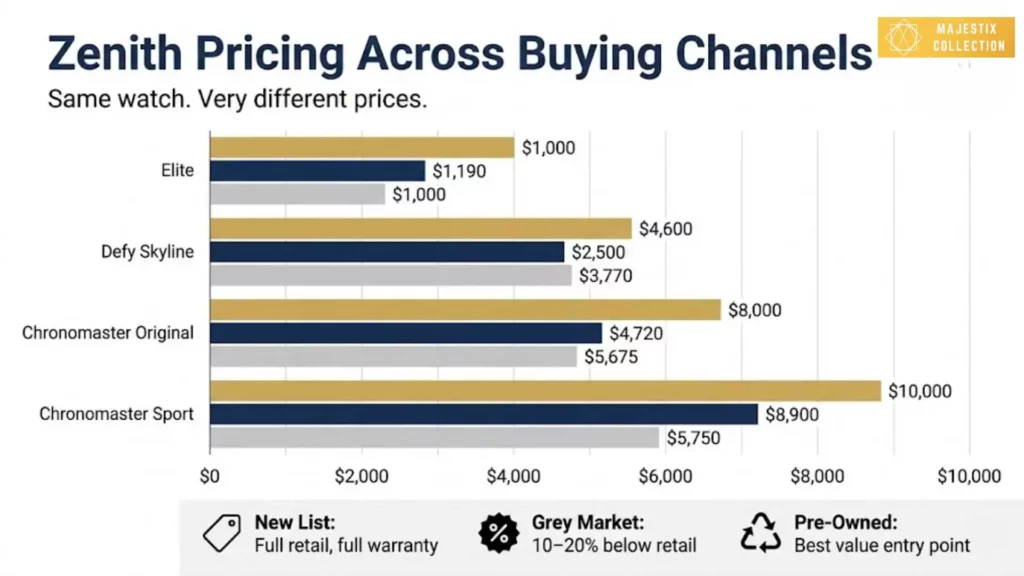
Zenith pricing varies significantly depending on where you buy, and real transaction values often differ from official retail tags. In some collector comparisons, even alternatives like pieces from the Majestix Collection are used as reference points for perceived value positioning.
Below is a clear breakdown of typical pricing across Zenith’s main collections:
| Model | New List Price | Grey Market | Pre-Owned |
| Elite | From ~$6,000 | $4,800–$5,500 | $3,000–$5,500 |
| Defy Skyline | From ~$7,000 | $5,800–$6,500 | $4,500–$6,500 |
| Chronomaster Original | From ~$8,200 | $7,000–$7,800 | $5,500–$7,500 |
| Chronomaster Sport | From ~$9,500 | $8,000–$9,000 | $7,000–$8,500 |
Buying New from Authorized Retailers
Purchasing new from an authorized retailer gives you direct manufacturer coverage and full presentation experience. This includes official packaging, documentation, and brand-backed service support, which can be important for buyers who prioritize long-term ownership security.
However, Zenith’s retail structure is widely available across global dealers, which means full-price purchases are not always necessary to access current models. Availability and dealer flexibility often influence the final price more than strict list pricing, especially for non-limited production references.
Grey Market Pricing Advantage
Grey market channels often reflect real-world demand more accurately than retail pricing. Many authorized dealers operate with built-in flexibility, and those reductions typically flow into secondary sellers.
In practical terms, buyers often find pricing around 10–20% below retail, depending on model popularity and stock levels. This is especially common with core production pieces that are not limited or boutique exclusive. The main consideration here is warranty structure, which can vary depending on the seller and region.
Pre-Owned Market Value
Pre-owned Zenith watches are strongly influenced by condition, completeness, and service history rather than just model type. Watches that include original packaging and documentation tend to maintain stronger resale confidence and attract more consistent demand.
Chronograph models powered by Zenith’s high-frequency movement tend to perform more consistently in the secondary market due to collector interest in the movement architecture. This creates a more stable value profile compared to non-chronograph references, which are more sensitive to condition and demand shifts.
As a result, the pre-owned market often becomes the most efficient entry point for buyers focused on obtaining higher technical value at a reduced acquisition cost.
Do Zenith Watches Hold Their Value?
Zenith watches retain around 60–70% of retail value, similar to Omega and Breitling but below Rolex. This reflects steady but limited resale strength in the secondary market (source).
Resale performance varies by model and is driven more by demand than brand name alone. Some references attract stronger buyer interest due to movement relevance and production scale, while others trade at lower levels.
Models with stronger resale performance:
- Chronomaster Original (steel versions with classic layout)
- Chronomaster Sport
- Limited-run El Primero Revival references
- Selected Defy Extreme configurations
Models with weaker resale performance:
- Elite dress watches, often closer to 50–60% value retention
- Non-chronograph Pilot models with lower demand
A key factor is the presence of the El Primero chronograph architecture. References built around this movement consistently see stronger demand in the secondary market compared to non-chronograph Zenith models.
Ultra-limited releases can behave differently. Certain low-production revival editions may hold value better due to scarcity, but this is not typical across the range.
Zenith is best understood as a brand centered on movement engineering and chronograph performance, instead of being primarily associated with long-term value appreciation. Buyers who prioritize mechanical significance over resale outcomes tend to align better with the brand’s strengths.
New vs. Pre-Owned Zenith: Which Makes More Sense?
Pre-owned Zenith watches make more sense for most buyers because they offer lower cost while delivering the same El Primero performance and build quality. This makes them a practical entry point into Zenith ownership without paying full retail pricing.
Pricing behavior after release plays a major role in this advantage. Many Zenith models trade below list value in the secondary market, which creates stronger value opportunities for buyers focused on specifications and engineering rather than retail status or brand-new condition.
What to check when buying pre-owned
- Case finishing: Look for sharp case lines and consistent brushing. Soft edges often indicate excessive polishing during service.
- Pushers and crown: On chronograph models, the actuation should feel precise and consistent. Irregular feedback can signal internal wear.
- Bracelet: Original bracelets usually strengthen market value, while strap changes should be reflected in pricing.
- Box and papers: Complete sets typically attract stronger demand and improve resale confidence.
- Service records: Documented maintenance reduces uncertainty and helps confirm proper long-term care.
Pre-owned is the most efficient way to enter Zenith ownership because it delivers the same mechanical experience at a lower cost. You still get the full El Primero engineering but without paying the premium attached to retail presentation.
New purchases make sense only when warranty coverage, untouched condition, or gifting presentation is the priority. Outside of those cases, the secondary market consistently offers stronger value for the same watch.
Final Takeaways on Zenith Buying Guide
The Zenith buying guide shows that Zenith stands out for its in-house engineering and strong chronograph identity. This makes it a serious choice for buyers who value mechanical performance over brand visibility.
The El Primero movement remains the defining strength of the brand, offering high-frequency precision that sets it apart in its price category. When evaluating Zenith, the key is matching the watch to your purpose rather than focusing only on design or popularity.
Some models highlight heritage execution, while others focus on modern daily wear or design-forward styling. Value also shifts based on condition and market timing, which makes informed selection more important than impulse decisions.
The strongest approach is to focus on movement quality, wrist comfort, and long-term wear experience. Viewed this way, Zenith delivers lasting value for buyers who appreciate serious watchmaking and want something beyond mainstream luxury branding.