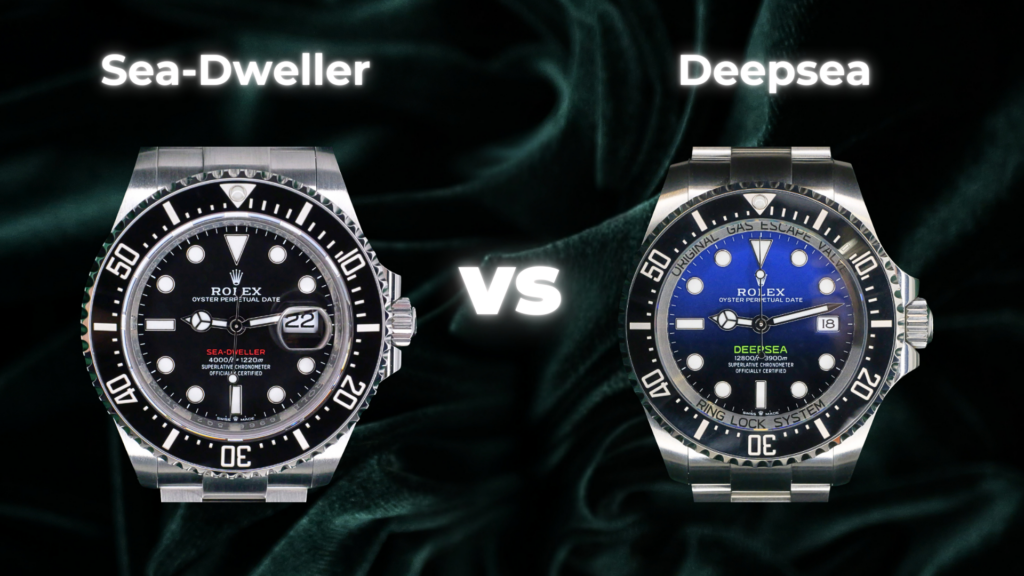
You’re likely here because Rolex Sea-Dweller vs Deepsea keeps surfacing in the same conversations. That overlap is intentional. These are Rolex’s most purpose-built dive watches, engineered far beyond everyday diving and aimed at buyers who value function, durability, and long-term ownership over surface-level design.
The Sea-Dweller grew out of real saturation-diving needs in the late 1960s. The Deepsea arrived in 2008 as a showcase of Rolex’s extreme pressure engineering. They speak to the same enthusiast, but the execution is very different, from case construction to how they wear on the wrist.
One is designed to feel usable and balanced. The other exists to push limits.
There’s also a 2024 wrinkle worth flagging up front. Rolex quietly dropped the “Sea-Dweller” text from the Deepsea line and added an 18ct yellow gold reference (the 136668LB) at Watches and Wonders 2024. The two collections are now officially distinct, and the comparison matters more than ever for buyers trying to pick the right one.
By the end, you’ll know which approach aligns better with how you wear your watches.
Rolex Sea-Dweller Overview

The Rolex Sea-Dweller was born in the late 1960s for commercial saturation divers, when helium buildup during decompression could literally blow a crystal off a watch. Rolex’s solution was the helium escape valve, which became the defining feature of the line and instantly separated it from the Submariner in both purpose and attitude.
Today, the Sea-Dweller is best represented by the ref. 126600, which balances professional capability with everyday wearability. Its 43mm case, 1,220m / 4,000ft water resistance, Cerachrom bezel, and Oyster bracelet with Glidelock give you far more dive capacity than any recreational diver needs, without pushing into novelty-sized territory.
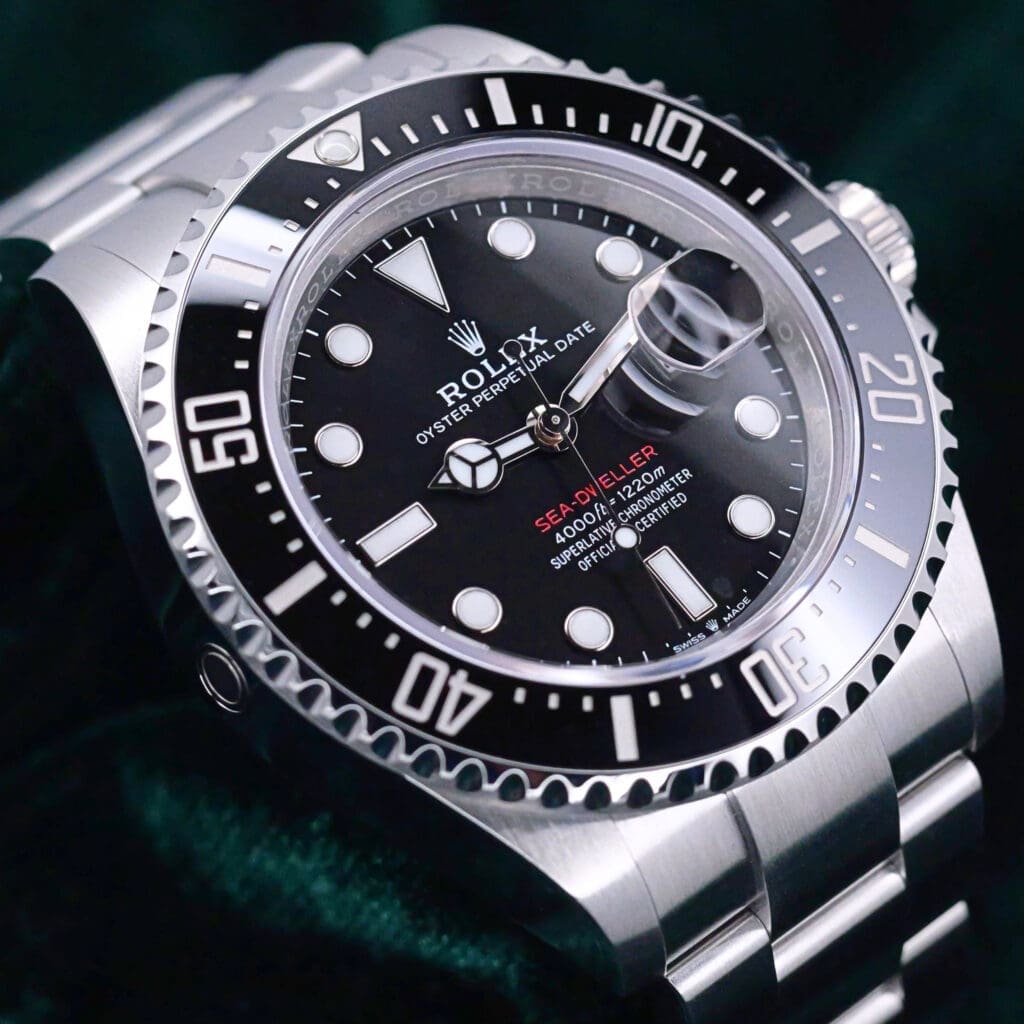



Inside, the caliber 3235 delivers modern Rolex performance with improved efficiency, anti-magnetism, and a ~70-hour power reserve. The Sea-Dweller is a serious tool, but one that doesn’t constantly remind you of its engineering when it’s on your wrist.
From a collector’s perspective, the Sea-Dweller appeals to buyers who want Rolex Professional DNA without flash. Vintage references like the 1665 “Double Red” are highly condition- and originality-sensitive, while neo-vintage models such as the 16600 offer classic proportions and long-term collectability at more accessible prices. If the vintage end of the line is where you’re looking, our full vintage Rolex buying guide covers what to check before you commit.
The Sea-Dweller feels like the tougher, more niche sibling to the Rolex Submariner. The helium escape valve and the red “Sea-Dweller” text on the 126600 are the visual cues that separate this from a luxury sports watch.
Notable references:
- Ref. 16600
- Ref. 116600 (“4000”)
- Ref. 126600 (“SD43”)
Rolex Deepsea Overview
The Rolex Deepsea takes the Sea-Dweller concept and pushes it to the extreme, acting as Rolex’s showcase for what its engineering department can do. Introduced in 2008, it uses the Ringlock system, a case architecture designed to withstand immense pressure rather than simply relying on thicker parts.
This construction allows the Deepsea to achieve a 3,900m / 12,800ft depth rating, far beyond human scuba limits and well into submersible territory. The result is a watch that feels more like a wearable pressure vessel than a conventional dive watch, with a noticeably taller case and heavier wrist presence.
Modern references like the ref. 136660 pair that extreme construction with Rolex’s current caliber 3235 (the same movement powering the modern Sea-Dweller). Despite its size, the Deepsea is still finished to Rolex’s usual standards, with a Cerachrom bezel and Glidelock-equipped Oyster bracelet.



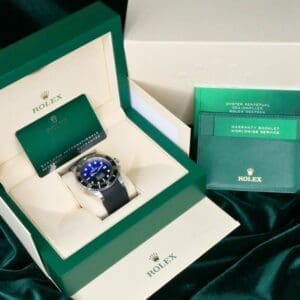
The Deepsea is made for buyers who want Rolex’s most hardcore diver and enjoy the feeling of overbuilt equipment on the wrist. It’s not trying to be subtle or versatile, and that’s precisely why some collectors love it.
Collectibility within the line often centers on the D-blue gradient dial, introduced to commemorate James Cameron’s 2012 Deepsea Challenge dive. Its fade from blue to black, combined with the Ringlock architecture, has made the Deepsea one of the easiest Rolex divers to spot across a room.
Notable References
- Ref. 16600
- Ref. 126660
- Ref. 136660

What Changed in 2024: The Deepsea Rebrand and Yellow Gold Release
At Watches and Wonders 2024, Rolex made two changes that reshaped this comparison.
First, Rolex removed the “Sea-Dweller” text from the Deepsea dial. The current 136660 is just a “Deepsea,” no longer a “Sea-Dweller Deepsea.” On paper it’s a font change. In practice, it ended a 16-year arrangement where the two lines shared a name and made the Deepsea its own line in the catalogue.
Second, Rolex launched the Deepsea 136668LB in 18ct yellow gold with a blue dial. The full-gold case at 44mm and ~17.7mm thick comes in at roughly 320g, heavier than the platinum Rolex Daytona, and one of the heaviest production Rolex watches you can buy. Retail sits around $50,000+ depending on region, with 2026 market prices around $57,000.
Why does this matter for a buyer choosing between the two lines? Two reasons.
One, the rebrand confirms the Deepsea is its own thing now, not a “deeper Sea-Dweller.” Two, the gold release tells you where Rolex sees the Deepsea going: as a flagship statement piece, not a workhorse diver. If you’re looking for the saturation-diver story without the flash, that pushes you back toward the Sea-Dweller side of the catalogue.
Rolex Sea-Dweller vs Deepsea: Main Differences

The Sea-Dweller and Deepsea are built around two different engineering problems. The Sea-Dweller aims for saturation-diving capability without sacrificing daily wear. The Deepsea is Rolex treating the case like a pressure system first, then making it wearable second.
Depth Rating
Modern Sea-Dwellers like the 126600 are rated to 1,220m. That capability comes from a more conventional Oyster case approach: a thick sapphire crystal, robust gaskets, and a helium escape valve for saturation-diving decompression. It’s normal watch engineering, just pushed hard enough for real commercial diving environments. If the rotating dive bezel on either watch is unfamiliar, we’ve broken down how it actually works in a separate guide.
The Deepsea (steel line) is rated to 3,900m, and that number is inseparable from its case architecture. The Deepsea is built around the Ringlock System, where the 5.5mm-thick sapphire crystal, an internal nitrogen-alloyed steel compression ring, and a grade 5 titanium caseback work together like a managed load path.
It’s not just a thicker shell. The depth rating is Rolex turning the case into a structural assembly.
Design and Purpose
The Sea-Dweller is Rolex’s practical end of the professional-diver spectrum: saturation-ready but designed to feel reliable and comfortable for daily wear. Its familiar Rolex ergonomics make it the kind of watch you can put on a Monday and forget about until Friday.
Sleeve fit is reasonable, weight sits naturally on a 6.5–7.5 inch wrist, and the bezel grip doesn’t snag on cuffs the way a thicker case does.
The Deepsea leans the other way. It’s designed to impress with its overbuilding first, wristwatch second. The design choices lean into that identity, encouraging admiration for its bold, purpose-built nature rather than subtlety. It’s a watch you put on knowing it’s the loudest thing in the room.
Case Proportions
The Sea-Dweller is balanced and predictable. Its 43mm case sits at roughly 15.5mm thick, and the thinner profile keeps the center of gravity close to the wrist. It feels solid without drawing constant attention to its size.
The Deepsea is tall and top-heavy by design. The 136660 measures 44mm in diameter and around 17.7mm thick. That’s over 2mm taller than the Sea-Dweller, with most of that added height stacked above the case midline.
The Ringlock System adds vertical mass through that thicker crystal and internal pressure ring. The result is more leverage and wrist awareness, driven by height, not diameter.
Comfort and Sleeve Fit
This is where most buyers land their decision, and it doesn’t show up on the spec sheet.
The Sea-Dweller 126600 fits under a dress shirt cuff with some effort and clears a polo or oxford easily. The 15.5mm thickness puts it in the same wearing territory as a Submariner Date. Slightly thicker, but not enough to change how you dress around it. On most wrists 6.5 inches and up, it wears like a serious sports watch without being a costume.
The Deepsea 136660 is a different conversation. At 17.7mm thick and 44mm wide, it does not fit under a dress shirt cuff. Period. It can be worn with a suit if the sleeves are tailored loose, but you’ll feel it the whole time.
For most buyers, the Deepsea is a weekend watch, a travel watch, or an everyday watch only if your wardrobe leans casual. On wrists under 6.75 inches, the case overhang at the lugs can also start to look top-heavy.
The honest test: roll up a sleeve to where a cuff would sit, then try the watch on. The Sea-Dweller passes that test for most buyers. The Deepsea is upfront about not trying to.
Price and Market Demand
Sea-Dweller and Deepsea prices are shaped more by who’s buying them than by raw dive specs. The Sea-Dweller trades like a broadly wearable Rolex tool watch with stronger liquidity. The Deepsea trades like an extreme-purpose instrument that fewer wrists can live with, which tightens demand and amplifies swings.
At the entry level, the discontinued Sea-Dweller 16600 sits around $8,800 on the secondary market as of 2026. Auction results cluster between $7,000 and $10,000 depending on condition and box-and-papers status.
At the other extreme, the yellow gold Sea-Dweller 136668LB trades around $57,000 in 2026, showing how precious metal can lift retail pricing while still narrowing the secondary buyer pool.
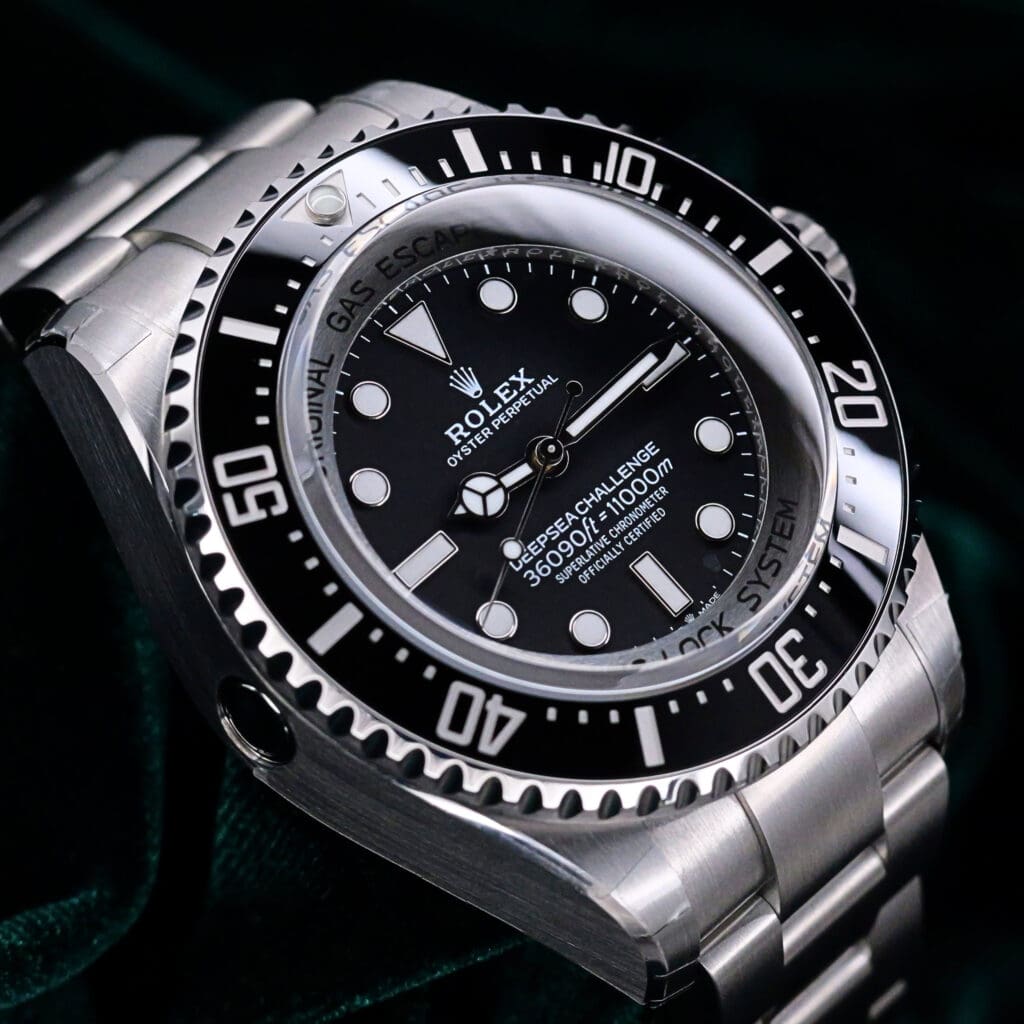
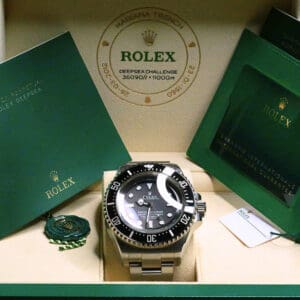
For the Deepsea, the discontinued 116660 is the cheapest entry, trading around $9,400–$9,800 in 2026. The current 136660 trades around $14,400–$14,600, sitting roughly 7% below its $15,550 retail price. That makes it one of the few in-production Rolex sports watches you can still buy below MSRP.
The high-end outlier is the Deepsea Challenge 126067 in RLX Titanium, around $29,100 retail and trading north of $40,000. That’s where the extreme engineering story can push values well above retail.
The Sea-Dweller line has shown a modest 2026 rebound. The 16600 is up roughly 7.5% over the past year. But the line as a whole remains below its post-2021 peak, matching the broader luxury-watch reset.
The Deepsea line has generally been softer in the long term because comfort and size filter demand. Even iconic references can lag unless they carry a uniquely recognizable identity or scarcity story. Market figures from WatchCharts and aggregated Chrono24 listings as of 2026, and our full Rolex pricing guide walks through the broader market context.
Popular Rolex Sea-Dweller References

The Sea-Dweller is Rolex’s accurate saturation-diving tool watch that still behaves like a typical sports Rolex on land. Built with a helium escape valve and a 1,220m depth rating, it sits clearly above the Submariner in capability without crossing into novelty size. This line is about professional dive credibility with real-world wearability.
1. Ref. 16600 — The Quiet Vintage Sea-Dweller (1988–2008)
The classic modern Sea-Dweller: 40mm, no Cyclops, 1,220m rating, and the last long-run Sea-Dweller before the Deepsea replaced it in 2008. It’s the pick if you want true tool-watch DNA that still wears like an atypical sports Rolex.
- Case: 40mm Oyster case, helium escape valve, no date magnifier
- Bezel: aluminum insert era; easy to gauge condition by bezel fade and edge wear
- Bracelet: Oyster bracelet (commonly referenced as 93160 on later examples)
- Movement: Cal. 3135, known for durability and serviceability
- Depth Rating: 1,220m / 4,000ft
- Typical pre-owned (2026): Market price around $8,800, with most clean examples between $7,800 and $10,500
2. Ref. 116600 “4000” — The Short-Run Cult Favorite (2014–2017)
The short-lived cult favorite: 40mm, ceramic bezel, no Cyclops, and the last Sea-Dweller that keeps the clean crystal look. It’s the nerd’s answer to a Submariner Date, but with the Sea-Dweller’s deeper rating and helium valve. For the full head-to-head, our Submariner vs Sea-Dweller comparison digs into the differences in detail.
- Case: 40mm Oyster case, helium escape valve, no Cyclops
- Bezel: first Sea-Dweller with Cerachrom ceramic insert, a significant durability upgrade
- Bracelet: Oyster bracelet with Glidelock micro-adjust for real-world comfort
- Movement: Cal. 3135
- Depth Rating: 1,220m / 4,000ft
- Typical pre-owned (2026): Market price around $12,800, range about $11,800–$14,000 depending on condition and box-and-papers
The 116600’s short three-year production run is the main reason it holds value better than most discontinued Rolex references. Clean examples with stickers and full sets sit at the top of that range.
3. Ref. 126600 “SD43” — The Modern Daily-Wear Pick (2017–present)
The modern daily-wear Sea-Dweller: 43mm, red “Sea-Dweller” text, Cyclops date, and the current Cal. 3235. It’s the right choice if you want the Sea-Dweller story and plan to wear it constantly, including with sleeves and in everyday life.
- Case: 43mm Oystersteel, ~15.5mm thick, helium escape valve, Cyclops over date
- Bezel: black Cerachrom insert, platinum-coated numerals and graduations
- Bracelet: Oyster with Oysterlock clasp and Glidelock extension system
- Movement: Cal. 3235, ~70-hour power reserve
- Depth Rating: 1,220m / 4,000ft
- Typical pre-owned (2026): Market price around $11,800, with full-set examples often trading $12,500–$14,500
The 126600 is one of the few current-production Rolex sports models trading below retail in 2026, which makes the pre-owned market the obvious place to buy if patience isn’t an issue.
Popular Rolex Deepsea References

The Deepsea is Rolex at its most extreme, built around the Ringlock System and a 3,900m depth rating. Everything about it prioritizes pressure resistance over subtlety, from the case architecture to the thick sapphire crystal. This line exists for buyers who want maximum Rolex dive engineering and bold wrist presence, not compromise.
1. Ref. 116660 — The Entry-Level Deepsea (2008–2018)
The original Deepsea statement piece: 44mm, Ringlock system, 3,900m rating, and the older Cal. 3135. It’s not just a bigger Sea-Dweller. It’s Rolex building a pressure tank you can wear.
- Case: 44mm Oystersteel with Ringlock System case architecture
- Bezel: Cerachrom ceramic dive bezel, built for hard use
- Bracelet: Oyster bracelet with Glidelock and dive extension hardware (varies by era)
- Movement: Cal. 3135
- Depth Rating: 3,900m / 12,800ft
- Typical pre-owned (2026): Market price around $9,400–$9,800, with the D-blue James Cameron variant commanding the upper end
The 116660 is the cheapest way into the Deepsea line in 2026. The early D-blue examples (2014–2018) tend to trade firmer than the all-black dials because of the James Cameron association.
2. Ref. 126660 — The Sweet-Spot D-Blue Deepsea (2018–2022)
The Deepsea’s first movement upgrade: still 44mm and 3,900m, but switched to Cal. 3235 and offered in both black and D-blue dial variants. If the D-blue look is the reason you’re here, this reference is usually the sweet spot for value.
- Case: 44mm, around 17.5mm thick, built around the Ringlock system
- Bezel: Cerachrom insert, classic Deepsea tank proportions
- Bracelet: Oyster with Glidelock and dive extension setup
- Movement: Cal. 3235, ~70-hour power reserve
- Depth Rating: 3,900m / 12,800ft
- Typical pre-owned (2026): Market price around $11,800, range about $10,800–$13,500 depending on dial and set completeness
3. Ref. 136660 — The Current-Generation Flagship (2022–present)
The current-generation Deepsea. The 136660 replaced the 126660 and brought subtle but real refinements to wearability and proportions. As of the 2024 update, this reference no longer carries the “Sea-Dweller” text. It’s simply a “Deepsea.” Still a 44mm, 3,900m professional saturation diver, but with cleaner branding and a tighter case-bracelet integration.
- Case: 44mm Oystersteel, ~17.7mm thick, Rolex Ringlock System architecture, helium escape valve
- Crystal: domed 5.5mm-thick sapphire
- Bezel: Cerachrom insert with platinum-coated numerals
- Bracelet: Oyster with Oysterlock clasp and Glidelock extension system
- Movement: Cal. 3235, ~70-hour power reserve
- Depth Rating: 3,900m / 12,800ft
- Typical pre-owned (2026): Market price around $14,500, with D-blue full-set examples reaching $16,000+ on Chrono24
At a $15,550 retail price and a $14,500 market price, the 136660 is one of the rare current Rolex sports watches you can buy pre-owned at a meaningful discount. That gap has narrowed since 2024 but hasn’t closed.
Should You Buy a Rolex Sea-Dweller or a Rolex Deepsea?
The right choice comes down to how you live with your watches, not how deep you imagine you might dive someday. Both are real professional Rolex divers, but only one feels normal enough for most wrists and routines. If you want the full lineup of references and pricing tiers on the Sea-Dweller side, our Rolex Sea-Dweller buying guide goes deeper on the model line itself.
Who Should Choose the Rolex Sea-Dweller
- You want a serious pro diver that still feels normal on a daily basis
- You care about comfort, sleeve fit, and a watch that won’t bully your wrist all day
- You like the idea of authentic saturation-diving heritage, not just the look
- You want a model line with substantial pre-owned depth, where condition and smart buying can pay off in the long term
- You prefer your diver to be the quietly capable choice, not the loudest thing in the room
Who Should Choose the Rolex Deepsea
- You want Rolex’s most extreme dive engineering and bold wrist presence
- You’re drawn to the Ringlock System story and the pressure-vessel-on-the-wrist feel
- You like thick cases, heavy feel, and that unapologetic tool aesthetic
- You want the Deepsea specifically for the D-blue gradient dial look and what it signals
- You’d rather own the overbuilt flagship, even if it’s not the most practical daily wear
If you’re 50/50 between the two, the simple test is what’s in your closet. Mostly suits and dress shirts? Sea-Dweller. Mostly polos, henleys, and tees? The Deepsea won’t fight you. If you’re still mapping out which Rolex line fits your wear pattern, our Rolex buying guide covers the wider lineup.
Where to Buy Authentic Sea-Dweller and Deepsea References Online
A handful of legitimate online channels handle Sea-Dweller and Deepsea sales well.
Chrono24 is the largest aggregated marketplace and the best place to see what the global asking-price range looks like across both lines. If you’ve never used the platform, our guide to buying a watch on Chrono24 covers what to verify before sending money.
eBay’s Authenticity Guarantee program authenticates Rolex listings above a price threshold and is workable for buyers who already know exactly which reference and condition they want.
Grailzee runs timed auctions and is a useful price discovery tool. Recent 16600 hammers there have landed between $7,000 and $10,000, which is a good sanity check on dealer asks.
We also sell, buy, and trade luxury watches. The reason clients pick us over a big marketplace is what happens before the purchase decision.
Before you commit to a watch, we give you layered communication: tour videos of the actual watch we have in hand (not stock photos), detailed condition notes including bezel insert wear and bracelet stretch, and a real conversation with someone who has physically inspected the piece.
You’re not buying blind off a listing. You’re getting the read you’d want from a friend who knows watches.
That’s reflected in our 4.9-star Google rating, which comes from clients who appreciate the back-and-forth before the wire goes out.
If you’re trying to figure out whether the 2024 changes or the current pre-owned market move your decision, reach out. We can help you source the specific reference you’re after — tour video of the actual watch, condition notes, and a straight conversation about what’s worth paying for in 2026.
Final Thoughts on the Rolex Sea-Dweller vs Deepsea
Both watches exceed what any real-world buyer needs from a dive watch. The 2024 rebrand of the Deepsea, dropping the “Sea-Dweller” text and adding the yellow gold reference, confirms what most collectors already felt: these are now two separate stories, not two flavors of the same one.
The Sea-Dweller is the story of saturation diving made wearable. The Deepsea is the story of how far Rolex can push the case architecture before the watch stops being a watch.
Two quick tips before you buy. If you can stretch the budget, the 116600 “SD4K” is the most appreciation-friendly Sea-Dweller because of its short three-year production run — for more on which references hold up over time, our list of Rolex models that hold value covers the broader picture. And on any pre-owned 16600, check serial numbers against Rolex card dates because service replacements of bezels and bracelets are common and meaningfully affect resale.
Pick the story you want on your wrist for the next ten years, and the spec sheet sorts itself out.
999+ Timepieces Available
Explore Our Timepieces
Authenticated, unworn, and ready to ship worldwide.
Rolex · Audemars Piguet · Patek Philippe · Omega · Cartier · Richard Mille · Hublot · Tudor
Newly Listed
2025 NEW Hermes Kelly Sellier en Desordre 20 Vert Mangrove Epsom Leather Permabrass Hardware
$38,900.00
2026 NEW UNWORN Audemars Piguet Royal Oak Chronograph Black Dial Black Ceramic Bezel Black Ceramic Bracelet 41mm COMPLETE SET 26240CE.OO.1225CE.02
$129,800.00
Tudor Black Bay GMT Pepsi Black Dial Red and Blue Bezel Stainless Steel 41mm MINT CONDITION COMPLETE SET 79830RB
$4,294.00
Breitling Superocean Heritage II Green Dial Black Ceramic Bezel Black Rubber Strap Stainless Steel 42mm MINT CONDITION COMPLETE SET AB2010121L1S1
$5,236.00
2025 Rolex Datejust Wimbledon Slate Gray Dial Fluted 18K White Gold Bezel Oyster Bracelet Stainless Steel 41mm MINT CONDITION COMPLETE SET 126334
$15,694.00
Rolex Day-Date II Brown Chocolate Dial Roman Numerals Fluted Bezel President Bracelet 18K White Gold 41mm MINT CONDITION COMPLETE SET 218239
$49,390.00
2026 NEW UNWORN Rolex Cosmograph Daytona "Baby Le Mans" Black Dial Silver Subdials Black Ceramic Bezel Black Oysterflex Strap 18K White Gold 40mm COMPLETE SET 126519LN-0002
$57,200.00
2025 Cartier Tank Louis Cartier Silver Dial Gray Alligator Strap 18K Yellow Gold 25.5mm MINT CONDITION COMPLETE SET WGTA0343
$12,495.00
Rolex GMT-Master II Green Dial Black Ceramic Bezel Oyster Bracelet 18K Yellow Gold 40mm MINT CONDITION COMPLETE SET 116718LN
$46,745.00
Omega Speedmaster Grey Side of the Moon Grey Dial Alligator Leather Strap Grey Ceramic 44.25mm MINT CONDITION 311.93.44.51.99.001
$8,690.00
Rolex Day-Date 36 Champagne Gold Dial Roman Numeral Markers Fluted Bezel Presidential Bracelet 18K Yellow Gold NEAR MINT CONDITION 18038
$20,345.00
Rolex Yacht-Master Rhodium Grey Dial Platinum Bezel Oyster Bracelet Stainless Steel 40mm MINT CONDITION COMPLETE SET 116622
$14,300.00