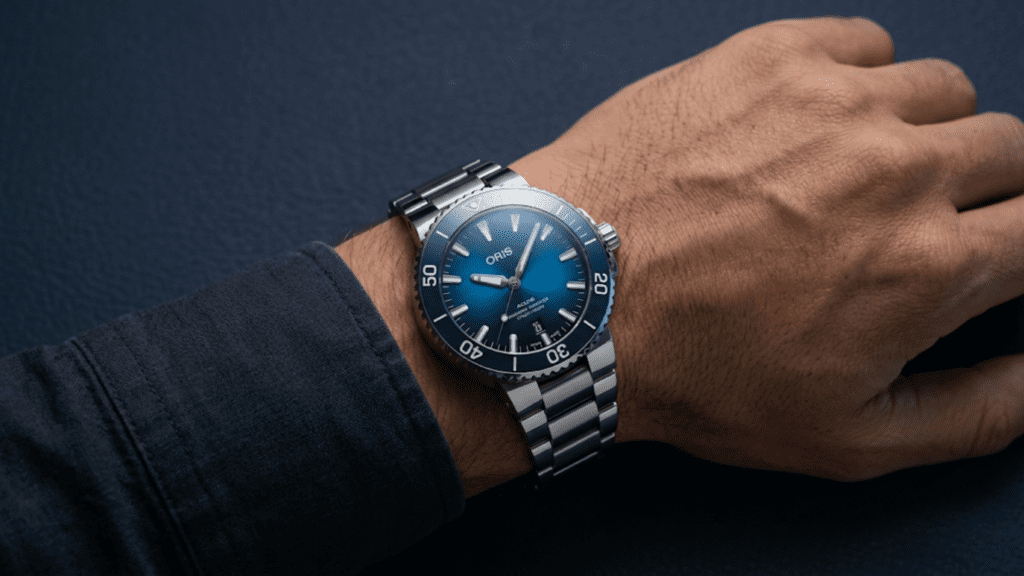
Most people searching for an Oris buying guide already have a shortlist in their head. They want confirmation, not another catalog description. So here’s what this guide covers: which Oris is worth buying based on how you plan to use it, whether the Calibre 400 premium makes sense for you, and where to buy so you’re not overpaying on day one.
Oris makes fully mechanical Swiss watches. Most models retail between $1,800 and $3,500. That’s the price range this guide focuses on, and it’s where most buyers end up.
Is Oris Worth Buying?

Yes, Oris is worth buying, especially if you want a fully mechanical Swiss watch under $3,500 without overpaying for a brand name. The closest competitors at this price are Tudor, Longines, and Tissot PRX, and Oris holds its own against all of them on specs and build quality.
Oris operates independently without a corporate parent or holding company, which gives it more flexibility in how it runs the business. The brand has remained based in the same Swiss town since 1904 and continues to focus directly on its customers.
That independence shapes how the brand operates. In the early 1990s, while many Swiss brands still produced quartz, Oris focused fully on mechanical watches. Every model today uses a mechanical movement, reflecting a clear, consistent direction.
One thing collectors notice quickly is the red rotor. Most Oris models have an exhibition caseback showing the movement, and the rotor is finished in red. It’s a small detail but it’s become a brand identifier. Pop the caseback on any modern Oris and you’ll know immediately what you’re looking at.
Here’s the honest trade-off though. Oris doesn’t hold resale value as well as Tudor or Omega. A new Oris will depreciate faster than a Tudor Black Bay on the secondary market. That’s just the reality of where each brand sits in the market hierarchy.
But if you’re buying to own and wear, Oris makes a strong case. More watch, more warranty, more technical spec, for less money.
What Are the Main Oris Collections and Who Are They For?

Oris has four main collections: the Aquis, Divers Sixty-Five, Big Crown, and Artelier. Each one serves a different type of buyer.
| Collection | Character | Water Resistance | Who It’s For |
|---|---|---|---|
| Aquis | Modern dive watch | 300m | Daily wearer, divers, versatile use |
| Divers Sixty-Five | Vintage-style dive watch | 100m | Casual wear, lifestyle, collectors |
| Big Crown | Aviation / pilot watch | 50–100m | Heritage lovers, pointer date fans |
| Artelier | Dress and complications | 50m | Formal wear, complication collectors |
1. Oris Aquis
The Aquis is Oris’s workhorse. Launched in 2011, it’s a modern tool watch built for daily use. The integrated bracelet, screw-down crown, and 300m water resistance make it the most practical watch in the lineup. It’s also the most versatile, comfortable at a desk or at the beach without looking out of place in either setting.
2. Oris Divers Sixty-Five
The Divers Sixty-Five gets the most attention, and it’s easy to see why. Its design draws from Oris’s original 1965 diver and carries that heritage well.
One detail often overlooked is its 100m water resistance, and many references lack a screw-down crown. It works best as a lifestyle piece. Fine for the pool, less suited for serious diving.
3. Oris Big Crown
The Big Crown is Oris’s aviation collection. The pointer date complication, where a hand sweeps the outer track of the dial to show the date, has been a signature Oris feature since 1938. The ProPilot models in this collection step up to larger case sizes, additional complications like GMT and altimeter functions, and in some references, the in-house Cal. 400 movement.
4. Oris Artelier
The Artelier is where Oris gets interesting for complication collectors. Moon phases, annual calendars, and in-house movements show up here. It’s the dressiest part of the catalog and the most varied. If you’re looking for a watch that works with a suit, this is the collection to explore.
Calibre 400 vs. Sellita: Does the Movement Matter?

The movement matters, especially if you plan to keep the watch for more than three years. The Calibre 400 is Oris’s in-house movement with a 10-year warranty and 5-day power reserve. Sellita models are reliable but come with a standard 2-year warranty and cost $500–$800 less. Here’s how they break down:
Sellita-powered Oris models (Cal. 733, Cal. 798):
- Based on the Sellita SW200/SW220/SW330
- Proven, reliable, widely used across the Swiss watch industry
- Standard 2-year warranty
- Service costs around $300–$600 at a qualified watchmaker
- Nothing wrong with it. Tudor used ETA for decades.
Calibre 400 models:
- Fully in-house movement designed and built by Oris
- 5-day (120-hour) power reserve
- Antimagnetic to 2,500 A/m, about 10x more resistant than most standard movements
- Accuracy of +5/-3 seconds per day from the factory
- 10-year warranty, one of the longest in Swiss watchmaking at this price
- Cal. 400 models run $500–$800 more than equivalent Sellita versions
A standard service on a Swiss movement costs $300–$600. The Cal. 400’s 10-year warranty covers that window. Over a 10-year ownership period, the Cal. 400 closes its own price gap. For a long-term keeper, it’s the smarter buy. For a pre-owned watch you might sell in three years, a Sellita model at a lower entry price often makes more sense.
After the 10-year warranty expires, the Cal. 400 services like any other Swiss automatic. Oris recommends a service interval of around 10 years for the Cal. 400 under normal use, which lines up neatly with the warranty period. Sellita-based movements typically recommend a service every 5–7 years. Factor that into your total ownership cost when comparing the two.
Which Oris Watch Should You Buy?

Your best Oris depends on three things: how long you plan to keep it, how you plan to use it, and what you’re willing to spend.
First-Time Luxury Watch Buyer: Oris Aquis Date Cal. 400 (41.5mm)
Your first mechanical watch should be simple to own, hard to break, and good for every situation. You don’t want to be second-guessing water resistance at the beach or worrying about a short warranty on a movement you’re still learning to maintain.
- 300m water resistance, no second-guessing near water
- 10-year warranty, the longest at this price in Swiss watchmaking
- Integrated bracelet, 50mm lug-to-lug, solid dial options in black, blue, and green
- If your wrist is under 6.7 inches, try the 39.5mm Aquis with Cal. 733 instead
The Divers Sixty-Five will tempt you. The vintage look is genuinely beautiful. But its 100m water resistance and lack of screw-down crown make it a weaker first watch. Get the Aquis first. Get the Sixty-Five second.
Collector or Enthusiast: Big Crown Pointer Date Cal. 403
The most underrated watch in the Oris lineup. In continuous production since 1938, the pointer date complication is a signature Oris feature no other mainstream brand does as well. The Cal. 403 is in-house. The design hasn’t needed updating in 86 years because it was right the first time.
- In-house Cal. 403 movement
- Pointer date complication, 36–40mm case sizes
- Available in a range of dial colors including burgundy, blue, and silver
- Comes on leather strap as standard, bracelet options available on select references
- Pre-owned examples hold character far better than a standard Aquis
The Divers Sixty-Five in Cal. 400 configuration is the alternative worth hunting for. It puts the Cal. 400’s 5-day power reserve and 10-year warranty inside the Sixty-Five’s vintage case. Production is limited on this combination so pre-owned is often the only way to find one.
Best Value Buyer: Pre-Owned Aquis Cal. 400, 1–2 Years Old
Skip the steepest part of the depreciation curve by buying recent pre-owned. Based on Chrono24 listings:
- Sellita-powered Oris models trade at 25–35% below retail
- Cal. 400 models trade at 15–25% below retail
- Grey market authorized dealers like Gnomon Watches offer 10–15% below MSRP with full warranty intact
- Always verify the Cal. 400 warranty was registered within 90 days of original purchase
Should You Buy Oris New, Pre-Owned, or Grey Market?

Here’s the honest breakdown, ranked by financial intelligence:
- Pre-owned (best value): 25–40% below retail on Sellita models, 15–25% on Cal. 400. No factory warranty on older pieces but the right model at the right price is hard to beat.
- Grey market authorized dealer (smart middle ground): 10–20% below MSRP on current models. Full warranty. This is often the best option for buyers who want a current production watch without paying full price at an AD.
- Authorized dealer, new (most expensive entry): Full warranty, current stock, but you absorb the steepest depreciation on exit. Some ADs will move on price for slower-selling models or older stock. It never hurts to ask.
If you go the pre-owned route, a quick physical and paperwork check will save you from buying someone else’s problem. Here’s what to look at before committing:
- Serial number matches the papers
- Crown screws down cleanly
- Movement runs and keeps reasonable time
- No moisture inside the crystal
- Bracelet links and clasp function properly
- Original box and papers add value but aren’t dealbreakers
Where to Buy and Sell Your Oris
Knowing where to buy matters as much as knowing what to buy. The wrong platform can cost you hundreds, and the wrong seller can cost you even more.
Buying New
Your safest option for a current production model is an authorized Oris dealer. Oris maintains a dealer locator on their official site. For online purchases, authorized grey market dealers like Gnomon Watches and Crown and Caliber carry current models at genuine discounts with the full manufacturer warranty still valid.
Buying Pre-owned
Chrono24 is the largest pre-owned watch marketplace and has the widest selection of Oris models at any given time. Watchrecon aggregates listings from multiple forums and is useful for finding private sales at lower prices. Both platforms carry buyer protection options but always verify seller ratings and ask for detailed photos before committing.
Selling Your Oris
Realistic expectations matter here. A Sellita-powered Aquis bought new for $2,200 will realistically sell for $1,400–$1,600 on the open market within the first two years. A Cal. 400 model holds slightly better. If you want a faster, cleaner sale without the back and forth of private listings, selling to a reputable dealer is worth the small price difference.
At Majestix Collection, we regularly buy and sell pre-owned Oris watches. If you’re looking to sell one or source a specific model, it’s worth reaching out. Every watch is verified before sale, and pricing reflects real secondary market data.
How Does Oris Compare to Tudor and Longines?
Two comparisons that come up constantly. Here are straight answers.
Oris Aquis Cal. 400 (~$2,600) vs. Tudor Black Bay 58 (~$3,500)
Tudor wins on resale value and brand recognition. The Black Bay 58 is more desirable on the secondary market and holds its price better. The bracelet on the BB58 is also more refined.
Oris wins on warranty (10 years vs. 2), antimagnetic resistance, and raw specification per dollar. Tudor is the better watch to sell later. Oris is the better watch to own.
Oris Divers Sixty-Five 40mm (~$2,200) vs. Longines HydroConquest 41mm (~$1,200)
Longines costs less, uses a proven ETA movement, and is straightforward to service worldwide. It’s a practical, easy choice.
Oris offers stronger dial finishing, more distinct design, and a case finish that stands out at this price. Longines makes sense on a tighter budget, while Oris suits buyers who want something with more character over time.
Oris Big Crown ProPilot (~$2,800) vs. Hamilton Khaki Aviation X-Wind (~$1,495)
The Hamilton is nearly half the price and uses a proven ETA-based movement with a useful wind calculation complication. It’s an excellent value for a pilot watch.
The Oris steps up with better finishing, a more refined bracelet, and in Cal. 400 references, the 10-year warranty and 5-day power reserve. For a pilot watch you plan to wear daily and keep long term, the Oris is the stronger buy. For someone entering the aviation watch category for the first time, the Hamilton is a smart starting point.
Final Thoughts on Oris Buying Guide
This Oris buying guide comes down to a few key decisions. Cal. 400 or Sellita? Cal. 400 suits long-term ownership. Sellita works well for pre-owned or shorter-term use.
Which collection? Aquis fits daily wear and practicality. Divers Sixty-Five leans more toward style and character. Big Crown Pointer Date offers stronger collector appeal.
New, grey market, or pre-owned? The grey market is practical for current models. Pre-owned gives better value. Buying new from an authorized dealer depends on how much that specific piece matters to you.
At Majestix Collection, we regularly buy and sell pre-owned Oris watches. The models we see come back less often, and that owners tend to keep, are Cal. 400 references bought with a clear plan.
It’s also worth noting that Oris releases many limited editions and collaborations each year. These usually don’t perform strongly on the secondary market, so it’s better to focus on core catalog models for long-term ownership.
Use the comparison table in this guide to narrow your options, and try the watch on if you can. What works on paper can feel very different on the wrist.