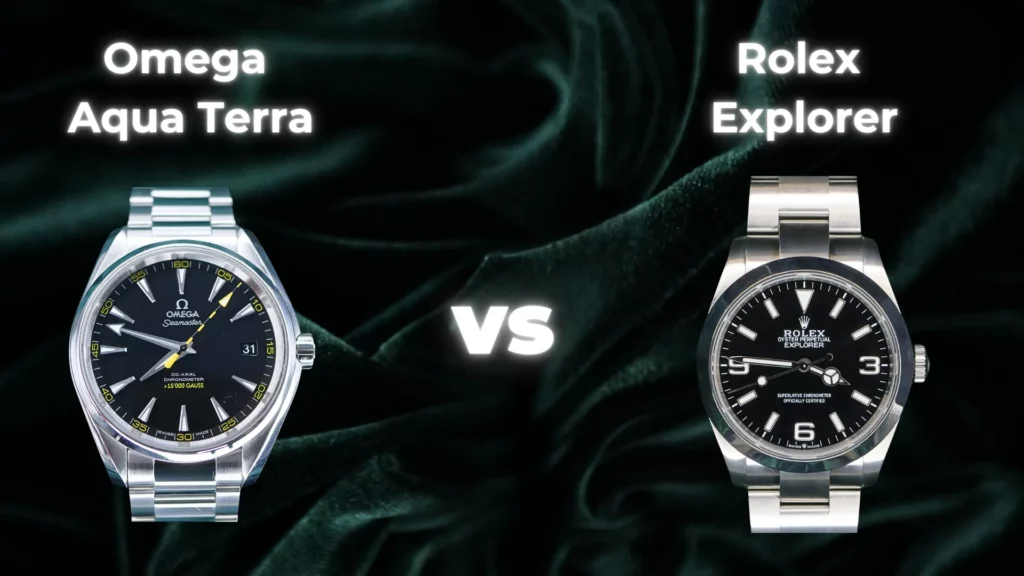
People keep comparing Omega Aqua Terra vs Rolex Explorer because both are versatile everyday watches. You want one watch with a clean design, daily durability, and zero regrets after the first month. These two always show up on that short list.
Omega Aqua Terra and Rolex Explorer offer the same promise, but the experience of owning and wearing them is different. One leans into modern engineering and flexibility, the other sticks to discipline and restraint. Understanding why they get compared is the first step to seeing which one actually fits how you wear a watch.
Omega Aqua Terra Background

Omega launched the Aqua Terra in 2002 as the non-diver Seamaster that still handles real water, thanks to 150 m water resistance and a screw-down crown on most models. It keeps a dressier case profile, but the build is still sporty, especially on a bracelet with a solid clasp and tight tolerances.
This line targets buyers who want one watch that can switch settings without having to switch watches. The big draw is movement tech, since many modern references feature Co-Axial Master Chronometer calibers certified by METAS, which tests accuracy across positions, temperatures, and magnetic fields.
The Aqua Terra’s real accomplishment is how it pairs a refined dial with serious engineering, including 15,000 gauss anti-magnetism on Master Chronometer models. That matters in daily life because magnets live everywhere now, and this watch shrugs them off without needing a soft-iron inner cage.
Collectors like the Aqua Terra for the range: multiple case sizes, dial colors, and complications like the Worldtimer, without turning the watch into a brick on the wrist. It also tends to be more stable on the secondary market, so that you can buy based on taste and specs rather than hype.
Iconic Aqua Terra cues include the teak-style dial grooves, a clean polished bezel, and a sharp case with contrasting brushed and polished facets. It looks simple, but the finishing and symmetry are what keep it from feeling generic.
Notable References:
- Ref. 2503.50.00
- Ref. 231.10.39.21.03.001 Skyfall
- Ref. 220.10.41.21.03.001
- Ref. 220.10.38.20.03.001
Rolex Explorer Background

The Explorer traces back to the early 1950s, built as a pure legibility-first Oyster watch and refined slowly rather than redesigned every few years. Modern references keep the same core layout but upgrade the case, lume, and movement standards to Rolex’s current baseline.
This line is made for someone who wants the cleanest Rolex tool watch and doesn’t care about complications. The Explorer’s whole identity is clarity and durability, backed by an Oyster case rated to 100 m water resistance and a bracelet built to take daily knocks.
Its key accomplishment is consistency in real use: the watch wears slim, reads fast, and stays stable on time thanks to Rolex’s Superlative Chronometer regulation. You also get the practical Rolex details collectors care about later, like strong lume, a tough, smooth bezel, and a bracelet that rarely feels flimsy.
Collectors value the Explorer because it avoids trend spikes and still carries deep brand equity. It usually holds demand without the loud premiums of Submariners or GMTs, which makes it easier to wear without feeling like you’re strapping on a fragile investment.
Iconic Explorer details include the smooth bezel, Mercedes hands, and the 3-6-9 dial, which is recognizable at a glance. It’s the Rolex that signals purpose and restraint, not flash.
Notable References:
- Ref. 6350
- Ref. 1016
- Ref. 114270
- Ref. 214270
- Ref. 224270 Explorer 40
Main Differences: Omega Aqua Terra vs Rolex Explorer
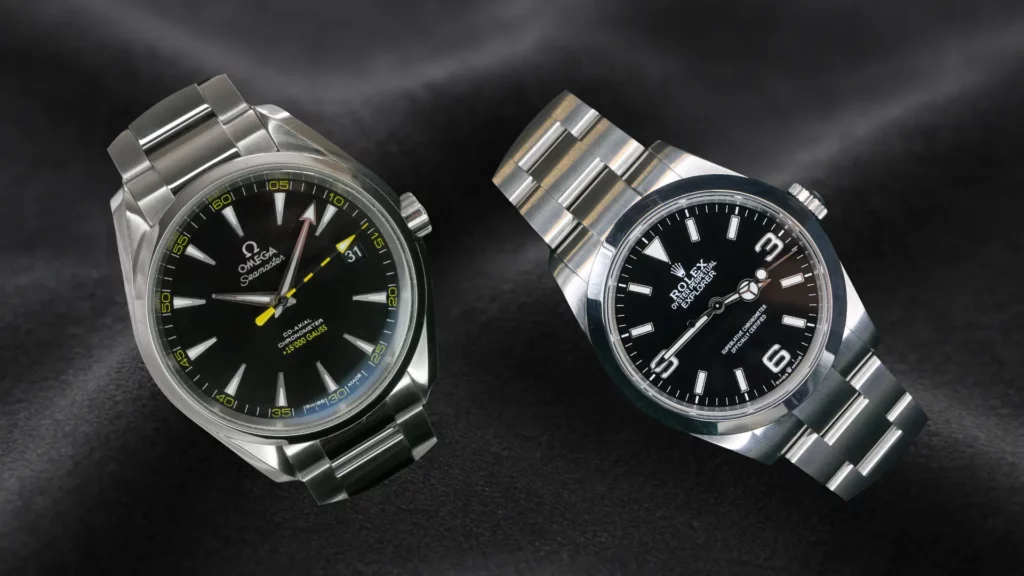
This is where the comparison gets practical. On the surface, both look simple and capable, but the differences emerge when you focus on how they wear, how they run, and how they fit into daily life.
The sections below break down the areas that matter most for ownership. These details shape comfort, reliability, and long-term satisfaction more than brand names ever will.
1. Case Design
The Aqua Terra wears like a refined sports watch. Omega shapes the case with lyre-style lugs, sharp facets, and more polished surfaces that catch light. Most buyers look at 38 mm or 41 mm versions with 150 m water resistance, which adds flexibility for swimming and travel.
The Explorer stays intentionally simple. Rolex keeps it compact in 36 mm or 40 mm with a smooth bezel and a flat, legible dial. The Oyster case offers 100 m water resistance and a more muted finish. On the wrist, it feels tool-first and blends into any setting.
2. Movement and Accuracy
The Aqua Terra leads in movement technology. Many modern references use Co-Axial Master Chronometer calibers, such as the 8800 or 8900, which METAS tests. These movements resist 15,000 gauss and stay stable around 0 to +5 seconds per day in real use.
The Explorer focuses on efficiency and long-term reliability. Rolex fits it with Caliber 3230, built for steady performance and a 70-hour power reserve. The movement meets the Superlative Chronometer standard of -2/+2 seconds per day. It keeps things simple and dependable.
3. Bracelet Style
The Aqua Terra bracelet leans dressier. Omega uses mixed finishing and smoother edges, which gives the bracelet a softer drape on the wrist. It matches the watch’s sport-luxury direction and works well in office settings.
The Explorer’s Oyster bracelet feels more utilitarian. It uses brushed chiefly surfaces and a solid clasp built for daily wear. Easylink allows quick size adjustment without tools. That minor feature adds absolute comfort over a long day.
4. Price and Market Demand
The trend splits cleanly between the two lines. Aqua Terra prices stay well below retail, even when the market ticks up, while Explorer prices stay flat and tight. That tells you demand behavior, not brand quality, drives value. Buyers chase Aqua Terras for value, while they chase Explorers for retention.
For the Aqua Terra, a standard steel reference like 220.10.41.21.03.001 retails around $7,100 and trades $4,000–$4,200, showing a 40%+ drop after purchase. At the low end, older steel references trade around $600–$800 market, signaling thin demand. At the high end, 220.50.41.21.02.001 lists at $43,500 retail but trades near $21,000, proving even precious-metal Aqua Terras are discounted heavily.
The Explorer shows the opposite pattern. A current 224270 lists at $8,350 retail and trades around $8,300 market, meaning almost no retail gap. At the entry end, older modern Explorers still hover close to retail, while the high end tells the real story: the vintage 1016 trades around $16,500–$17,000 market with no retail anchor at all. That trend tells buyers they pay more upfront, but collectors gain stability, liquidity, and long-term confidence.
Iconic Omega Aqua Terra References

The Aqua Terra line makes the most sense when viewed by movement generation, not just looks. Omega kept the design familiar, then upgraded calibers, certification, and magnetic resistance in steps. That makes the reference number critical when buying.
Here are the Aqua Terra models that best show how the line evolved and why specific versions continue to draw strong attention in the market.
1. Ref. 2503.50.00
This reference is iconic as the early modern Aqua Terra that balanced sport specs with a dress-friendly case. Buyers liked it because it offered 150 m water resistance and a clean dial at a time when Omega had not yet pushed heavy certification language.
Collectors approach this reference with a wear-first mindset. They value comfort, classic proportions, and lower entry cost. Most buyers accept softer resale because daily usability matters more than appreciation.
Key Specs:
- Case Diameter: 39 mm
- Bracelet: Stainless steel three-link
- Movement: Omega Caliber 2500, automatic Co-Axial
- Power Reserve: 48 hours
- Water Resistance: 150 m
- Crystal: Sapphire
- Pricing: ~$5,700 retail | ~$3,400 market
2. Ref. 231.10.39.21.03.001 Skyfall
The Skyfall gained popularity because demand stayed consistent across market cycles. The Skyfall association helped visibility, but the real driver was sizing. The sub-39 mm case fits most wrists and avoids the oversized trend. Collectors see this as a liquidity-safe Aqua Terra. They choose it knowing resale moves faster than most Omega dress-sport models. The goal is flexibility, not long-term value growth.
Key Specs:
- Case Diameter: 38.5 mm
- Bracelet: Stainless steel three-link
- Movement: Omega Caliber 8500, automatic Co-Axial
- Power Reserve: 60 hours
- Water Resistance: 150 m
- Crystal: Sapphire
- Pricing: ~$7,800 retail | ~$4,400 market
3. Ref. 220.10.38.20.03.001
This model became popular because it delivered modern Master Chronometer specs in a compact case. Buyers wanted current Omega tech without moving to 41 mm sizing. Collectors treat this as a value-driven purchase. They prioritize certification, anti-magnetism, and daily performance. Resale matters less than the spec-to-price ratio.
Key Specs:
- Case Diameter: 38 mm
- Bracelet: Stainless steel three-link
- Movement: Omega Caliber 8800, Master Chronometer
- Power Reserve: 55 hours
- Anti-Magnetism: 15,000 gauss
- Water Resistance: 150 m
- Crystal: Sapphire
- Pricing: ~$7,100 retail | ~$4,300 market
4. Ref. 220.10.41.21.03.001
This gained traction as the modern-day baseline for the Aqua Terra. Buyers chose it for full Master Chronometer certification and a larger, contemporary presence on the wrist. Collectors view it as a technical benchmark, not a future collectible. They buy expecting depreciation, then rely on reliability and performance to justify ownership.
Key Specs:
- Case Diameter: 41 mm
- Bracelet: Stainless steel three-link
- Movement: Omega Caliber 8900, Master Chronometer
- Power Reserve: 60 hours
- Anti-Magnetism: 15,000 gauss
- Water Resistance: 150 m
- Crystal: Sapphire
- Pricing: ~$8,750 retail | ~$6,000 market
Iconic Rolex Explorer References

The Explorer line makes the most sense when viewed by era and proportion, not by specs. Rolex keeps the design steady, then refines details like dial execution, lume, bracelet construction, and movement efficiency over time. That makes small reference changes matter more than big feature upgrades.
Here are the Explorer models that best illustrate how the line evolved and why specific references continue to drive demand and market confidence.
1. Ref. 1016
The Ref. 1016 became in-demand because it defined the Explorer for decades. Long production and visual consistency made it the reference that collectors recognize instantly. Collectors buy this as a historical asset. Originality drives value more than wearability. Owners accept fragility and maintenance risk in exchange for scarcity and long-term appreciation.
Key Specs:
- Case Diameter: 36 mm
- Bracelet: Oyster bracelet
- Movement: Rolex Caliber 1570
- Power Reserve: 48 hours
- Water Resistance: 100 m
- Crystal: Plexiglass
- Pricing: ~$3,700 original | ~$16,500–$17,000 market
2. Ref. 114270
This reference gained popularity as the modern 36 mm Explorer that avoided vintage complications. Buyers liked the familiar proportions paired with sapphire and updated manufacturing. Collectors approach it as a low-risk daily Rolex. They expect stable pricing, steady demand, and easy resale rather than dramatic upside.
Key Specs:
- Case Diameter: 36 mm
- Bracelet: Oyster bracelet
- Movement: Rolex Caliber 3130
- Power Reserve: 48 hours
- Water Resistance: 100 m
- Crystal: Sapphire
- Pricing: ~$6,900 retail | ~$8,900 market
3. Ref. 214270
Ref. 214270 became known by changing the Explorer’s wear profile. The move to 39 mm attracted buyers who wanted a modern presence without abandoning the Explorer identity. Collectors see it as a transitional reference. Dial variations and production years matter. Market activity remains high because buyers remain split on sizing.
Key Specs:
- Case Diameter: 39 mm
- Bracelet: Oyster bracelet
- Movement: Rolex Caliber 3132
- Power Reserve: 48 hours
- Water Resistance: 100 m
- Crystal: Sapphire
- Pricing: ~$6,550 retail | ~$7,100 market
4. Ref. 224270 Explorer 40
This became popular because it offered the Explorer in a size that aligns with modern Rolex standards. Buyers wanted current production, warranty coverage, and predictable ownership. Collectors treat it as a stability play. They expect minimal price swings and high liquidity. The goal is confidence, not speculation.
Key Specs:
- Case Diameter: 40 mm
- Bracelet: Oyster bracelet with Easylink
- Movement: Rolex Caliber 3230
- Power Reserve: 70 hours
- Accuracy: -2/+2 seconds per day
- Water Resistance: 100 m
- Crystal: Sapphire
- Pricing: ~$8,350 retail | ~$8,300 market
Aqua Terra or Explorer: Modern All-Rounder or Timeless Tool?
The debate comes down to how you define an everyday watch, not which one wins on paper. One focuses on modern engineering, broader specs, and value positioning. The other focuses on consistency, familiarity, and long-term market pull.
Both succeed because they solve the same problem from opposite directions. Understanding that contrast sets the context for the points below.
Choose the Omega Aqua Terra If:
- You want more specs per dollar, especially Master Chronometer testing and strong anti-magnetism on newer refs.
- You want a watch that shifts from casual to dressy without looking like a dedicated tool watch.
- You want a clear value entry since many popular refs trade well below retail.
Choose the Rolex Explorer If:
- You want the simplest Rolex daily watch with the most consistent design language over decades.
- You care about market demand and resale stability, especially in current production references.
- You want a model line where older references can command collector premiums when condition and originality align.
Final Thoughts on Omega Aqua Terra vs Rolex Explorer
The real takeaway from Omega Aqua Terra vs Rolex Explorer comes down to philosophy, not numbers. One watch reflects steady technical progress through movement upgrades and certification. The other stays relevant by barely changing and letting demand do the work.
Both succeed because they stay honest to their roles. The Aqua Terra moves forward with engineering and measurable performance. The Explorer holds its ground through familiarity and long-term trust. Understanding that difference helps collectors read the market with clearer eyes.