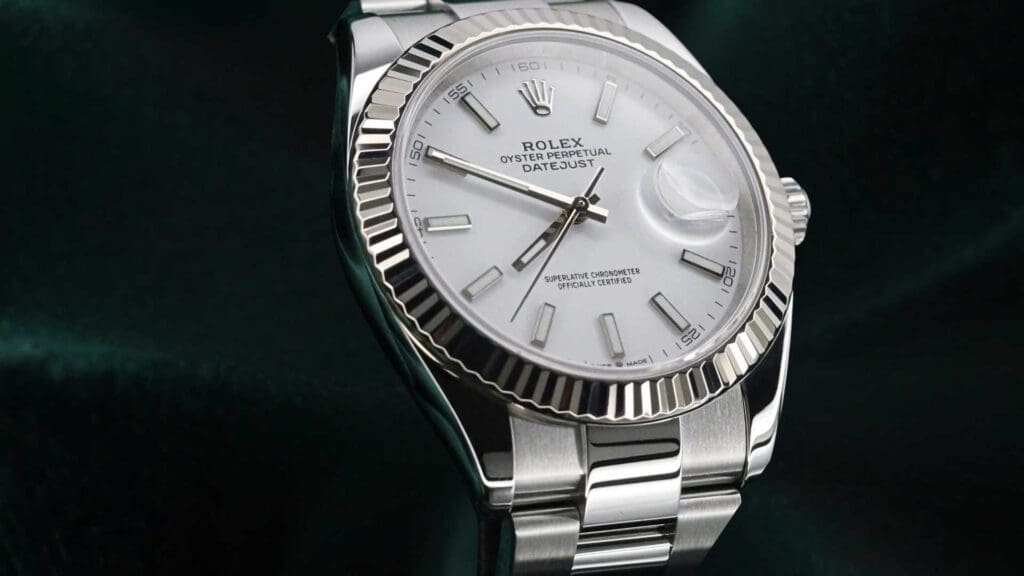
Knowing how to spot a fake Rolex Datejust is essential for any buyer, whether you’re shopping pre-owned, comparing listings online, or verifying a watch you already own. Counterfeit Datejust models have become increasingly sophisticated, with replicas now mimicking case proportions, bracelet designs, and even movement behavior.
Despite these improvements, genuine Rolex craftsmanship still leaves clear, consistent markers that counterfeits rarely execute correctly. Let’s examine the details that define authenticity and help you evaluate a Datejust with confidence.
Overview of the Rolex Datejust
The Rolex Datejust has appeared in many sizes, metals, and configurations since its debut in 1945. Learning these variations makes authentication easier, because each generation follows clear Rolex design standards. These include case proportions, bezel materials, bracelet construction, dial layouts, and movement upgrades.
Understanding these core elements makes you well equipped with the Datejust details before you begin checking for red flags.
Key Datejust Sizes and Generations
Authenticating a Datejust becomes easier once you recognize its standard sizes and reference eras. Here are the major model families to guide your checks.
- 26mm Lady-Datejust (older models) – Primarily found in 1960s–2000s references.
- 28mm Lady-Datejust (modern) – Replaced the 26mm size starting 2015.
- 31mm Mid-Size Datejust – Available across multiple generations; often targeted by counterfeiters due to its unisex appeal.
- 36mm Classic Datejust – The original and longest running Datejust size.
- 41mm Datejust II / Datejust 41 – Launched as the larger modern alternative, with the Datejust II (1163xx) produced 2009–2016 and the refined Datejust 41 (1263xx) starting 2016.
Key Reference Generations
- 16xx Series (1960s–1970s): Acrylic crystals, pie-pan dials, folded bracelets, non-quickset calibers (1570/1575).
- 162xx Series (1980s–1990s): Sapphire crystals, improved case finishing, quickset calibers (3035/3135).
- 1162xx Series (2000s–2016): Solid end links, updated clasps, heavier bracelets, refined cases.
- 1262xx Series (2016–present): Latest movements (3235), slimmer lugs, upgraded bracelets, and modern dial options.
Smooth vs. Fluted Bezels and Correct Metal Usage
A genuine Datejust will always pair specific bezel styles with correct metals. Counterfeits frequently mismatch these combinations.
| Bezel Style | Correct Metals | Notes |
| Smooth Bezel | Stainless steel, yellow gold, rose gold, Rolesor | Steel smooth bezels are common; gold smooth bezels appear on precious-metal models. |
| Fluted Bezel | Yellow gold, white gold, rose gold, Rolesor | Never full stainless steel – fluted steel bezels do not exist. White gold fluted bezels appear on “steel” Datejusts. |
| Engine-Turned Bezel (discontinued) | Stainless steel | Found on older 16xx/162xx models. Rare today; often incorrectly seen on fake “modern” Datejusts. |
Jubilee vs. Oyster Bracelets Across Eras
Bracelet construction is one of the most reliable authentication points because counterfeiters often misjudge weight, flexibility, and clasp design.
Jubilee Bracelet
- Earlier models used hollow center links and hollow end links.
- Late 1990s onward introduced solid center links and solid end links (SEL).
- Modern versions feature the super-Jubilee with a concealed Crownclasp.
- Correct for many Datejust 36 and Datejust 41 configurations.
Oyster Bracelet
- Older Oyster bracelets used hollow links with stamped clasps.
- 2000s references adopted solid center links and SEL construction.
- Modern Oysterclasp or Oysterlock clasps appear depending on the reference.
- Common on both Datejust 36 and Datejust 41, especially on smooth-bezel models.
How to Spot a Fake Rolex Datejust
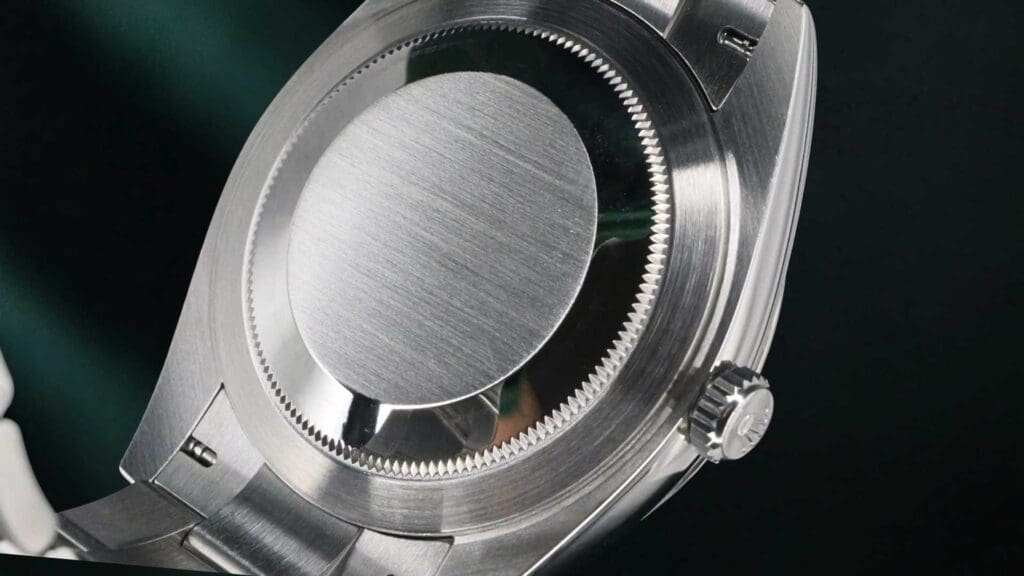
Spotting a fake Rolex Datejust comes down to checking details that counterfeiters consistently get wrong, whether it’s the case finishing, bezel material, bracelet construction, or movement behavior. Even when replicas look convincing at a glance, they rarely match Rolex’s precision, weight, and consistency across generations.
The next sections highlight the details that reveal authenticity and give you a clear basis for evaluating any Datejust. Let’s break down each category so you know exactly where to look.
Physical Checks
1. Examine the Case Finishing – Genuine Datejust cases feature crisp brushing, sharp transitions, and clean polishing. Fakes often show uneven texture, rounded edges, or sloppy polishing.
2. Verify the Bezel Style and Metal – Ensure the bezel matches Rolex rules; fluted bezels are always gold, never stainless steel. Mismatched metal color or incorrect proportions are major red flags.
3. Inspect the Dial Printing – Lettering on a real Datejust is razor-sharp with even spacing. Counterfeits tend to show fuzzy text, misaligned minute markers, or incorrect fonts.
4. Check the Cyclops Magnification – A real cyclops lens magnifies the date 2.5× with centered, clear numerals. Many fakes show weak magnification or off-center dates.
5. Assess Bracelet and Clasp Quality – Rolex bracelets feel solid, articulate smoothly, and use precise links. Fakes may have rattling links, light weight, or inaccurate clasp engravings.
6. Evaluate the Weight and Balance – The Datejust has a noticeably balanced heft because of its solid parts. A watch that feels overly light or top-heavy can indicate counterfeit materials.
Movement Checks
1. Observe the Second-Hand Motion – A genuine Rolex runs at 28,800 vph, producing a smooth, fluid sweep. Many fakes show stuttering or uneven movement.
2. Test the Date-Change Mechanism – The date on most Datejust models switches cleanly at midnight. Counterfeits may change slowly or misalign within the window.
3. Listen for Movement Noise – Real Rolex movements operate quietly. Loud ticking usually signals a low-quality replica movement.
4. Check Winding and Setting Feel – Crown action on a real Datejust is smooth, controlled, and solid. Gritty or inconsistent feedback is a sign of a fake stem or movement.
5. Confirm Hacking and Quickset Functions – Most Datejust generations allow precise stop-seconds and date quickset. Missing or inconsistent functionality is a major warning sign.
Documentation & Packaging Checks
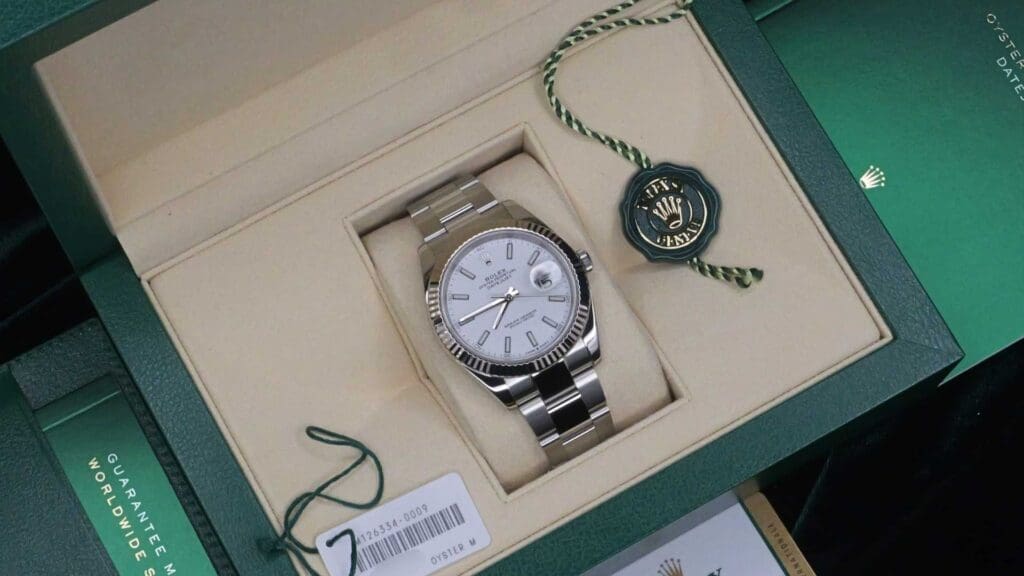
1. Inspect the Warranty Card – Genuine cards have perfect microprint, consistent font weight, and correct reference/serial formatting. Fakes often display mismatched spacing or low-quality printing.
2. Check the Box Quality – Real Rolex boxes are well-structured with clean edges and high-quality materials. Counterfeit boxes may feel flimsy or have uneven color tones.
3. Review Booklets and Manuals – Official booklets use premium paper, crisp printing, and correct model names. Fake sets often mix generations or include incorrect languages.
4. Compare Serial and Reference Numbers – On authentic Datejust models, the serial and reference numbers are deeply engraved and match the warranty card. Shallow or uneven engraving is a red flag.
5. Look for Missing Accessories – A real Datejust typically includes a booklet, hang tags, bezel protector (varies by era), and cardholder. Missing items alone don’t confirm a fake, but incomplete kits should be inspected more carefully.
Complete Rolex Datejust Authenticity Checklist
Use this quick-reference table to evaluate the most important elements of a Rolex Datejust. Each row highlights what a genuine watch should display and the red flags that often reveal a counterfeit.
| Item to Check | What to Look For | Red Flags |
| Case Finishing | Sharp brushing, crisp edges, even polishing | Rounded edges, uneven texture, sloppy polish |
| Bezel Style & Metal | Smooth or fluted bezels paired with correct metals (fluted = always gold) | Stainless-steel fluted bezel, mismatched metal tone, wrong proportions |
| Dial Printing | Crisp fonts, clean markers, correct date window alignment | Fuzzy text, misaligned minute track, incorrect fonts |
| Cyclops Lens | 2.5× magnification with centered date | Weak magnification, off-center date, distorted lens |
| Bracelet Construction | Solid links, SEL on modern models, smooth articulation | Rattling links, hollow feel on modern models, inaccurate clasp engravings |
| Clasp & Crown Operation | Smooth winding, precise clicks, strong crown tube engagement | Gritty winding, loose crown, inconsistent crown threading |
| Weight & Balance | Hefty, balanced feel appropriate to the reference | Too light, top-heavy, or unbalanced construction |
| Second-Hand Sweep | Smooth motion at 28,800 vph | Noticeable stuttering, jerky movement |
| Date Mechanism | Instant jump at midnight (varies slightly by era) | Slow roll-over, misaligned numerals |
| Movement Noise | Quiet operation with minimal ticking | Loud ticking typical of cheap replica movements |
| Serial & Reference Engravings | Deep, even engravings matching the warranty card | Shallow, uneven, or incorrect font engravings |
| Warranty Card | Crisp microprinting, accurate formatting, correct model/serial | Faded print, spelling errors, mismatched serials |
| Box & Papers | High-quality box, correct booklets for the era, matching accessories | Cheap materials, wrong booklet versions, missing or mismatched items |
Final Thoughts on Spotting a Fake Rolex Datejust
A genuine Rolex Datejust stands out through balance, precision, and impeccable finishing. Counterfeit pieces often miss these subtle qualities, even when they appear convincing at first glance. A careful, detail-oriented inspection reveals the truth.
When you take the time to evaluate each element with intention, you protect your investment and choose a watch that reflects the enduring craftsmanship that defines the Datejust.
FAQs About How to Spot a Fake Rolex Datejust
What is the quickest way to spot a fake Rolex Datejust?
The fastest way is to evaluate build quality. Replicas often show weak date magnification, uneven printing, light bracelets, or poorly finished edges. A genuine Datejust displays sharp dial text, precise brushing, solid bracelet weight, and a clear 2.5× cyclops magnification.
Are fluted bezel Datejust models more commonly counterfeited?
Yes. Fluted bezel versions are frequent targets because the bezel adds a premium look that counterfeiters try to mimic. Many fakes use incorrect metals, especially stainless steel. Authentic fluted bezels are always crafted in gold, making any steel fluted bezel an immediate warning sign.
Can I authenticate a Datejust without opening the caseback?
Yes. External checks provide strong evidence of authenticity, including dial accuracy, bezel type, engraving depth, bracelet construction, crown behavior, and date function. These areas often reveal inconsistencies on counterfeits. Caseback opening should be left to a professional, because improper handling can damage the watch.
Should I buy a Datejust without papers if it passes visual and functional checks?
Buying without papers is possible, but it requires a careful evaluation. Strong physical, mechanical, and serial checks can support authenticity, though documentation still adds confidence and resale value. A professional inspection is recommended before completing the purchase, especially for higher value configurations.