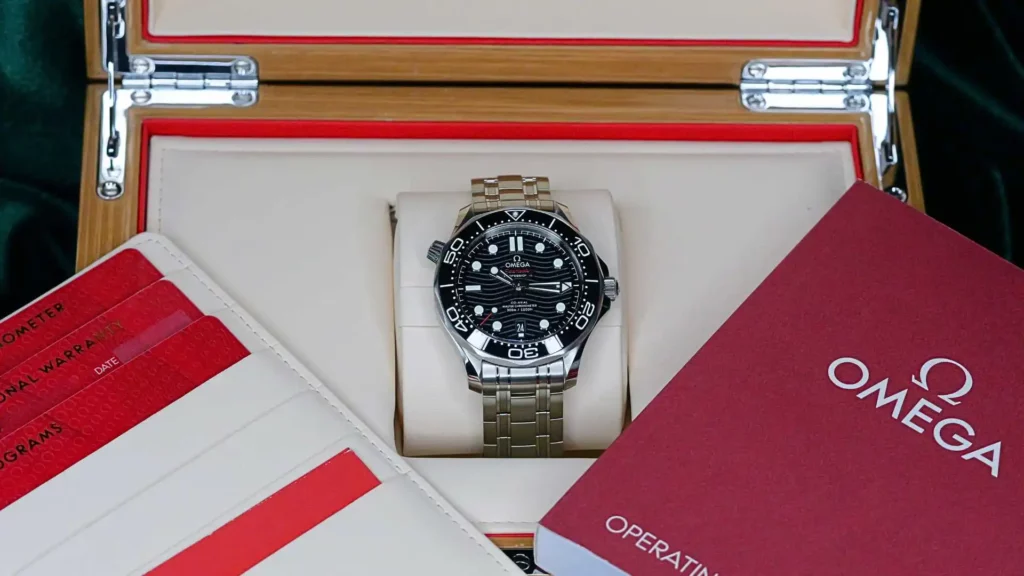
Looking for your first Omega watch in 2026 can feel overwhelming. Prices have jumped, models have changed, and “entry-level” isn’t what it used to be. The Speedmaster, once the obvious starting point, now starts around $7,000, nearly double what it cost a few years ago.
How do you find an Omega that fits your budget without sacrificing quality or style? This guide covers the best entry-level Omega watches for different buyers, real pricing across retail, grey market, and pre-owned channels, and the movement details that matter when you own them.
What Does “Entry-Level Omega” Actually Cost in 2026?

In 2026, an entry-level Omega watch generally ranges from $3,000 to $6,000 at retail, depending on the model and movement. Watches like the Omega Seamaster Diver 300M, Omega Aqua Terra, and Omega Railmaster fall into this bracket, offering reliable automatic movements and durable designs.
On the pre-owned market, prices drop significantly. You can often find these same watches for 30 to 45 percent less, especially if you buy from trusted dealers or online platforms. Grey-market retailers also offer discounts but require careful verification to avoid counterfeits.
Entry-level pricing varies with features. Chronographs or models with higher-grade calibers push the cost toward the top of the range, while simpler time-and-date models sit near the lower end. Materials like stainless steel dominate this segment, keeping watches affordable without sacrificing longevity.
Buying strategies matter. Watches purchased from authorized dealers include warranty coverage but at higher prices. Pre-owned options remove the warranty safety net but deliver better value. Grey-market sources sit in between, often providing savings with limited guarantees.
Understanding these price ranges helps you decide whether to focus on retail, grey market, or pre-owned options to get the most from your first Omega purchase.
Which Entry-Level Omega Watch Should You Actually Buy?

Choosing your first Omega is about which watch fits your lifestyle and long-term satisfaction. Different entry-level models suit different types of buyers, so it helps to identify what you want from your watch. Below, we break down the standout options and explain who each watch is best for.
1. You Want One Watch That Does Everything: Seamaster Aqua Terra
The Seamaster Aqua Terra is the most versatile entry-level Omega, combining a clean design with robust in-house mechanics for everyday wear. Its features make it ideal for someone who wants one watch that can handle everything, from work to weekends.
Key highlights
- Movement: METAS Master Chronometer Caliber 8900 with Co-Axial escapement
- Accuracy: 0/+5 seconds per day
- Power Reserve: 60 hours
- Water Resistance: 150 meters, suitable for swimming and snorkeling
- Case Size: 41mm or 38mm steel options
- Pre-Owned Entry Price: Around $3,400 for earlier Co-Axial 2500 references
- Design: Clean, versatile, works with suits and casual outfits
- Durability: Resistant to magnetic fields up to 15,000 gauss
The Aqua Terra does not get the same attention as the Speedmaster or Seamaster 300M and the horizontal-striped “teak” dial can be polarizing. If you want technical performance and everyday versatility without focusing on collector appeal, this watch stands out as the best all-around entry-level Omega.
2. You Want the Most Recognized Omega Sport Watch: Seamaster Diver 300M
The Seamaster Diver 300M is one of the most iconic dive watches in the world and has been James Bond’s watch since 1995. Right now, it is arguably the best overall entry-level Omega for buyers who want recognition, performance, and classic dive watch style.
Key highlights
- Movement: METAS Master Chronometer Caliber 8800 with Co-Axial escapement and silicon hairspring
- Accuracy: 0/+5 seconds per day
- Power Reserve: 55 hours
- Water Resistance: 300 meters, with helium escape valve and screw-down crown
- Case Size: 43.5mm steel
- Dial and Bezel: Wave-patterned ceramic dial with ceramic unidirectional bezel and white enamel diving scale
- Pre-Owned Entry Price: Around $3,600 for GoldenEye-era reference 2531.80
- Recognition: Instantly recognizable and highly respected among dive watch enthusiasts
The 43.5mm case wears larger than it looks on paper, and the lug-to-lug distance can feel big on smaller wrists. If your wrist measures under 17cm, try it on before buying. The wave-patterned dial is visually striking but can appear busy in certain lighting.
Despite this, the Diver 300M offers excellent value, making it a standout entry-level luxury watch.
3. You Want the Best Long-Term Value and Collector Credibility: Speedmaster Moonwatch Professional
The Speedmaster Moonwatch Professional is not the most practical first Omega, but it is the right choice for buyers who value long-term credibility and collector appeal. It holds its value better than any other entry-level Omega, retaining roughly 70 to 78 percent of its retail price after three years.
For comparison, the Aqua Terra retains 58 to 68 percent and the De Ville as low as 43 to 60 percent.
Key highlights
- Movement: COSC-certified Caliber 1861, manual wind
- Accuracy: –1/+11 seconds per day
- Power Reserve: 48 hours, requires winding every one to two days
- Water Resistance: 50 meters
- Case: 42mm steel with hesalite crystal and closed caseback
- Pre-Owned Entry Price: Around $4,000 for reference 3570.50 (1996–2014 production)
- Collector Appeal: Authentic Moonwatch experience, NASA flight-qualified, and historic lunar heritage
The Speedmaster has modest water resistance, so it is not suitable for swimming or showering. The manual-wind Caliber 1861 requires regular winding and is not as modern as METAS-certified movements. Despite these practical limits, its historical significance, strong resale value, and collector credibility make it an unmatched choice for buyers seeking long-term value and authenticity.
Pre-owned examples provide the correct hesalite crystal, closed caseback, and manual-wind movement without paying the full retail price.
4. Your Budget Is Tighter: De Ville Prestige
The De Ville Prestige is the most affordable automatic Omega with a classic dress watch design, making it a common pick on entry-level lists. It has an ultra-slim profile and Co-Axial movement, with some references retailing between $3,600 and $4,600. It is elegant, well-built, and perfectly suitable as a formal watch.
Key highlights
- Movement: Co-Axial automatic on many references
- Accuracy: Standard Omega automatic tolerances
- Power Reserve: Typically 48 to 50 hours
- Water Resistance: Modest, suitable for everyday splashes but not swimming
- Case: Slim dress watch profile, generally around 39 to 41mm
- Pre-Owned Entry Price: Around $2,000 for discontinued references
- Design: Classic and elegant, ideal as a formal watch or secondary piece in a collection
The De Ville Prestige has the weakest resale value of major Omega references, retaining only 43 to 60 percent after a few years. It is not the best daily wearer or first-choice investment. If your budget is tight and you need a formal dress watch, it gets the job done.
However, many buyers find that similar pre-owned pricing on sportier models like the Seamaster Diver 300M or Aqua Terra offers better value and versatility.
New Grey Market or Pre-Owned — What’s the Smartest Way to Buy?
Pre-owned watches are not just a budget option. They are a strategic way to get more watches for the same money. A pre-owned Diver 300M with the Caliber 8800 at $3,800 offers the same movement, quality, and performance as many new pieces at that price without paying the full retail premium.
Here is how the three buying channels compare
1. Retail: Full MSRP at an authorized dealer or Omega boutique. You get the new-watch experience and full manufacturer warranty. Prices are highest, and many sport models depreciate immediately after purchase.
2. Grey Market: Unworn watches with box and papers sold through unauthorized dealers, typically 15 to 25 percent below MSRP. Many regions still honor the manufacturer warranty. This is a smart option for buyers who want a new watch without paying full retail.
3. Pre-Owned: Used watches from platforms like Chrono24 or specialist dealers. Discounts can be 30 to 45 percent off retail on many references. Condition and authenticity are key, so buying from a reputable, authenticated seller is critical. Avoid skipping boxes and papers as missing documentation can reduce resale value by 15 to 25 percent.
Specific Pre-Owned References Worth Targeting in 2026
Targeting these specific pre-owned references lets buyers consistently get more watch for their money than buying new at the bottom of the current lineup.
| Model | Reference | Movement | Key Features | Pre-Owned Price |
|---|---|---|---|---|
| Speedmaster Moonwatch | 3570.50 (1996–2014) | Manual-wind Caliber 1861 | Hesalite crystal, closed caseback, authentic Moonwatch experience | ~$4,000 |
| Diver 300M | 2531.8 | Co-Axial Caliber 8800 | GoldenEye Bond watch, strong availability | Under $3,000 |
| Aqua Terra | 231.10.42.21.01.004 | Co-Axial Caliber 2500 | Earlier teak-dial generation, reliable movement | ~$2,800 |
What Does METAS vs. COSC Actually Mean for You as an Owner?

Many guides mention these certifications but rarely explain what they mean day to day. Understanding the difference helps you know what to expect in accuracy, durability, and service costs as an owner.
The practical difference is significant. A METAS-certified watch will maintain accuracy near phones, laptops, and airport security scanners. A COSC watch may still run fine, but it is not engineered for high magnetic environments and has a slightly wider accuracy tolerance.
The Co-Axial escapement in METAS movements reduces friction, which doubles the service interval compared to a traditional lever escapement. Omega servicing costs typically range from $400 to $700 per service, so extending intervals to 10 years reduces long-term ownership costs.
The Speedmaster’s Caliber 1861 does not have these advantages. It is a manual-wind COSC-certified movement with a traditional lever escapement and requires service roughly every five to seven years. It is reliable and historically important but represents the oldest technology in the entry-level Omega lineup.
Common Mistakes First-Time Omega Buyers Make
First-time buyers often regret their purchase when revisiting the secondary market. Avoiding these mistakes helps you get the right watch for your wrist, budget, and lifestyle. Key mistakes to watch for:
1. Paying full retail for a sport Omega: Grey market watches often save 15 to 25 percent on the same unworn piece. Paying MSRP only makes sense if you value the boutique experience.
2. Choosing case size based on diameter alone: A 42mm Speedmaster can wear larger than a 43.5mm Diver 300M because of longer, flatter lugs. Always check the lug-to-lug measurement before buying online.
3. Using the Speedmaster as a daily watch: Its 50-meter water resistance limits pool or shower wear. It is not ideal for year-round, all-weather daily use.
4. Skipping box and papers: Saving $200–$300 upfront can cost more at resale. Complete sets always command a premium on the secondary market.
5. Buying the De Ville Prestige as the cheap entry: Pre-owned sport models at similar prices often provide better value, versatility, and resale retention.
Avoiding these common missteps ensures you get the watch that matches your needs and holds value over time.
Final Thoughts on Top Entry-Level Omega Watches Worth Buying in 2026
Choosing your first Omega is not only about selecting a watch. It is about finding one that feels right for you, understanding the quality behind it, and enjoying something you can wear for many years.
The top entry-level Omega watches worth buying in 2026 offer access to the same movements and quality as higher end pieces, especially through pre-owned and grey market channels.
Thinking carefully about your wrist size, lifestyle, and collector goals can prevent regrets and ensure you get the most from your investment. The smartest buyers focus on the experience of ownership and the durability of the watch, not fleeting trends.
Selecting your first Omega thoughtfully turns it into a long-term source of enjoyment and pride.