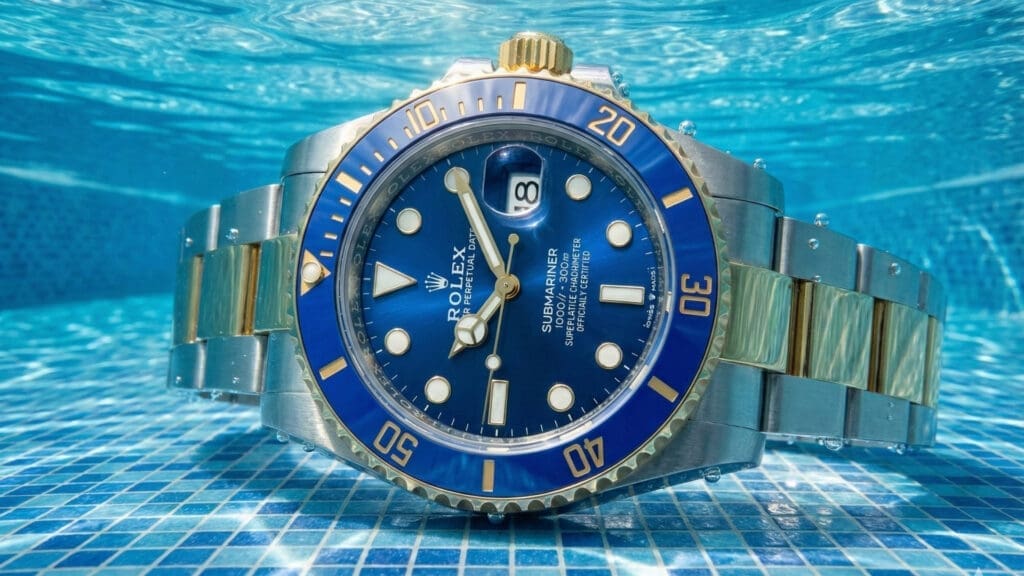
Can I wear my Rolex in the pool without worrying about damage? That’s a question many new owners ask the moment they strap on their watch during vacation or a weekend swim. Rolex has a reputation for toughness and water resistance, but the answer isn’t as simple as yes or no. Your watch’s performance depends on the model you own, how you maintain it, and the conditions you expose it to.
If you want to enjoy your time in the pool without putting your watch at risk, you need to know the details behind water resistance, model differences, and proper aftercare. Stick with us as we break down everything you need to know about swimming with your Rolex.
Understanding Rolex Water Resistance

Rolex watches are engineered with water resistance in mind, but it’s important to separate marketing terms from reality. No Rolex is truly waterproof. The proper term is water-resistant, which means the watch is built to withstand water exposure up to a specific pressure and depth.
The Oyster case is the backbone of Rolex’s water resistance. It uses an airtight sealed case middle, a screw-down case back, and a screw-down crown with multiple gaskets. Depending on the model, Rolex crowns come with either Twinlock (two-seal system) or Triplock (three-seal system) technology, both designed to keep moisture out.
Complications also affect resistance. A simple three-hand watch with a screw-down crown is less vulnerable than a chronograph with pushers. Rolex specifically designs its chronograph pushers to screw down as well, but pressing them underwater can still compromise the seals. Moonphase, calendar, or other high-complication watches usually carry lower water resistance ratings.
Here’s a simple scale you can use as a guideline:
- 30m (3 ATM) – Splash resistant only. Safe for hand washing and rain.
- 50m (5 ATM) – Light swimming at the surface, but not recommended for pool use.
- 100m (10 ATM) – Suitable for pool swimming, snorkeling, and everyday water exposure.
- 200m–300m (20–30 ATM) – Designed for diving and extended water activities.
- 1000m+ (100 ATM) – Professional saturation diving levels.
Which Rolex Models Are Safe for Pool Use?

If you want to take your Rolex into the pool, the first thing to check is its water resistance rating. Rolex doesn’t build all watches the same—some are made for underwater use, while others are strictly dress pieces. Use this breakdown to see where your watch falls.
Not Safe for Swimming – 30 m to 50 m (3–5 ATM)
If you own a Rolex Cellini, keep it away from the pool. Even the modern Cellini with a 50-meter rating isn’t designed for swimming. That depth rating is only for splashes, hand washing, or light rain.
Vintage Cellini references are even lower, rated around 30 meters. References include: 50505, 50509, 50519, 50525, 50535, 50539, and the Moonphase 50535.
Safe for Pool Use – 100 m (10 ATM)
Most Rolex models come with the Oyster case and a 100-meter rating. That’s more than enough for swimming and casual water activities. As long as your crown is fully screwed down and the gaskets are in good condition, you can wear these in the pool without worry. Models include:
- Oyster Perpetual (124200, 124300, 126000, 277200)
- Datejust (126200, 126300, 126334, 126331, 126233, 278274)
- Day-Date (228238, 228239, 228235, 228206)
- Sky-Dweller (326934, 336934, 336239)
- Explorer I (124270)
- Explorer II (226570)
- GMT-Master II (126710BLRO, 126710BLNR, 126720VTNR, 126711CHNR)
- Milgauss (116400GV)
- Air-King (126900)
- Yacht-Master (126622, 126621, 226659, 268622)
Safe with Extra Care – 100 m (10 ATM) Chronograph
The Cosmograph Daytona is also rated to 100 meters, so you can swim with it just like the models above. The difference is in the chronograph pushers. They’re screw-down for protection, but if you forget to lock them or accidentally press one underwater, the seal breaks and water can get in. That’s why Rolex advises against using the pushers when submerged.
If you keep the crown and pushers screwed down properly, your Daytona is safe in the pool. References include: 116500LN, 126500LN, 126503, 126518LN, 126529LN.
Built for Diving – 300 m and Above
Rolex dive watches are made to go far beyond the pool. These use reinforced cases and Triplock crowns, so you can swim, snorkel, and even dive without concern.
- Submariner (124060, 126610LN, 126610LV, 126619LB) – 300 m
- Sea-Dweller (126600) – 1,220 m
- Deepsea Sea-Dweller (126660, 136660) – 3,900 m
In short, every current Rolex with an Oyster case (except Cellini) is safe for pool use, provided it’s properly serviced and the crown is screwed down. The only real no-go for swimming is the Cellini line. Vintage references (pre-1980s) also require caution, since gaskets and crowns may no longer guarantee water resistance.
Best Practices for Pool Use When Wearing a Rolex
Even if your Rolex is swim-rated, how you care for it after each pool session determines its longevity. Follow these focused practices to protect your watch long-term:
- Rinse case and bezel under fresh tap water – Always rinse your Rolex with clean tap water after every swim to remove chlorine deposits and microscopic salts that can dry into the case.
- Keep the Triplock or Twinlock crown fully screwed – Never unscrew or adjust the crown when the watch is wet. Even a partial opening can let water bypass the stem seal and reach the movement.
- Dry crystal and lugs with a microfiber cloth – Pat the sapphire crystal, bezel, and lugs gently to absorb moisture. Avoid rubbing, since grit trapped in pool water can leave fine scratches.
- Have crown tube threads measured at service – Ask Rolex service to check the crown tube and thread alignment with gauges. Any wear or misalignment in this area directly reduces the security of your water seal.
- Avoid heat on the case after swimming – Do not expose the watch to hair dryers, heaters, or strong sunlight while drying. Rapid heating hardens gasket lips and reduces their elasticity over time.
- Check and bracelet screws – Pool chemicals and frequent rinsing can loosen bracelet screws faster than normal wear.
- Rotate swimming use between watches – If you swim often, alternate between Rolex models instead of relying on just one.
Situations When You Should Not Wear a Rolex in the Pool
Even though most modern Rolex watches are designed for swimming, there are certain conditions where wearing one in the pool becomes a real risk. Here are the situations when you should avoid wearing your Rolex:
- During pool cleaning or heavy chlorination: Chemical shock treatments use chlorine concentrations far higher than normal pool water. This can wear out the gaskets faster and also scratch or dull the finish on Oystersteel, gold, or platinum.
- Right after service, if the watch hasn’t been pressure-tested: Freshly opened cases must be pressure-tested to confirm water resistance. Skipping this step puts the watch at risk of leaks.
- If you see condensation under the crystal: Even the smallest fogging indicates water intrusion or gasket failure. Swimming again without a full check-up makes the damage worse.
- Vintage Rolex models without modern seals: Watches produced before the 1980s, such as the Submariner ref. 5512, 5513, and 1680 used early Oyster cases with less advanced gaskets. Over time, these seals degrade, reducing water resistance and making pool use risky.
- Any watch that hasn’t been serviced in over 5–7 years: Gaskets and seals degrade with age, so an overdue service increases the likelihood of leaks.
- Watches with aftermarket modifications: Non-OEM parts, crowns, or casebacks can compromise the integrity of the Oyster case, reducing water resistance and creating potential points of entry for water.
Our Expert Recommendations
You can wear your Rolex in the pool—most modern models handle it well—but if your watch has a 30–50 meter water resistance rating, like the Cellini, swimming is not recommended. Even with higher-rated, water-resistant models, protecting your watch from chlorine and chemical buildup helps preserve gaskets, metal, and straps over time.
Gold and two-tone models are particularly sensitive to chlorine or saltwater (if you’re on the beach), so rinse them immediately after contact. For more demanding underwater activities, Rolex dive watches feature reinforced gaskets and pressure-tested cases, giving you confidence without compromising performance or aesthetics.
Taking a few simple precautions after each swim keeps your Rolex looking and performing its best for years. Treat your watch with care, and it will continue to handle pool and ocean use reliably.