
Two watches, two completely different personalities, one shortlist. The TAG Heuer Carrera vs Omega Seamaster comparison keeps coming up because both sit in a similar price range, both carry real heritage, and both make a strong case on paper. The problem is they were built for entirely different purposes.
If you are researching your first serious purchase, or trading up to something you plan to wear for decades, this decision deserves more than a gut check. One watch came from the racetrack. The other came from the ocean. That difference runs deeper than you might expect, and this article will show you exactly where it matters.
TAG Heuer Carrera Overview

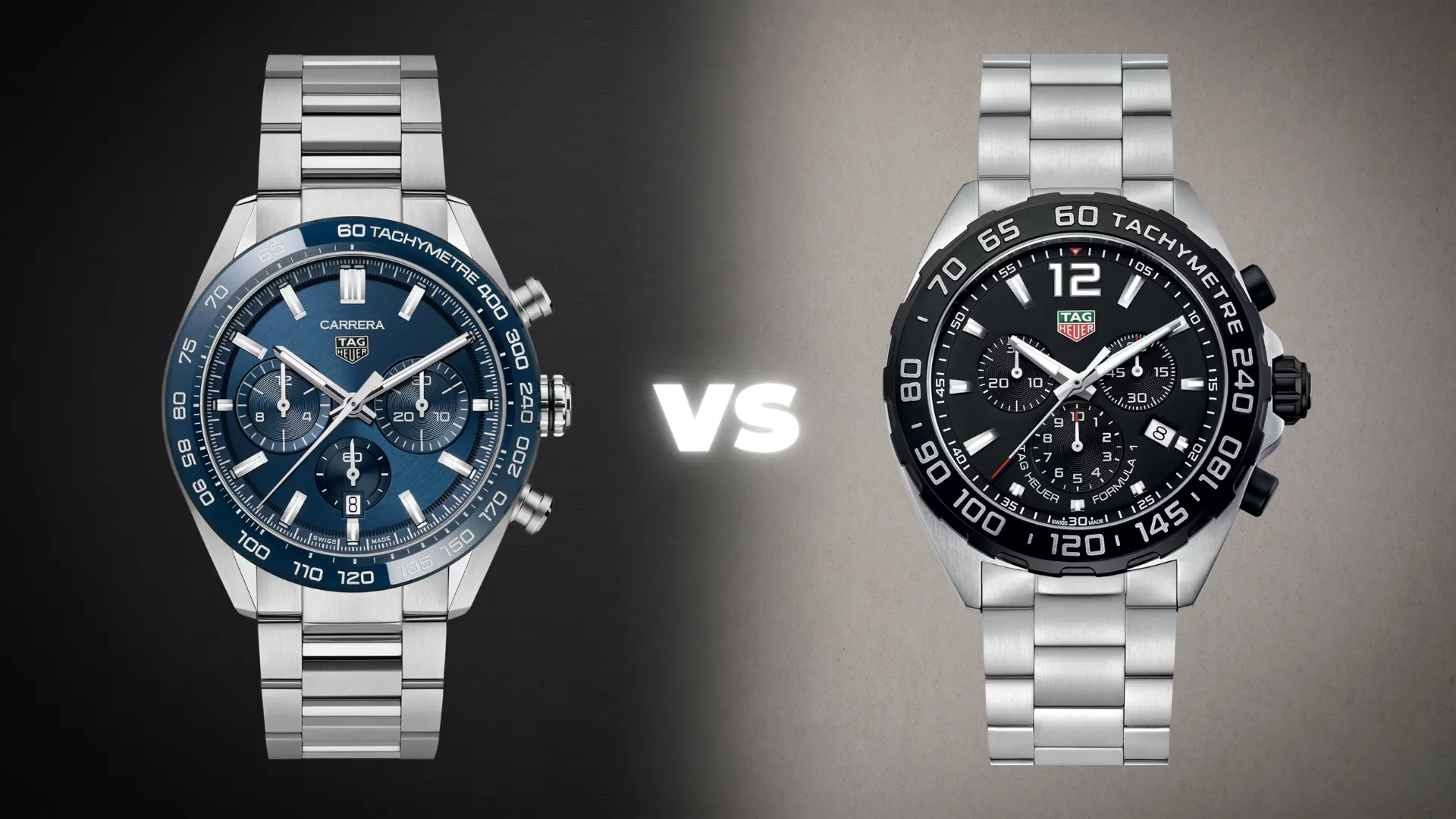
Jack Heuer had a clear goal in 1963: build a chronograph that a racing driver could actually read at speed. He named it after the Carrera Panamericana, a notoriously dangerous road race across Mexico, and the watch reflected that pressure. Clean dial, deep-set subdials, slim case, nothing in the way of legibility.
The Carrera went through several distinct eras. Earlier generations used third-party movements, including the Valjoux 7750-based Calibre 16, before TAG Heuer eventually moved to in-house production. The current Glassbox generation, launched in 2023, is the most significant redesign in the model’s history. The edge-to-edge domed sapphire crystal wraps over the entire dial and pulls the tachymeter scale inside the glass, creating a modern look that still connects directly to the original spirit.
From a collector standpoint, the Glassbox references are the ones to pay attention to today. The TH20 in-house movement and the new case architecture changed what buyers expect from a Carrera. It suits someone who wants a precise chronograph with motorsport roots and a dial that shows more detail the closer you look at the subdial finishing.
Notable References of the TAG Heuer Carrera:
- CBS2212.FC6535 (Carrera Chronograph 39mm, Blue Glassbox)
- CBS2216.BA0041 (Carrera Chronograph 39mm, Panda)
- CBS2113.BA0053 (Carrera Chronograph 41mm, Blue)
- CBS2114.BA0053 (Carrera Chronograph 41mm, Black/Red)
- CBN2A10.BA0643 (Carrera Heuer 02 Automatic Chronograph)
- CBS5010.FC6543 (Carrera Chronograph Tourbillon)
Omega Seamaster Diver 300M Overview

The Seamaster line goes back to 1948, but the Diver 300M as most people know it arrived in 1993. Omega built it as a genuine professional dive watch from day one: unidirectional rotating bezel, screw-down crown, helium escape valve, and a 300-meter water resistance rating tested to ISO 6425 diver’s watch standard. The laser-engraved wave dial, skeletonized hands, and five-link bracelet became some of the most copied design signatures in the segment.
The watch got global attention after 1995, when it was chosen for James Bond in GoldenEye. The 2018 generation was the most important update since launch. The bezel moved to ceramic with laser engraving, the dial became a fully ceramic piece, and the movement was upgraded to Co-Axial Master Chronometer with METAS certification. Magnetic resistance reached 15,000 gauss. That made the post-2018 Seamaster the most technically capable version the watch has ever been.
Collectors focus on the post-2018 ceramic generation for modern references. Older aluminum bezel references from the late 1990s and early 2000s carry strong nostalgia and are accessible entry points. The core design worked in 1993 and it still works today. That is rare.
Notable References of the Omega Seamaster Diver 300M:
- 210.30.42.20.01.001 (42mm Steel, Black Ceramic Dial and Bezel)
- 210.30.42.20.03.001 (42mm Steel, Blue Ceramic Dial and Bezel)
- 210.90.42.20.01.001 (42mm Titanium, No Time to Die Edition)
- 210.30.44.51.01.001 (44mm Steel Chronograph, Black Dial)
- 2531.80 / 2220.80 (Late 1990s Aluminum Bezel Era)
TAG Heuer Carrera vs Omega Seamaster: Most Notable Differences
These two watches overlap in price and ambition, but the specs tell very different stories. The differences below are the ones that actually change how you use the watch, not just how it looks on paper. None of these are cosmetic gaps — each one changes what you can actually do with it.
1. Water Resistance

The Carrera is rated to 100 meters. That covers rain, swimming, and daily water contact. What it does not have is a screw-down crown, a helium escape valve, or a bezel that can track dive time. The 100m rating is based on standard pressure testing, not the ISO 6425 diver’s watch standard.
The Seamaster Diver 300M is rated to 300 meters and is built to ISO 6425, tested under actual diving conditions. The screw-down crown, unidirectional rotating bezel, and helium escape valve at 10 o’clock are all part of a purpose-built dive architecture. For any serious water use beyond surface swimming, the Seamaster is the only practical choice of the two.
Who it favors: The Seamaster, clearly, for any buyer who wants real water capability.
2. Movement Certification
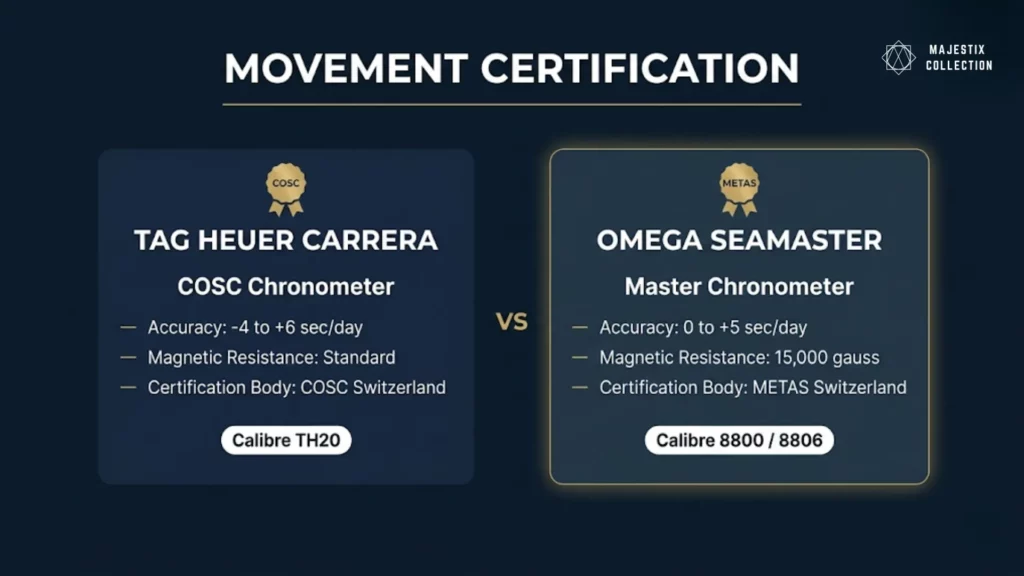
The current Carrera Glassbox uses the in-house Calibre TH20, certified to COSC standard at -4/+6 seconds per day. Some three-hand Carrera references use the TH31 (a Sellita/AMT collaboration), which is capable but not COSC-certified on all variants.
The Seamaster runs on Omega’s Co-Axial Master Chronometer Calibre 8800 or 8806, certified by METAS, a stricter standard than COSC. METAS tests for six-position accuracy, precision of 0/+5 seconds per day in real conditions, and magnetic resistance up to 15,000 gauss. That last number matters in daily life: most conventional movements lose accuracy near MRI scanners or strong speaker magnets. The Seamaster’s silicon balance spring resists those fields entirely.
Who it favors: The Seamaster has the higher certified standard. The Carrera’s COSC is solid, but METAS tests more and tests harder.
3. Bezel Type
The Carrera uses a fixed stainless steel tachymeter. On Glassbox models, the tachymeter scale sits inside the glass as part of the flange. It does not rotate. Its function is to calculate speed over distance using the chronograph. There is no dive-time function on any Carrera reference.
The Seamaster uses a unidirectional rotating ceramic bezel with a 60-minute dive scale. The unidirectional mechanism means it can only turn counterclockwise, so the elapsed time reading can never accidentally show less time than has actually passed underwater. Post-2018 models use a ceramic insert that resists daily scratching well. Earlier references had aluminum inserts that showed wear over time.
Who it favors: The Carrera for a chronograph sport instrument. The Seamaster for any buyer who needs a functional dive timer with durable, scratch-resistant bezel material.
4. Case Dimensions
The Carrera Glassbox Chronograph comes in 39mm (approximately 46mm lug-to-lug, 13.86mm thick) and the newer 41mm (approximately 47.48mm lug-to-lug, 14.17mm thick). The three-hand Carrera sits at 41mm with a 47.5mm lug-to-lug and a slimmer 12.57mm case thickness.
The Seamaster Diver 300M standard references measure 42mm with approximately 47.4mm lug-to-lug and 13.1 to 13.8mm thickness depending on the variant. On paper the two collections sit close, but the Carrera’s beveled lugs and bezel-free Glassbox design make the 39mm wear more compactly than the numbers suggest. The Seamaster’s rotating bezel and crown guards add visual bulk. Buyers with smaller wrists consistently find the 39mm Carrera easier to wear without lug overhang.
Who it favors: Smaller wrists or buyers who want a compact feel favor the Carrera 39mm. Medium-to-large wrists that want a full dive watch presence are well-suited to the Seamaster 42mm.
5. Power Reserve
The Carrera’s TH20 in-house movement delivers an 80-hour power reserve. The TH31 three-hand variant also reaches 80 hours. A Carrera left on a nightstand Friday evening will still be running Monday morning.
The Seamaster’s Cal. 8800/8806 offers 55 hours. It is a well-regulated movement, but the power reserve is shorter. For buyers who rotate between several watches, the Carrera’s extra reserve is a real daily convenience, not just a spec sheet number.
Who it favors: The Carrera has a clear power reserve advantage for multi-watch collectors.
6. Dial Layout
The Carrera Glassbox Chronograph uses a tricompax layout with three recessed subdials: 30-minute counter at 3, 12-hour counter at 9, and small seconds at 6. The subdials use azurage finishing and the concave flange rises at the dial edge. There is no date on the Glassbox Chrono references. The domed edge-to-edge sapphire crystal creates visual depth by sitting flush over the entire dial surface.
The standard Seamaster Diver 300M uses a three-hand date layout, with the date at 6 o’clock on most references. The dial is fully ceramic with a laser-engraved wave pattern that refracts light differently depending on the angle. The sword-shaped skeleton hands are hollow and filled with luminous material for strong underwater readability. Both dials are highly legible, but the Carrera is built around chronograph function while the Seamaster is built around time-reading in low-light and wet conditions.Who it favors: Buyers who want a dedicated chronograph instrument favor the Carrera. Buyers who want a practical everyday watch with a date complication favor the Seamaster.
Price and Market Demand
Price tells you a lot about what the market actually thinks of a watch, not just what the brand charges for it. These two collections behave very differently on both sides of the counter.
Tag Heuer Carrera
The Carrera entry point sits around $3,900–$4,500 for three-hand references, while the Glassbox Chrono 39mm retails in the $6,800–$7,500 range. The Heuer 02 Chronograph lands between $5,500–$6,500. On the secondary market, all of these trade below retail. Grey market pricing for new references runs 15–25% below MSRP, which lowers the real entry cost but also sets a lower floor for resale.
The Glassbox redesign is recent and its long-term collector standing is still being established. What moves Carrera prices: full box and papers, unpolished case, special dial configurations (Panda, collaborations), and confirmed movement generation. Older Calibre 16 era references are available in the $1,500–$3,500 range depending on condition (source).
Omega Seamaster
The Seamaster Diver 300M standard steel references retail in the $5,600–$6,500 range, with pre-owned clean examples trading between $4,500–$5,500. The titanium No Time to Die edition retails around $7,000–$8,000 and regularly exceeds retail on the secondary market, trading between $7,500–$9,000. That is unusual for any watch outside of Rolex and high-end independents.
The 44mm Chronograph sits at $7,500–$9,000 retail with a pre-owned range of $6,500–$8,500. Older aluminum bezel references are accessible in the $3,000–$3,800 range. The Seamaster sells faster and to a wider buyer pool because its design and cultural footprint are recognized globally. What moves Seamaster prices: titanium or special edition status, ceramic bezel condition (chips reduce value significantly), unpolished lugs, and complete documentation (source).
Notable TAG Heuer Carrera References

Here are five of the most relevant Carrera references for anyone cross-shopping this collection against the Seamaster. Each one represents a distinct entry point into the line.
1. Carrera Glassbox Chronograph 39mm (CBS2212.FC6535)
The 39mm Glassbox is where most of the current Carrera attention is. The compact case combined with the edge-to-edge domed sapphire crystal creates a genuinely distinctive profile in modern chronograph design. The tachymeter sits under the glass, the subdials are deep and clearly defined, and the watch communicates precision without bulk.
- Case size: 39mm stainless steel
- Movement: In-house Calibre TH20, COSC certified
- Power reserve: 80 hours
- Water resistance: 100m
- Typical pre-owned range: $4,500–$6,000
2. Carrera Glassbox Chronograph 41mm (CBS2114.BA0053)
The 41mm Glassbox arrived in 2026 as a step up in presence while keeping the same architecture. The lug-to-lug of approximately 47.48mm places it close to the Speedmaster Professional in actual wrist footprint. T
he Black/Red reference (CBS2114) adds motorsport contrast with red accents on the chronograph hands. It suits buyers with medium-to-large wrists who found the 39mm slightly compact.
- Case size: 41mm stainless steel
- Movement: In-house Calibre TH20-01, COSC certified
- Power reserve: 80 hours
- Water resistance: 100m
- Typical retail: approx. CHF 7,500
3. Carrera Heuer 02 Automatic Chronograph (CBN2A10.BA0643)
The Heuer 02-powered Carrera is an earlier chapter in the in-house movement story. The 43mm case has a bolder, more assertive look than the Glassbox, with a modular construction that was a real technical step forward at the time. Pre-owned availability is strong and pricing is competitive.
It suits buyers who prefer a more substantial wrist presence and are less attached to the Glassbox design language.
- Case: 44mm stainless steel, brushed and polished
- Movement: In-house Heuer 02 automatic chronograph, 80h power reserve
- Water resistance: 100m
- Bracelet: Five-row stainless steel with folding clasp
- Status: Discontinued
- Typical pre-owned range: $3,500–$5,000
4. Carrera Chronograph 39mm, Panda (CBS2216.BA0041)
The Panda is the most visually distinctive 39mm Glassbox reference. The silver sunray-brushed dial with twin black azurage subdials is a direct nod to the Heuer 7753 SN from the late 1960s. It suits buyers who want the Glassbox architecture with stronger dial contrast and a more collector-facing reference.
The three-row steel bracelet was offered for the first time on a 39mm Glassbox with this reference. The bicompax layout keeps the dial clean, and the red accents on the chapter ring connect it directly to the original racing chronograph identity.
- Case: 39mm stainless steel
- Movement: In-house Calibre TH20-00, COSC certified
- Power reserve: 80 hours
- Water resistance: 100m
- Bezel: Fixed tachymeter under Glassbox sapphire crystal
- Typical pre-owned range: $4,500–$6,000
5. Carrera Chronograph Tourbillon (CBS5010.FC6543)
At the top of the Carrera range, the Tourbillon uses the in-house TH20-09 with a flying tourbillon at 6 o’clock that also serves as the running seconds indicator. Available in steel and limited titanium configurations, it is a technical statement and a collector-level piece, with production limited to small runs.
- Case size: 42mm (varies by reference)
- Movement: In-house TH20-09 with flying tourbillon, 65h power reserve
- Water resistance: 100m
- Typical range: $20,000–$30,000+
Notable Omega Seamaster Diver 300M References

The Seamaster line has more depth than most buyers realize before they start looking closely. These five references cover the range from the most practical daily option to the titanium editions that consistently outperform retail.
1. 42mm Steel, Black Dial (210.30.42.20.01.001)
This is the most understated configuration in the current line. The all-dark execution lets the ceramic wave texture do the visual work without the color contrast of the blue version, and for buyers who want the full Seamaster spec without the Bond-blue look, this is the cleaner path.
The Master Chronometer Calibre 8800 and the monochromatic palette make this unusually versatile for a dive watch. It pairs cleanly with almost any strap material and wears as naturally with a casual outfit as it does with anything more formal. Buyers who want the complete Seamaster specification in a quieter package tend to land here.
- Case: 42mm steel, 13.8mm thick
- Movement: Co-Axial Master Chronometer Cal. 8800, METAS certified
- Water resistance: 300m
- Bezel: Black ceramic, unidirectional
- Typical pre-owned range: $4,500–$5,300
2. 42mm Steel, Blue Dial (210.30.42.20.03.001)
The blue reference is the most recognizable Seamaster in production today. The ceramic dial shifts tone under different light, deeper indoors, brighter near a window, and the wave texture does not fade or peel because it is engraved into the ceramic rather than printed on top of it.
This reference carries the Bond heritage most directly and is one of the easier pre-owned luxury watches to resell across most markets. The five-link steel bracelet with Omega’s quick-change system adds practical convenience that the Carrera bracelet does not currently match.
- Case: 42mm steel
- Movement: Co-Axial Master Chronometer Cal. 8800, METAS certified
- Water resistance: 300m
- Bezel: Blue ceramic, unidirectional
- Typical pre-owned range: $4,700–$5,500
3. 42mm Titanium, No Time to Die Edition (210.90.42.20.01.001)
The titanium case saves meaningful weight compared to steel. The brown dial references British military property markings, a detail tied to the James Bond character. It is a quieter take on the Bond connection than the standard blue.
This reference trades above retail on the secondary market, which is uncommon for Omega outside of dedicated limited editions. The combination of titanium construction, a distinctive colorway, and the Daniel Craig collaboration creates collector demand that standard steel references do not match. It suits buyers who want a Seamaster that stands clearly apart from the standard configuration.
- Case: 42mm Grade 5 titanium, 13.1mm thick
- Movement: Co-Axial Master Chronometer Cal. 8806, METAS certified
- Water resistance: 300m
- Bezel: Grade 5 titanium with diving scale
- Typical pre-owned range: $7,500–$9,000
4. 44mm Chronograph (210.30.44.51.01.001)
The chronograph version combines 300m water resistance with a full stopwatch complication, something the Carrera does not offer in any configuration. At 44mm it wears large, and the symmetrical bicompax layout gives the dial a bold, direct look.
It suits buyers with larger wrists who want both the dive architecture and a timing function in a single watch, without having to choose between capability and convenience.
- Case: 44mm steel
- Movement: Co-Axial Master Chronometer Cal. 9900/9901, METAS certified
- Water resistance: 300m
- Dial: Black, bicompax subdials at 3 and 9 o’clock
- Typical pre-owned range: $6,500–$8,500
5. Late 1990s Aluminum Bezel Era (2531.80 / 2220.80)
These are the references worn by Pierce Brosnan on screen and they remain the most accessible entry point into Seamaster history. The aluminum insert scratches over time, and the movement predates the co-axial escapement and METAS certification.
The appeal is simple: the original Bond watch at a fraction of current retail, with a dial design that has held up well for three decades. Condition varies widely on the pre-owned market, so a careful look at the bezel insert and dial is important before buying.
- Case: 41mm steel
- Movement: ETA-based automatic
- Water resistance: 300m
- Typical pre-owned range: $3,000–$3,800
Which Watch Should You Choose?
Both the TAG Heuer Carrera and the Omega Seamaster are strong watches. The right one depends on what you actually need from it.
Choose the TAG Heuer Carrera if:
- You want a dedicated chronograph, not a dive watch
- A 100m water resistance rating covers your daily life
- An 80-hour power reserve matters because you rotate between watches
- The 39mm Glassbox fits your wrist better than a 42mm dive watch
- A motorsport instrument aesthetic suits your taste
- You are buying pre-owned and want strong value at market price
- You prefer a watch that reads as distinctive without being immediately recognizable
Choose the Omega Seamaster Diver 300M if:
- You want a watch rated to a professional dive standard (ISO 6425)
- Magnetic resistance up to 15,000 gauss is relevant to your daily environment
- You want the highest publicly available movement certification (METAS Master Chronometer)
- Long-term resale value and secondary market liquidity factor into your decision
- A three-hand date watch suits your daily use better than a chronograph
- You want one watch that works in a suit, at the beach, and on a dive trip
Final Thoughts on TAG Heuer Carrera vs Omega Seamaster
The Carrera and the Seamaster tend to attract different types of owners, and that usually shows up in how they’re worn long term. The Carrera fits someone who wants a focused chronograph with clear motorsport roots, something precise and intentional that still works day to day without feeling like a dive watch. The Seamaster fits someone who wants one watch that can handle anything, from daily wear to water, travel, and more active use without needing to think twice.
Both watches hold up well over time, and neither feels dated a few years down the line. The difference is not quality, it’s how you plan to use it. If you see yourself timing things, appreciating the chronograph layout, and leaning toward a cleaner, sport-dress look, the Carrera will likely stay interesting on your wrist. If you want something more versatile, more forgiving, and easier to wear in any setting, the Seamaster tends to win that role.
The TAG Heuer Carrera vs Omega Seamaster decision comes down to one honest question: how do you actually live with a watch. Fit, thickness, and how it sits on your wrist will tell you more in a few seconds than any spec sheet can. The one that feels natural the moment you put it on is usually the one you’ll keep reaching for.