Are you wondering how much your Rolex GMT-Master will actually cost to keep it running like new? Many owners assume the service price is straightforward, but once the watchmaker opens the case, the real details start to show. The GMT-Master is a complex travel watch with a dual-time movement, a rotating bezel, and model-specific parts that can raise the service bill more than expected.
And that’s why understanding the real service cost matters. You should know what you’re paying for, what Rolex actually does during a full overhaul, and which factors make one GMT-Master more expensive to service than another. This guide breaks everything down clearly, so you’ll know exactly what to expect before you hand over your watch.
How Much Does a Rolex GMT-Master Service Cost?
A typical Rolex GMT-Master overhaul ranges around $800–$1,200 USD (only for standard steel models without major issues), but the final cost can climb quickly if the watch needs extra repairs or if the movement is more complex.
However, Rolex doesn’t publish fixed service fees for any model, including the GMT-Master. According to Rolex’s FAQ, the cost depends on the type of servicing required and the state of the watch. You always need a quote before anything begins.
Independent watchmakers usually charge less than an official Rolex Service Center. Some Rolex-certified independents in the U.S. list base overhaul prices at $600–$800, not including replacement parts. One well-known service firm advertises a complete Rolex overhaul for $699, while another lists a $695 base price for any GMT-Master or GMT-Master II model, plus shipping and parts.
Another independent U.S. Rolex dealer notes that smaller shops often quote $800–$1,800 total, depending on condition, while official centers tend to start higher—often $1,200 or more.
Most independent prices already cover the labor steps involved in a full service—complete disassembly, ultrasonic cleaning, lubrication, timing calibration, pressure testing, and exterior refinishing. But just like Rolex, they charge extra for crystals, crowns, bracelet repairs, or any movement parts that need replacing.
What’s Included in a Rolex GMT-Master Factory Service?

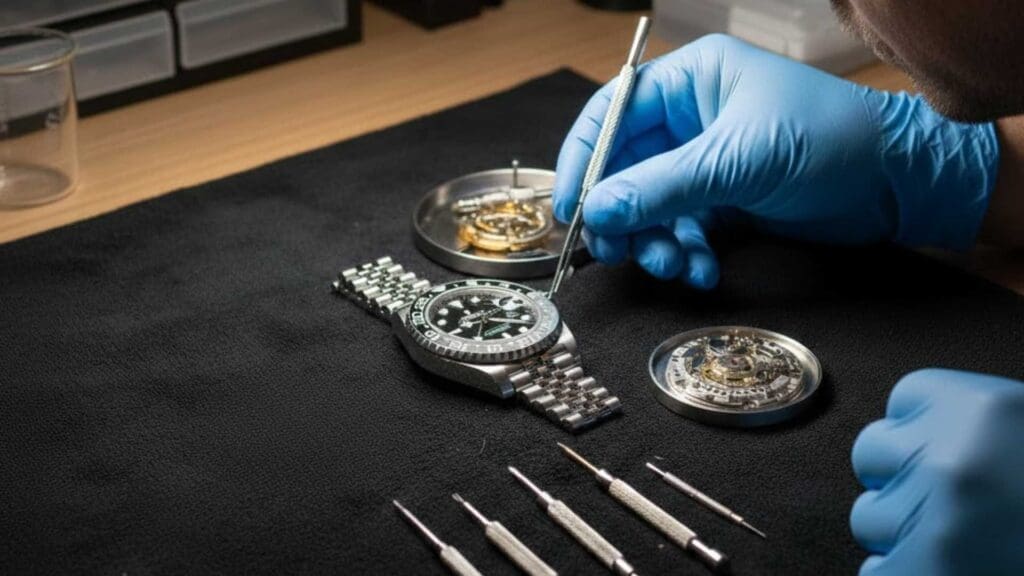
A complete Rolex service is a thorough multi-step overhaul. While procedures vary slightly by watchmaker, they typically include the following (official and independent service descriptions agree):
- Initial inspection and quote. The watchmaker examines the watch (movement, case, bracelet, water resistance) and provides a detailed cost estimate for any repairs. Only with customer approval does the service begin.
- Disassembly. The bracelet is removed and the movement is taken out of the case. The dial and hands are also removed, and the movement is fully disassembled into its individual parts.
- Ultrasonic cleaning. All movement parts (gears, springs, plates) are cleaned in an ultrasonic bath to remove old oils and debris. The case and bracelet components are usually cleaned and refinished separately.
- Parts inspection and replacement. Each component is examined. Worn gears, pivots, jewels, mainsprings, etc. are replaced with genuine parts. All gaskets/seals are replaced with new ones. Any damaged external parts (crystal, crown, pushers, bezel, links) can be replaced or repaired as needed. Rolex standards mandate replacement of any part “no longer meeting their high standards”
- Reassembly and lubrication. The movement is reassembled and lubricated at all friction points with high-grade oils/greases. During reassembly, the watchmaker adjusts the movement for timekeeping.
- Water-resistance testing. Before closing the case, new seals are installed and the watch is pressure-tested to verify its rated depth rating. Any leaks are addressed.
Case and bracelet refinishing. The exterior (case and bracelet) is polished or brushed to restore the original finish. Scratches can be removed (often called “reconditioning” or “factory refinish”. Note some specific parts (like solid-steel bezels on older Subs/Explorers) are sometimes swapped rather than polished, per Rolex’s current procedures. - Final assembly and quality control. The cleaned, reconditioned movement is recased, and the fully assembled watch undergoes final testing. This includes timekeeping accuracy testing (often over 24 hours) and a final visual inspection. Only after passing all checks is the watch returned to the customer.
Official service centers typically provide a 2-year warranty on parts and workmanship after this process. (Independent shops often offer a similar guarantee on their work.)
What Affects the Service Cost of a GMT-Master?
The cost of servicing a Rolex GMT-Master varies widely depending on several key factors. Here’s a detailed breakdown of the main factors that affect service pricing:
Model Complexity
A GMT‑Master II has an additional hour hand and extra gears for a second time zone, plus a 24-hour rotating bezel that works with the movement. These extra parts require precise adjustment and careful testing during service.
Watches with simpler functions, like the Oyster Perpetual or Datejust, have only a standard three-hand movement and a date function. These watches take less time to disassemble, inspect, and adjust, so their service is generally faster and less expensive.
Servicing a GMT‑Master II is roughly as complex as a Submariner—it is more challenging than a Datejust but not as intricate as a Daytona chronograph, which adds chronograph levers and extra gear trains. Features like ceramic bezels or different bracelet types can add minor steps, but the dual-time function is the main factor that raises service time and cost.
Movement and Generation
Older movements or parts that are no longer made can increase the price. Vintage GMT‑Master models from the 1950s to the 1980s often use movements like the Caliber 1575 or 3075 and have acrylic crystals. These parts may need special ordering, which can take extra time.
Modern GMT‑Master II watches use newer movements such as the 3186 or 3285 and often have ceramic bezels. The service process is similar for old and new models, but getting parts for older movements can take more work and time. Rolex guarantees parts for at least 35 years after a model stops being made, so even older watches can be serviced, though the labor may cost more.
Age and Condition
A well-maintained GMT-Master may only need a standard overhaul, including cleaning, lubrication, and minor adjustments. In contrast, an older or neglected watch may require extensive work: rusted or damaged wheels, full resealing, crystal replacement, or complete polishing.
Older or vintage watches “often require more time and care, sometimes needing discontinued or hard-to-find parts,” which naturally increases labor and parts costs.
Materials
Watches made from precious metals like yellow gold, white gold, or platinum, or those with diamonds or other gems, cost more because replacement parts are more expensive and require careful handling.
For example, the Rolex GMT-Master II Ref. 126715CHNR is made of Everose gold, the Ref. 126719BLRO comes in white gold, and some limited editions are crafted in platinum. Independent service shops usually charge the same base labor fee as for steel GMT-Masters, but they add extra costs for gold or platinum cases, bracelets, or gem-set models due to the higher value of parts and the care needed during service.
GMT‑Master vs GMT‑Master II Servicing Cost Difference
Rolex’s GMT‑Master and GMT‑Master II share almost identical case and movement designs, so the service process is the same for both. Most service price lists do not separate the two models, treating them together.
The main technical difference lies in the movement. Early GMT‑Masters from the 1960s to the 1980s used older calibers like the 1565, 1575, or 3075 and had aluminum 24-hour bezels. Modern GMT‑Master IIs, produced from 1983 onward, use movements such as the 3085, 3186, or 3285 and usually feature ceramic bezels. This basically means:
- Parts: Servicing a GMT‑Master II may involve newer components like ceramic bezels, sapphire crystals, or updated dials and hands. Vintage GMTs may need acrylic crystals or older hands that are harder to source. Rolex ensures parts are available for decades, but very old components can require extra effort to obtain.
- Complexity: Both models include the GMT complication—an extra hour hand and gearing for a second time zone. Official sources note that a GMT‑Master II “requires specialized attention for its dual-time mechanism.” In practice, the extra labor is minimal, and most of the added cost comes only if replacement parts such as the crystal, bezel, or crown are needed.
- Pricing: References show that GMT and GMT‑II services are priced the same. For example, one independent U.S. service lists a flat base fee of about $695 USD for either model from the 1980s onward. Watches in 18K gold or with ceramic bezels may incur small surcharges.
There is no separate “GMT‑Master II service surcharge.” Any cost difference between a GMT and GMT‑Master II usually comes down to the watch’s age, condition, or specific parts that need replacing, not the model name.
Do Servicing Costs Differ in the US vs Europe?
Service costs for a Rolex GMT-Master can vary depending on the region.In the United States, owners typically report total overhaul costs—including incidental parts—ranging from the high hundreds to low thousands of dollars. For example, one U.S. owner paid about $865 USD for a GMT‑Master II service that included a new crown.
Another reported just over $1,000 USD at a New York Rolex Service Center for a GMT with a new crown. Authorized dealers mention that the minimum official service fee for any Oyster model is now around $700 USD, excluding tax and parts.
In Canada, a GMT service from around the 2000 era reportedly cost C$1,050. In Europe, published estimates for a complete GMT‑Master II overhaul are roughly €650–€800, depending on the movement’s age and condition.
For example, a Swiss magazine lists a GMT‑Master II base service at €700. In the UK, Rolex-accredited independent watchmakers list modern GMT services at around £645 and vintage GMTs around £695. Unofficial reports vary: one London owner paid £500–£650 for an older Submariner in 2019, while another was quoted £1,000 for a vintage GMT in 2022.
US and European costs are generally comparable when currency is considered—for example, $850 USD ≈ €700–£600 GBP.
Differences mostly come from taxes, import fees, and local dealer policies. In Asia and other markets, prices reflect local rates; a Singapore guide estimates S$550–S$850 (about US$400–$600) for routine GMT‑Master II servicing, including movement overhaul and case reconditioning.
Quick Summary: Rolex GMT-Master Servicing Cost
Here’s a clear overview of typical service costs for the Rolex GMT-Master and GMT-Master II, broken down by factors that influence pricing.
| Service Item / Factor | Typical Cost Range (USD) | Notes |
| Standard overhaul (steel GMT-Master) | $800 – $1,200 | Includes movement cleaning, lubrication, timing adjustment, case & bracelet refinishing |
| Independent service base labor | $600 – $800 | Excludes replacement parts; covers full disassembly, cleaning, lubrication, testing |
| Replacement crown | $100 – $200 | Cost depends on model and material |
| Replacement crystal | $150 – $300 | Acrylic or sapphire depending on model year |
| Replacement bezel | $200 – $500 | Aluminum (vintage) vs Cerachrom ceramic (modern) |
| Gold or platinum models | +$200 – $600 | Extra charges for precious metal or gem-set watches |
| Vintage/older GMT parts | +$100 – $400 | Extra sourcing effort for discontinued movements or components |
| Minimum official Rolex service fee (Oyster models) | ~$700 | Excludes tax and parts, U.S. reference |
How Often Should You Service a Rolex GMT-Master?

Rolex recommends servicing your GMT-Master approximately every 10 years, though the exact service interval for rolex can vary depending on usage and condition. Regular maintenance keeps the movement running accurately, protects water resistance, and helps preserve the watch’s value.
Watches that are worn daily, exposed to water, travel frequently, or experience temperature changes may benefit from more frequent checks. Conversely, a lightly worn watch kept in controlled conditions might safely extend the interval between full services.
Even if the watch appears to run well, routine service ensures that oils don’t dry out, gaskets remain intact, and small wear issues don’t turn into larger, more expensive repairs.
How to Save Money on GMT-Master Service (Without Risk)
Maintaining your GMT-Master doesn’t have to break the bank. Here are practical tips to reduce service costs safely:
- Compare Authorized vs Independent Service: Independent Rolex-certified watchmakers often charge lower base fees than official Rolex Service Centers. Make sure they use genuine Rolex parts and follow factory procedures.
- Plan Ahead: Avoid urgent service requests. Scheduling in advance can prevent rush fees and gives you time to compare quotes.
- Keep Your Watch Well-Maintained: Regularly clean and lightly lubricate the bracelet, avoid exposure to extreme conditions, and wind the watch correctly. A well-maintained watch often needs fewer repairs, lowering service costs.
- Bundle Repairs: If multiple parts need replacement (crown, crystal, bezel), having them done at the same time can reduce labor costs compared to separate repairs.
- Document Service History: Providing previous service records can help the watchmaker assess the condition faster and avoid unnecessary replacements.
- Understand What’s Optional: Cosmetic refinishing or polishing is not always needed. Skipping non-essential refinishing can save money while keeping the movement in top condition.
Is Rolex Service Worth the Cost for a GMT-Master?
Yes, servicing a GMT-Master at an official center or a certified Rolex watchmaker is generally worth the investment. A properly serviced watch maintains accurate time, preserves water resistance, and ensures long-term durability of all movement components.
It also protects the resale value, as buyers prefer watches with documented, certified service history. Even for vintage or rarely worn models, the peace of mind from a full inspection, genuine parts replacement, and factory-standard calibration often outweighs the cost, making it a smart decision for both daily wearers and collectors.
Final Thoughts
If you own a GMT-Master, think of servicing as taking care of something that will last a lifetime. You want your watch running smoothly, so don’t ignore small issues like a stiff crown or unusual timekeeping before a full service. Keep track of your service history and note any unusual noises or signs of wear—it helps the watchmaker make better decisions.
Also, try to store your watch safely and avoid harsh conditions that could damage seals or movement parts. Taking these small steps can save you surprises and help your GMT-Master stay reliable and beautiful for years.
FAQs About Rolex GMT-Master Service Cost
How long does a full Rolex GMT-Master service usually take?
A complete Rolex GMT-Master service typically takes 4–6 weeks at an authorized service center. The timeline can vary depending on parts availability, the watch’s condition, and the workload of the service center. Vintage or rare models may take longer if special components need sourcing. Independent watchmakers may complete similar work in a slightly shorter time.
Are there any risks in using independent watchmakers for GMT-Master servicing?
Using an independent watchmaker can save money, but risks include non-genuine parts, improper lubrication, or incorrect timing adjustments. Make sure the watchmaker is Rolex-certified and experienced with GMT movements. Poor servicing can impact accuracy, water resistance, and long-term durability, so research credentials and reviews before entrusting your watch.
Will servicing affect the value of my GMT-Master for resale?
Yes, proper servicing generally increases or maintains resale value, especially if documented. Buyers prefer watches with certified service history, genuine parts, and no neglected repairs. Skipping service or using unverified watchmakers can reduce value, while well-maintained and recently serviced GMT-Masters tend to sell for higher prices on the secondary market.
Do I need to provide proof of previous service when getting a new service?
Providing proof of previous service is helpful but not mandatory. It allows the watchmaker to understand prior repairs, replaced parts, and service intervals. This can reduce unnecessary replacements and save time. Even without documentation, an authorized center or certified watchmaker can evaluate the watch and create a complete service record.
Can minor scratches be removed without a full service?
Yes, minor scratches on the case or bracelet can often be addressed through polishing or light refinishing without a full movement service. However, this should be done carefully to avoid excessive material removal. Many independent watchmakers or authorized centers offer cosmetic-only refinishing if the movement doesn’t need maintenance.