The Rolex Explorer II is a true icon in the world of adventure watches, admired for its durability, precision, and the unique features that make it an essential tool for explorers and adventurers. From spelunkers to mountaineers, the Explorer II has earned its reputation as a reliable companion in the most extreme conditions. Whether you’re an avid outdoor enthusiast or a passionate Rolex collector, the Explorer II combines functionality with timeless style. In this Rolex Explorer II guide, we’ll take you through its history, key features, and the distinctive qualities that have made this watch a favorite among those who require both performance and elegance.
The Birth of the Rolex Explorer II (1971)

In 1971, Rolex introduced the Explorer II as a dedicated tool watch designed to cater to the needs of spelunkers (cave explorers) and other adventurers operating in environments where distinguishing day from night was difficult. Building upon the success of the earlier Rolex Explorer (launched in 1953), the Explorer II was engineered for extreme conditions – particularly in the polar regions and caves where natural light could be scarce for extended periods.
The Rolex Explorer II reference 1655 became the first model in this line, featuring a 39mm stainless steel case, a fixed bezel with 24-hour graduations, and an iconic orange 24-hour hand. This orange hand would rotate once every 24 hours, pointing to the graduated bezel, allowing wearers to easily distinguish between day and night.
For those operating in environments where the sun’s movement is unpredictable, such as caves or the polar regions, this 24-hour hand was an essential function. Unlike the traditional Explorer, which had no such feature, the Explorer II made it possible to differentiate between day and night in complete darkness, a significant advantage for explorers.
Early Years: The 1655 Model and Its Legacy
The 1655 was a practical tool watch, designed with a focus on functionality over aesthetics. However, it had some unique characteristics that would make it stand out in the Rolex catalog. The orange 24-hour hand became a symbol of the watch, but it was often referred to as the “Freccione” or “Steve McQueen Rolex” (despite there being no evidence McQueen wore this model).
Produced until 1985, the reference 1655 became iconic in its own right, despite being somewhat overlooked during its initial release. The model’s purpose-driven design – its simplicity and utilitarian features – made it a favorite among collectors today, especially those who appreciate the Explorer II’s history as a true tool watch.
The Evolution of the Explorer II (1985-2000s)
In 1985, Rolex introduced a new reference to replace the 1655: the Rolex Explorer II ref. 16550. This was a significant turning point for the model, as it incorporated several changes to enhance both functionality and style.
Reference 16550: The Introduction of the Polar Dial and Sapphire Crystal
The 16550 featured a 40mm case, slightly larger than its predecessor, and introduced the Polar dial, which was a white dial version of the Explorer II, alongside the traditional black dial. The white dial (Polar) would go on to become one of the most iconic and sought-after features of the Explorer II lineup. This reference also marked the introduction of a sapphire crystal, replacing the acrylic crystal used in earlier models. The use of sapphire provided better durability and scratch resistance, ensuring the watch could withstand the rigors of adventure.
One of the key updates in the 16550 was the introduction of an independent 24-hour hand, turning the Explorer II into a GMT-style watch that allowed wearers to track two time zones at once. This was a big upgrade over the earlier 1655, which was purely a time-of-day tracking watch.
Continued Refinements (1989-2010): The 16570

In 1989, the 16570 replaced the 16550 and would remain in production until 2001, making it one of the longest-produced references in the Explorer II line. This model continued the changes begun with the 16550, offering both black and Polar white dials.
Introduction of the 3185 and 3186 Movements
The 16570 was powered by the Rolex Caliber 3185 (later updated to the 3186), a movement that enhanced the precision and reliability of the Explorer II. Rolex began introducing Luminova in the late 1990s to improve visibility in low light, replacing the tritium previously used for lume.
The 16570 saw several minor refinements over the years, particularly to the movement and the introduction of the Rolex rehaut engraving (a feature added in the mid-2000s to help combat counterfeiting). While the overall design remained largely unchanged, these tweaks continued to solidify the Explorer II’s position as a functional and stylish tool watch, able to withstand harsh environments while remaining highly legible and practical.
The Advent of the 42mm Case (2011-2020): The 216570

In 2011, Rolex introduced the 216570 as the next iteration of the Explorer II, marking a bold step in the model’s evolution. The most significant change with the 216570 was the increase in case size from 40mm to 42mm, reflecting the trend of larger watches in the 2010s. The 216570 also featured the return of the bright orange 24-hour hand, reminiscent of the original 1655 model.
The 216570 used the Rolex Caliber 3187 movement, which included a Paraflex shock absorption system, making the movement more resistant to shocks and enhancing its robustness, a key feature for adventurers and explorers.
The updated model was released in two dial options: the familiar black dial and the Polar white dial, both maintaining the high legibility and durable design that the Explorer II had become known for. The introduction of the larger size was polarizing among collectors, with some praising the increased wrist presence and others preferring the original, more compact design.
The Modern Explorer II (2021-Present): The 226570

To celebrate the 50th anniversary of the Explorer II in 2021, Rolex introduced the 226570 model. While the case size remained at 42mm, subtle design refinements were made, including the slimmer lugs and slightly wider bracelet to enhance comfort and fit.
Caliber 3285 and Other Refinements
One of the biggest upgrades in the 226570 is the introduction of the Rolex Caliber 3285 movement, a self-winding mechanical movement that provides a 70-hour power reserve and is fitted with the Rolex patented Chronergy escapement, which ensures greater efficiency. This movement, as well as the blue Parachrom hairspring, which offers resistance to shocks and temperature variations, marks a significant improvement over previous iterations.
Other changes to the 226570 include the addition of a small Rolex crown under the six o’clock marker, aligning with the brand’s modern design language. The Chromalight luminescence has been further improved to last longer and provide clearer legibility in the dark. The Polar dial now features matte black hour markers for better contrast against the white dial, improving visibility and reducing reflections.
Key Functions and Features of the Rolex Explorer II
With features that enhance readability, timekeeping, and durability, the Explorer II is a favorite among adventurers, explorers, and travelers.
24-Hour Display and the Fixed 24-Hour Graduated Bezel
The Rolex Explorer II features a 24-hour hand, a key function that distinguishes daytime hours from nighttime hours, particularly useful in environments where natural time markers are absent, such as caves or polar regions. This 24-hour hand is paired with a fixed 24-hour graduated bezel, allowing the wearer to read time in 24-hour format or track a second time zone. The bezel is engraved with clear 24-hour markings, making it easy to differentiate between day and night, crucial for explorers working in extreme conditions.
The 24-hour hand also allows the Explorer II to serve as a dual-timepiece, making it invaluable for travelers who need to keep track of different time zones.
Chromalight Display for Enhanced Legibility
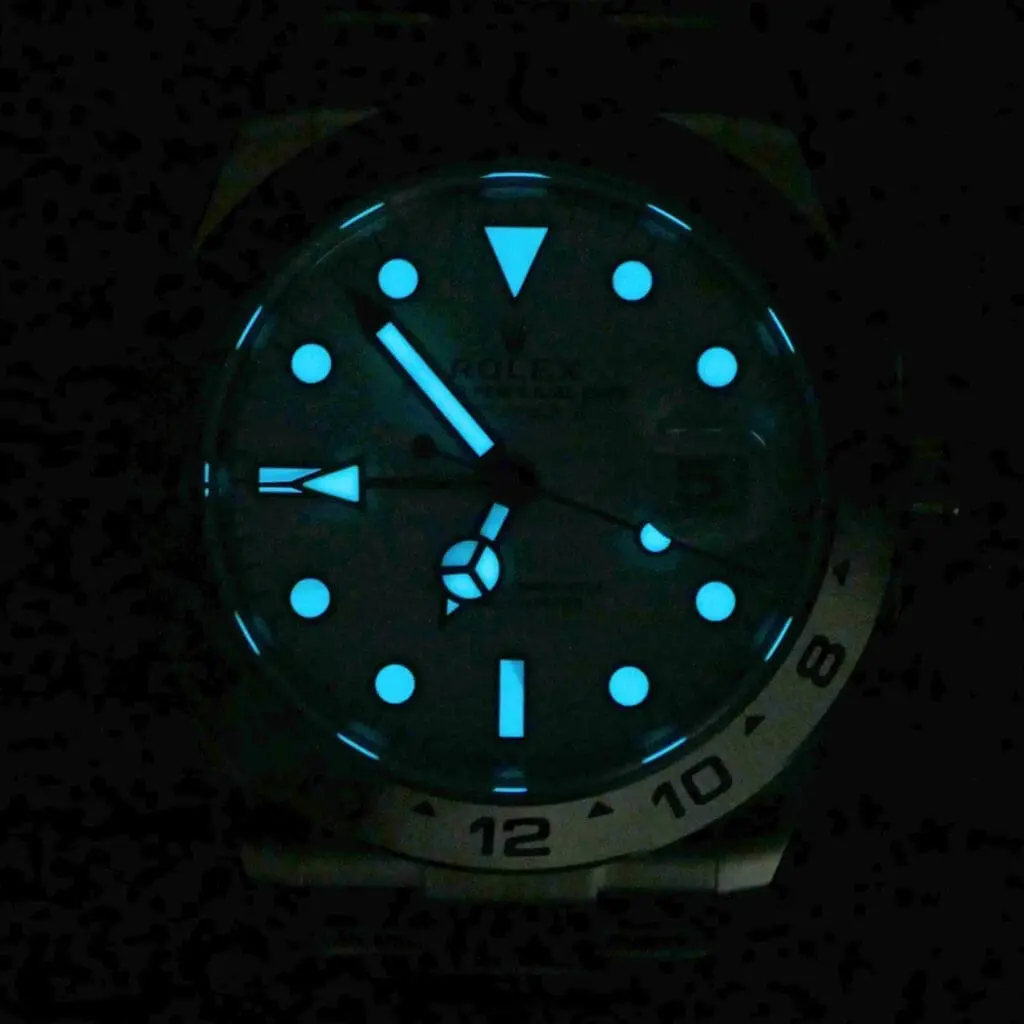
The dial of the Rolex Explorer II is equipped with Chromalight, Rolex’s proprietary luminescent material, which provides an intense blue glow in the dark for enhanced legibility in low-light conditions. This luminescence is applied to the hour markers, hands, and numerals, ensuring that time can be easily read in any environment, whether in total darkness or in environments where visibility is limited.
This feature is especially crucial for adventurers, speleologists, and explorers who often work in low-visibility conditions, such as caves or the polar regions.
Water Resistance and Oyster Case
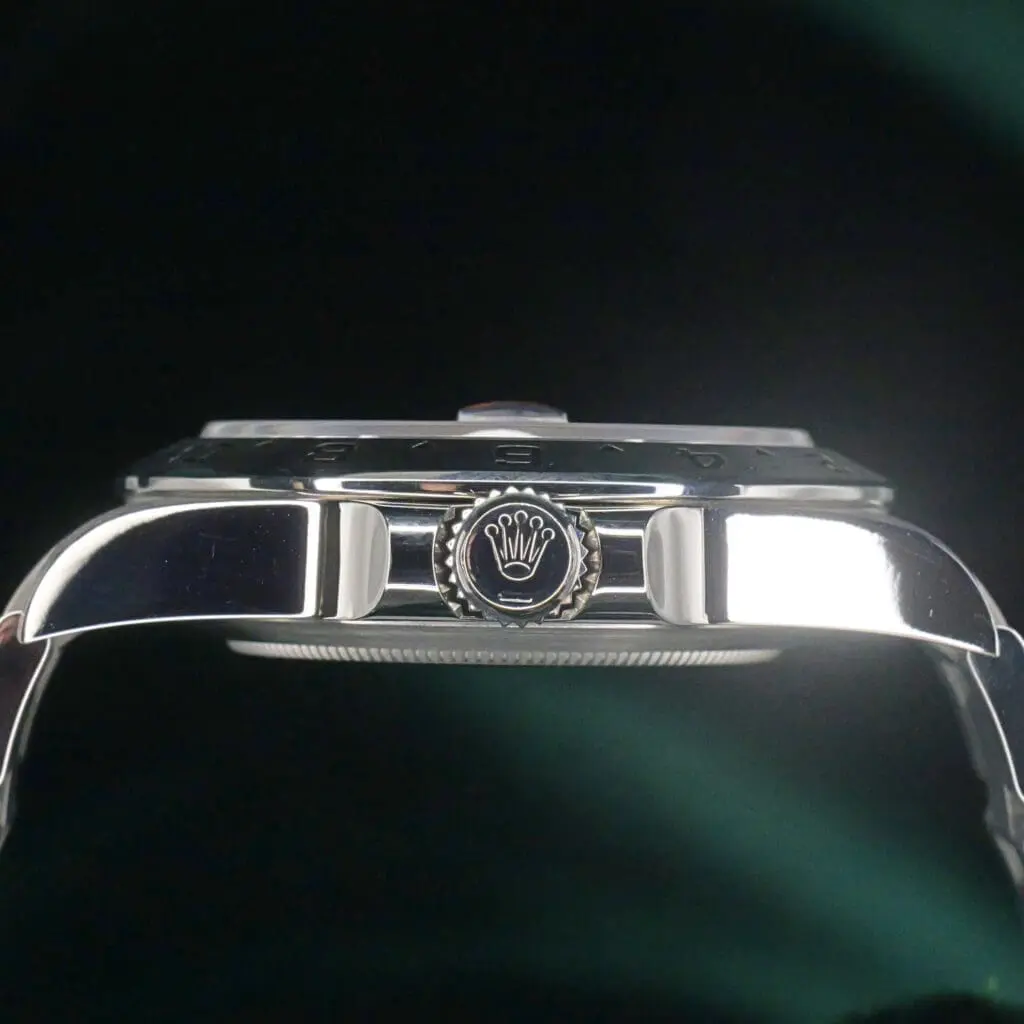
The Rolex Explorer II features the Oyster case, a hallmark of the Rolex durable case designs, providing water resistance up to 100 meters (330 feet). This makes the Explorer II suitable for surface-level explorations, outdoor adventures, and general wear in wet conditions. The case is designed to protect the movement from dust, water, and external shocks, ensuring its longevity and performance in harsh environments.
Self-Winding Movement – Caliber 3285
At the heart of the Rolex Explorer II is the Caliber 3285, a self-winding mechanical movement developed and manufactured by Rolex. This movement offers a 70-hour power reserve, ensuring the watch continues to operate even when not worn for extended periods. The Chronergy escapement, incorporated into the movement, provides greater energy efficiency and dependability, while the blue Parachrom hairspring ensures superior resistance to shocks and magnetic fields.
The precision and reliability of the Caliber 3285 make the Explorer II an ideal companion for those who need accurate timekeeping in remote locations, far from the convenience of a time signal.
Cyclops Lens and Date Display

The Cyclops lens positioned above the date at the 3 o’clock position magnifies the date, making it easier to read in difficult conditions. This lens is an iconic Rolex feature, providing a magnified view of the date without the need for additional complication on the dial. The instantaneous date change at midnight further enhances the practicality of the Explorer II, ensuring accurate time tracking on expeditions where reference to the date is essential.
Durable Oystersteel Construction
Crafted from Oystersteel, a highly corrosion-resistant material, the Rolex Explorer II is built to withstand the harshest environments. Oystersteel is a proprietary alloy made of 904L stainless steel, known for its exceptional durability and ability to maintain its sheen even after prolonged exposure to the elements. This makes the Explorer II a highly reliable timepiece for those venturing into extreme conditions like caves, polar regions, or high-altitude treks.
Comfortable and Secure Oyster Bracelet

The Explorer II is equipped with an Oyster bracelet, which is known for its comfort and robustness. The bracelet is designed with solid end links and features an Oysterlock clasp to prevent accidental opening. The Easylink extension system allows for quick, tool-free adjustments to the bracelet length, making it easy to ensure a secure fit throughout the day, regardless of temperature fluctuations or wrist swelling.
The Polar Dial – Unique and Practical Design
One of the most iconic features of the Rolex Explorer II is its Polar (white dial) version, which offers superior contrast between the hour markers and hands for better readability in varying light conditions. The black outlines around the hour markers on the white dial version of the Explorer II enhance legibility, and the blackened hands provide added contrast for optimal clarity. This unique dial design is not only functional but also visually striking, making the Explorer II instantly recognizable.
Popular Rolex Explorer II Variations
Since its introduction in 1971, the Rolex Explorer II has become a standard piece for adventurers and explorers. Renowned for its durability, the Explorer II has undergone several transformations over the years. Here’s a look at some of the most iconic and significant Rolex Explorer II models:
1. Rolex Explorer II Ref. 1655 (1971–1985)
The first iteration of the Explorer II, the Ref. 1655, introduced in 1971, was specifically designed for spelunkers (cave explorers) who needed a tool to differentiate between day and night in dark environments. This model featured a 39mm stainless steel case, an orange 24-hour hand, and a fixed bezel with 24-hour graduations.
The Ref. 1655 was a bold and functional design that later became popular among collectors for its unique look. It was the first Rolex to introduce the 24-hour hand, which was paired with the fixed bezel to offer a useful way to track time even in complete darkness.
Key Features:
- Case Size: 39mm stainless steel case
- Dial: Black dial with orange 24-hour hand
- Bezel: Fixed 24-hour graduated bezel
- Movement: Caliber 1575
- Production Years: 1971–1985
- Water Resistance: 100 meters (330 feet)
2. Rolex Explorer II Ref. 16550 (1985–1989)
In 1985, Rolex introduced the Ref. 16550, which marked a significant shift in the Explorer II’s design and functionality. This model featured a 40mm case and introduced the option of a white dial, commonly referred to as the Polar dial. The white dial option, with its black markers and hands, became a hallmark of the Explorer II’s aesthetic and is still highly regarded by collectors today.
The Ref. 16550 also introduced a sapphire crystal for enhanced scratch resistance, and the independent 24-hour hand allowed the wearer to track two different time zones simultaneously, marking the beginning of the GMT functionality for the Explorer II.
Key Features:
- Case Size: 40mm stainless steel case
- Dial Options: Black or white (“Polar”) dial
- Bezel: Fixed 24-hour graduated bezel
- Movement: Caliber 3085
- Production Years: 1985–1989
- Water Resistance: 100 meters (330 feet)
3. Rolex Explorer II Ref. 16570 (1989–2011)

The Ref. 16570, introduced in 1989, became the mainstay of the Explorer II collection for over two decades, running until 2011. This model retained the 40mm case size and introduced subtle updates to both the design and movement. The most notable change was the switch to the Caliber 3185 movement, which offered improved performance and reliability.
The Ref. 16570 also featured updated Super-Luminova for better legibility in low-light conditions, as well as a blackened 24-hour hand to enhance contrast with the dial. The Explorer II’s Polar dial continued to be a popular option, and this model solidified the Explorer II as one of the Rolex iconic tool watches.
Key Features:
- Case Size: 40mm stainless steel case
- Dial Options: Black or white (“Polar”) dial
- Bezel: Fixed 24-hour graduated bezel
- Movement: Caliber 3185 (later Caliber 3186)
- Production Years: 1989–2011
- Water Resistance: 100 meters (330 feet)
4. Rolex Explorer II Ref. 216570 (2011–2021)

The Ref. 216570, released in 2011 to mark the 40th anniversary of the Explorer II, introduced a larger 42mm case, a change that made the watch more modern and appealing to collectors who preferred larger watches. This model also marked the return of the orange 24-hour hand, a direct nod to the original Ref. 1655.
With this reference, Rolex updated the movement to the Caliber 3187, featuring the Paraflex shock absorbers for increased resistance to shocks. The dial was also slightly redesigned with a maxi dial, featuring larger hour markers and hands for improved readability. This model continues to be a favorite for those who appreciate a more robust design while maintaining the tool watch legacy of the Explorer II.
Key Features:
- Case Size: 42mm stainless steel case
- Dial Options: Black or white (“Polar”) dial
- Bezel: Fixed 24-hour graduated bezel
- Movement: Caliber 3187
- Production Years: 2011–2021
- Water Resistance: 100 meters (330 feet)
5. Rolex Explorer II Ref. 226570 (2021–Present)

The latest version of the Explorer II, the Ref. 226570, was introduced in 2021 to celebrate the 50th anniversary of the model. This new reference retains the 42mm case size but includes several refinements, such as a slightly thinner lug design and a wider bracelet for better comfort and durability.
The dial of the Ref. 226570 has also been updated with matte black outlines on the hour markers for better contrast and legibility. It also features the new Caliber 3285 movement, which provides a 70-hour power reserve and incorporates the Rolex Chronergy escapement for greater energy efficiency.
Key Features:
- Case Size: 42mm stainless steel case
- Dial Options: Black or white (“Polar”) dial
- Bezel: Fixed 24-hour graduated bezel
- Movement: Caliber 3285
- Production Years: 2021–Present
- Water Resistance: 100 meters (330 feet)
Rolex Explorer II vs. Other Rolex Models
Each Rolex model is uniquely designed to serve specific functions and cater to distinct needs. Below are some key comparisons between the Rolex Explorer II and other iconic Rolex models.
Versus Rolex Explorer

The Rolex Explorer and the Rolex Explorer II are both built for explorers, but they cater to different types of environments and needs. The Explorer is a straightforward, rugged watch designed for mountaineers, hikers, and general outdoor adventurers. The Explorer II, on the other hand, is built with a specific focus on explorers in environments where distinguishing between day and night is difficult, such as caves or polar regions. While both models are designed for durability and legibility, the Explorer II offers more specialized features for extreme conditions.
Key Differences:
- Case Size: The Explorer has a 36mm case, which offers a classic, versatile size suited for a variety of activities, while the Explorer II comes in 40mm (Ref. 16570) or 42mm (Ref. 216570 and Ref. 226570) sizes, providing a larger, more robust feel.
- Bezel: The Explorer has a smooth, fixed bezel with no markings, emphasizing simplicity and ease of use. The Explorer II, however, features a 24-hour bezel with markings, designed specifically to help distinguish between day and night or to track a second time zone in environments where natural light is absent.
- Functionality: The Explorer is a simple, reliable watch for timekeeping and legibility in extreme conditions, with a clean dial and no date function. The Explorer II, however, includes a 24-hour hand and a fixed 24-hour bezel, allowing the wearer to track time in two time zones or differentiate between day and night, making it more suitable for explorers who need to be aware of these distinctions.
- Target Audience: The Explorer is ideal for outdoor enthusiasts like climbers and hikers who need a robust, legible watch for general outdoor use. The Explorer II, with its 24-hour functionality, is tailored for spelunkers, scientists, and explorers in environments where traditional timekeeping can be difficult, such as caves or the polar regions.
- Design & Build: The Explorer is smaller and more understated, with a focus on legibility. The Explorer II has a more rugged design with larger markers and hands for enhanced readability in low-light conditions, making it more specialized for extreme environments.
Versus Rolex GMT-Master II

The GMT-Master II is a traveler’s watch, offering dual time zone tracking through its rotating bezel and additional GMT hand. The Explorer II also features a 24-hour hand for tracking time, but with a fixed bezel, it serves different purposes. While both watches have 24-hour displays, the Explorer II is designed for explorers in extreme terrestrial environments, such as caves and polar regions, where distinguishing between day and night is difficult. In contrast, the GMT-Master II is tailored for frequent travelers and aviators, providing the ability to track multiple time zones with ease.
Key Differences:
- Bezel: The GMT-Master II features a rotating bezel for time zone adjustment, while the Explorer II has a fixed 24-hour bezel for distinguishing day and night or tracking a second time zone.
- Functionality: The GMT-Master II offers more versatility for travelers needing to track time in different parts of the world, whereas the Explorer II focuses more on function for explorers in extreme environments, with its simple but effective 24-hour hand and fixed bezel.
- Water Resistance: Both models have 100 meters of water resistance, making them equally suitable for surface-level activities.
- Design & Build: The Explorer II has a more rugged design, with a 42mm case and larger hour markers for better legibility in low-light environments, while the GMT-Master II typically features a more refined design, with a polished bezel and various color options for the bezel.
Versus Rolex Submariner

The Rolex Submariner is the standard dive watch, designed to handle extreme underwater pressures with its superior water resistance and specialized bezel for tracking dive times. While both the Explorer II and the Submariner are known for their durability, they cater to different environments. The Explorer II is built for land-based exploration, especially in environments where distinguishing between day and night is difficult, such as caves and polar regions. The Submariner, on the other hand, is designed for underwater exploration, with a focus on water resistance and diving-specific features.
Key Differences:
- Water Resistance: The Submariner is water-resistant up to 300 meters (1,000 feet), making it ideal for professional divers. The Explorer II has a water resistance of 100 meters (330 feet), suitable for most surface-based adventures but not deep-sea diving.
- Bezel: The Submariner has a rotating bezel with a 60-minute scale to track elapsed dive time, while the Explorer II features a fixed 24-hour bezel for distinguishing between day and night.
- Design & Build: The Submariner has a thicker case and is designed to withstand the harsh conditions of diving. The Explorer II is focusing more on comfort and practicality for land-based activities.
- Functionality: The Explorer II is designed for adventurers in challenging environments, offering a 24-hour time display to differentiate day from night. The Submariner focuses on tracking dive times and ensuring reliability underwater.
Versus Rolex Sea-Dweller

The Rolex Sea-Dweller is built for deep-sea divers, offering superior water resistance and a helium escape valve. While both the Explorer II and the Sea-Dweller are tool watches designed for extreme environments, they are made for different types of exploration. The Explorer II is designed for land-based adventures, such as spelunking and polar exploration, while the Sea-Dweller is built for professional divers who venture to great depths.
Key Differences:
- Water Resistance: The Sea-Dweller can withstand depths of 1,220 meters (4,000 feet), far surpassing the Explorer II’s 100 meters (330 feet) water resistance.
- Helium Escape Valve: The Sea-Dweller features a helium escape valve, which is essential for deep-sea diving, where the build-up of helium can affect the integrity of the watch. The Explorer II does not have this feature, as it is designed for surface-level adventures.
- Bezel: The Sea-Dweller has a unidirectional rotatable bezel to track elapsed dive times, while the Explorer II has a fixed 24-hour bezel for time tracking in environments where distinguishing between day and night is necessary.
- Design & Build: The Sea-Dweller is built for extreme underwater conditions, while the Explorer II focuses on legibility and durability for land-based explorers.
Versus Rolex Air-King

The Rolex Air-King is built with a clean, straightforward design to ensure easy time-reading during flight. While the Explorer II and the Air-King both prioritize legibility, the Explorer II offers additional functionality with its 24-hour hand and fixed bezel, which are designed to help explorers track time in environments where natural light is scarce. The Air-King, however, is tailored for those in aviation, focusing on clarity and precision in the skies.
Key Differences:
- Design & Build: The Air-King has a more minimalist dial design, with a larger, easy-to-read Arabic numeral dial that is ideal for pilots. The Explorer II has 24-hour display and a fixed bezel, emphasizing durability and legibility in extreme environments.
- Functionality: The Explorer II offers a 24-hour graduated bezel to track time in extreme environments, especially where distinguishing between day and night is necessary. The Air-King focuses on simplicity, making it ideal for aviation but less functional for land-based exploration.
- Water Resistance: Both the Air-King and Explorer II have water resistance of 100 meters (330 feet), making them suitable for surface-based activities but not deep diving.
While these watches offer similar features like legibility, water resistance, and precision, the Explorer II distinguishes itself with its 24-hour graduated bezel and fixed bezel, making it the ideal timepiece for explorers in caves, polar regions, or anywhere distinguishing between day and night is difficult.
Rolex Explorer II vs. Other Luxury Brands
When compared to other watches with similar functions, the Rolex Explorer II stands out for its exceptional durability and purpose-built functionality. While these other luxury brands offer similar capabilities, each watch has its own distinctive appeal. Here’s a look at how the Rolex Explorer II compares with these iconic models:
Versus Omega Seamaster Planet Ocean GMT

The Omega Seamaster Planet Ocean GMT is designed for underwater exploration and extreme conditions, similar to the Rolex Explorer II, but it is built with a focus on diving and water-based adventures.
Key Differences:
- Water Resistance: The Seamaster Planet Ocean GMT offers a robust water resistance of up to 600 meters (2,000 feet), which far exceeds the Explorer II’s 100 meters (330 feet). This makes the Seamaster better suited for deep-sea diving, while the Explorer II is optimized for land-based adventures in environments where distinguishing day from night is a challenge.
- Bezel: The Seamaster features a rotating bezel with a 60-minute scale for timing dives, while the Explorer II has a fixed 24-hour bezel, designed to help the wearer distinguish between day and night, which is essential in caves or polar regions.
- Design & Build: The Seamaster is thicker and heavier than the Explorer II. The Explorer II is suitable for both adventures and casual wear.
- Target Audience: The Seamaster Planet Ocean GMT is tailored for divers and water sports enthusiasts, while the Explorer II is aimed at explorers who traverse extreme terrestrial environments.
Versus IWC Big Pilot’s Watch Top Gun

The IWC Big Pilot’s Watch Top Gun shares similar GMT functionality with the Explorer II, but it is more aviation-focused, with a larger, bolder design.
Key Differences:
- Design & Build: The Big Pilot’s Watch is significantly larger at 46mm and is designed with aviation professionals in mind, providing excellent legibility from a cockpit. In contrast, the Explorer II has a 42mm case and a design better suited for land-based adventurers, offering a more balanced size for everyday wear.
- Water Resistance: The Big Pilot’s Watch offers water resistance up to 60 meters (200 feet), which is lower than the Explorer II’s 100 meters (330 feet), making it less suitable for water-based activities but ideal for aviation.
- GMT Functionality: Both watches feature GMT functionality, but the Explorer II has a more specialized 24-hour hand with a fixed bezel, while the Big Pilot’s Watch uses a standard GMT hand to track time zones.
- Target Audience: The IWC Big Pilot’s Watch is tailored for aviation enthusiasts, while the Explorer II is better suited for adventurers who need a tool watch for extreme outdoor expeditions.
Versus Panerai Luminor GMT

The Panerai Luminor GMT offers similar GMT tracking functionality but with a distinctive military-inspired design and robust build, making it a worthy competitor to the Explorer II.
Key Differences:
- Design & Build: The Panerai Luminor GMT is known for its large, cushion-shaped case and bold, military-inspired aesthetic. It has a versatile look suitable for both outdoor adventures and casual settings.
- Water Resistance: The Luminor GMT is water-resistant to 300 meters (1,000 feet), which is significantly higher than the Explorer II’s 100 meters (330 feet), making it more suitable for diving and water-based activities.
- GMT Functionality: Both watches feature GMT functionality, but the Luminor GMT uses a rotating bezel to track additional time zones, while the Explorer II uses a fixed 24-hour bezel to provide better legibility in environments with little to no natural light.
- Target Audience: The Panerai Luminor GMT appeals to those who prefer a more robust and military-inspired design, while the Explorer II is perfect for explorers who need a reliable tool watch with specialized functionality for extreme terrestrial conditions.
Versus Seiko Prospex SBDC051
The Seiko Prospex SBDC051 offers similar GMT functionality but at a more affordable price point, making it a great option for those looking for a reliable tool watch without the price tag.
Key Differences:
- Water Resistance: The Seiko Prospex SBDC051 offers 200 meters (660 feet) of water resistance, which is better suited for surface water activities compared to the Explorer II’s 100 meters (330 feet), which is optimized for land-based explorations.
- Design & Build: The Seiko Prospex has a more utilitarian design, focusing on durability and function, whereas the Explorer II balances with everyday wearability.
- GMT Functionality: Both watches feature a 24-hour hand, but the Seiko lacks the Explorer II’s fixed 24-hour bezel, which helps differentiate between day and night in extreme environments, such as caves or polar regions.
- Target Audience: The Seiko Prospex SBDC051 is ideal for those looking for an affordable, reliable tool watch for outdoor and diving activities, while the Explorer II is for adventurers seeking a more specialized tool watch with refined design and unique functionality.
Versus Tudor Black Bay GMT

The Tudor Black Bay GMT shares similar GMT functionality with the Rolex Explorer II, but with a more robust, vintage-inspired design. Tudor, a subsidiary of Rolex, offers a similar level of craftsmanship and reliability but at a more affordable price point.
Key Differences:
- Design & Build: The Black Bay GMT features a more retro, tool-like design with a thicker case and a snowflake hour hand, while the Explorer II is more functional. The Explorer II is also slightly larger at 42mm, compared to the Black Bay GMT’s 41mm.
- Bezel: The Black Bay GMT features a rotatable bezel, which allows for tracking a second time zone by rotating the bezel alongside the GMT hand, while the Explorer II uses a fixed 24-hour bezel to provide enhanced legibility in dark environments.
- Water Resistance: The Black Bay GMT offers a water resistance of 200 meters (660 feet), which is higher than the Explorer II’s 100 meters (330 feet), making it more suitable for underwater activities.
- Target Audience: The Tudor Black Bay GMT appeals to those who enjoy a vintage-inspired design with solid GMT functionality at a lower price point, while the Explorer II is aimed at serious adventurers who require a more specialized tool watch for extreme terrestrial conditions.
Versus Breitling Avenger II GMT

The Breitling Avenger II GMT is another strong contender with similar GMT functionality, designed for those who need to track multiple time zones. Breitling is known for its bold designs and focus on aviation and diving timepieces.
Key Differences:
- Design & Build: The Breitling Avenger II GMT has a military-inspired aesthetic with a larger 43mm case and a thicker build, compared to the Explorer II, which is more refined at 42mm.
- Water Resistance: The Avenger II GMT offers water resistance up to 300 meters (1,000 feet), which is significantly higher than the Explorer II’s 100 meters (330 feet), making it more suited for diving and water-based activities.
- Bezel: The Avenger II GMT features a unidirectional rotating bezel with 24-hour graduations, offering an easy way to track a second time zone. In comparison, the Explorer II uses a fixed 24-hour bezel, which is ideal for environments where distinguishing between day and night is important.
- Target Audience: The Breitling Avenger II GMT appeals to those with a preference for aviation or diving with a larger, bolder aesthetic, while the Explorer II is better suited for adventurers who need a tool watch designed for exploration in extreme environments on land.
Rolex Explorer II Price Guide: What You Can Expect to Pay
The price of the Rolex Explorer II varies significantly depending on factors such as the model, material, dial color, and condition. Below is a breakdown of the price range you can expect to pay for different versions of the Explorer II, whether you’re purchasing new or pre-owned:
Stainless Steel Models
The Stainless Steel Rolex Explorer II is one of the most popular options, known for its durability. It’s a great choice for adventurers and collectors alike.
Rolex Explorer II 42mm (Stainless Steel)
- Price Range (New): $8,500 to $9,500
- Pre-owned Price Range: $7,000 to $8,500
The 42mm Stainless Steel Explorer II is the modern version of the iconic watch, offering excellent legibility and functionality for both daily wear and exploration. This version is considered a classic in the lineup, offering a robust build and a clean design.
Rolex Explorer II Polar Dial
The Polar Dial is a standout variant, known for its striking white dial and excellent contrast, making it one of the most sought-after versions of the Explorer II. This version is often considered a must-have for collectors, thanks to its unique aesthetic and its connection to the “Polar” expeditions.
Rolex Explorer II Polar Dial
- Price Range (New): $9,000 to $10,500
- Pre-owned Price Range: $8,000 to $9,500
The Polar Dial Explorer II offers an appealing, high-contrast design with its white dial and black hour markers. It’s a great choice for those who want a more classic, yet still highly functional, version of the Explorer II.
Vintage Explorer II Models
Vintage Rolex Explorer II models, especially those from earlier references such as the Ref. 1655 and Ref. 16570, can fetch higher prices due to their rarity and collector demand. Prices for these models can vary significantly based on reference, condition, and whether they come with original boxes and papers.
Vintage Explorer II Models
Price Range: $6,000 to $15,000 (Depending on reference and condition)
The vintage Explorer II models are highly sought after, with collectors willing to pay a premium for rare pieces, such as the Ref. 1655 Freccione or the early Ref. 16570 Polar Dials. The price for these models can vary widely based on factors such as the year of production, condition, and unique dial variations.
New stainless steel models typically priced between $8,500 to $9,500, while pre-owned models can be found at a lower price point. The Polar Dial version generally ranges between $9,000 to $10,500, with pre-owned versions available at slightly lower prices. Vintage models can be a great investment but may command significantly higher prices, ranging anywhere from $6,000 to $15,000, depending on condition and rarity.
A Companion for the Adventurer Who Demands Resilience and Elegance

The Explorer II attracts those who enjoy mountaineering, hiking, and other outdoor activities. Its ability to withstand harsh weather conditions, coupled with its elegant design, means that it’s as functional as it is stylish. It provides the peace of mind that comes with knowing the watch will continue to work under tough conditions without compromising its appearance.