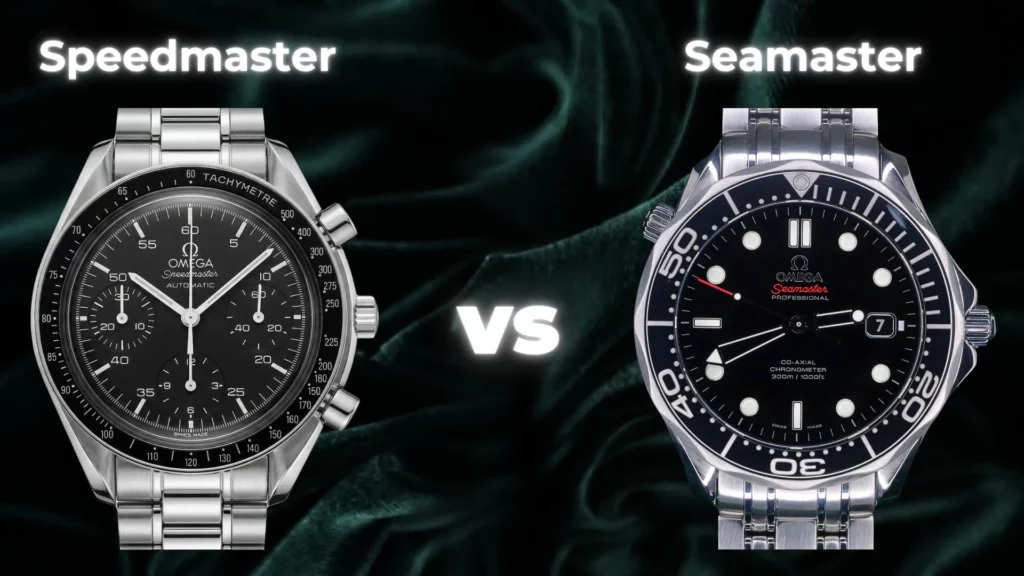
Omega Speedmaster vs Seamaster is the comparison most new Omega buyers run into first. Both feel like safe entry points, and most people already know the rough story: one is tied to space, the other to the sea. That label gets you about ten percent of the way to a decision.
A Speedmaster is a hands-on watch built around timing and a design that has barely moved in decades. A Seamaster is built around water and daily wear you never think twice about. Both work as everyday steel sports watches. Where they split is how you live with them.
This guide compares them on what ownership feels like day to day, not just the marketing. It also fixes the details that matter when you are about to spend real money, including the reference numbers and prices that shift year to year.
Omega Speedmaster Overview

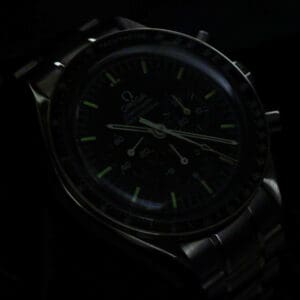
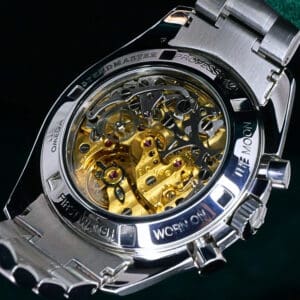
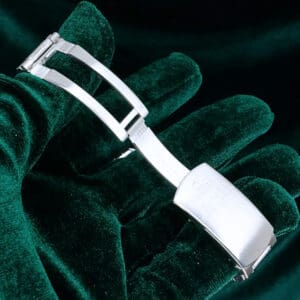
Omega launched the Speedmaster in 1957 as a racing chronograph built for track timing and fast reading at speed. Moving the tachymeter to the bezel kept the dial clean and easy to scan, and if you have never used one, here is how to read a tachymeter in a couple of minutes.
In 1965, NASA qualified the watch for crewed spaceflight after a brutal round of testing that most competitors failed. That moment shaped the watch’s identity and led to the Moonwatch name.
If you want a watch you interact with every day, the Speedmaster delivers that. You wind it by hand and use the pushers to track real elapsed time. The layout stays legible even with three subdials packed onto the face.
Its biggest claim to fame is the Apollo program. The Speedmaster was worn during lunar exploration, which locked in its place in watch history. That was not a marketing story invented later; it came from documented NASA testing and actual mission use, and it still defines the model.
Collectors stick with the Speedmaster because the core design barely changes while the small details shape ownership. Crystal type, bezel condition, dial tone, and case edges all affect how it wears over the years. The constants are the chronograph layout and the tachymeter bezel, now driven by calibre 3861 in current models.
If you are mapping the full lineup before committing, our Omega Speedmaster buying guide walks through the references in detail.
What Changed: The 2021 Calibre 3861 Update
The single biggest shift for Speedmaster buyers is the 2021 move from calibre 1861 to calibre 3861, which is why reference numbers and prices look different now than in older guides. Omega replaced the long-running 1861 with the Co-Axial Master Chronometer 3861.
Calibre 3861 adds a co-axial escapement, METAS Master Chronometer certification, magnetic resistance up to 15,000 gauss, a 50-hour power reserve, and a hacking seconds function. It also brought back vintage cues like the step dial and the “dot over 90” bezel.
Here is the practical upshot: current Moonwatch references start with 310.30.42.50, while the older 1861 versions (311.30.42.30) are discontinued and now sit on the pre-owned market. If a listing shows an 1861, it is a previous-generation watch, not the current one.

Notable Omega Speedmaster References:
- 310.30.42.50.01.001, Moonwatch Professional Hesalite (calibre 3861)
- 310.30.42.50.01.002, Moonwatch Professional Sapphire Sandwich (calibre 3861)
- 311.32.40.30.01.001, First Omega in Space (FOIS, calibre 1861)
Omega Seamaster Overview
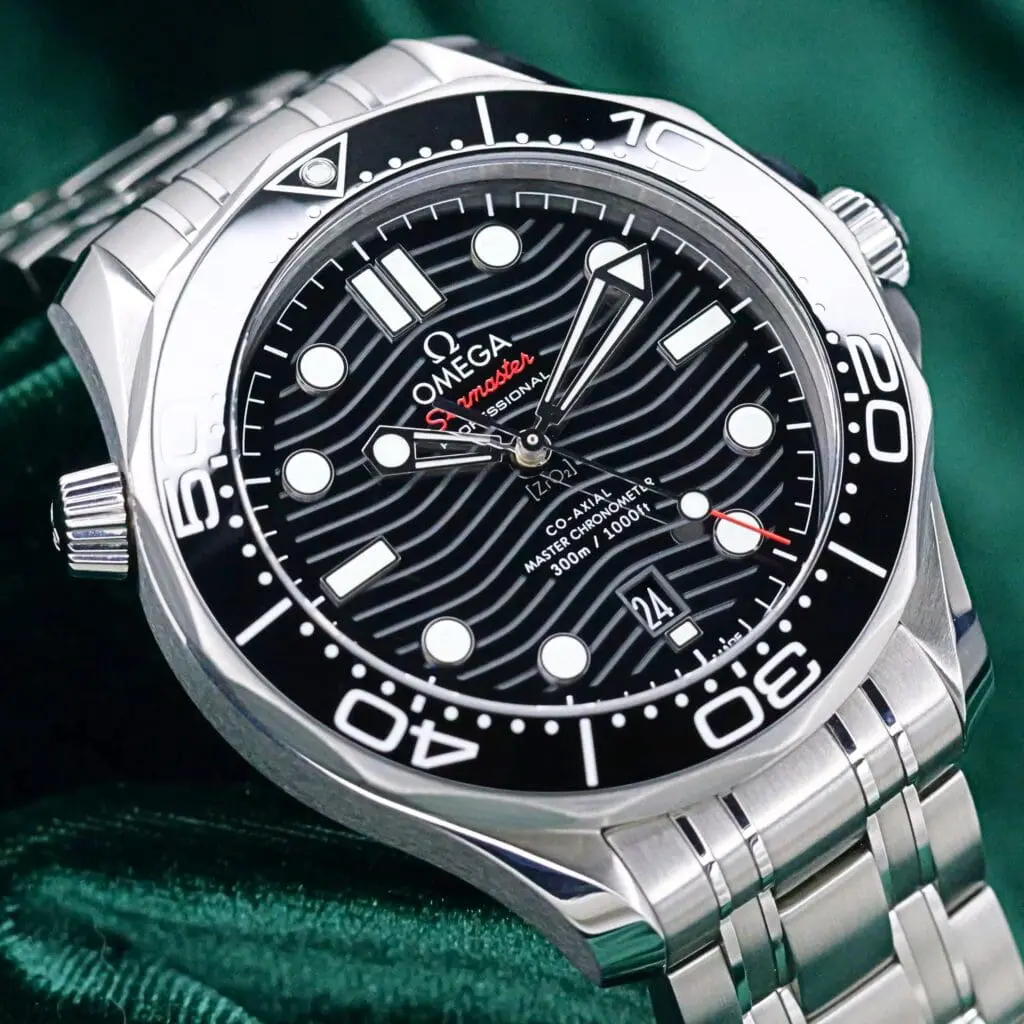
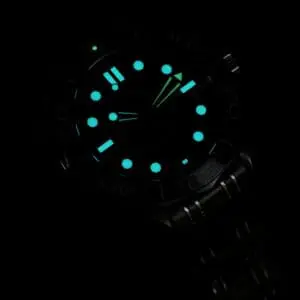

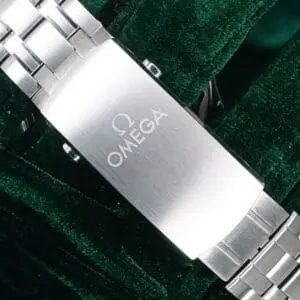
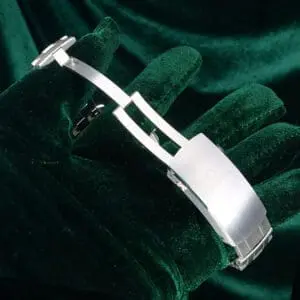
Omega launched the Seamaster in 1948 as a tougher everyday watch with better water resistance than the dress watches of the day. The brand took wartime case-sealing knowledge and built a civilian sports line around it. That original purpose still runs through the collection, which is defined by water capability.
A Seamaster suits you if your week includes water, sweat, travel, and daily wear without babying the watch. It leans on real dive features like a rotating bezel and high water resistance. Some versions run sportier, others clean up nicely for the office.
It built its modern reputation by staying credible underwater while looking good on land, helped along by decades of screen time and a consistent tool-watch design. Omega kept the functional details front and center, including 300m water resistance on most dive models.
Collectors value the Seamaster for its range without losing the core identity. Case finishing, bezel material, dial texture, and bracelet choice shape ownership more than minor spec changes. The signature cues are the dive bezel and the visible helium escape valve on many models. Modern pieces also carry Master Chronometer certification for daily reliability.
For a full breakdown of the references and where they sit, see our Omega Seamaster buying guide.

Notable Omega Seamaster References
- 210.30.42.20.01.001, Diver 300M Black Wave Dial (calibre 8800)
- 220.10.41.21.03.001, Aqua Terra 150M Teak Dial (calibre 8900)
- 234.30.41.21.01.001, Seamaster 300 Heritage Diver (calibre 8912)
Omega Speedmasters vs Seamaster: The Differences That Matter

Omega Speedmaster vs Seamaster comes down to purpose and how you use a watch. The Speedmaster is built for timing events and hands-on interaction. The Seamaster prioritizes water resistance, durability, and set-and-forget daily wear. Both sit among the brand’s core lines, covered in our wider Omega buying guide.
Here is how movement, case build, and market behavior separate them.
Movement and Winding
On the Speedmaster you get a manual-wind chronograph movement, the calibre 3861, with a Co-Axial escapement in current versions. You feel it through the pushers, which press with a firm mechanical click instead of a soft bounce. With no rotor, the case stays slimmer and sits flatter on the wrist.
A Seamaster runs an automatic Master Chronometer movement with magnetic resistance up to 15,000 gauss across most current models. The rotor winds the watch as you move, so power reserve rarely crosses your mind during a normal week. What stands out is the stability around phones, laptops, and other magnetic sources.
Water Resistance
A Speedmaster offers around 50 meters of water resistance on its core Moonwatch models. That covers rain and splashes but does not invite swimming. The chronograph pushers add extra case openings, so the sealing is built for everyday life rather than depth.
A Seamaster carries 300 meters on its dive-focused versions. A screw-down crown and thicker case lock it down tight, and the unidirectional bezel gives you real underwater timing. If timing a dive with the bezel is new to you, here is how it works. This is the one you swim, travel, and shower with without a second thought.
Case and Wrist Feel
A Speedmaster case sits around 42mm with pump-style pushers and a tachymeter bezel. The lugs curve inward, so the watch sits balanced rather than top-heavy, and the profile stays controlled even with three subdials. It wears comfortably across a wide range of wrist sizes.
A Seamaster, in its dive variants, runs around 42mm with a screw-down crown and helium escape valve. The case walls are thicker and the bezel is often ceramic for scratch resistance, which gives the watch a more planted feel. Day to day, it reads as the tougher, more impact-ready of the two.
Price and Market Demand
Speedmaster pricing splits into clear lanes. Core Moonwatch models trade close to retail, while limited editions run hot. The Silver Snoopy Award 50th Anniversary (310.32.42.50.02.001) carries a retail around $11,900 and trades near $15,000 on the secondary market as of 2026, a premium driven by the animated caseback and tight supply.
Plenty of vintage and oddball Speedmasters sit far lower. A Speedmaster LCD ref. 186.009 trades in the low hundreds because the interest is niche. Across the line, Speedmaster prices tend to jump rather than drift, since supply is limited and the buyer pool for any given reference is small. Timing the buy matters more than chasing a trend.
Seamaster pricing runs wider and feels more practical. The current Diver 300M wave dial (210.30.42.20.01.001) lists new around $5,800 and trades used closer to $4,000 to $4,700 as of 2026. That puts a clean pre-owned example in reach if you are shopping luxury watches under $5,000.
Vintage examples like the ref. 101.010 can change hands cheaply when the narrative is thin and condition is average.
Modern Seamasters follow a normal luxury curve, with steady depreciation off retail rather than collector spikes. A steel Planet Ocean 600M Chronograph retails around $9,000 to $10,400 and trades near $8,500 used. The takeaway: Seamaster demand centers on use and design, while a handful of Speedmasters attract genuine collector premiums.
Omega Speedmaster Iconic References
Related Models from Majestix
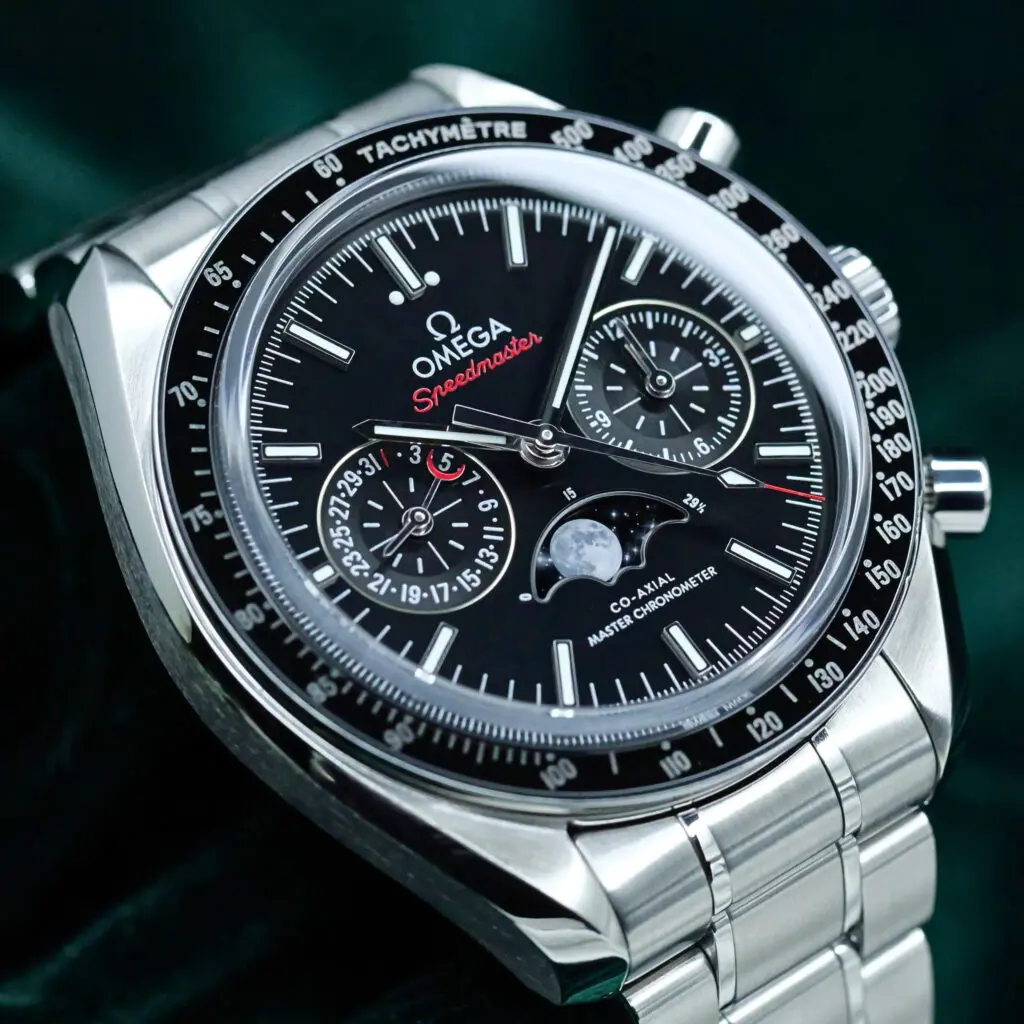
Omega Speedmaster Moonphase Black Dial Stainless Steel 44.25mm MINT CONDITION COMPLETE SET 304.30.44.52.01.001
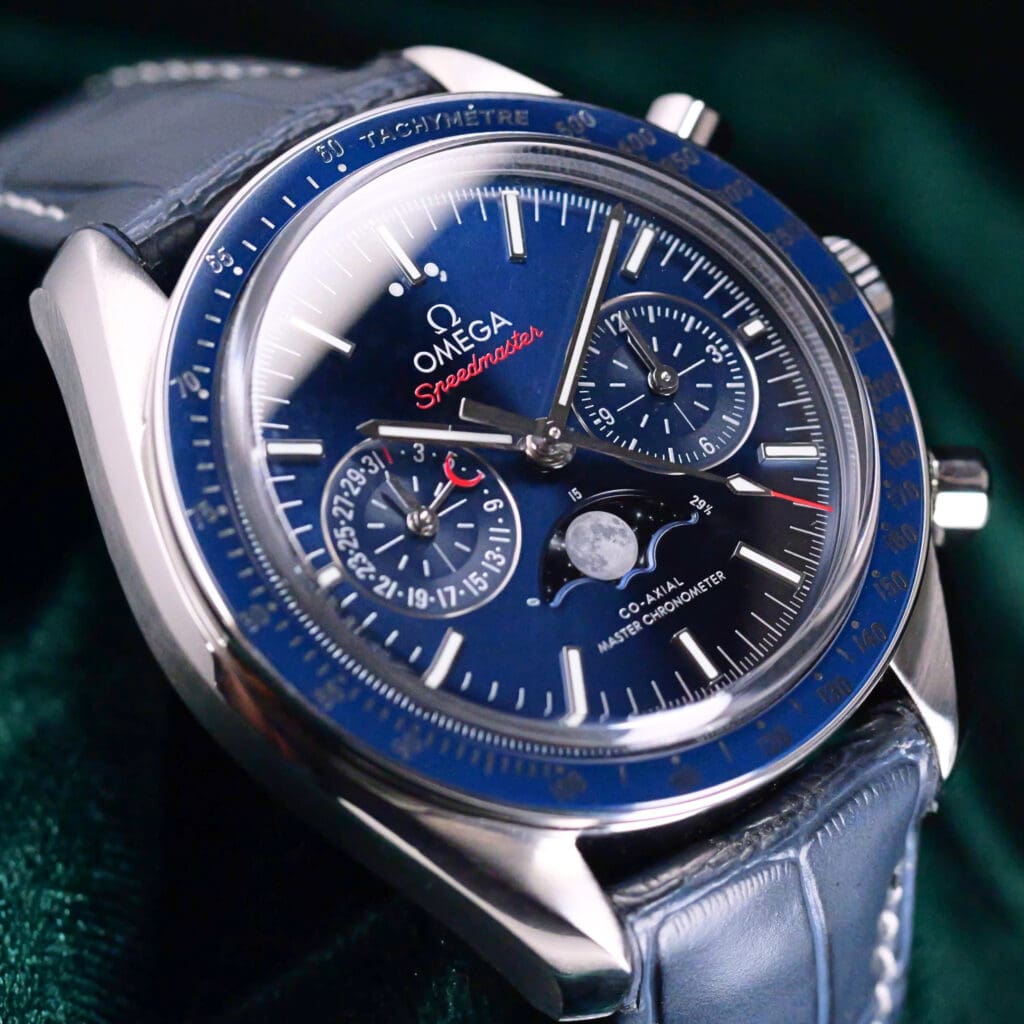
Omega Speedmaster Moonphase Blue Dial Blue Leather Strap Stainless Steel 44.25mm MINT CONDITION COMPLETE SET 304.33.44.52.03.001
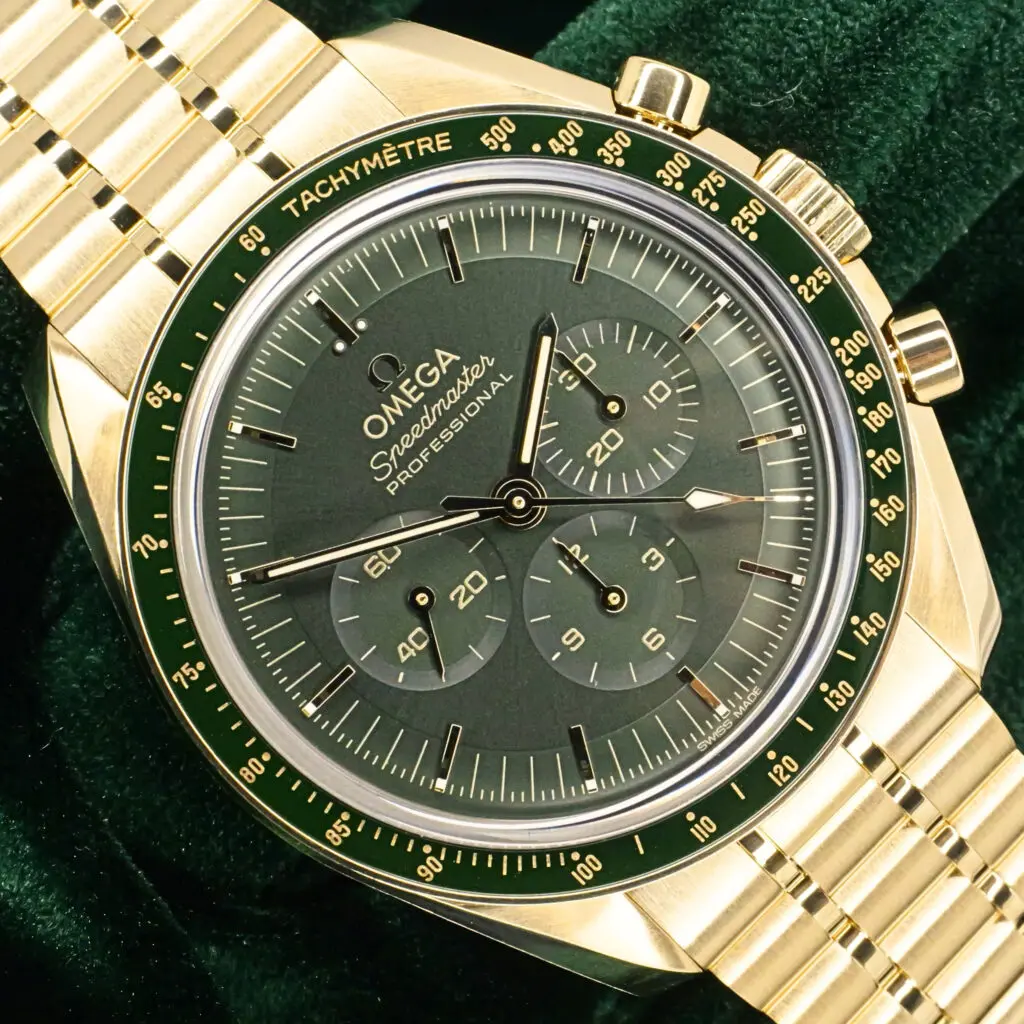
Omega Speedmaster Professional Moonwatch "Moonshine" Green Dial 18K Yellow Gold 42mm MINT CONDITION COMPLETE SET 310.60.42.50.10.001
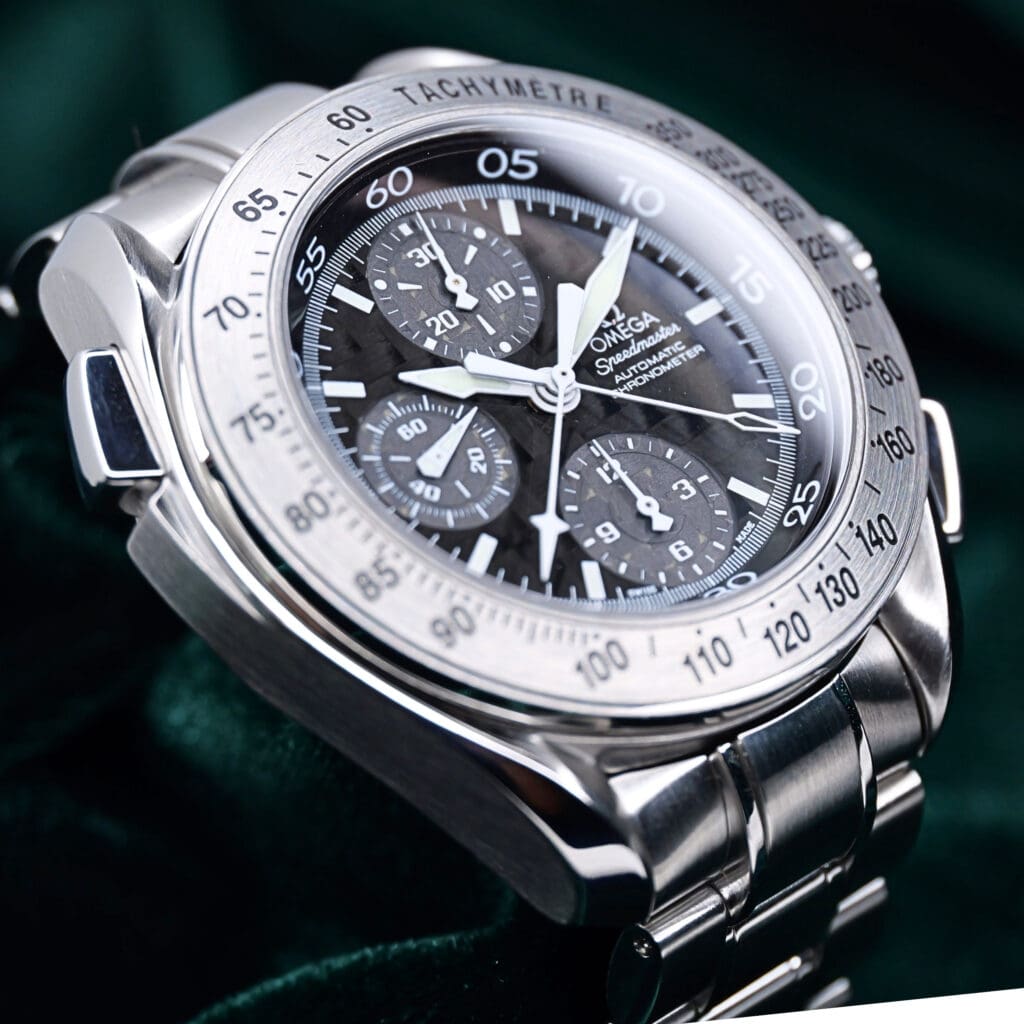
Omega Speedmaster Split-Seconds "Rattrapante" Black Carbon Fiber Dial Stainless Steel 42mm MINT CONDITION 3540.50
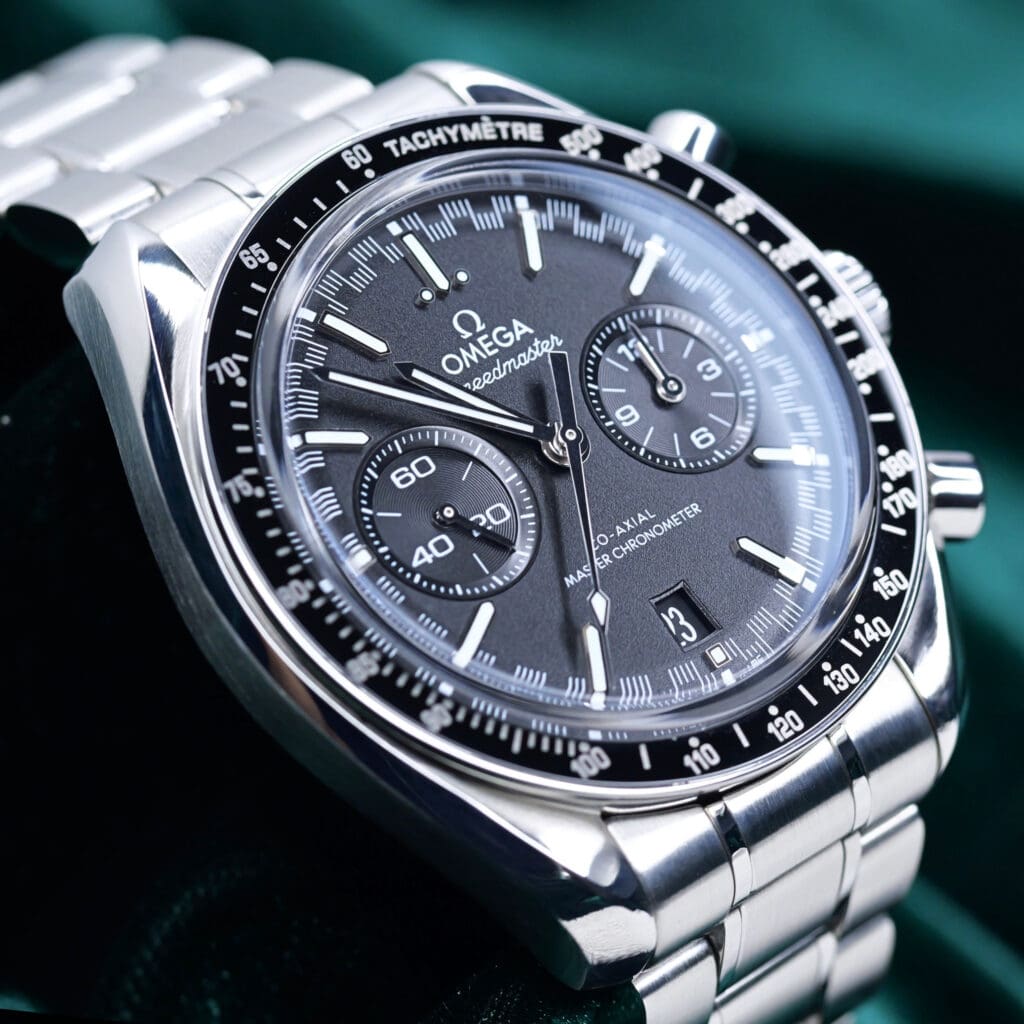
Omega Speedmaster Racing Co-Axial Master Chronometer Black Dial Stainless Steel 44.25mm MINT CONDITION COMPLETE SET 329.30.44.51.01.001

Omega Speedmaster '57 Blue Dial Stainless Steel 40.5mm MINT CONDITION COMPLETE SET 332.10.41.51.03.001
A few references shape how most buyers understand the Speedmaster line. These three cover the classic execution, the modern upgrade, and the heritage-sized option.
1. Moonwatch Professional Hesalite (310.30.42.50.01.001)
This is the closest you get to the traditional Moonwatch feel in current production. Hesalite up front and a closed caseback engraved “the first watch worn on the moon” keep it rooted as a tool chronograph. The acrylic crystal softens reflections for a warmer, vintage tone.
A manual-wind routine adds a small daily ritual, and the solid back keeps the focus on history and function. If you want the most direct line to the NASA-qualified Speedmaster experience with the current movement, this is it.
Key Specifications
- Movement: Omega Calibre 3861, manual-wind chronograph, Master Chronometer
- Case Diameter: 42mm
- Crystal: Hesalite
- Caseback: Solid steel, engraved
- Water Resistance: 50 meters
- Power Reserve: Approx. 50 hours
- Magnetic Resistance: Up to 15,000 gauss
- Market Price: Approximately $5,000 to $6,800
2. Moonwatch Professional Sapphire Sandwich (310.30.42.50.01.002)
This keeps the 42mm case but swaps in a sapphire crystal front and a sapphire display caseback, so you can watch the 3861 work. The sapphire version is more scratch-resistant than the hesalite and sits slightly slimmer, with the applied Omega logo and refined bracelet.
In daily wear it sits flat and balanced, and it feels a touch more polished than the hesalite version. It usually carries a 10 to 20 percent premium over the hesalite for the same movement.
Key Specifications
- Movement: Omega Calibre 3861, manual-wind chronograph, Master Chronometer
- Case Diameter: 42mm
- Crystal: Sapphire front and sapphire display caseback
- Water Resistance: 50 meters
- Power Reserve: Approx. 50 hours
- Magnetic Resistance: Up to 15,000 gauss
- Market Price: Approximately $6,000 to $7,500

3. First Omega in Space, FOIS (311.32.40.30.01.001)
This one trims the case to 39.7mm and uses straight, symmetric lugs, which changes how it sits on the wrist. It feels more compact and closer to early Speedmaster proportions, which helps if the standard 42mm runs wide on you. The shorter lug span prevents overhang and keeps the dial looking tight.
You still get the classic chronograph layout, just in a size that wears more easily. It runs the hand-wound calibre 1861, the movement family that flew on the Moon, under a closed caseback with the 1962 Seahorse.
Key Specifications
- Movement: Omega Calibre 1861, manual-wind chronograph
- Case Diameter: 39.7mm
- Crystal: Sapphire
- Caseback: Solid, embossed Seahorse
- Water Resistance: 50 meters
- Power Reserve: Approx. 48 hours
- Market Price: Approximately $4,000 to $5,500 (pre-owned, numbered edition)
Omega Seamaster Iconic References
Related Models from Majestix
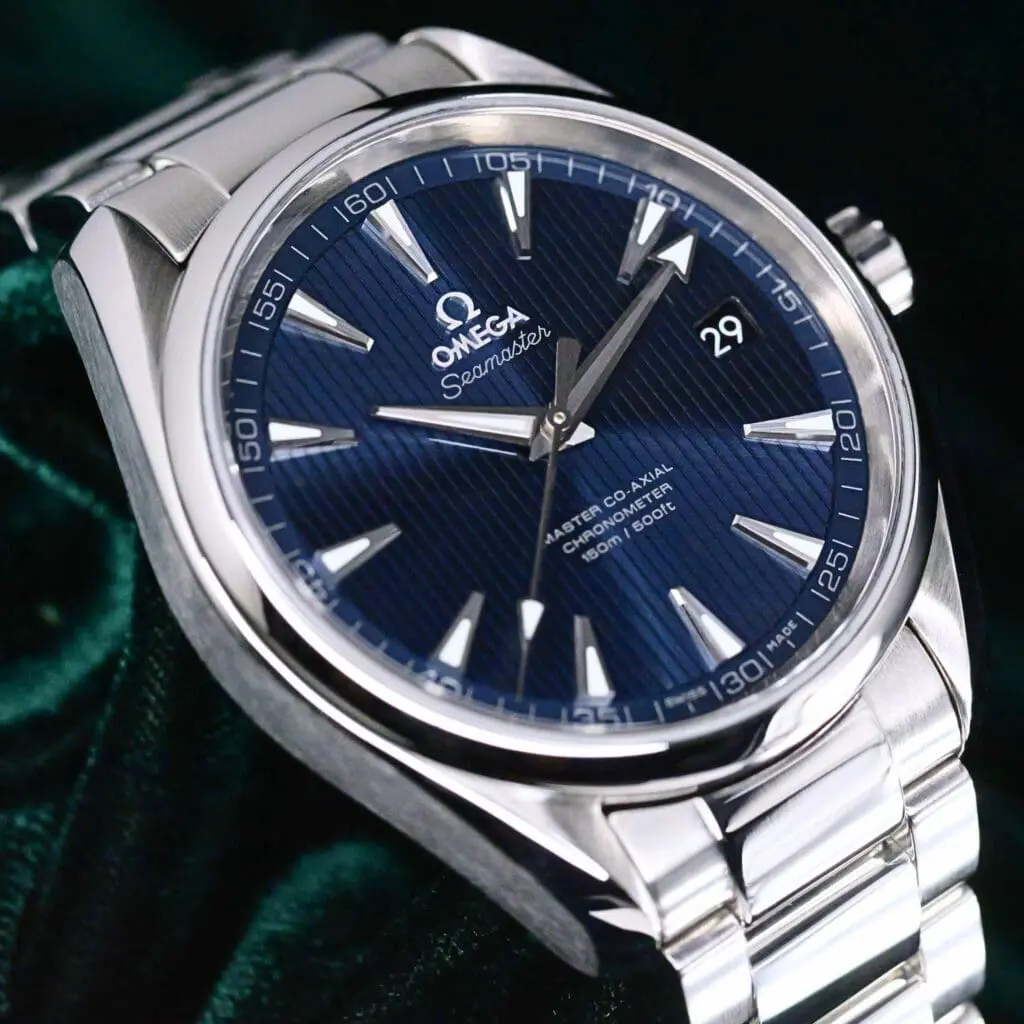
Omega Seamaster Aqua Terra 150M Master Co-Axial Chronometer Blue Teak Dial Stainless Steel 41.5mm MINT CONDITION COMPLETE SET 231.10.42.21.03.003
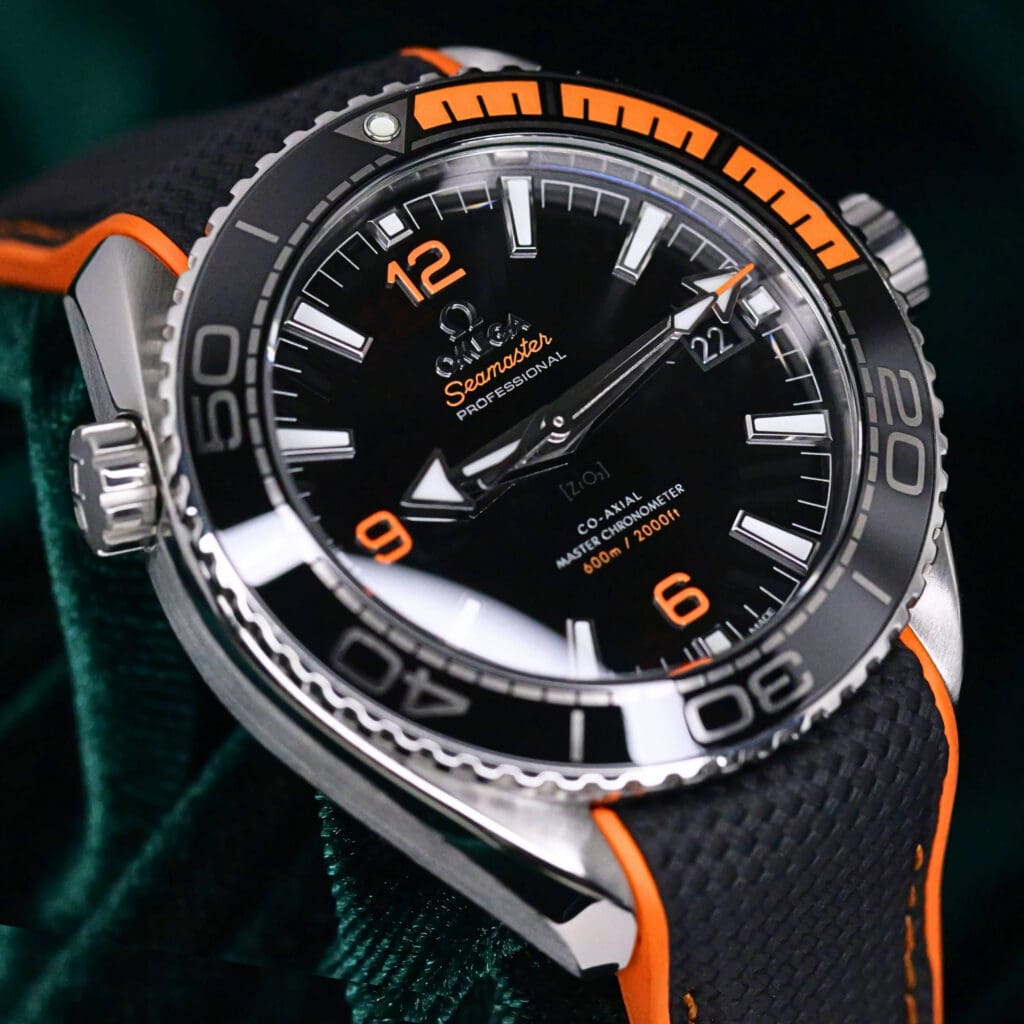
Omega Seamaster Planet Ocean 600M Black Dial Black Orange Ceramic Bezel Black Orange Rubber Strap Stainless Steel 43.5mm MINT CONDITION COMPLETE SET 215.32.44.21.01.001
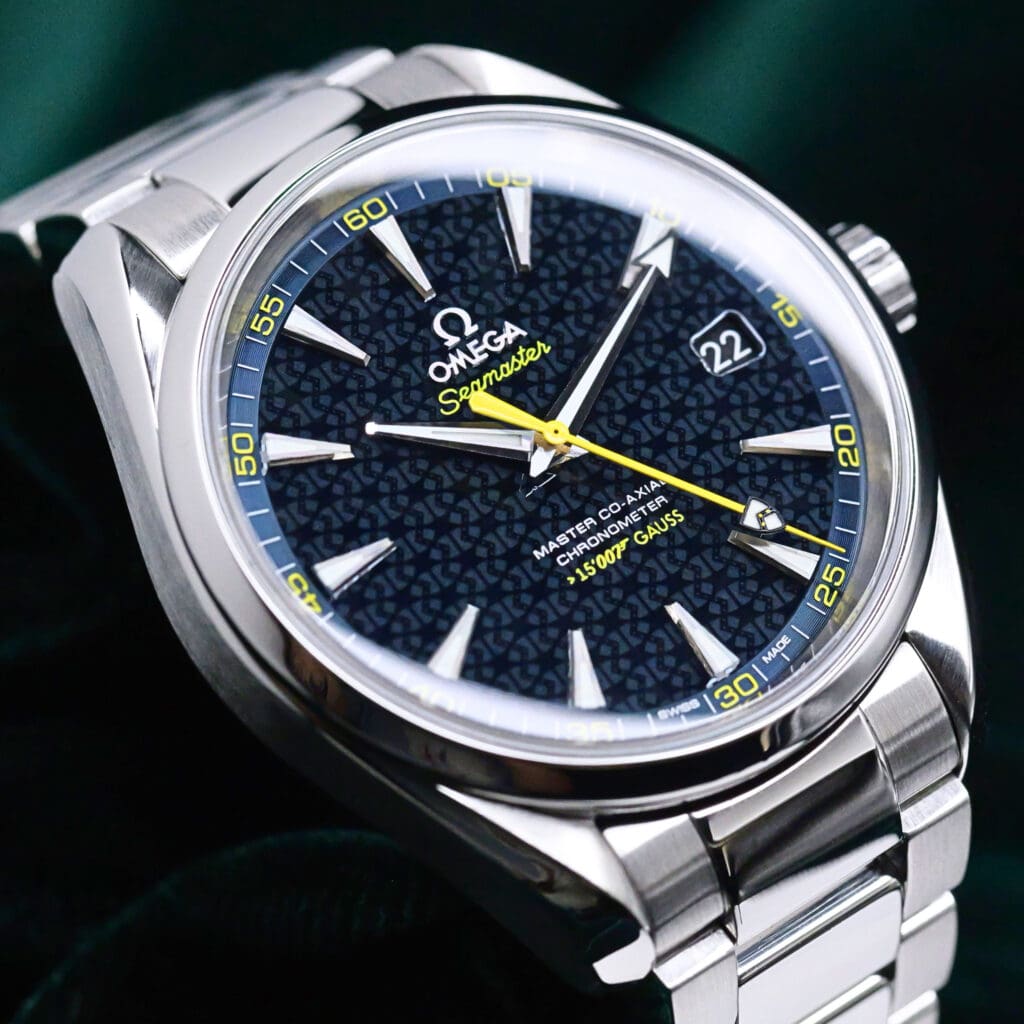
Omega Seamaster Aqua Terra 150M "James Bond Spectre" Blue Dial Yellow Accents Stainless Steel 41.5mm MINT CONDITION COMPLETE SET 231.10.42.21.03.004

Omega Seamaster Diver 300M "James Bond 007 Commander's Watch" Limited Edition White Dial Blue Ceramic Bezel Stainless Steel 41mm MINT CONDITION COMPLETE SET 212.32.41.20.04.001
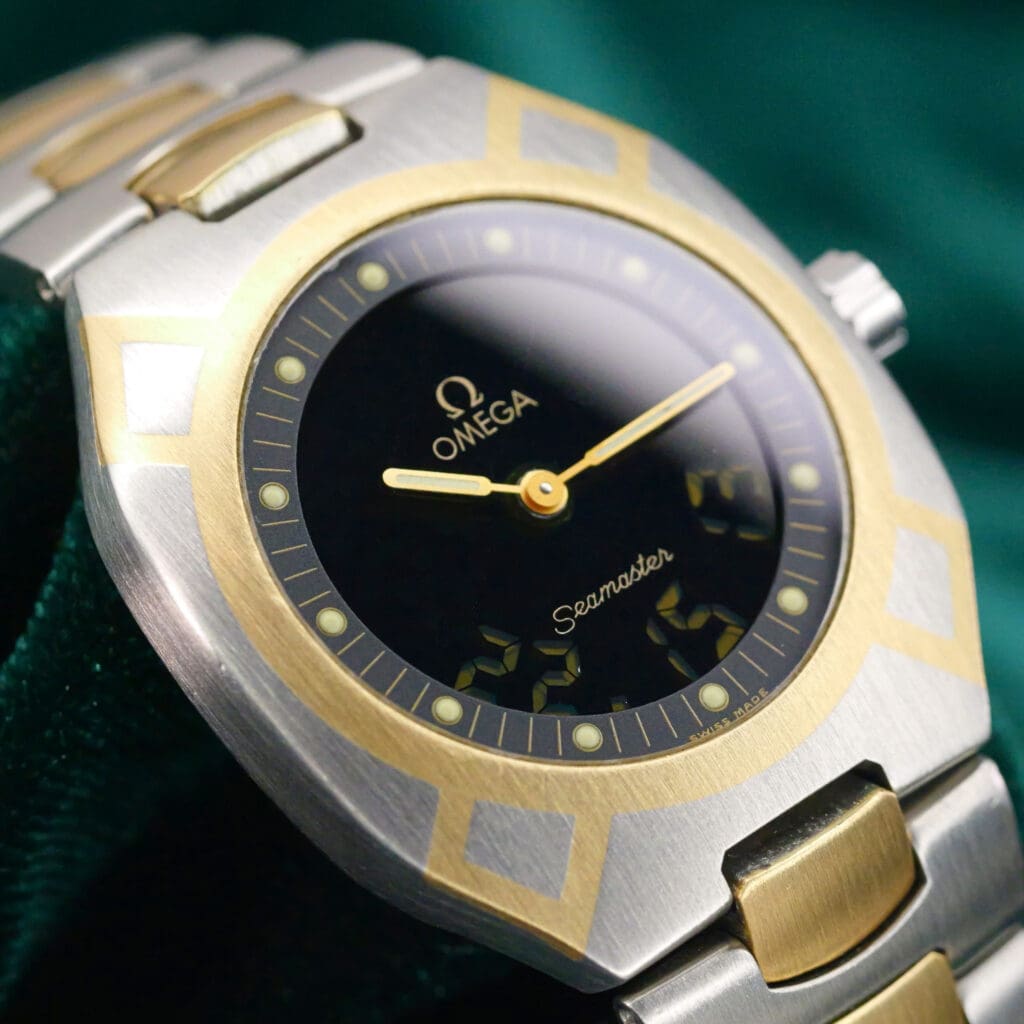
Omega Seamaster Polaris Multifunction Black Dial Two-Tone Stainless Steel & Yellow Gold 32mm Excellent 386.0822

2026 NEW UNWORN Omega Seamaster Aqua Terra Green Sunburst Dial Diamond Markers Stainless Steel 30mm COMPLETE SET 220.10.30.20.60.001
A Seamaster wears different personalities under one name. Some go all-in on dive duty, others balance sport and office, and a few look back at vintage roots. These three show how Omega shifts design, movement, and case build for different routines.
1. Diver 300M Black Wave Dial (210.30.42.20.01.001)
This Seamaster sits sporty and planted, and the black ceramic bezel keeps its edge looking crisp after hard wear. The laser-engraved wave dial adds texture without making the face busy, so you read the time fast at a glance. With 300m water resistance, you treat it like a real water watch.
Key Specifications
- Movement: Omega Calibre 8800, automatic, Master Chronometer
- Case Diameter: 42mm
- Case Thickness: 13.6mm
- Crystal: Sapphire
- Water Resistance: 300 meters
- Power Reserve: 55 hours
- Market Price: Approximately $4,000 to $5,900
2. Aqua Terra 150M Teak Dial (220.10.41.21.03.001)
This one leans cleaner and quieter, with teak-style dial lines that add depth without clutter. It slips under a cuff and feels natural in an office, yet still handles water with confidence. You get the Seamaster identity without the full dive-watch look. The 41mm case is slim for a sports watch, and the texture keeps the dial from feeling flat.
If the Aqua Terra is pulling your eye, our Omega Aqua Terra buying guide covers the wider lineup.
Key Specifications
- Movement: Omega Calibre 8900, automatic, Master Chronometer
- Case Diameter: 41mm
- Case Thickness: 13.2mm
- Crystal: Sapphire
- Water Resistance: 150 meters
- Power Reserve: 60 hours
- Market Price: Approximately $3,500 to $6,500

3. Seamaster 300 Heritage Diver (234.30.41.21.01.001)
This reference leans into vintage diver cues, but the build feels modern and tight in hand. The aluminum bezel and Arabic numerals give it a clear tool-watch tone, and the case wears well without feeling oversized. On the wrist it sits balanced and purposeful rather than bulky.
Key Specifications
- Movement: Omega Calibre 8912, automatic, Master Chronometer
- Case Diameter: 41mm
- Case Thickness: 13.85mm
- Crystal: Sapphire
- Water Resistance: 300 meters
- Power Reserve: 60 hours
- Market Price: Approximately $4,600 to $8,000
Omega Speedmaster vs Seamaster: Which Which One Fits You?
Both wear as steel sports watches, but they project a different feel once they settle on the wrist. If your shortlist is really the dressier Aqua Terra against a dive Seamaster, we cover that Aqua Terra vs Seamaster comparison separately. Use these checklists to find your side fast.
Choose the Speedmaster If
- You want a manual-wind chronograph and like feeling the pushers click with purpose
- You enjoy winding in the morning and keeping the watch alive through routine
- You want the Moonwatch look and the NASA history on your wrist
- You prefer a tachymeter bezel and an instrument-style dial that reads fast
- You live mostly in dry settings and treat water as a risk
- You want a watch that sits flatter and slips under a cuff
Choose the Seamaster If
- You want a watch that shrugs off water, sweat, and travel without thinking
- You prefer automatic convenience so the watch stays wound through normal wear
- You want a dive bezel and 300m water resistance for full swim confidence
- You value modern stability, including Master Chronometer anti-magnetism
- You like a sportier, more planted presence on the wrist
- You want one watch that handles weekends, work, and wet days cleanly
Where to Buy Authentic Omega Watches Online
999+ Timepieces Available
Explore Our Timepieces
Authenticated, unworn, and ready to ship worldwide.
Rolex · Audemars Piguet · Patek Philippe · Omega · Cartier · Richard Mille · Hublot · Tudor
Newly Listed
2026 NEW UNWORN Bvlgari Serpenti Tubogas Studs Capsule Limited Edition Green Dial Diamond Bezel Steel & 18k Yellow Gold 35mm COMPLETE SET 104360
$24,255.00
Vacheron Constantin Overseas Chronograph Blue Dial Blue Leather Strap Stainless Steel 42.5mm MINT CONDITION COMPLETE SET 5500V/110A-B148
$37,793.00
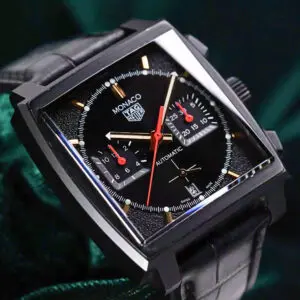
Tag Heuer Monaco Chronograph “Dark Lord” Special Edition Black Dial Black Leather Strap DLC Titanium 39mm MINT CONDITION COMPLETE SET CBL2180.FC6497
$8,135.00
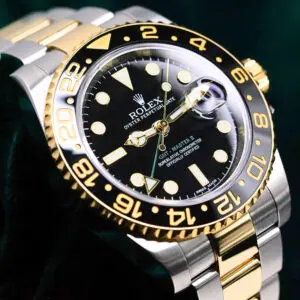
Rolex GMT-Master II “Green Arrow” Black Dial Black Ceramic Bezel Oyster Bracelet Two-Tone 18K Yellow Gold Stainless Steel 40mm MINT CONDITION COMPLETE SET 116713LN
$15,740.00
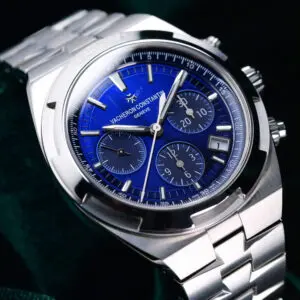
Vacheron Constantin Overseas Chronograph Blue Dial Stainless Steel 42.5mm MINT CONDITION COMPLETE SET 5500V/110A-B148
$37,793.00
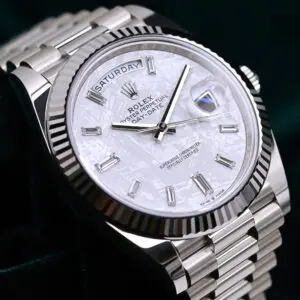
Rolex Day-Date Meteorite Baguette Diamond Dial Fluted Bezel President 18K White Gold 40mm MINT CONDITION COMPLETE SET 228239
$78,629.00
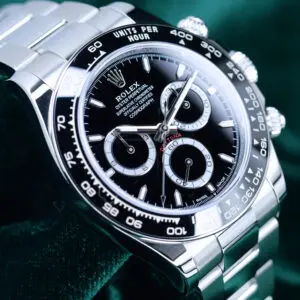
2026 Rolex Cosmograph Daytona Black Dial Black Ceramic Bezel Oyster Bracelet Stainless Steel 40mm MINT CONDITION COMPLETE SET 126500LN
$33,594.00
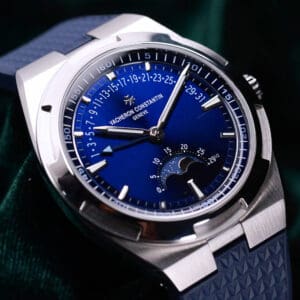
2025 Vacheron Constantin Overseas Moonphase Retrograde Date Blue Dial Blue Rubber Strap Stainless Steel 41mm MINT CONDITION COMPLETE SET 4000V/210A-B911
$52,800.00
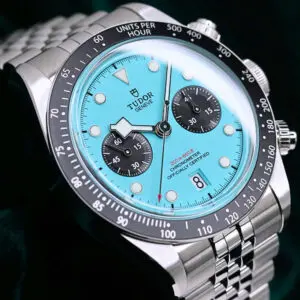
2025 Tudor Black Bay Chrono "Flamingo Blue" Turquoise Dial Black Bezel Stainless Steel 41mm MINT CONDITION COMPLETE SET 79360N-0024
$10,494.00
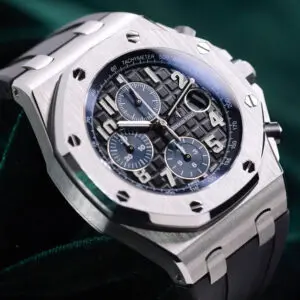
Audemars Piguet Royal Oak Offshore Chronograph "Batman" Black Dial Blue Accents Black Rubber Strap Stainless Steel 42mm MINT CONDITION COMPLETE SET 26470ST.OO.A028CR.01
$25,715.00
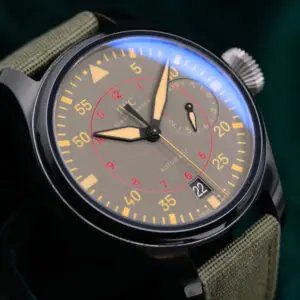
IWC Big Pilot's Watch Top Gun Miramar Grey Dial Green Textile Strap Black Ceramic 48mm MINT CONDITION COMPLETE SET IW501902
$7,240.00
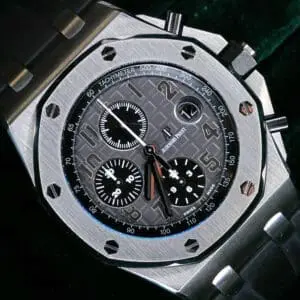
Audemars Piguet Royal Oak Offshore Chronograph "Elephant" Gray Dial Stainless Steel Rubber Strap 42mm 26470ST.OO.A104CR.01
$23,974.50
There are a few solid online channels for buying a Speedmaster or Seamaster. Chrono24 aggregates listings from dealers and private sellers worldwide and offers buyer protection through escrow, though it pays to know what to watch for on Chrono24 before you wire money.
eBay covers a wide range, and its Authenticity Guarantee program inspects watches above a set price before they reach you.
Grailzee runs auction-style listings if you prefer bidding. Watch forums like Omega Forums and WatchUSeek also have active sales sections where collectors move pieces directly. For the bigger picture on channels and what separates them, our guide on where to source a pre-owned watch lays it out.
We also buy, sell, and trade luxury watches, and the reason clients choose us over a big marketplace is the walkthrough before you commit. We send tour videos of the actual watch instead of stock photos, detailed condition notes, and a direct conversation with someone who has handled the piece. You are not buying blind off a listing.
That shows up in our 4.9-star Google rating, which comes from buyers who wanted a real human to talk them through the decision.
If you are torn between a Speedmaster and a Seamaster and want eyes on specific references, reach out and we will line up a few options that match your wrist size, budget, and how you plan to wear it. You can also browse our current collection to see what is in stock right now.
Omega Speedmaster vs Seamaster: Common Questions
A few questions come up again and again when buyers weigh these two. Here are quick answers before you decide.
Can you swim with an Omega Speedmaster?
No, keep the standard Speedmaster Moonwatch out of the pool, since it carries only about 50 meters of water resistance meant for splashes and rain. Hot showers are worth avoiding too, because heat and steam stress the gaskets faster than cold water does. If swimming is part of your routine, the Seamaster is the side of this comparison built for it.
Which holds its value better, the Speedmaster or Seamaster?
Neither is a strong value play in steel, since standard Moonwatches and Seamaster divers both settle below retail once pre-owned. Limited Speedmaster editions like the Silver Snoopy are the exception and can trade above retail. For how Omega resale stacks up against the brand most people benchmark against, our Omega vs Rolex resale value guide digs in.
How does the Speedmaster compare to the Rolex Daytona?
A hand-wound, NASA-qualified Speedmaster costs a fraction of the Daytona’s price and skips the multi-year waitlist. Both deliver a steel chronograph, but the Daytona runs automatic and trades at a steep premium with limited retail access. We break down the full Speedmaster vs Daytona comparison in a separate guide.
Is the Seamaster or a Rolex Submariner the better dive watch?
Both are true 300-meter dive watches, but the Seamaster adds a helium escape valve and usually costs less than a Submariner. The Submariner holds value better and carries more status, while the Seamaster gives you more dive-spec features for the money. Our Submariner vs Seamaster comparison covers the head-to-head.
Final Thoughts on Omega Speedmaster vs Seamaster
An Omega Speedmaster vs Seamaster choice gets clearer once the excitement fades and your routine takes over. What stays is how the watch fits your week, how it sits through long days, and how it feels when you glance down months later.
A Speedmaster rewards buyers who want history and a hands-on ritual; a Seamaster rewards buyers who want to forget the watch is there and just go.
Two quick tips before you commit: try both on a strap as well as the bracelet, since the wrist feel changes a lot, and if you go Speedmaster, decide early whether the hesalite charm or the sapphire’s durability matters more to you. Pick the one that matches your pace, and you stop evaluating and start living with it.