
Some watches beg to be used. You wind them, time things with them, fiddle with the pushers. Others just sit on your wrist and quietly do their job. Omega Speedmaster vs Rolex Explorer is really that split: one is a tool you operate, the other is a tool you forget you are wearing.
Both are steel tool watches built for daily wear, which is why buyers keep pitting them against each other. Your call rarely comes down to brand prestige or a few spec-sheet numbers. What matters is how the watch fits the way you live with it day to day.
This guide walks through the history, the design, the references worth knowing, and current 2026 pricing for both. By the end, you should know which one belongs on your wrist for the next decade. Let us get into it.
Omega Speedmaster Overview
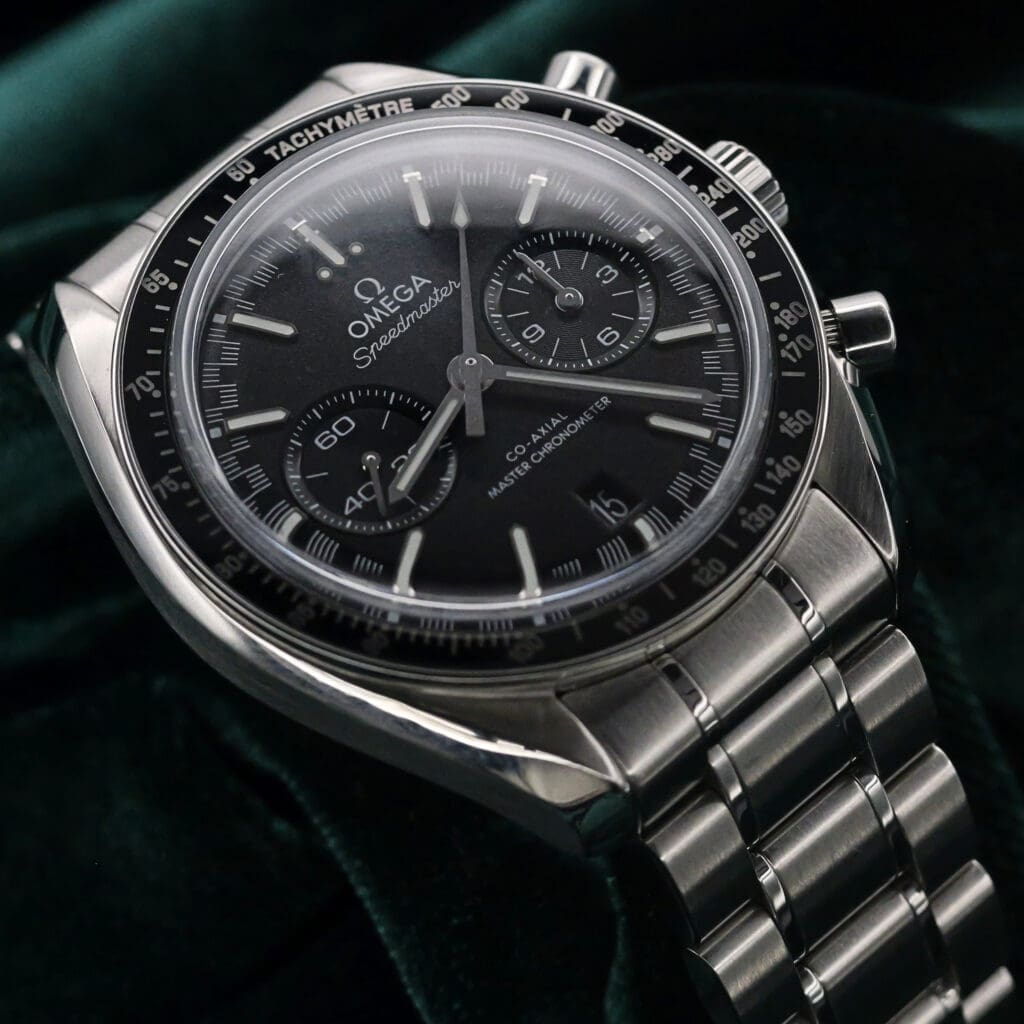
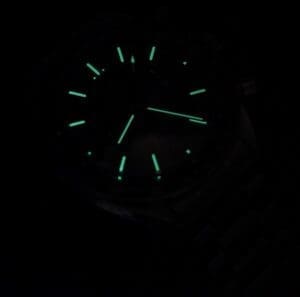
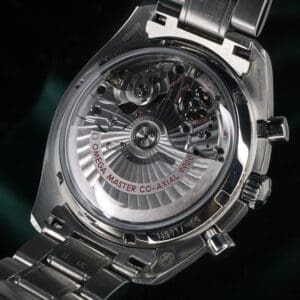
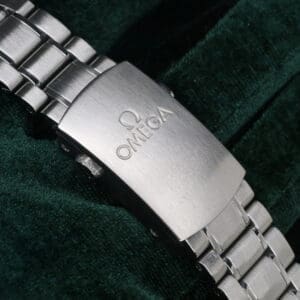
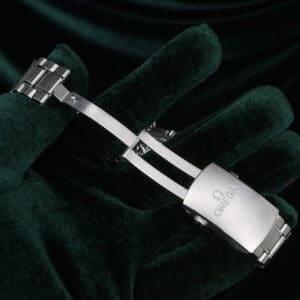
Omega launched the Speedmaster in 1957 as a motorsport chronograph, and it arrived with a trick no rival had: a tachymeter scale printed on the bezel instead of the dial. That move freed up the dial for three clean subdials and made speed-timing easy to read at a glance.
Racing drivers used it to clock laps, but a bigger moment came in 1965 when NASA flight-qualified the Speedmaster for spaceflight. Four years later it went to the Moon on Apollo 11, and the nickname Moonwatch stuck for good.

You can spot a Speedmaster instantly from its tri-compax layout, three subdials plus that external tachymeter bezel. That silhouette has barely changed in over sixty years, which is part of why collectors care about the small stuff: dial text, bracelet construction, caseback engravings, and which caliber sits inside.
Rolex Explorer Overview
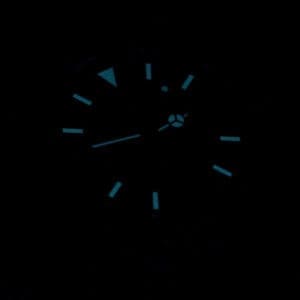
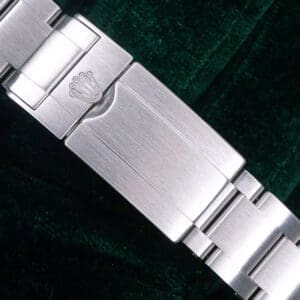
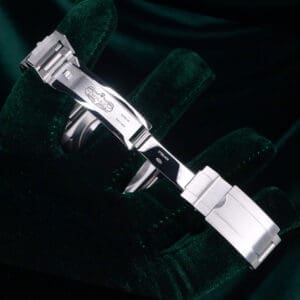
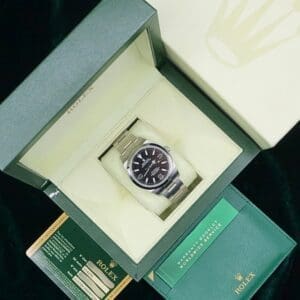
Rolex built the Explorer for a completely different kind of mission. Its story traces to 1953, the year a British team put Edmund Hillary and Tenzing Norgay on the summit of Everest with Rolex Oyster Perpetuals on the expedition. Rolex turned that proving ground into a model and named it the Explorer.
Unlike the Speedmaster, the Explorer carries no chronograph, no subdials, and no tachymeter. It is a time-only watch, and that is the entire point. Everything not needed for reading the time at a glance got stripped away. For how it stacks up against Rolex’s plainest tool watch, see our Explorer vs Oyster Perpetual comparison.

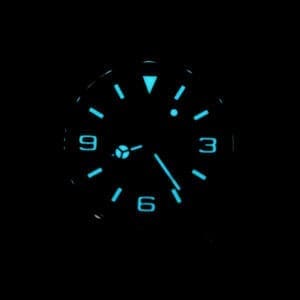
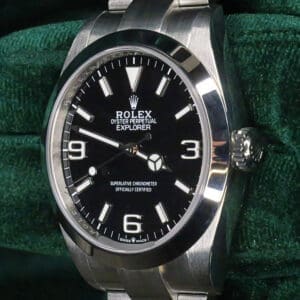
You recognize an Explorer by its glossy black dial with oversized 3, 6, and 9 numerals, plus Mercedes-style hands filled with luminous material. A smooth steel bezel and an Oyster case round it out. No fuss, no clutter, just legibility and toughness.
Across seventy years the recipe held steady while the engineering improved. Early references used acrylic crystals and modest water resistance; modern ones get sapphire, 100 metres of water resistance, and Rolex’s latest movements. Same look, far tougher build.
Omega Speedmaster vs Rolex Explorer: Most Notable Differences

Both watches survive daily abuse and both will outlast their owners. Where they split is in how they want to be used, so here are the differences that shape ownership day to day.
Movement Style: Manual Chronograph vs Automatic
Speedmaster runs the hand-wound Calibre 3861, a Master Chronometer movement you wind yourself before pressing the pushers to run the stopwatch. That winding ritual becomes part of the day if you like mechanical watches. Many owners notice the firm pusher click within the first week. If you have never run a chronograph, our step-by-step guide to using one covers the pushers.
Explorer takes the opposite approach with the automatic Calibre 3230, a time-only movement Rolex rates to about two seconds a day either way. A rotor winds it as you move, so it never needs daily attention. Set it once and forget it.
Case Design: External Pushers vs Sealed Oyster
Speedmaster uses a 42 mm case with pump pushers flanking the crown so you can run the chronograph directly. Water resistance sits at 50 metres, fine for daily wear and rain but not for serious swimming. Crystal choice, hesalite or sapphire, shifts the look depending on reference.
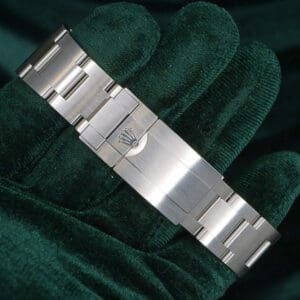
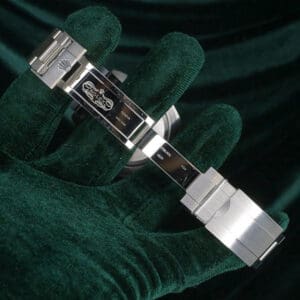
Explorer goes the sealed route with a screw-down Oyster crown and 100 metres of water resistance. Buyers pick 36 mm or 40 mm, both with a smooth steel bezel. Fewer external parts mean fewer things to knock loose, which suits a knockabout daily watch.
More Explorers

Rolex Explorer I Black Dial Stainless Steel 39mm MINT CONDITION COMPLETE SET 214270

2026 NEW UNWORN Rolex Explorer II "Polar" White Dial 42mm COMPLETE SET 226570
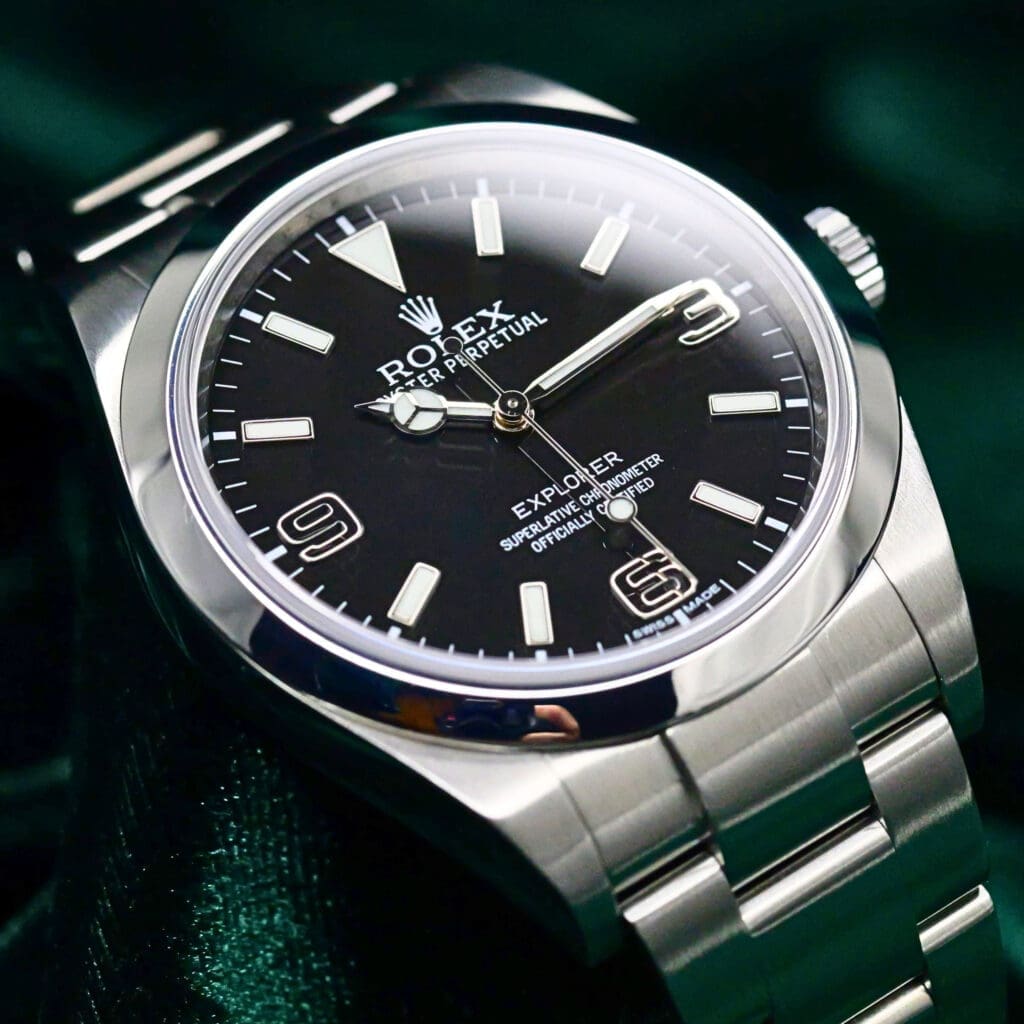
Rolex Explorer 1 Black Dial Stainless Steel 39mm MINT CONDITION COMPLETE SET 214270

Rolex Explorer Black Dial Stainless Steel 39mm MINT CONDITION COMPLETE SET 214270
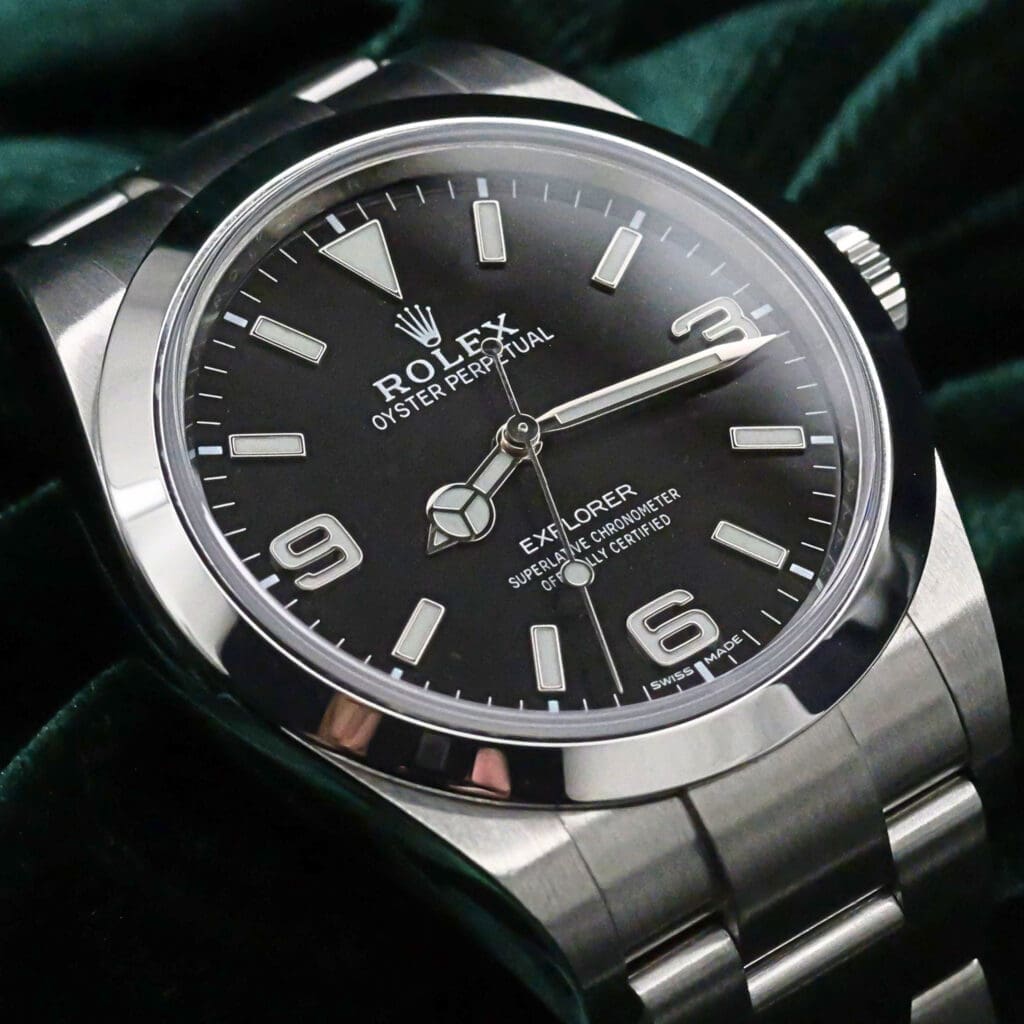
Rolex Explorer Black Dial Stainless Steel 39mm MINT CONDITION COMPLETE SET 214270

Rolex Explorer II "Polar" White Dial Stainless Steel 40mm MINT CONDITION COMPLETE SET 16570
Dial Layout: Busy Tool vs Clean Legibility
Speedmaster packs a lot onto its face: three subdials, a running seconds counter, and the tachymeter ring on the bezel. Plenty of information, and plenty to look at, which is part of the appeal for people who enjoy a busy dial.
Explorer does the reverse. Big 3-6-9 numerals and fat luminous hands make the time readable in a glance, day or night. A clean bezel keeps the whole thing visually quiet. Nothing competes for your attention.
Price and Market Demand
Speedmaster pricing spans a wide range because the family runs from standard Moonwatches to rare limited editions. A current steel Moonwatch on hesalite sits around $4,500 to $5,500 on the pre-owned market as of 2026, which is the realistic entry point most buyers weigh against an Explorer.
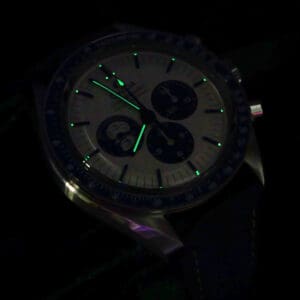
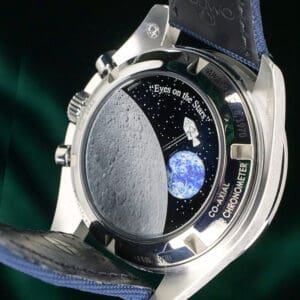
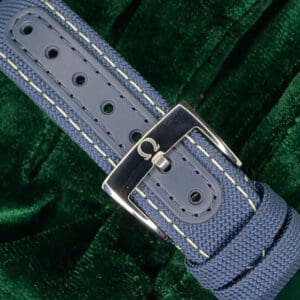
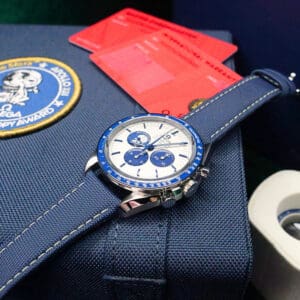
Limited editions stretch the ceiling fast. A 2015 Silver Snoopy Award (Ref. 311.32.42.30.04.003) retailed near $7,400 yet trades well into five figures today, often above $25,000 when the right example surfaces. Demand for a specific dial and a tiny production run drives that gap.

Explorer pricing stays far more predictable since the design barely moves between generations. A current 40 mm Explorer (Ref. 224270) retails around $8,350 and trades close to $8,500 on the secondary market as of 2026. Buyers treat it as a durable daily Rolex more than a collectible.
Vintage flips that logic. A clean Explorer Ref. 1016 runs roughly $12,000 to $20,000 depending on dial condition and originality, with honest dials and matching lume pulling the strongest money. Here condition and authenticity matter more than configuration.
If resale weighs on the decision, our Omega vs Rolex resale value breakdown compares how the two brands hold up over time.
Pricing like this shifts with condition, box and papers, and which generation you are after. If you want a straight read on what a specific Speedmaster or Explorer should cost right now, we are happy to talk it through before you buy.
Notable Omega Speedmaster References

A few references anchor the whole Speedmaster line, and most buyers meet these first. Here is how the modern lineup breaks down, with verified specs and 2026 pricing. For the full family beyond these three, our Omega Speedmaster buying guide walks through the lineup.
Omega Speedmaster Ref. 311.30.40.30.01.001 — Ed White
Ed White earns its following by putting the column-wheel Calibre 321 back into a compact 39.7 mm straight-lug case. Winding feels smooth, pushers click cleanly, and the smaller proportions read vintage straight away. Hard to find at retail, easy to love on the wrist.
Key Specs:
- Movement: Omega Calibre 321, manual wind chronograph
- Case Diameter: 39.7 mm
- Case Thickness: 13.70 mm
- Crystal: Sapphire
- Water Resistance: 50 m
- Power Reserve: 55 hours
- Price Range: about $13,000 to $16,000
Omega Speedmaster Ref. 310.30.42.50.01.001 — Hesalite Moonwatch
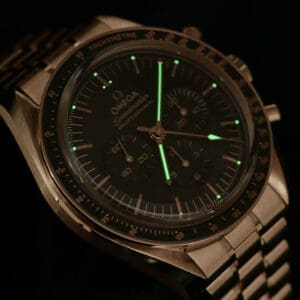
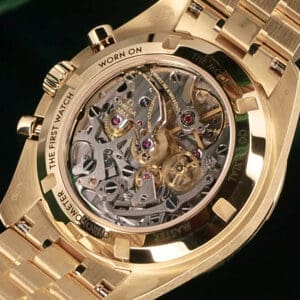
This is the current Moonwatch most people picture, the one carrying forward the closed caseback engraved with “the first watch worn on the moon.” Inside is the modern Calibre 3861. Hesalite gives the dial a warmer, glare-cutting look indoors and shrugs off scratches with a quick polish.
Key Specs:
- Movement: Omega Calibre 3861, manual wind chronograph
- Case Diameter: 42 mm
- Case Thickness: 13.60 mm
- Crystal: Hesalite
- Water Resistance: 50 m
- Power Reserve: 50 hours
- Price Range: about $4,500 to $5,500

Omega Speedmaster Ref. 310.30.42.50.01.002 — Sapphire Moonwatch
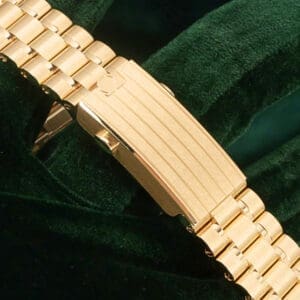
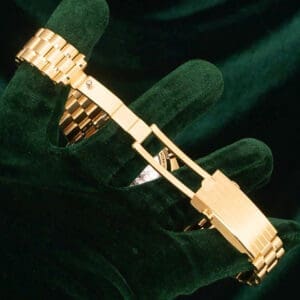
Same modern Calibre 3861, but this version swaps in a sapphire crystal up front and a sapphire display caseback so you can watch the movement work. Sapphire reads sharper and darker than hesalite. Sitting slightly thinner on the wrist, it is the pick for buyers who want the view and the scratch resistance.
Key Specs:
- Movement: Omega Calibre 3861, manual wind chronograph
- Case Diameter: 42 mm
- Case Thickness: 13.20 mm
- Crystal: Sapphire
- Water Resistance: 50 m
- Power Reserve: 50 hours
- Price Range: about $6,000 to $7,200
Notable Rolex Explorer References

Explorer references show a model that evolved slowly and deliberately. Each keeps the 3-6-9 dial and tool-watch brief while the case and movement quietly improved. Here are five worth knowing, vintage to current. Our Rolex Explorer buying guide covers the full lineup if you want to go deeper.
Rolex Explorer Ref. 1016 — Vintage Explorer
Ref. 1016 set the template by staying nearly unchanged from 1963 to 1989. You get a 36 mm case, a matte 3-6-9 dial, and an acrylic crystal that warms the look under normal light. Most run Calibre 1560 or 1570, both smooth to wind and set.
Key Specs:
- Movement: Rolex Cal. 1560 or 1570, self-winding
- Case Diameter: 36 mm
- Case Thickness: about 12 mm
- Crystal: Acrylic (Plexiglass)
- Water Resistance: about 50 m
- Power Reserve: about 48 hours
- Price Range: about $12,000 to $20,000
Rolex Explorer Ref. 114270 — Transitional Explorer
Ref. 114270 bridges vintage and modern. Rolex held the classic 36 mm size, switched to a sapphire crystal, and fitted the Calibre 3130. Dial stays familiar while the case and bracelet feel noticeably tighter. Produced 2001 to 2010, so it is a pre-owned-only proposition now.
Key Specs:
- Movement: Rolex Cal. 3130, self-winding
- Case Diameter: 36 mm
- Case Thickness: about 11.3 mm
- Crystal: Sapphire
- Water Resistance: 100 m
- Power Reserve: about 48 hours
- Price Range: about $6,500 to $8,500



Rolex Explorer Ref. 214270 — Explorer 39
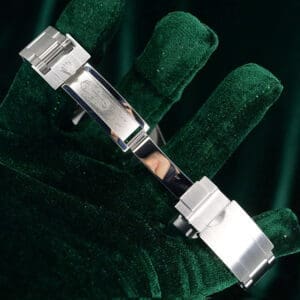
Ref. 214270 is the odd one out, the only modern Explorer at 39 mm, made from 2010 to 2021. Rolex fitted the Calibre 3132 and Chromalight lume, then updated the dial to larger numerals in 2016, which collectors call the Mark 2. Discontinuation in 2021 gave it a slight cult status.
Key Specs:
- Movement: Rolex Cal. 3132, self-winding
- Case Diameter: 39 mm
- Case Thickness: about 11.6 mm
- Crystal: Sapphire
- Water Resistance: 100 m
- Power Reserve: about 48 hours
- Price Range: about $7,500 to $8,500
Rolex Explorer Ref. 124270 — Current 36 mm Explorer
Ref. 124270 brought the Explorer back to 36 mm in 2021, surprising a market that expected bigger. You get the Calibre 3230 with its 70-hour reserve, so a weekend off the wrist will not stop it. For purists who consider 36 mm the true Explorer size, this is the current answer.
Key Specs:
- Movement: Rolex Cal. 3230, self-winding
- Case Diameter: 36 mm
- Case Thickness: about 11.6 mm
- Crystal: Sapphire
- Water Resistance: 100 m
- Power Reserve: 70 hours
- Price Range: about $7,700 retail, about $8,700 market
Rolex Explorer Ref. 224270 — Explorer 40
Ref. 224270 answers everyone who wanted more wrist presence without losing the formula. Rolex moved to a 40 mm Oyster case in 2023, kept the smooth bezel and 3-6-9 dial, and used the same Calibre 3230 with a 70-hour reserve. Closest thing to a modern do-everything Explorer.
Key Specs:
- Movement: Rolex Cal. 3230, self-winding
- Case Diameter: 40 mm
- Case Thickness: about 11.6 mm
- Crystal: Sapphire
- Water Resistance: 100 m
- Power Reserve: 70 hours
- Price Range: about $8,350 retail, about $8,500 market

Omega Speedmaster vs Rolex Explorer: Which Should You Choose?
Both are excellent, so the honest answer comes down to temperament more than tier. Match the watch to how you behave with one on your wrist.
Choose the Omega Speedmaster If:
- You want a real chronograph for timing workouts, cooking, parking meters, or work intervals.
- You enjoy a hand-wound movement and the small daily ritual of winding it.
- A busy, sporty dial with subdials and a tachymeter appeals to you.
- Space history and the Moonwatch story add something to ownership for you.
- You like having many references and eras to collect across.
- You see a watch as a hands-on mechanical object, not only a timekeeper.
Choose the Rolex Explorer If:
- You want a time-only Rolex that slides under a cuff and pairs with anything.
- You value 100 m water resistance and a sealed Oyster case for daily abuse.
- An automatic movement that runs without winding suits your routine better.
- Fast legibility matters more to you than extra functions.
- Choosing between 36 mm, 39 mm, and 40 mm lets you dial in the fit.
- You want one watch that just works and never asks for attention.
999+ Timepieces Available
Explore Our Timepieces
Authenticated, unworn, and ready to ship worldwide.
Rolex · Audemars Piguet · Patek Philippe · Omega · Cartier · Richard Mille · Hublot · Tudor
Newly Listed
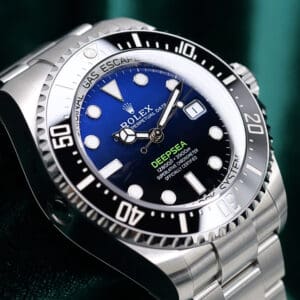
2026 NEW UNWORN Rolex Deepsea "James Cameron" D-Blue Black and Blue Dial Black Ceramic Bezel Stainless Steel 44mm COMPLETE SET 136660-0005
$20,208.00
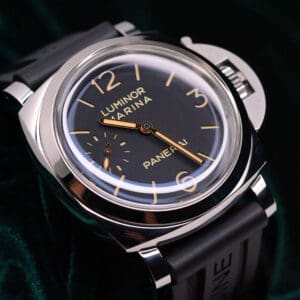
Panerai Luminor Marina 1950 3 Days Limited Edition Black Sandwich Dial Stainless Steel Black Rubber Strap 47mm MINT COMPLETE SET PAM00422
$7,503.00
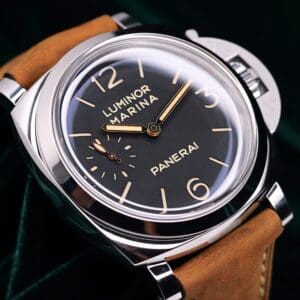
Panerai Luminor Marina 1950 3 Days Black Dial Stainless Steel Brown Leather Strap 47mm LIMITED EDITION MINT CONDITION COMPLETE SET PAM00422
$7,503.00
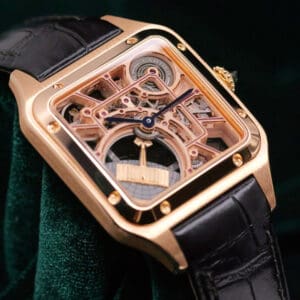
Cartier Santos-Dumont Micro-Rotor Skeleton Dial Black Alligator Strap 18k Rose Gold 43.5 x 31mm MINT CONDITION COMPLETE SET WHSA0030
$40,425.00
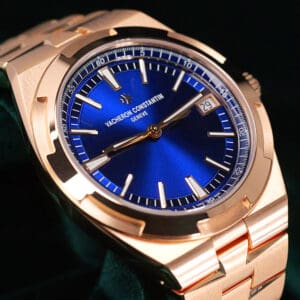
2026 Vacheron Constantin Overseas Blue Dial 18k Rose Gold 41mm MINT CONDITION COMPLETE SET 4520V/210R-B705
$72,764.00
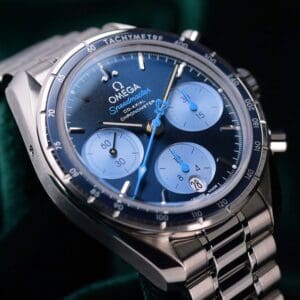
Omega Speedmaster 38 Orbis Edition Blue Dial Stainless Steel 38mm MINT CONDITION COMPLETE SET 324.30.38.50.03.002
$6,599.00
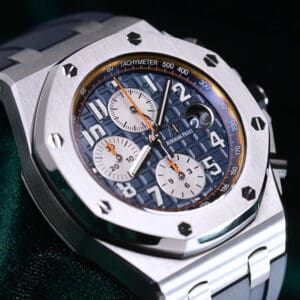
Audemars Piguet Royal Oak Offshore Chronograph “Navy” Blue Dial Orange Accents Blue Rubber Strap Stainless Steel 42mm MINT CONDITION COMPLETE SET 26470ST.OO.A027CA.01
$22,245.00
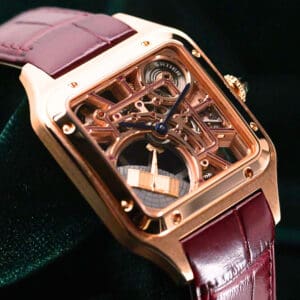
Cartier Santos-Dumont Micro-Rotor Skeleton Dial 18K Rose Gold Burgundy Alligator Strap 31mm MINT CONDITION COMPLETE SET WHSA0030
$40,425.00
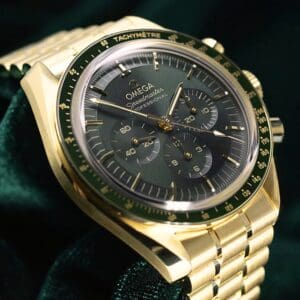
Omega Speedmaster Professional Moonwatch "Moonshine" Green Dial 18K Yellow Gold 42mm MINT CONDITION COMPLETE SET 310.60.42.50.10.001
$35,695.00
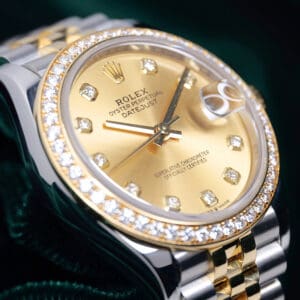
Rolex Datejust 31 Champagne Diamond Dial Diamond Bezel Jubilee Yellow Gold & Stainless Steel 31mm MINT CONDITION COMPLETE SET 278383RBR
$31,990.00
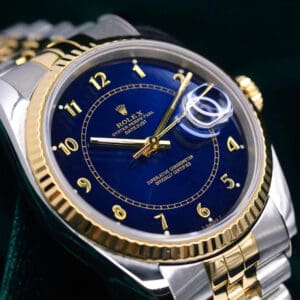
Rolex Datejust Blue Arabic Numeral Refinished Dial Fluted Bezel Jubilee Bracelet 18k Yellow Gold Stainless Steel 36mm MINT CONDITION 16233
$7,975.00
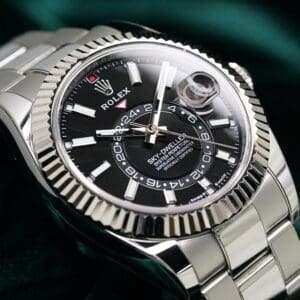
2025 Rolex Sky-Dweller Bright Black Dial 18k White Gold Fluted Bezel Stainless Steel Oyster Bracelet 42mm MINT CONDITION COMPLETE SET 336934
$22,895.00
Still mapping out alternatives? If the Explorer fits but you want a date window, our Rolex Explorer vs Datejust comparison is worth a read. Omega buyers often cross-shop within the brand too. The Speedmaster vs Seamaster breakdown covers the other obvious daily Omega.
Where to Buy Authentic Watches Online
You have a few solid channels for buying a pre-owned Speedmaster or Explorer online. Chrono24 is the largest global marketplace, with an escrow service that holds your payment until the watch arrives. Our guide to buying on Chrono24 walks through the escrow steps and what to check.
eBay covers many of these references too, and its Authenticity Guarantee program inspects eligible watches before they reach you. Grailzee runs enthusiast-focused auctions if you prefer a bidding format.
We also buy, sell, and trade luxury watches, and the reason clients come to us instead of a big listing is the conversation before the sale. You get tour videos of the actual watch, honest condition notes, and a real person who has handled the piece answering your questions, so you are never buying blind off a photo.
That approach is reflected in our 4.9-star Google rating, which comes from buyers who wanted to understand the watch before committing.
If you want that kind of walkthrough on a specific Speedmaster or Explorer, reach out and we will line up options that match your budget and wrist.
Final Thoughts on Omega Speedmaster vs Rolex Explorer
Omega Speedmaster vs Rolex Explorer really comes down to whether you want a watch to operate or a watch to forget. Speedmaster rewards the hands-on owner who likes winding and timing; Explorer rewards the person who wants legibility and durability with zero fuss.
Two things worth knowing before you buy. First, on the Speedmaster, decide between hesalite and sapphire early, since hesalite is cheaper and more period-correct but scratches, while sapphire costs more and shows off the movement.
Second, on the Explorer, try all three sizes on your wrist if you can. A 36 mm wears very differently from a 40 mm, and that one choice affects resale more than buyers expect, with 36 mm and 40 mm currently holding value better than the discontinued 39 mm.