
The Yacht-Master II is designed to meet the needs of professional sailors. This regatta chronograph features the world’s first programmable countdown with a mechanical memory. It provides precise synchronization with the crucial starting sequence of a yacht race.The Yacht-Master II was first introduced in 2007 in white gold and yellow gold. In 2011 a version in stainless steel / Everose was added to the collection, while the stainless steel version was added to the collection in 2013 and in the same year the caliber 4160 movement was updated to the 4161. Reference 116689-0002 was introduced in 2017 as a replacement for the earlier 116689-0001. It features a gently redesigned dial and a different set of hands.
Watch our tour video about the ROLEX YACHT-MASTER 2 WHITE GOLD 116689-0002
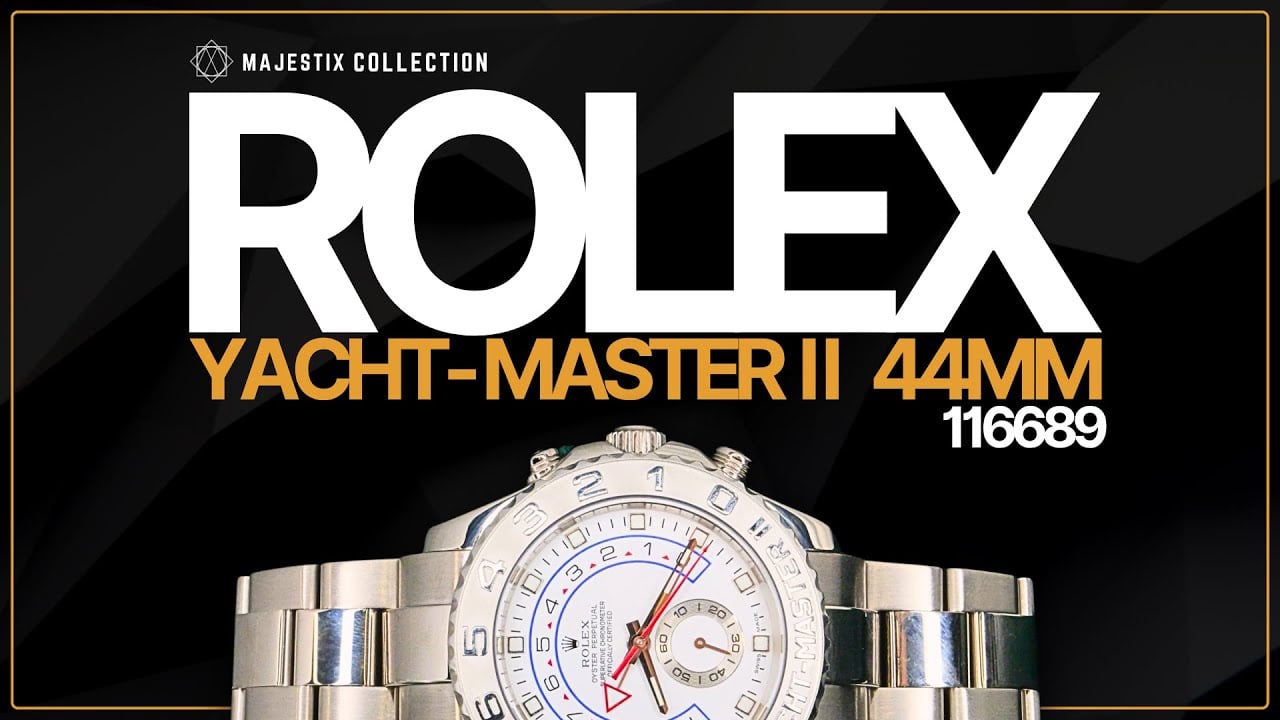
You don’t see 116689 every day – and that’s exactly what makes it interesting. This version of the Yacht-Master II comes in solid white gold with a platinum bezel, and it was built for skippers who actually race yachts. But here’s the thing: even if you’ve never sailed a boat in your life, there’s still a lot to like.
It’s one of the largest and heaviest watches Rolex ever made, and under the hood is one of their most complex movements. But it’s not just about specs – this piece feels special on the wrist. Let’s break it down and see why the 116689 might be one of the coolest watches nobody’s talking about.
Origins and Design Evolution

After years of sticking to the basics – time, date, maybe a second timezone – Rolex did something unexpected in 2007. They rolled out the Yacht-Master II, not as an update to the original Yacht-Master, but as a totally new series built for regatta racing. It was big, technical, and introduced something Rolex had never done before: a programmable countdown timer with mechanical memory. For a brand known for simplicity, this was a bold move.
At launch, you had two choices: the yellow gold 116688 and this one – the white gold 116689 with a platinum bezel. Both were positioned at the top end of the Rolex sports watch lineup, not just in terms of functionality, but also price. And that exclusivity has never really gone away. While Rolex eventually released more accessible versions, including the Everose Rolesor in 2011 and the full steel 116680 in 2013, the white gold and platinum 116689 stayed in a league of its own – unique and harder to come by.
In 2013, Rolex gave the movement an upgrade across the entire Yacht-Master II lineup, swapping the original Caliber 4160 for the more refined Caliber 4161. Then, in 2017, the dial design got a small but noticeable update. The hour hand changed to the familiar Mercedes style, the minute hand became partially skeletonized, and the hour markers at 6 and 12 were reshaped for better balance. Even with these changes, the reference number stayed the same, so spotting an updated model means looking closely at the dial.
Production of the 116689 wrapped up in 2024, and that makes the post-2017 version – with the updated dial and white gold build – especially rare. It is the kind of detail collectors pay attention to, and over time, small production changes like this can really shape how sought-after a watch becomes.
Now that we’ve got the backstory covered, let’s get into what this watch actually looks like – starting with the case, bezel, bracelet, and clasp.
Case, Bezel, Bracelet & Clasp

Once you see the Yacht-Master II 116689 in person, you instantly get why this piece stands out. The case measures 44mm across and about 14mm thick, making it one of the largest watches Rolex has ever produced. But it’s not just big – it is built with serious materials that you won’t find on most sports models.
The entire case, including the screw-down crown and solid caseback, is made from 18k white gold. Yes, Rolex uses their own proprietary alloy here, known as grey gold, which keeps its color over time without needing any rhodium plating. The surface is fully polished, creating a fluid look that flows directly into the matching bracelet.
Where this version really sets itself apart is the bezel. While most Yacht-Master IIs come with colorful ceramic bezels, the 116689 features one made entirely from solid platinum. The finish is a sandblasted texture with polished raised numerals – so you can actually feel the numbers with your finger. It is functional too: this bezel is part of the Rolex Ring Command system, which helps control the regatta timer inside the watch.
The bracelet sticks to the classic Oyster layout, with three solid links: brushed outer links for a slightly muted contrast, and high-polish center links that reflect the case finish. Everything’s made from 18k white gold, just like the case. The clasp is Rolex’s Oysterlock system, with a secondary safety latch and the Easylink comfort extension – giving you an extra 5mm of adjustment when your wrist swells up from heat or activity. No tools needed.
From the platinum bezel to the solid white gold clasp, the 116689 wears like a serious piece of gear – but it doesn’t feel overbuilt or awkward.
Next, let’s look at the dial and how that unique regatta timer actually works in practice.
Dial Layout and Regatta Functionality

After you’ve taken in the case and bracelet, the dial is where this watch really starts to show what it can do. Unlike the other versions with bright ceramic bezels, the 116689 keeps things cooler – clean white dial, platinum tones, and just the right amount of color with the red hands and blue countdown track.
At 6 o’clock, you’ll see a small seconds subdial that runs continuously. The long red central hand is for the chronograph, and the short red arrow points to your countdown time. This is where the Yacht-Master II’s standout feature comes into play: the regatta timer.
Using the Ring Command bezel, you rotate it 90 degrees counterclockwise to unlock the timer-setting mode. From there, press the bottom pusher to engage it, unscrew the crown, and use it to set your countdown interval between 1 and 10 minutes. Once you lock the bezel back into place, the watch remembers your setting thanks to its mechanical memory – a detail that’s unique to this model.
When you’re ready to use the timer, press the top pusher and the central seconds hand starts sweeping. If the timer falls out of sync with a race’s signal, the flyback (or fly-forward) function lets you snap the hand to the closest minute with a single press – perfect for regattas with staggered start signals.
That said, you don’t need to be on a boat to get real use out of this feature. It is surprisingly handy for everyday tasks where short countdowns matter – anything from keeping track of a workout set to timing your French press.
Visibility is solid, too. The hands and hour markers are filled with Chromalight, the Rolex proprietary lume that glows blue in the dark. You also get updated details from the 2017 refresh, like the Mercedes-style hour hand and a partially skeletonized minute hand for better legibility.
So, let’s take a look at the engine behind all this functionality – the Caliber 4161 movement.
Movement and Performance

All the functionality packed into the Yacht-Master II wouldn’t be possible without the right engine – and that’s where the Caliber 4161 comes in. Rolex developed this movement specifically for the Yacht-Master II, drawing on their Daytona’s Caliber 4130 but adding a serious level of complexity. In fact, it took over 35,000 hours of development to get it right.
Inside the case, you’ve got more than 360 components working together, including parts made using a process called UV-LiGA – the Rolex way of creating ultra-precise microstructures for smoother and more reliable performance.
The movement runs at 28,800 vibrations per hour and delivers a 72-hour power reserve. It is also fitted with a column wheel and vertical clutch system, which means the chronograph starts, stops, and resets without any jitter. That’s a big plus for a watch built around countdown timing.
Rolex also added their Parachrom hairspring, a blue alloy that’s highly resistant to shocks and magnetic fields – useful whether you’re at sea or just dealing with everyday electronics. And with 48 jewels, this is one of the most jewel-dense movements Rolex has ever made.
As expected, it is a COSC-certified Superlative Chronometer, which means it’s tested both externally and in-house to stay within -2/+2 seconds per day once cased.
Everything inside this watch is working to support what’s happening on the dial. And even with all that complexity, the Caliber 4161 remains surprisingly durable and user-friendly.
So with all that packed inside, how does the 116689 actually wear? Let’s break down what it feels like on the wrist – from the weight to the fit to the kind of presence it really brings.
On-Wrist Presence
With so much going on inside, it’s no surprise that the Yacht-Master II 116689 makes a strong impression when you wear it. This isn’t a subtle piece—and that’s part of its appeal. Between the white gold case and platinum bezel, there’s serious weight here. You’ll feel it the moment you put it on, but it’s the kind of weight that reminds you there’s something special on your wrist.
Despite the size and materials, it wears better than you’d expect. Once it’s sized properly, the watch sits securely without feeling awkward or bulky. The way the case curves and connects cleanly to the bracelet helps spread out the weight, so the watch doesn’t feel top-heavy or unstable – even though it’s one of the heaviest models. Once it’s sized right, it stays in place and doesn’t shift or dig in, which makes it much more wearable than the specs might suggest.
It also has a visual that doesn’t need bright colors or flashy surfaces to stand out. There’s something about the all-metal look that commands quiet attention. And while this isn’t the kind of watch that disappears under a shirt cuff, it was never meant to be. This is a piece you wear when you want to feel it – and be reminded why you chose it.
| Category | Details |
| Case | – 44mm diameter, approx. 14mm thick. – Made entirely from 18k white gold (Rolex “grey gold”), including the screw-down crown and solid caseback. – Fully high-polished for a seamless transition into the bracelet. |
| Bezel | – Solid platinum bezel with sandblasted texture and raised, high-polished numerals. – Integrates the Ring Command system to set and control the regatta timer. |
| Bracelet | – Oyster bracelet in 18k white gold with brushed outer links and high-polished center links, mirroring the case’s finish. |
| Clasp | – Oysterlock folding clasp with a secondary safety latch and Easylink extension system, allowing 5mm of tool-free micro-adjustment for comfort. |
| Dial Layout & Functionality | – Clean white dial with platinum tones. – Features red accents: red chronograph hand, red arrow countdown hand, and blue regatta countdown track. – Mercedes-style hour hand and skeletonized minute hand for clarity. Small seconds subdial at 6 o’clock. – Chromalight lume on hands and markers for visibility in the dark. – Regatta countdown timer adjustable via bezel and crown, with flyback/fly-forward synchronization. |
| Movement & Performance | – Rolex Caliber 4161, automatic chronograph movement with regatta timer. Based on Caliber 4130 with over 360 components. – Features column wheel, vertical clutch, Parachrom hairspring, and 72-hour power reserve. COSC-certified Superlative Chronometer rated to -2/+2 seconds/day. |
| On-Wrist Presence | – Noticeably substantial due to white gold and platinum construction, yet surprisingly wearable when properly sized. – Curved case and integrated bracelet help distribute weight evenly. – Visually understated despite its scale – exudes quiet power without bright colors. – Meant to be felt and seen, not hidden under a cuff. |
Now, let’s talk about how rarity plays into all of this, and why you don’t see many of these out in the wild.
Rarity and Collectibility
Not long after it was released, the 116689 quietly became the most elusive version of the Yacht-Master II. From the beginning, it was the top-tier option in the lineup – solid white gold, platinum bezel, and the highest price tag of the bunch. But once Rolex introduced the stainless steel version in 2013, many buyers shifted their attention to the more affordable alternative, and sales of the white gold model naturally slowed.
That shift made a real impact. Fewer of the 116689s were produced over the years, especially compared to the steel and two-tone versions. And when Rolex refreshed the dial in 2017 without changing the reference number, it added another layer to its uniqueness. The version with the updated hands and hour markers was only made until 2024, giving it a limited production window that collectors are just now starting to pay attention to.
Unlike the steel or two-tone versions, which are relatively easy to spot at watch meets or in listings, the 116689 shows up far less frequently – especially the post-2017 variant. Most authorized dealers didn’t stock many to begin with, and once the steel model launched in 2013, demand for the white gold version dropped sharply. That shift means far fewer of these were produced and sold over its lifetime. Today, it is not unusual to scroll through dozens of Yacht-Master II listings and never see a 116689. For collectors who recognize the platinum bezel and updated dial layout, spotting one in the wild almost feels like a win.
And that’s what makes it special. Collectibility doesn’t just come from hype – it comes from a mix of low production, unique configuration, and the kind of slow-burn appeal that ages well.
Not Your Everyday Yacht-Master
The 116689 isn’t loud, and that’s what gives it character. It takes one of the most complex features – the regatta timer – and pairs it with precious metals you rarely see together. You won’t find this model on every wrist, and that’s part of the experience. It feels different. It wears different. And for collectors who want something that’s rare and mechanically impressive, this one checks all the boxes.