
Introduced in 2023, the Rolex Explorer reference 224270-0001 has a stainless steel case (40.00mm) and matching Oyster bracelet. The dial is black. Inside ticks the self-winding caliber 3230.
Watch our tour video about the Rolex Explorer 40 Stainless Steel
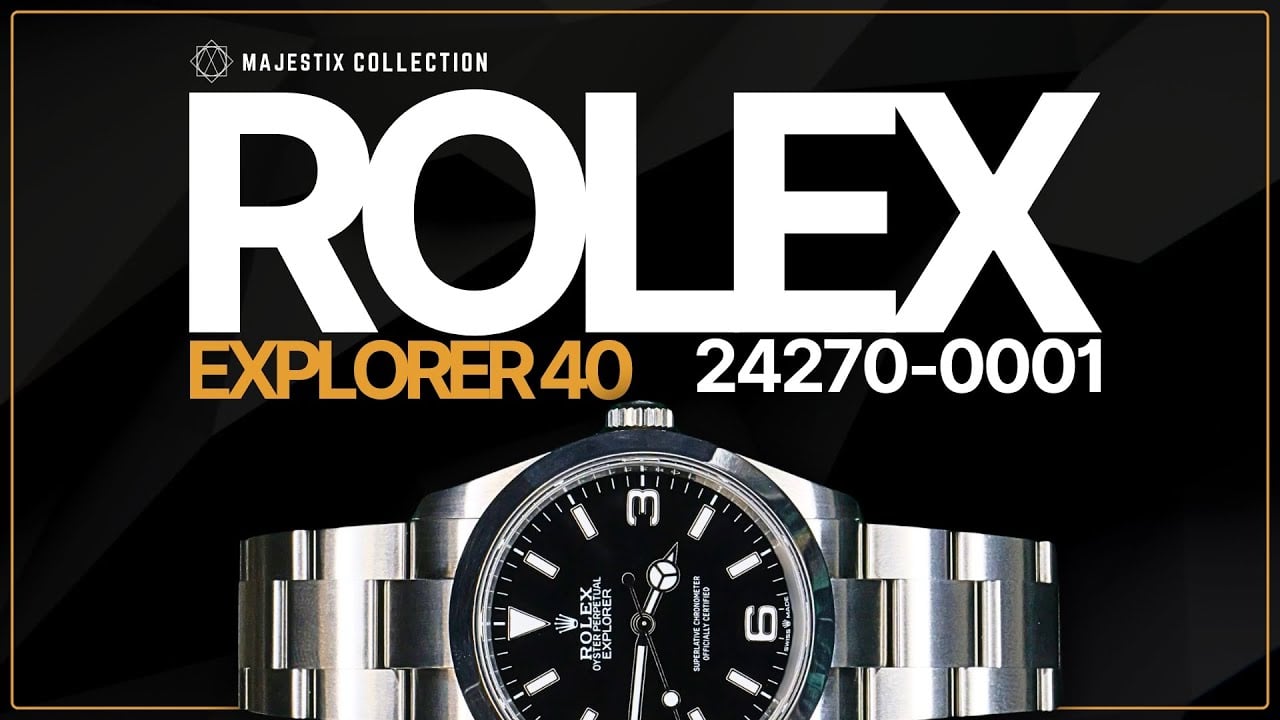
Rolex doesn’t shake things up often, but when it does, even a 1mm change makes headlines. In 2023, the brand introduced the Explorer 40 reference 224270 – the biggest version yet of its long-standing field watch. The design stays true to the Explorer formula: a black dial, large Arabic numerals at 3, 6, and 9, Mercedes-style hands, and a time-only layout with no date complication.
While the look hasn’t changed much, the Explorer 40 offers a more substantial presence on the wrist – without losing the everyday wearability that has made this model a favorite for everything from travel to the office. It may appear familiar at first glance, but the change in scale has sparked plenty of conversation. To understand why that matters, it helps to look back at how the Explorer has evolved over the last 70 years.

To understand why a single millimeter has sparked so much discussion, it helps to rewind to the Explorer’s start.
Rolex launched the first Explorer after supplying watches to the British Everest expedition. Built around the caliber A296, the 6350 carried a 36 mm steel case, a matte black dial, and large 3-6-9 numerals that could be read in freezing dawn light.
1955–1959: Reference 6610
The follow-up slimmed the case profile and introduced the chronometer-rated caliber 1030. The basic design – black dial, triangle at 12 o’clock, no date, stayed locked in.
1960–1989: Reference 1016
With a nearly 30-year production run, the 1016 turned the Explorer from “expedition gear” into a daily-wear watch. Lume switched from radium to tritium, water-resistance climbed to 100 m, and owners began pairing it with everything from field jackets to business suits.
1989–2001: Reference 14270
Sapphire crystal, applied white-gold hour markers, and the high-beat caliber 3000 modernized the line. Despite the upgrades, the case diameter remained 36 mm – true to the original footprint.
2001–2010: Reference 114270
Solid end links and the caliber 3130 refined reliability, but sizing still held at 36 mm.
2010–2020 – Reference 214270 (39 mm)
Responding to the wider watch trend, Rolex upsized the Explorer to 39 mm and added the caliber 3132. Early batches used undersized hands; a 2016 “Mk II” revision fixed that and filled the 3-6-9 numerals with lume for the first time.
2021: References 124270 & 124273 (36 mm, cal. 3230)
Rolex pivoted back to the original diameter and, for the first time, offered a steel-and-gold version. The new caliber 3230 delivered a 70-hour power reserve and the Chronergy escapement, but some collectors still wanted more wrist presence.
2023: Reference 224270 (40 mm)
Enter the Explorer 40. While Rolex officially lists it at 40 mm, many collectors who’ve measured the case themselves report it closer to 39 mm. Still, it adds just enough metal to satisfy larger wrists without straying from the watch’s core identity. It shares the same movement, dial layout, and 100-meter water resistance as the 36 mm version, but the increase in size makes a noticeable difference in how it wears.
Decades of gradual updates – like the switch to sapphire crystal, the introduction of brighter lume, and improved in-house movements – have helped the Explorer stay current without losing its identity. With the 224270, Rolex hasn’t rewritten the formula, but the increased case size and updated proportions mark the most noticeable shift in feel since the 39mm version debuted.
So how does this larger Explorer wear, and what exactly has changed? Let’s take a closer look at the case, bracelet, and clasp in the next section.

With the Explorer’s timeline fresh in mind, it is time to handle the new watch itself. The updated proportions don’t jump out in photos, but they become clear once you strap it on your wrist.
Rolex lists the case as 40 mm, but independent reviewers and collectors who’ve measured it with calipers consistently report a diameter closer to 38.9 mm. This has been noted in several hands-on videos and reinforced by others who’ve handled the watch, suggesting that it may wear slightly smaller than the spec sheet implies.
The case is milled from the Rolex 904L-based Oystersteel, chosen for its high corrosion resistance and glossy polish potential. The top of each lug is brushed to maintain a tool-watch character, while the smooth bezel and sides of the case are polished to a high shine, giving the watch a subtle gleam when light hits at certain angles. A slightly larger Twinlock crown and a solid, screw-down case-back keep water resistance at 100 m.
Unlike the old 39 mm Explorer, the 224270’s bezel overhangs a small recess in the mid-case. The first bracelet links now slot into that recess, giving the watch a more integrated look and reducing long-term wear on the lugs.
On the wrist, the wider bracelet spreads the extra mass comfortably, and the shallow case height helps the watch sit flat rather than perching on the lugs. The result is a field watch that wears closer to a modern sport piece than the vintage-sized 36 mm, yet still feels trimmer than most 40 mm divers.
With the exterior sorted, the next question is how Rolex scaled up the face itself. Let’s move to the dial and see what changed – and what stayed exactly the same.

Now that the metalwork is sorted, turn the watch face-up and the familiar Explorer look appears – yet a few small tweaks give it a different character.
The setup is classic Explorer: a glossy black surface, large Arabic numerals at 3, 6, and 9, and the signature triangle at 12. The hour markers and Mercedes-style hands are made of 18k white gold and filled with the Rolex Chromalight lume, which gives off a long-lasting blue glow in the dark. The white minute track and text pop clearly against the black background, keeping legibility sharp.
One noticeable change from the previous 39mm model is the dial layout. On the newer version, the word “Explorer” moves back up to 12 o’clock – right under the Rolex logo – just like it appears on the current 36mm version and vintage references like the 1016. Some collectors appreciate the historical consistency, while others feel it leaves the lower half of the dial looking a bit empty.
Rolex also adjusted the scale of the hands and markers to fit the slightly larger dial opening. The hands reach properly to the minute track – something the first 39mm version was criticized for – and the numerals have been upsized just enough to feel balanced. Still, a few reviewers mention that the dial feels more open or spaced out than it did on the smaller versions, even though the layout hasn’t changed.
Overall, though, it is unmistakably an Explorer. It is clean, highly readable, and stays true to what’s worked for over 70 years – no date, no extras, just time.
Let’s move under the hood and look at the movement that keeps it running: the Caliber 3230.

You won’t find an exhibition caseback here, but even without a clear view, there’s still plenty to appreciate inside.
Inside this model beats the Rolex Caliber 3230, a modern no-date automatic movement introduced in 2020. It is the same engine used in the Submariner No-Date and the larger Oyster Perpetual models, so it is well-tested.
Here’s what stands out:
It is simple in function – just time, no date – but that’s part of what makes it reliable. You don’t have to think about it much. Just wear it, wind it occasionally, and it keeps time with almost no fuss.
And how does all of that translate to the wearing experience? Let’s see what it’s like on the wrist.
Once you put the Explorer 40 on, the size difference becomes more noticeable, not because it wears huge, but because of how the dial and case proportions interact.
The slimmer bezel leaves more open space on the dial, making the watch feel a touch larger than what you might expect from a 40 mm case. That visual spread, combined with the wider 21 mm lug width, gives the watch a bit more presence – especially on medium to larger wrists.
For most wrists between 6.5 and 7.5 inches, the case sits flat and centered. Weighing in at approximately 135 grams with a few links removed, it feels sturdy without being top-heavy. The case height of 11.6 mm also helps it slide under sleeves easily – something you’ll appreciate if you wear it to the office or under a jacket.
Daily comfort also gets a boost from the updated Oyster bracelet. The larger clasp and broader end link design make the watch feel more stable, and the larger screw-down crown is easier to grip when winding or setting the time.
So, if the 36mm felt too small and the 39mm slightly awkward, the Explorer 40 could be the version that finally feels just right for daily wear.
| Category | Details |
| Case Diameter (Measured) | Approximately 38.9 mm (though officially listed as 40 mm) |
| Case Height | 11.6 mm – thin enough to slide under a cuff |
| Lug-to-Lug | 48 mm – balanced with no overhang on a 17 cm wrist |
| Lug Width | 21 mm – up from 19 mm on the 36 mm version |
| Sized Weight | Approximately 135 g on bracelet with links removed |
| Case Material | Rolex Oystersteel (904L-based alloy) |
| Case Finishing | Brushed lug tops with high-polished bezel and case sides |
| Water Resistance | 100 meters |
| Crown | Screw-down Twinlock crown |
| Caseback | Solid, screw-down caseback |
| End-Link Geometry | Bezel overhangs a recess; first bracelet link slots in for reduced lug wear |
| Bracelet Type | Three-link Oyster bracelet in brushed Oystersteel with high-polished sides |
| Bracelet Width | 21 mm tapering to 16.5 mm at clasp |
| Clasp Type | Oysterlock folding clasp with safety lock |
| Adjustment System | Easylink (+5 mm extension), three micro-adjust holes, no Glidelock |
| Dial Layout | Glossy black |
| Dial Material & Finish | 18k white gold markers |
| Lume | Rolex Chromalight with long-lasting blue glow |
| Hands | Mercedes-style, white gold with proportionally scaled reach |
| Numerals & Markers | Applied 18k white gold with 3-6-9 Arabic numerals and triangle at 12, adjusted to fit larger dial |
| Text Placement | “Explorer” text placed below Rolex logo at 12 o’clock |
| Movement | Rolex Caliber 3230 (no-date automatic, introduced 2020) |
| Beat Rate | 28,800 beats per hour |
| Power Reserve | 70 hours |
| Key Technologies | Chronergy escapement, Parachrom hairspring, Paraflex shock protection |
| Chronometer Certification | Superlative Chronometer (-2/+2 sec/day after casing) |
| Wrist Size Range | Best for wrists between 6.5–7.5 inches |
| Wearability | Flat, balanced, visually larger due to bezel and dial proportions |
| Comfort Features | Larger clasp and bracelet enhance stability; sits low on wrist |
The Explorer 40 reference 224270 doesn’t try to reinvent anything – and that’s exactly the point. It stays true to what the Explorer has always been: a straightforward, reliable watch built for daily wear.
The real change here is in the sizing. For those who liked the 36mm but wanted more wrist presence, or for anyone who missed the now-discontinued 39mm version, the Explorer 40 fills that gap confidently.
You’re still getting a reliable movement, a proven design, and a size that opens the door to a broader range of wearers. So, whether it’s a commute, a meeting, or a trail, this is a watch that moves with you – no fuss, no flash, just doing the job it was built for.