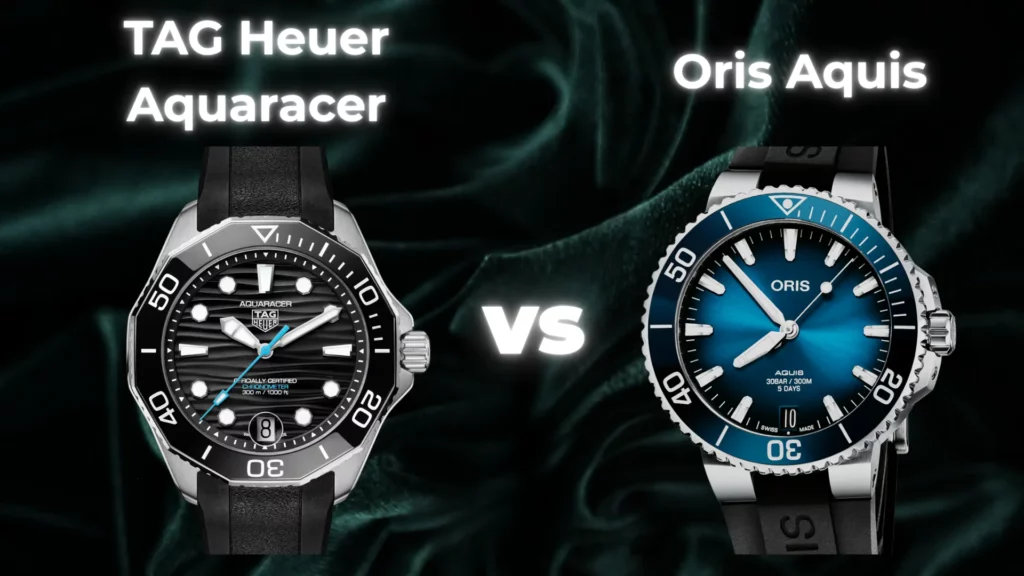
Both watches cost nearly the same and share a 300m water resistance rating, ceramic bezels, and automatic Swiss movements. But the TAG Heuer Aquaracer vs Oris Aquis debate keeps coming up because they feel like completely different watches once you own one.
Most comparisons stop at the spec sheet. The real differences show up in daily use. Things like strap options, glare from the crystal, and how the power reserve affects your weekly routine all matter more than the numbers on paper.
This article covers where they actually split, which differences matter for long-term ownership, and which specific references to look at. Start with the five key differences below. That is where your decision happens.
TAG Heuer Aquaracer Overview

The Aquaracer evolved from the Heuer 2000 Series, a dive watch line from the 1980s. TAG Heuer launched the Aquaracer name around 2004-2005 as a direct replacement for the 2000 Series branding. As part of LVMH, TAG Heuer carries broader name recognition than most independent Swiss watch brands at this price.
The most distinctive design feature is the 12-sided (dodecagonal) ceramic bezel and octagonal hour markers. This geometric style originated with the 2000 Series and has stayed with the line ever since. Few divers in the sub-$4,000 range share the same angular look.
The 2024 update brought a significant movement upgrade. TAG replaced the old Calibre 5 (38-hour power reserve) with the Calibre TH31-00, developed with AMT, a division of Sellita. It is COSC-certified, runs for 80 hours, and comes with a 5-year warranty. The case also dropped from 43mm to 42mm, which makes it easier to wear on smaller wrists.
TAG Heuer Aquaracer Notable References:
- WBP5110
- WAY2015
- WBP201D
Oris Aquis Overview

Oris launched the Aquis around 2011-2012 as a sport diver built for everyday use. Oris was founded in 1904 in Hölstein, Switzerland, and has no parent company or holding group behind it. That makes it one of the few fully independent Swiss watch brands you can buy at this price.
The Aquis is Oris’s best-selling line by a significant margin. The most distinctive design feature is how the bracelet connects to the case. The lugs are short and sculpted, and the bracelet flows into the case through proprietary end links, giving the watch a compact look on the wrist.
On most references, the ceramic bezel insert uses a toothed cogwheel edge that closely matches the dial color. The biggest upgrade came in 2020 with the Calibre 400, Oris’s first modern in-house automatic movement.
It runs for 120 hours (5 days), resists magnetic fields up to 2,250 gauss, and includes a 10-year service interval plus a 10-year warranty through MyOris registration.
Oris Aquis Notable References:
- 01 400 7769 4135
- 01 400 7763 4135
- 01 733 7730 4157
TAG Heuer Aquaracer vs Oris Aquis: Most Notable Differences

Here are five differences that actually matter when you own either watch. Most online comparisons focus on specs that look different on paper but feel the same on the wrist.
1. Power Reserve
The Oris Calibre 400 lasts 120 hours (5 days). The TAG Aquaracer TH31-00 lasts 80 hours.
The TAG’s 80 hours is a big jump from the old Calibre 5’s 38 hours. Take it off Friday night, put it back on Monday morning, and it is still running. It is COSC-certified at -4/+6 seconds per day and comes with a 5-year warranty.
The Oris goes further. At 120 hours, you can skip wearing it all week and pick it back up without resetting the time. The 10-year service interval and 10-year warranty through MyOris are the real long-term cost advantages.
2. Crystal Type
The TAG has a flat sapphire crystal with AR coating on both sides. The Oris has a domed sapphire with AR coating on the inside only.
The TAG’s flat, dual-coated crystal cuts glare across most angles. In sunlight or bright indoor light, the dial stays easy to read. The downside is that the outer coating can pick up fine scratches over time.
The Oris dome makes the dial look deeper, closer to how watches looked before flat crystals became standard.. The inner-only coating is more protected since it sits inside the case. The trade-off is more glare at certain angles compared to the TAG.
3. Bezel Shape
Both bezels are ceramic, unidirectional, 60-minute scale, and 120-click. The function is the same, the look is not.
The TAG has a 12-sided bezel that matches the angular hour markers on the dial. It gives the whole watch a bold, geometric look and makes it read slightly larger than 42mm.
The Oris has a round bezel with a toothed edge. On most current models, the ceramic insert closely matches the dial color. The bezel and dial blend together, so there is no hard visual line between them.
4. Strap and Bracelet System
This is the most practical difference between the two watches.
The TAG uses standard 21mm lugs. Any strap fits: NATOs, leather, rubber, or mesh. The clasp has dual push-buttons and a diver extension. The build is functional but not as refined as the Oris.
The Oris uses a proprietary lug system. Outside straps do not fit. You are limited to the Oris steel bracelet or rubber strap. Current models have a quick-release for easy swapping. The Oris bracelet has noticeably better finishing and feels more solid than the TAG clasp.
5. Case Thickness
Both watches are similar in size but feel different on the wrist.
The TAG 2024 is 42mm wide, around 48mm lug to lug, and about 12.2-12.5mm thick. The flat crystal keeps it sitting low on your wrist. It fits under a dress shirt more easily than most 300m divers at this price.
The Oris 41.5mm is 41.5mm wide, 47-48mm lug to lug, and about 12.5-13mm thick. The domed crystal adds some height. The bracelet drapes naturally, so it usually feels smaller than the numbers suggest. The 43.5mm version is noticeably heavier and works best on wrists over 7 inches.
Price and Resale Value
Prices vary widely depending on the generation, reference, and condition. Older references with the Calibre 5 movement trade significantly below retail on both brands. Current generation models hold closer to retail but still depreciate after purchase. Box and papers, dial color, and bracelet vs rubber strap all affect the final price.
The Ref. WAY2015 retails at around $2,400 and trades at $1,243 used (source). The Ref. WBP201D retails at $3,700 and trades at around $1,952 used (source). Both run the older Calibre 5. Neither holds value well on the secondary market.
The Ref. 01 400 7769 4135 retails at around $3,400 and trades at $1,713 used (source). The Ref. 01 400 7763 4135 retails at $3,700 and trades at $1,495 used (source). Calibre 400 models hold better than Sellita-based references but still trade well below retail.
The Aquis takes longer to sell than the TAG because thebuyer pool is smaller. But buyers who seek it out know the watch and tend to pay fair prices for it.
Notable TAG Heuer Aquaracer References

The Aquaracer line covers several configurations across different generations. Here are the three references most worth your attention right now.
1. TAG Heuer Aquaracer Ref. WBP5110
This is the strongest case for the current Aquaracer. The 2024 update brought the case down to 42mm and swapped in the Calibre TH31-00 with COSC certification. The dial uses a wavy sunray pattern, available in black, blue, or green. At 12mm thick, it sits low enough to wear under a dress shirt.
- Case: 42mm, stainless steel
- Movement: Calibre TH31-00, COSC, 80hr power reserve, 5-year warranty
- Water resistance: 300m
- Crystal: Flat sapphire, dual-sided AR coating
- Market price: ~$2,687
2. TAG Heuer Aquaracer Ref. WAY2015
This is a discontinued Aquaracer from the 2021 generation. It runs the older Calibre 5 in a 43mm case with a green sunray brushed dial and a horizontal stripe pattern. A good option if you want the Aquaracer look with a green dial at a lower price point than current generation references.
- Case: 43mm, stainless steel
- Movement: Calibre 5, Sellita SW200-1 base, 38hr power reserve
- Water resistance: 300m
- Crystal: Flat sapphire, AR coating
- Market price: ~$1,243
3. TAG Heuer Aquaracer Ref. WBP201D
This one is built around its look, not its movement. The case is sandblasted steel with black DLC coating and a matching black ceramic bezel. The white dial is fully coated in Super-LumiNova, so the entire dial glows in the dark rather than just the markers. Buy it for the blacked-out design and lume output, not the movement specs.
- Case: 43mm, sandblasted stainless steel with black DLC coating
- Movement: Calibre 5, Sellita SW200-1 base, 38hr power reserve
- Water resistance: 300m
- Crystal: Flat sapphire, AR coating
- Market price: ~$1,952
Notable Oris Aquis References

The Aquis line splits into two tiers: Sellita-based models and Calibre 400 models. Here are the three references worth your attention right now.
1. Oris Aquis Ref. 01 400 7769 4135
This is the best daily-wear Aquis for most wrists. The short lugs and integrated bracelet make it wear closer to 40mm despite the case size. The dial comes in blue, green, or anthracite with a gradient finish that darkens toward the edge.
The Calibre 400 is the main reason to pick this over a Sellita-based Aquis. The 5-day reserve, 10-year service interval, and 10-year warranty lower your total ownership cost over time.
- Case: 41.5mm, stainless steel
- Movement: Calibre 400, 120hr power reserve, 10-year service interval
- Water resistance: 300m
- Crystal: Double-domed sapphire, internal AR
- Market price: ~$1,713
2. Oris Aquis Ref. 01 400 7763 4135
Best for buyers with wrists over 7 inches who want the full look of the Aquis design. This is the original 43.5mm host for the Calibre 400. At roughly 50mm lug to lug and 13.5mm thick, it wears bigger and more substantial than the 41.5mm. Movement specs are identical to the smaller reference.
- Case: 43.5mm, stainless steel
- Movement: Calibre 400, 120hr power reserve, 10-year service interval
- Water resistance: 300m
- Crystal: Double-domed sapphire, internal AR
- Market price: ~$1,495
3. Oris Aquis Ref. 01 733 7730 4157
This is the entry point into the Aquis line. Build quality and bracelet system are the same as the Calibre 400 models. What you give up is the 5-day reserve, 10-year service interval, and extended warranty. A solid choice if you want the Aquis look without the Calibre 400 price.
- Case: 43.5mm, stainless steel
- Movement: Calibre 733 (Sellita SW200-1), ~41hr power reserve
- Water resistance: 300m
- Crystal: Double-domed sapphire, internal AR
- Market price: ~$1,061
Which Dive Watch Should You Choose?
Both watches cover the same functional ground at the same price point. The difference comes down to how you actually wear and think about a watch day to day.
Choose the TAG Heuer Aquaracer if:
- You want full strap flexibility (NATOs, leather, rubber, mesh, or aftermarket options)
- You prefer the slimmest 300m diver at this price, especially under a dress shirt
- You like the angular, geometric design
- You want a watch with broad name recognition outside the watch community
- You plan to buy pre-owned and want a large, liquid secondary market
Choose the Oris Aquis Calibre 400 if:
- You want to lower long-term ownership costs with the 10-year service interval and 10-year warranty
- You prefer a 5-day power reserve over 80 hours
- You prefer a clean look where the bezel and dial blend together
- You value bracelet build quality (machined clasp and solid links) over strap variety
- You are comfortable owning a less mainstream watch with stronger specs per dollar
Final Thoughts on TAG Heuer Aquaracer vs Oris Aquis
The TAG wins on strap flexibility, slim profile, and brand recognition. The Oris Calibre 400 wins on power reserve, long-term service costs, and bracelet quality.
If you are buying pre-owned, inspect the bezel insert for chips on the TAG (the angular edges take damage first) and check the Oris bracelet clasp for stretch. Both are wear points sellers often miss in listing photos. Your final call should come down to how you actually wear a watch and what you want to own for the next 10 years.
One thing most buyers miss: the Aquaracer’s 21mm lug width is easy to find straps for, but the stepped lug design can limit which aftermarket straps sit flush. Check strap reviews before ordering.