If you’re shopping for a TAG Heuer and stuck between these two, the TAG Heuer Aquaracer vs Formula 1 comparison comes up constantly because both watches sit in the same price range, carry the same brand name, and look similar at a glance. But they are built for completely different purposes.
The Aquaracer is a professional dive watch with 300-meter water resistance and a functional rotating ceramic bezel. The Formula 1 is a motorsport-inspired daily watch built for style and everyday wear, not water.
This guide breaks down the TAG Heuer Aquaracer and Formula 1 so you can clearly see which one fits your budget, lifestyle, and daily use.
TAG Heuer Aquaracer Background
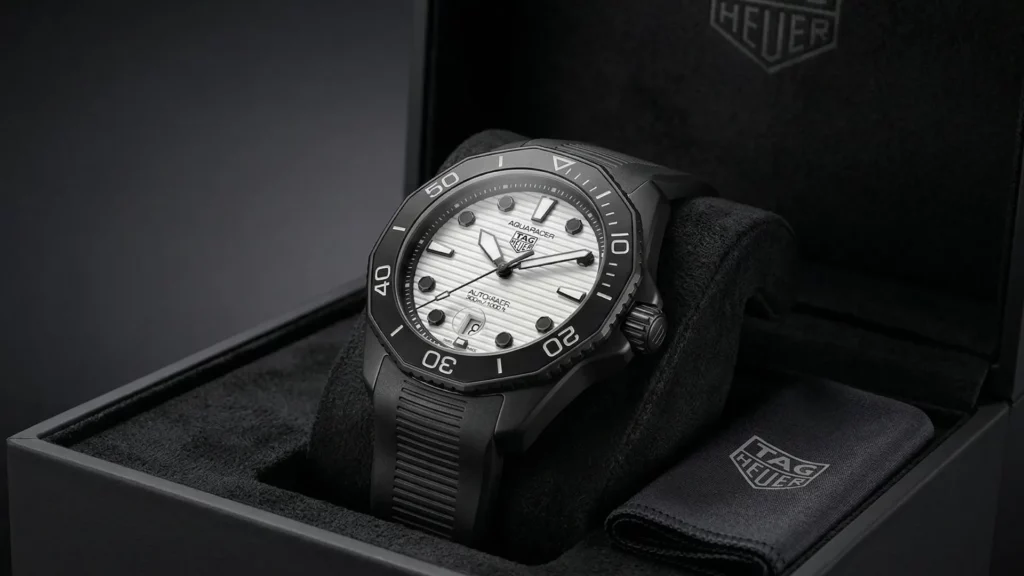
Image courtesy of TAG Heuer Official Website (source)
The Aquaracer traces back to Heuer’s dive watches from 1978, starting with the Ref. 844. The 1000 Series followed, and then the 2000 Series in 1982, which became the direct foundation of the Aquaracer line. The Aquaracer name became official in 2004 when TAG Heuer renamed the 2000 Series, dropping the number entirely by 2005.
The 12-faceted ceramic bezel is the most consistent design trait across modern Aquaracer references. Some current models also feature an underside-mounted cyclops magnifier and dual-color Super-LumiNova, though these vary by reference. The clean dial layout on references like the WBP201B also makes it easy to wear beyond water activities.
The 2024 update added the COSC-certified TH31-00 movement with an 80-hour power reserve. It is the biggest mechanical upgrade the collection had seen in years. Previous Calibre 5 models topped out at 38 hours.
Notable References of the TAG Heuer Aquaracer:
- WBP201D
- WAY201F
- WBP201B
TAG Heuer Formula 1 Background
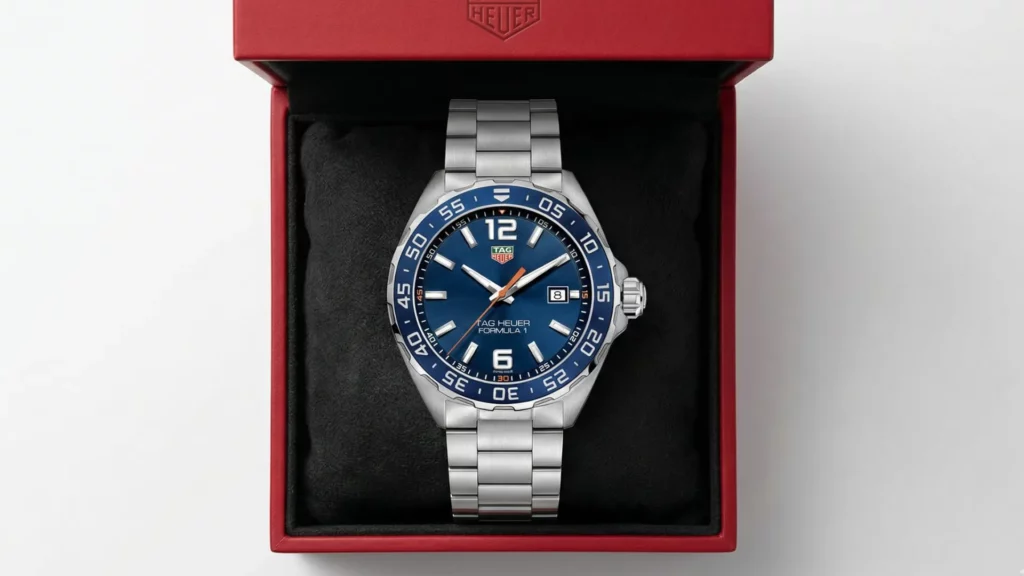
Image courtesy of TAG Heuer Official Website (source)
Formula 1 launched in 1986, shortly after Techniques d’Avant Garde acquired Heuer in 1985. The brand needed an affordable watch with a motorsport personality. The first models had colorful fiberglass cases, which were replaced by stainless steel in the late 1990s.
Formula 1 was never designed as a dive watch. It was made for everyday wear tied to racing culture, and over the years it expanded into automatic and chronograph variants.
In 2025, TAG Heuer strengthened its partnership with Formula 1 as a major sponsor. The Kith collaboration dropped in 2024, and Solargraph models were introduced to the Formula 1 line in 2025.
Notable References of the TAG Heuer Formula 1:
- WAZ1010
- CAZ1010
- WAH1013
TAG Heuer Aquaracer vs Formula 1: Most Notable Differences
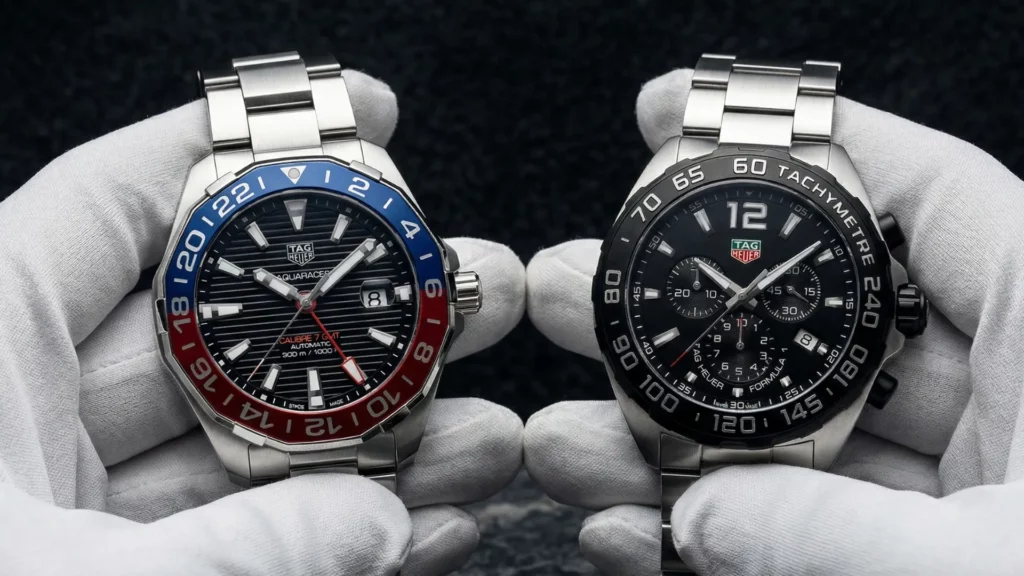
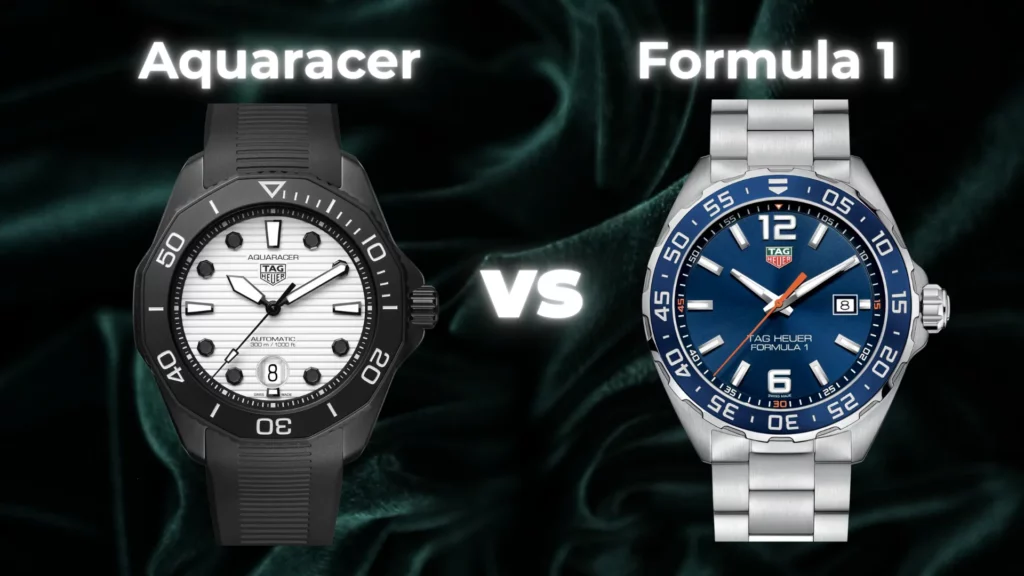
TAG Heuer Aquaracer (left) vs TAG Heuer Formula 1 (right)
Image courtesy of TAG Heuer Official Website
Aquaracer: [source]
Formula 1: [source]
The Aquaracer and Formula 1 share a case shape and a brand name. The specs are where they split. Here are the six areas where they differ most.
1. Bezel Type
The Aquaracer uses a unidirectional rotating dive bezel with a ceramic insert and 60 clicks per full rotation. The 12-faceted shape helps you grip it with wet hands. Ceramic resists scratches and holds its color permanently. This bezel tracks dive time.
The Formula 1 bezel is fixed on most references, with tachymeter markings for speed calculations. It does not rotate. On references that do have a rotating bezel, the insert is typically titanium carbide coated steel, not ceramic. On the Formula 1, the bezel is a design feature, not a tool.
2. Water Resistance
The Aquaracer Professional 300 lineup is rated to 300 meters across its core references. All use screw-down crowns and casebacks to maintain that rating over time. The Professional 200 sub-line sits at 200 meters.
The Formula 1 is rated to 200 meters across current references. It can handle swimming and casual water exposure. It was not designed or rated for diving.
3. Movement and Power Reserve
The 2024 Aquaracer Professional 300 runs the COSC-certified TH31-00 with an 80-hour power reserve. Older Aquaracer references use the Calibre 5 at 38 hours, not COSC-certified. The GMT variant runs the Calibre 7 with a 50-hour power reserve and a built-in GMT hand.
Formula 1 runs quartz across most of its lineup. Three-hand references use battery-powered quartz calibers. The chronograph version uses a Ronda-based quartz movement from the 5040 family, accurate to 1/10th of a second. No winding required and no power reserve to track.
4. Bracelet and Clasp
The 2021+ Aquaracer H-link bracelet has a double-pusher folding clasp and 15mm of micro-adjustment across five positions. The taper from case to clasp is clean and holds up well to daily use.
Formula 1 uses a simpler three-link bracelet with less refined finishing and clasp. This is the most consistent complaint across owner forums and used-market listings. Rubber strap variants are available on select references and are more comfortable over long sessions.
5. Case Size and Thickness
The current Aquaracer Professional 300 is 42mm wide, 48mm lug-to-lug, and 12mm thick. The compact lugs and tapered bracelet make it wear closer to a 40mm in practice. Previous generation models ran 43mm with a slightly longer lug-to-lug at the same thickness.
The Formula 1 three-hand references run 43mm at 11.5 to 11.65mm thick. The chronograph sits at the same diameter but varies slightly by variant. Formula 1 references generally wear slimmer on the wrist than the Aquaracer because the case profile is thinner, even at similar diameters.
6. Case Material
The Aquaracer core lineup is brushed and polished stainless steel, straightforward to service and polish. Select references add a black DLC (diamond-like carbon) coating over the steel. DLC is hard but cannot be polished out if it chips. Always check the coating condition on any used DLC Aquaracer before buying.
Most Formula 1 references use standard stainless steel throughout. Select references have black titanium carbide coated bezels. Standard steel Formula 1 references can be polished or serviced at any watchmaker.
Price and Market Demand
Both collections sit in a similar retail range, but their secondary market behavior is very different. The Aquaracer is closer to retail. The Formula 1 drops significantly once it leaves the store.
The WBP201B retails at around $3,700 and currently trades at approximately $1,952 used, about 47% below retail (source).
The WAY201F retails for around $3,000 and trades at approximately $1,897 pre-owned, about 37% below retail (source). It is up roughly 3% over the past year, one of the few pre-2021 Aquaracer references that has not lost ground.
Condition matters on both. A full set with box, papers, and original bracelet adds a clear premium. On discontinued references like the WAY201F, condition at the lugs and bracelet is the first thing sellers use to justify a lower ask.
The WAZ1010 retails for around $3,300 but trades at approximately $1,666 used, nearly 50% below retail (source). The market price dropped roughly 13% over the past year. The upside: it sells fast, with a median sell time of 13 days, making it one of the most liquid references in the Formula 1 lineup.
The CAZ1010 is a sharper drop. Retail sits around $1,600, but the current market price is approximately $720 used, about 55% below retail (source). It fell roughly 17.5% in price over the past year. Despite that, it still ranks in the top 1% of Formula 1 references by transaction volume.
These figures shift based on condition, dial variant, and market timing. For both collections, full set and near-mint condition separate a strong deal from an average one.
Notable TAG Heuer Aquaracer References
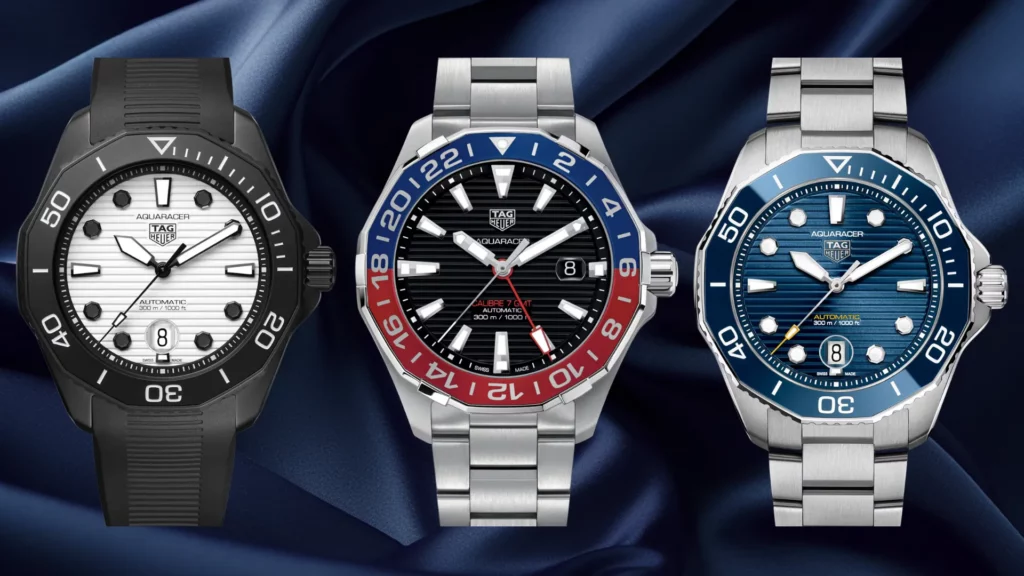
Image courtesy of TAG Heuer Official Website
WBP201D: [source]
WAY201F: [source]
WBP201B: [source]
A few Aquaracer references carry most of the buying interest. Here are the three that come up most often in buyer conversations and on the secondary market.
1. TAG Heuer Aquaracer Ref. WBP201D
The Night Diver has a DLC-coated steel case, a black ceramic bezel, and a white luminescent dial. The white dial against the all-black case is the most distinctive look in the current Aquaracer lineup, inspired by TAG Heuer’s glowing dials from the 1980s.
The movement is not COSC-certified and the power reserve is short by current standards. On used examples, always check the DLC coating at the lugs and crown. Chips are common and sellers use them to push the price down.
- Case: 43mm, stainless steel with black DLC coating
- Dial: White opaline, black lacquer details, Super-LumiNova
- Movement: Calibre 5 automatic (Sellita SW200-1 / ETA 2824-2), 38-hour power reserve
- Bezel: Unidirectional rotating, black DLC with black ceramic insert
- Water resistance: 300m
- Strap/Bracelet: Black rubber with DLC buckle
- Market price: ~$1,952 (retail ~$3,700)
2. TAG Heuer Aquaracer Ref. WAY201F
The Aquaracer GMT is discontinued but still widely traded. The blue and red “Pepsi” bezel is bidirectional aluminum with a 24-hour scale for a second time zone. The black dial has a red GMT hand for easy reading.
This reference is up roughly 3% over the past year, one of the few pre-2021 Aquaracers holding value. The Pepsi colorway trades higher than black/black variants.
- Case: 43mm, 12.80mm thick, stainless steel
- Dial: Black opaline, luminous baton markers, red GMT hand, date at 3 o’clock
- Movement: Calibre 7 automatic (ETA 2893-2), ~50-hour power reserve
- Bezel: Bidirectional rotating, blue and red aluminum, 24-hour scale
- Water resistance: 300m
- Strap/Bracelet: Stainless steel, folding clasp with diver’s extension
- Market price: ~$1,897 (retail ~$3,000)
3. TAG Heuer Aquaracer Ref. WBP201B
The 2021 Aquaracer Professional 300 brought a blue sunray dial, a 12-faceted blue ceramic bezel, and octagonal hour markers. The updated bracelet added a double-pusher clasp and micro-adjustment range, something previous Aquaracer bracelets did not have.
The power reserve is short by today’s standards, but the movement is solid and reliable for daily use. Full-set examples with the original bracelet sit at the upper end of the price range.
- Case: 43mm, 12mm thick, stainless steel
- Dial: Blue sunray brushed, octagonal luminous markers, date at 6 o’clock
- Movement: Calibre 5 automatic (Sellita/ETA base), 38-hour power reserve
- Bezel: Unidirectional rotating, 12-facet blue ceramic insert
- Water resistance: 300m
- Strap/Bracelet: H-link stainless steel, micro-adjust folding clasp
- Market price: ~$1,952 (retail ~$3,700)
Notable TAG Heuer Formula 1 References
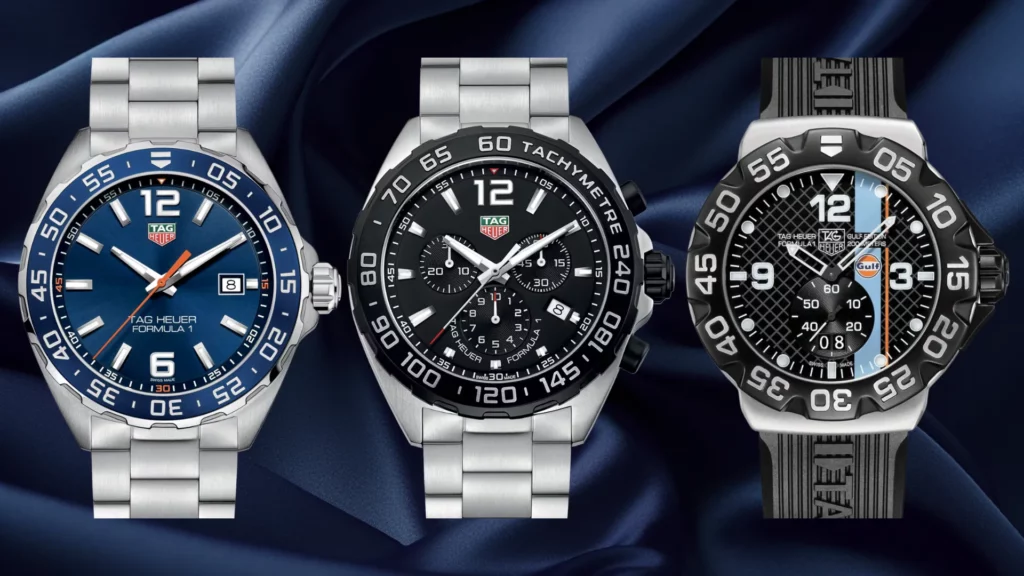
WAZ1010: Image courtesy of TAG Heuer Official Website (source)
CAZ1010: Image courtesy of TAG Heuer Official Website (source)
WAH1013: Image courtesy of Everywatch (source)
The Formula 1 catalog covers a lot of ground, but three references come up most in buyer conversations. Here are the ones worth knowing before you shop.
1. TAG Heuer Formula 1 Ref. WAZ1010
The Formula 1 Quartz Date has a blue sunray dial with oversized “6” and “12” markers, orange accents, and a date at 3 o’clock. The fixed blue aluminum bezel carries a tachymeter scale.
The three-link bracelet is the most common complaint from long-term owners. Despite the soft pricing, it sells fast. The median sell time is 13 days, one of the quickest in the Formula 1 lineup.
- Case: 43mm, 11.65mm thick, stainless steel
- Dial: Blue sunray, orange accents, date at 3 o’clock
- Movement: Quartz (Ronda 6003D)
- Bezel: Fixed, blue aluminum, tachymeter scale
- Water resistance: 200m
- Strap/Bracelet: Three-link stainless steel, folding clasp
- Market price: ~$1,666 (retail ~$3,300), down ~13% over the past year
2. TAG Heuer Formula 1 Ref. CAZ1010
The Formula 1 Chronograph has an all-black dial with three sub-dials and a red-tipped central seconds hand that makes timing easy to read. The fixed tachymeter bezel has a black titanium carbide coating.
Two variants are available: a steel bracelet version and a black rubber strap version. The rubber strap version is more comfortable for long daily wear.
- Case: 43mm, 11.5mm thick, stainless steel; black titanium carbide coated bezel
- Dial: Black, three sub-dials, red-tipped seconds hand, date at 4 o’clock
- Movement: Ronda 5040-series quartz chronograph (TAG Heuer branded), 1/10th second
- Bezel: Fixed, tachymeter scale, black titanium carbide coated
- Water resistance: 200m
- Strap/Bracelet: Steel bracelet or black rubber strap
- Market price: ~$720 (retail ~$1,600), down ~17.5% over the past year
3. TAG Heuer Formula 1 Ref. WAH1013
The Formula 1 Gulf Edition is a discontinued piece from around 2011. The sky blue and orange Gulf Oil stripes make it one of the most recognizable Formula 1 references ever made.
Full-set pieces in very good condition are scarce and sell quickly. A clean full-set example around $850 to $900 is a fair price.
- Case: 44mm, 12.5mm thick, stainless steel with black titanium carbide coated bezel
- Dial: Black with sky-blue and orange Gulf stripes, Grande Date double window at 6, small seconds sub-dial
- Movement: Quartz
- Bezel: Unidirectional rotating, black titanium carbide coated
- Water resistance: 200m
- Strap/Bracelet: Steel bracelet or black rubber strap; discontinued
- Market price: ~$838 (retail ~$1,200)
Which TAG Heuer Should You Choose?
Both collections are well-built and priced similarly at retail, but they solve different problems. If you dive or swim regularly, the Aquaracer is the practical choice. If you follow racing and want a lower entry price, Formula 1 is the better fit.
Choose the TAG Heuer Aquaracer If:
- You want a proper dive watch with 300m water resistance and a rotating ceramic bezel
- You want a COSC-certified automatic with an 80-hour power reserve
- You want a bracelet with micro-adjustment and a double-pusher clasp
- You want one watch for casual, outdoor, and business casual wear
- You want a tool watch with more stable resale value
Choose the TAG Heuer Formula 1 If:
- You follow Formula 1 and want a watch connected to the sport
- You want an affordable TAG Heuer entry at around $1,666 used
- You prefer quartz with no winding and no power reserve to manage
- You want a chronograph with 1/10th second timing under $800 used
- You want the Gulf Edition as a motorsport collector piece
- You prefer a casual motorsport watch over a dive tool
Final Thoughts on TAG Heuer Aquaracer vs Formula 1
The Aquaracer and the Formula 1 are built for different buyers. The TAG Heuer Aquaracer vs Formula 1 decision comes down to one question: do you need a dive tool or a motorsport daily watch? Aquaracer gives you 300m water resistance, a rotating ceramic bezel, and an automatic movement. Formula 1 gives you quartz precision and a much lower used price.
If you dive, swim, or want a versatile automatic, the Aquaracer is the right call. If you follow the sport and want a low-maintenance daily watch, the Formula 1 makes more sense at its current prices.
Always go for a full set on both. For the Aquaracer, check the ceramic bezel and DLC coating for chips before agreeing on a price. For Formula 1, inspect the bracelet clasp closely. It is the part that shows wear first and the easiest thing to negotiate on.