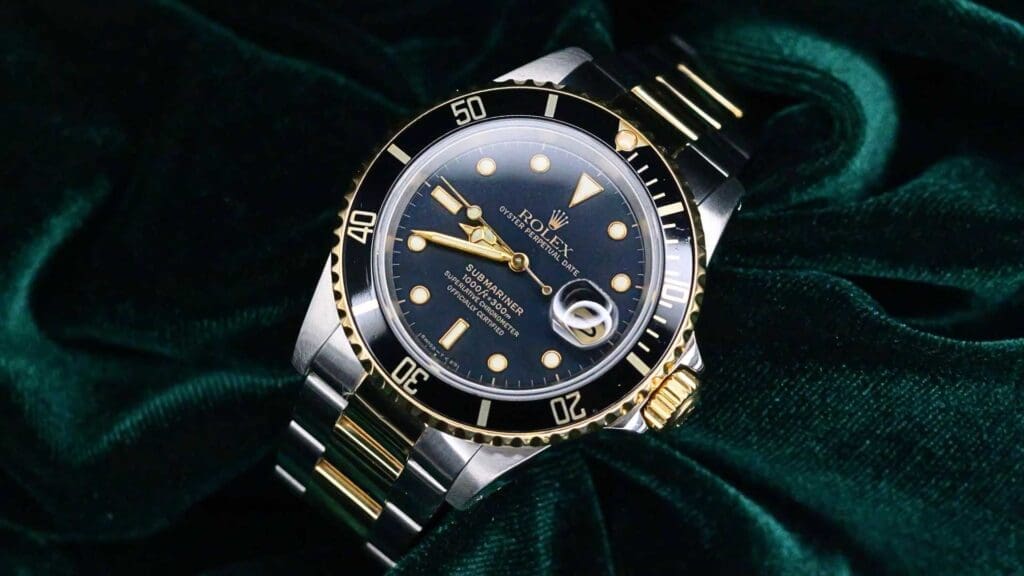
Rolex watches look clean and simple on the wrist, but a lot is happening behind that dial. If you’ve ever handled a Submariner or Datejust and thought, “Why does this feel so solid?”, it comes down to how Rolex makes its parts with consistency. Rolex controls everything and doesn’t rely on third parties to produce the same premium release.
That’s also why the little details feel perfect. The bezel has crisp clicks, the crown turns smoothly, and the dial markers line up immaculately. Rolex builds and assembles in Switzerland with precise machines and trained watchmakers. It’s a mix of modern automation and human finishing, where machines handle precision and watchmakers handle the final feel.
In this guide, we’ll walk you through the Rolex manufacturing process, from raw materials to a finished watch. Use this information to better understand what you own and to spot claims online that don’t match how Rolex really works.
Rolex Brand History and Evolution
Rolex began offering watches in 1905, founded by Hans Wilsdorf with a focus on accuracy and everyday reliability. The brand’s goal was to make wristwatches that could handle real life, not just sit in a pocket. Early innovations like the Oyster case improved water resistance, while the Perpetual self-winding system made daily wear more practical and dependable.
Rolex then expanded into purpose-built tool watches. The Submariner became the standard for diving, the GMT-Master II made tracking time zones easy for travelers and pilots, and the Daytona became the brand’s signature chronograph. Each of these lines pushed Rolex to tighten its process so every new batch would feel and perform the same.
Over time, Rolex moved deeper into in-house manufacturing to keep results consistent. Today, the brand combines automated precision with trained watchmakers who handle assembly, adjustment, and inspection. That evolution is why modern Rolex watches tend to feel uniform in build quality, even across different collections and materials.

Stages in the Rolex Manufacturing Process
Rolex builds each watch through a strict sequence, beginning with raw materials and ending with final checks on the finished piece. Each step focuses on accuracy, durability, and consistency.
Below are the main steps Rolex follows to turn metal, sapphire, and finely made movement parts into a watch that meets its own performance standards.
Stage 1: Turning Raw Metals Into Alloys
Rolex starts by turning raw metals into alloys that meet its strength and corrosion standards. It uses Oystersteel for many steel models like the Oyster Perpetual and Submariner, while Rolesor combines steel and gold in the same case and bracelet. By controlling this step in-house, Rolex keeps the look and durability of each model consistent from one production run to the next.
For precious metal watches, Rolex also creates its own gold alloys, including yellow gold and Everose gold. This control helps keep color and hardness consistent, which affects how accurately parts are shaped and how well cases and bracelets hold up after years of wear and polishing.
Stage 2: Shaping the Cases and Bezels
Rolex turns solid alloy into metal bars, then cuts them into smaller blanks for specific parts. At this phase, the pieces still look rough and unfinished. Rolex then uses computer-controlled machines to shape each part with extreme precision.
For the case, these machines carve out space for the movement, form the lugs and crown guards, and drill exact openings for the crown and bracelet. For the bezel, the machines cut the round shape and add details like teeth or inner grooves, depending on the model. This step sets the foundation for how the watch fits together, wears on the wrist, and functions over time.
Rolex makes each case component as a separate part rather than a single piece. This includes the case middle, bezel, case back, and crown. Building them separately gives Rolex better control over strength and fit, helps maintain long-term water resistance, and makes future servicing more straightforward.
Different bezel styles also need different machining.
- Smooth bezels require perfectly even shapes.
- Fluted bezels need sharp, clean cuts to reflect light correctly.
- Rotating bezels use precise grooves and teeth so they click and lock the way they should.
- Even on Cerachrom models, Rolex machines the metal bezel ring at this point.
Before any finishing begins, Rolex measures every part with lasers. If a piece falls outside its standards, Rolex removes it from production. By the end of this step, the case and bezel already have the correct Rolex shape and proportions.
Stage 3: Polishing, Finishing, and Surface Perfection
Rolex gives each part its final “Rolex” look by removing fine machining marks and refining every surface, without changing the precise shapes created earlier. It uses a mix of automated polishing machines and careful hand-finishing with polishing wheels and fine abrasives.
Rolex finishes each component separately (e.g., the case middle, bezel ring, and case back) before final assembly. Different surfaces receive different finishes to achieve the familiar balance of shine and contrast seen on a finished watch.
- Mirror polish on areas like case sides and smooth bezels for a deep shine
- Satin brushing on surfaces like lugs/outer areas for clean, straight grain
- Crisp edge definition where brushed and polished surfaces meet (no rounded edges)
Rolex inspects each part under strong lighting and magnification to check reflections, brushing, and edge sharpness. If anything looks uneven or falls outside its standards, Rolex removes the part from production. Only parts that pass these checks move on to assembly and water-resistance testing.
Stage 4: Case Assembly & Water-Resistance Testing
Rolex brings the case parts together in the next step. The case middle, bezel, case back, crown, and sapphire crystal are assembled with tight tolerances. Multiple gaskets/seals are installed at key points (around the crown tube, case back, and crystal) to create the Oyster’s watertight barrier, and the screw-down crown locks the system.
Before anything moves forward, each assembled case goes through water-resistance testing—typically using air-pressure and vacuum tests to detect microscopic leaks (often without immersing the watch). Only cases that pass are approved; failures are disassembled and rejected/reworked.
By the end of this process, the Oyster case is fully sealed, pressure-tested, and ready to protect the movement.
Stage 5: Movement Assembly & Regulation
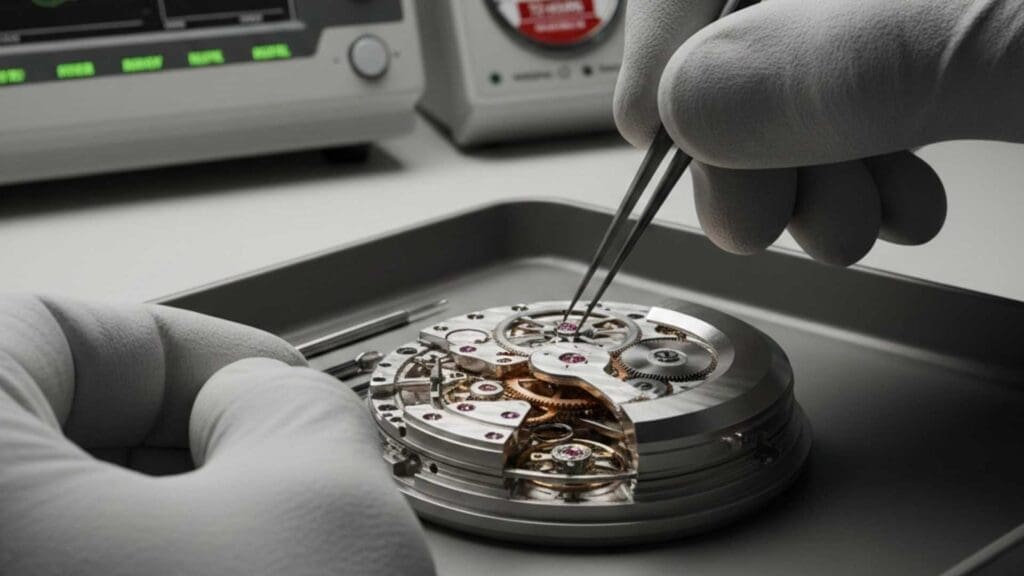
Rolex builds the movement in clean, dust-controlled rooms to protect the tiny components. The movement is assembled from hundreds of parts, including:
- Gear train, escapement, and balance system
- Mainspring and automatic winding system (Perpetual rotor)
- Bridges, plates, and jewels
- Precise lubrication at critical friction points
Once assembled, each movement is regulated and tested for:
- Accuracy in multiple positions
- Power reserve performance
- Automatic winding efficiency and stability
Rolex approves only movements that meet its strict mechanical and timing standards. Watchmakers then install these regulated movements into pressure-tested Oyster cases, followed by the dial and hands.
Stage 6: Final Casing, Dial, Hands, & Bracelet
Rolex turns the finished movement into a complete watch during this phase. Watchmakers place the regulated movement into the pressure-tested Oyster case under clean-room conditions.
Key steps include:
- Installing the dial and aligning it precisely with the movement
- Setting the hands—hour, minute, seconds, and any complications—so they clear each other perfectly
- Closing and sealing the case to protect the movement
- Fitting and sizing the bracelet for proper alignment and comfort
Throughout this process, technicians check hand clearance, dial alignment, crown operation, and the feel of winding and setting. Once complete, the watch is fully assembled and ready for final testing and certification.
Stage 7: Final Testing & Certification Complete
At the final checkpoint, Rolex puts every fully assembled watch through detailed performance testing to make sure it meets its Superlative Chronometer standards.
Rolex tests each watch for:
- Time accuracy across different positions and temperatures
- Power reserve and automatic winding performance
- Water resistance, often checked again after full casing
- Shock resistance and real-world reliability
Only watches that pass every test within Rolex’s strict limits move forward. Rolex then engraves them as Superlative Chronometer Officially Certified and prepares them for packaging and delivery. This last round of testing confirms the watch performs exactly as intended before it ever reaches your wrist.

How Long Does It Take to Make a Rolex Watch?
Rolex typically takes about a year to turn raw materials into a finished, fully tested watch. Each phase goes through repeated checks. When a part fails inspection, Rolex fixes or replaces it instead of moving it forward. This slows production, but it keeps quality consistent.
The build time also depends on the model. An Oyster Perpetual uses a simpler design with fewer parts to assemble and adjust. A Daytona takes longer because its chronograph movement has more components and needs extra testing.
Then there’s the waiting period for buyers. Even after Rolex completes a watch, authorized dealers may not have the exact reference you want available right away.
Here is a table so you can easily understand:
Gold, platinum, and special dials can add time too, because finishing has to be cleaner and mistakes are easier to spot.
Final Takeaways on Rolex Manufacturing Process
You now understand why Rolex watches feel consistent across models like the Oyster Perpetual, Datejust, and Submariner. Rolex controls each major step, checks components carefully, and tests every finished watch for accuracy and water resistance before it leaves the factory. This approach helps a Rolex wear and age in a predictable way, rather than developing uneven or unexpected issues over time.
When you come across a “Rolex factory secret” online, you’ll know what actually matters. The result isn’t one special trick—it comes from careful processes, tight standards, and repeated testing that work together to create a watch that feels solid and reliable on the wrist.