
Speedmaster vs Daytona comes up in almost every chronograph buying conversation because both watches were born on the racetrack. Each built its reputation timing laps when accuracy mattered most. When people picture a mechanical chronograph, these two usually come to mind first.
Choosing between them goes deeper than reading lap times. You are deciding how the watch fits your daily routine, how visible the brand feels on your wrist, and how easy the buying process will be. One offers hands-on experience, while its rival trades on demand and recognition.
This guide focuses on the ownership details buyers care about after the purchase. You will see how each chronograph feels on the wrist, how the controls behave, and how the market treats them once money changes hands. Those small differences shape long-term satisfaction more than most first-time buyers expect.
Omega Speedmaster Overview

Omega launched the Speedmaster in 1957 as part of its first professional tool watch family, built for engineers, scientists, and drivers who needed clear timing. Early models put the tachymeter on the bezel instead of the dial, which freed up space and made the scale easy to read at a glance.
Drivers used it to clock lap times, and that motorsport DNA shaped the layout you still see today. Then came the moment that changed everything. NASA flight-qualified the Speedmaster in 1965 after a brutal test regimen, and astronauts wore it on the Apollo missions.
When Buzz Aldrin stepped onto the lunar surface in 1969, his Speedmaster went with him, because the lunar module’s onboard clock had failed and Armstrong left his inside as a backup. No other watch can claim that.
Spotting a Speedmaster is easy once you know the look. A tri-compax layout with three subdials sits under an external tachymeter bezel, a profile that has barely changed in decades. Modern references still follow that same blueprint, which is part of why the design ages so well.
Rolex Daytona Overview

Rolex introduced the chronograph that became the Cosmograph Daytona in 1963, naming it after Daytona Beach and the land speed records set on that sand. Motorsport timing was having a moment, and Rolex slotted the watch into its professional sports lineup right alongside the Submariner and GMT-Master.
Racers used the tachymeter bezel to calculate average speed over a measured distance, no calculator required, and reading the tachymeter scale yourself takes about a minute to learn. That practical timing job defined the dial layout. Over the years, vintage references like the Paul Newman dials turned the Daytona into auction-house royalty, and demand has never cooled since.
Recognizing a Daytona is just as quick. A tri-compax layout sits under an engraved tachymeter bezel, with the Oyster case and bracelet giving it one solid, unified profile. Screw-down chronograph pushers are the signature tell, a feature that first appeared on the vintage reference 6240 and still defines the modern watch.
Omega Speedmaster vs Daytona: Most Notable Differences

Both watches are racing chronographs, but they handle timing, movement design, and case construction in genuinely different ways. Those choices change how each one feels to use day to day. Below are the four differences most buyers notice first.
1. Chronograph Function
Speedmaster keeps things simple and direct. Press the top pusher to start or stop the timer, then press the bottom pusher to reset. No unscrewing, no extra steps before you time something. Three subdials track running seconds, elapsed minutes, and elapsed hours.
Daytona asks for one more step. Before you use the stopwatch, you unscrew both chronograph pushers, which protects them and improves water sealing. Inside, a column wheel paired with a vertical clutch lets the central seconds hand snap into motion without the little stutter you sometimes get on cheaper chronographs.
New to chronographs? The basics of running one take all of a minute to pick up, and both watches use the same start-stop-reset logic.
2. Movement Type
Power inside the modern Moonwatch comes from the Omega Calibre 3861, a hand-wound, Master Chronometer-certified movement. You wind the crown by hand, a full wind gives roughly 50 hours of reserve, and it shrugs off magnetic fields up to 15,000 gauss. Some buyers love that daily ritual. Others find it a chore.
Daytona runs on the automatic Rolex Calibre 4131, introduced in 2023. A rotor winds it as your wrist moves, the reserve stretches to about 72 hours, and you can leave it on a winder over the weekend and pick it up still ticking. Less interaction, more set-and-forget.
3. Case Design
Speedmaster wears a 42 mm case with a fixed aluminum tachymeter bezel and 50 meters of water resistance, which is fine for rain and hand-washing but not for swimming. It sits a touch flatter and wider on the wrist than its diameter suggests.
Daytona uses a 40 mm Oyster case with an engraved Cerachrom ceramic bezel on current models, a screw-down crown, and screw-down pushers that push water resistance to 100 meters. That Oyster bracelet locks tightly to the case and gives the watch a denser, more compact feel in hand.
Related Models from Majestix
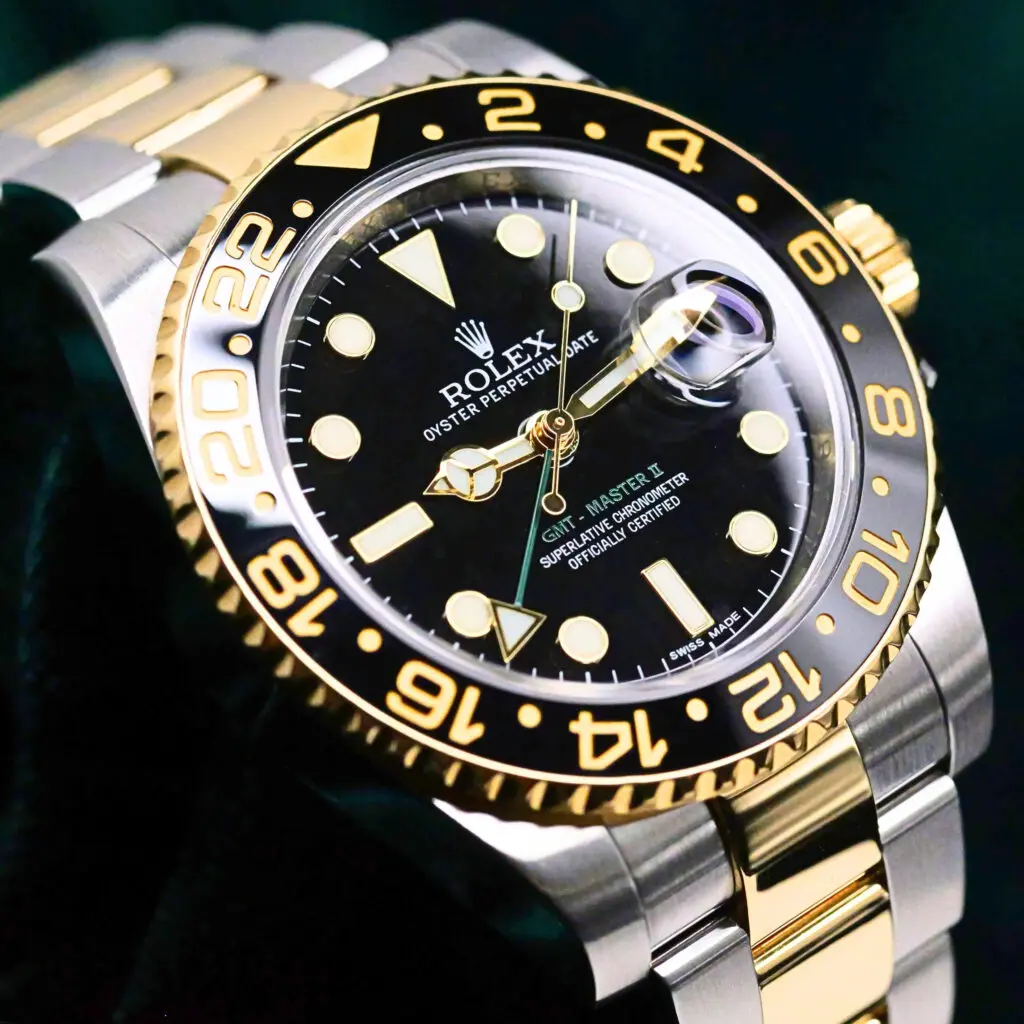
Rolex GMT-Master II “Green Arrow” Black Dial Black Ceramic Bezel Oyster Bracelet Two-Tone 18K Yellow Gold Stainless Steel 40mm MINT CONDITION COMPLETE SET 116713LN
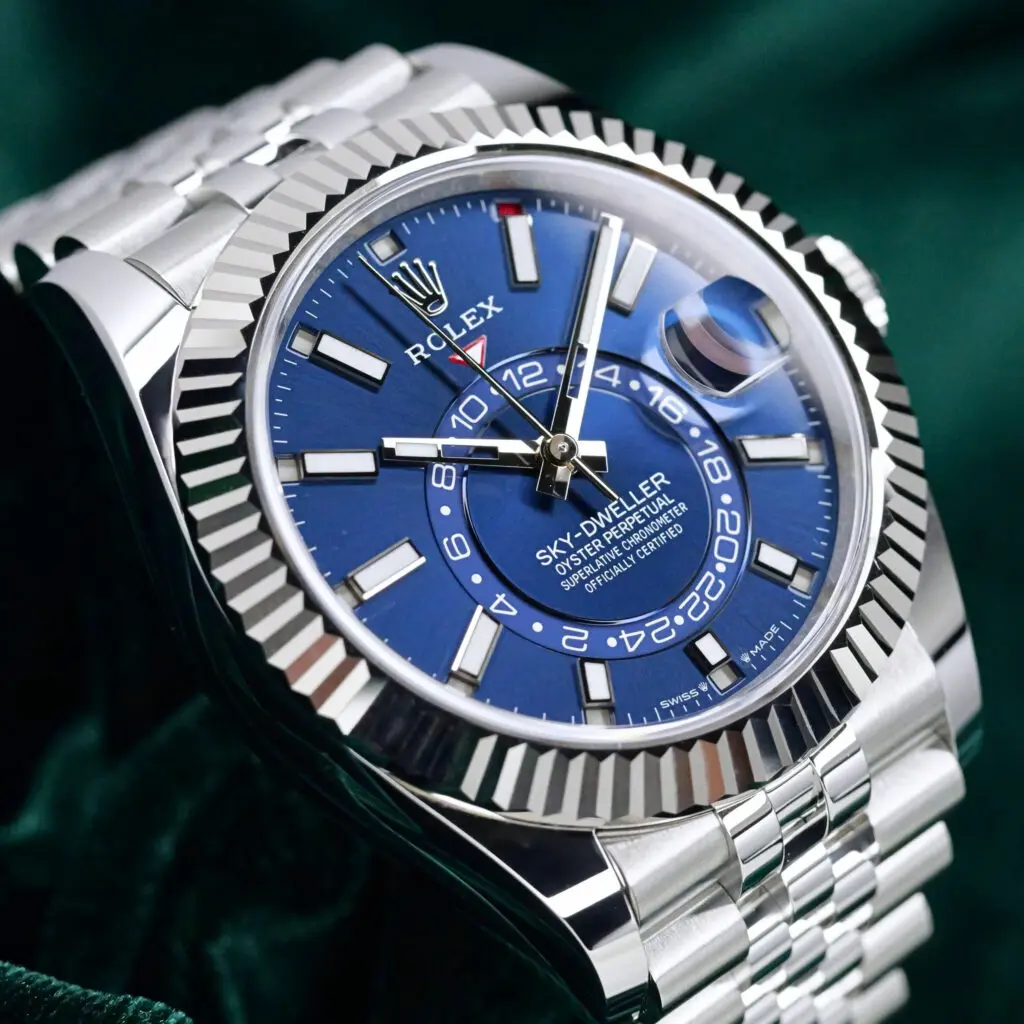
2026 NEW UNWORN Rolex Sky-Dweller Bright Blue Dial 18K White Gold Fluted Bezel Jubilee Bracelet Stainless Steel 42mm COMPLETE SET 336934-0006
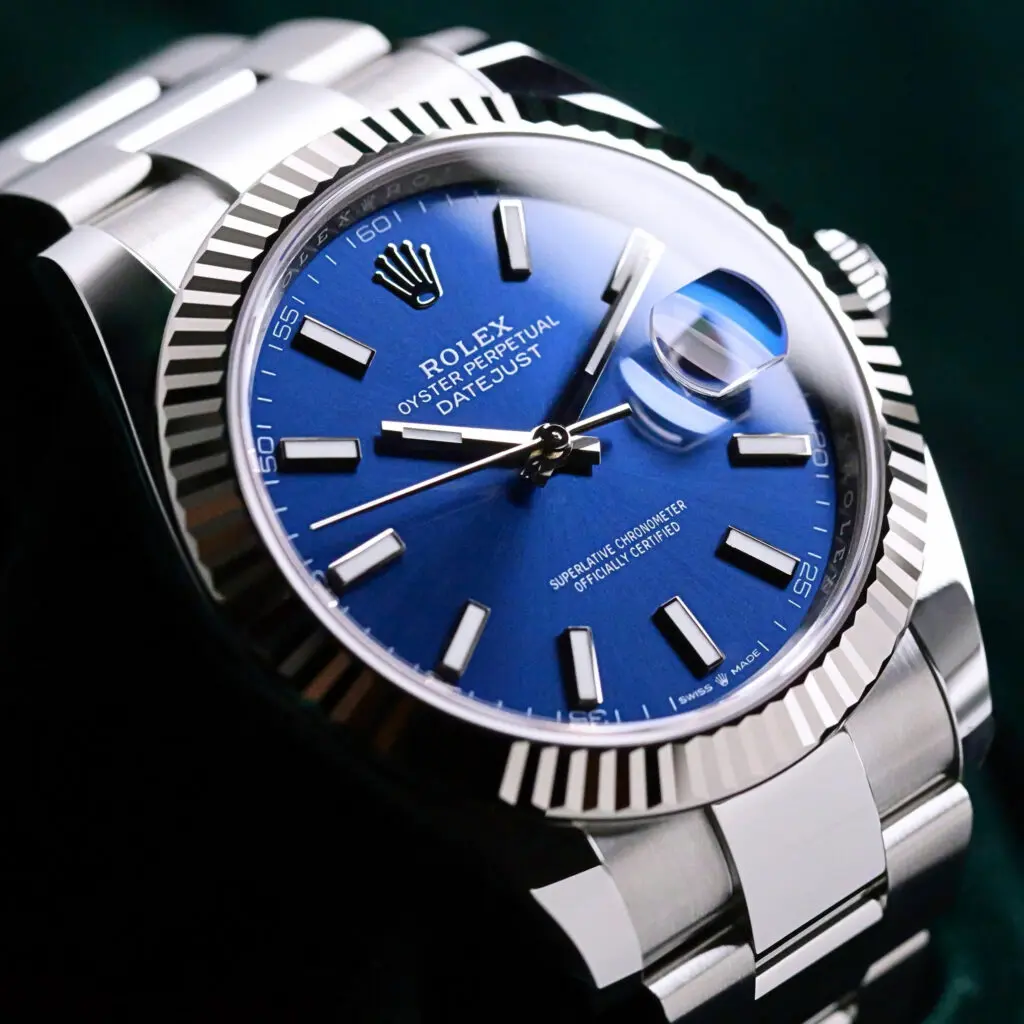
2026 NEW UNWORN Rolex Datejust Blue Dial 18K White Gold Fluted Bezel Oyster Bracelet Stainless Steel 41mm COMPLETE SET 126334
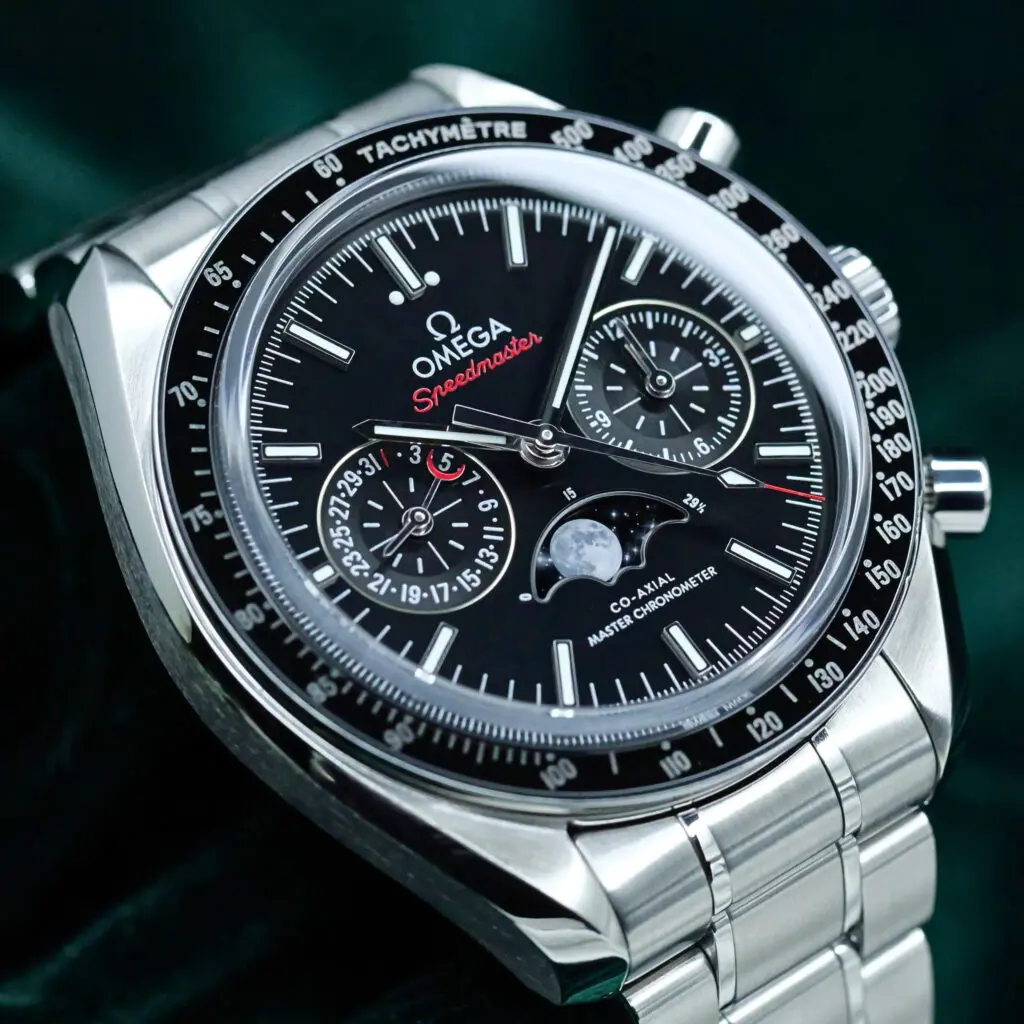
Omega Speedmaster Moonphase Black Dial Stainless Steel 44.25mm MINT CONDITION COMPLETE SET 304.30.44.52.01.001
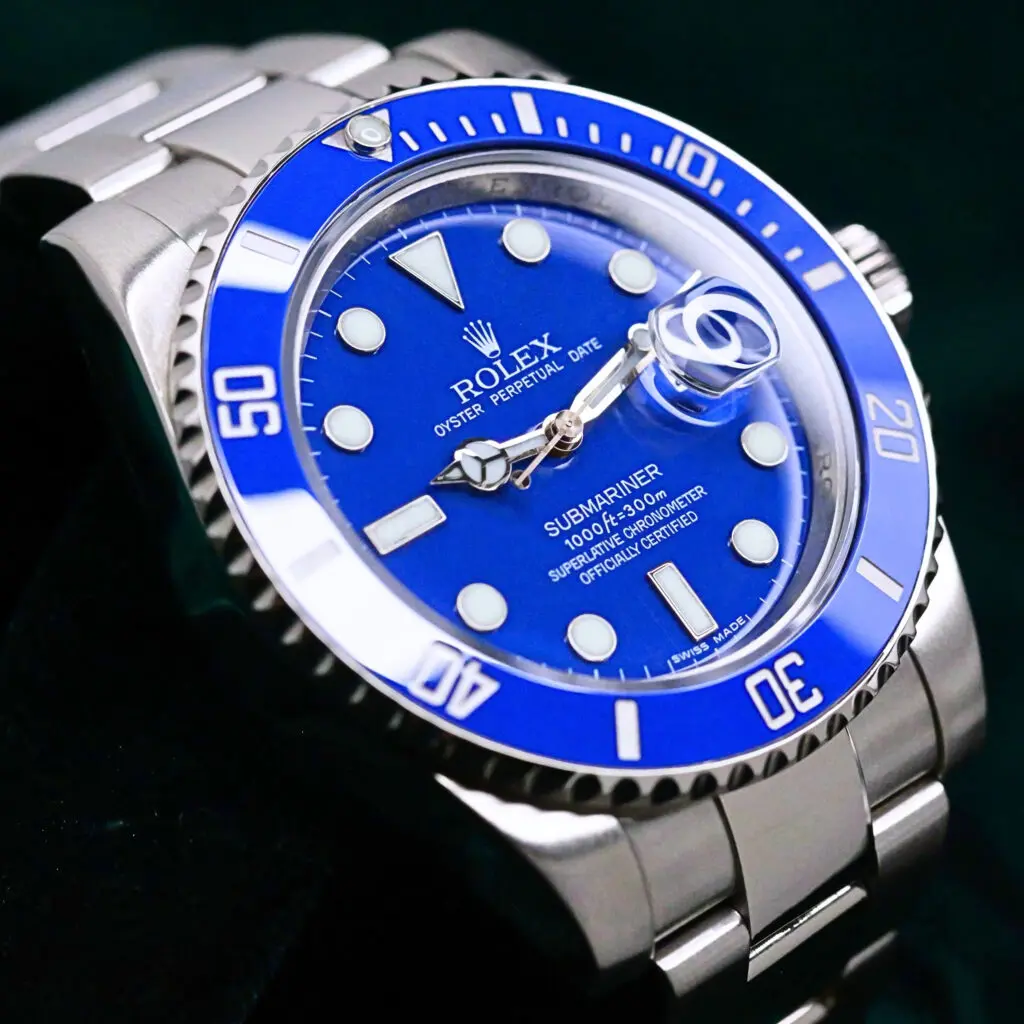
Rolex Submariner Date "Smurf" Blue Dial Blue Bezel Oyster Bracelet 18K White Gold 40mm MINT CONDITION COMPLETE SET 116619LB
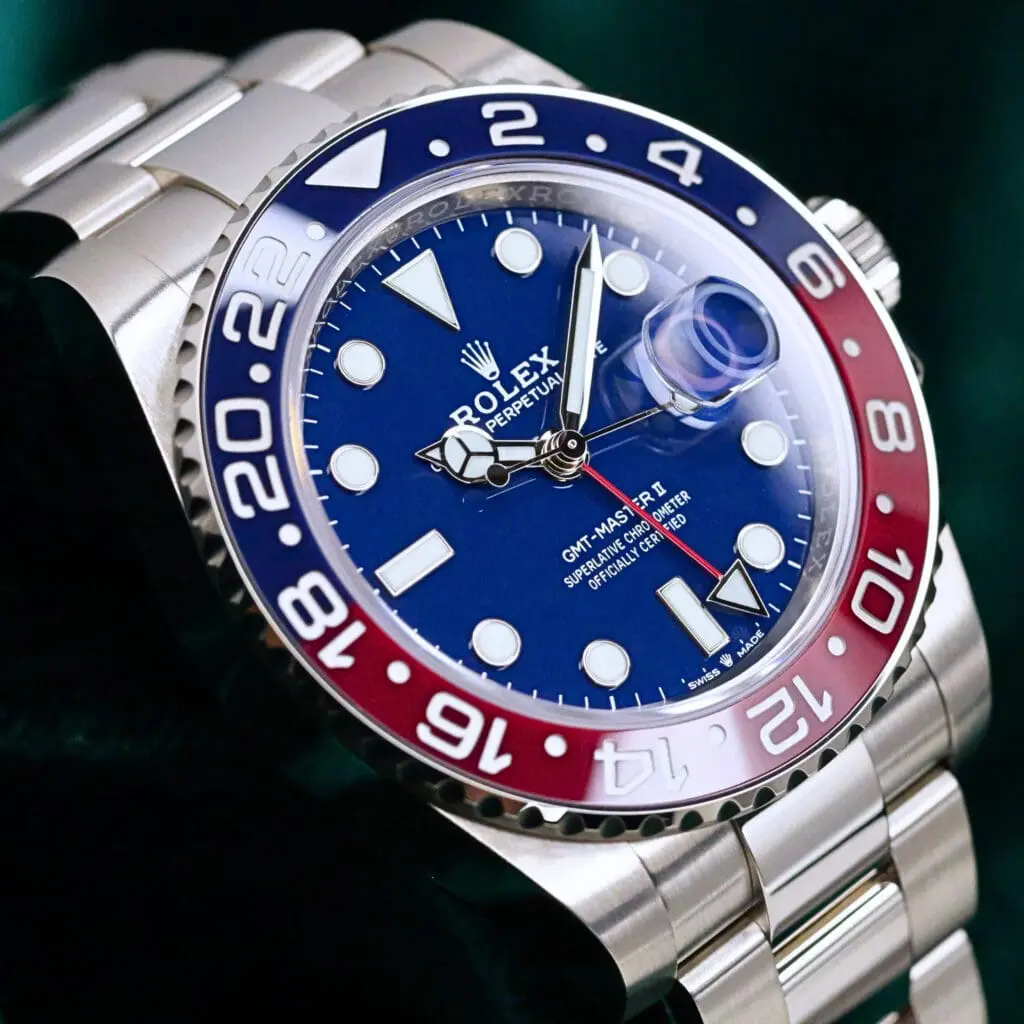
Rolex GMT-Master II "Pepsi" Blue Dial Blue Red Ceramic Bezel Oyster Bracelet 18K White Gold 40mm MINT CONDITION COMPLETE SET 126719BLRO
Price and Market Demand
Speedmaster pricing spreads wide depending on the reference. A quartz oddity like the Speedmaster LCD reference 186.009 trades for only a few hundred dollars, because collectors gravitate toward the mechanical chronographs and ignore the digital experiments.
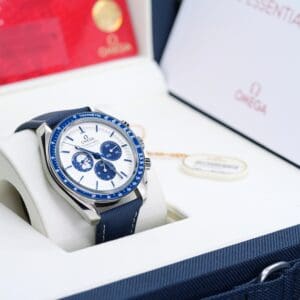
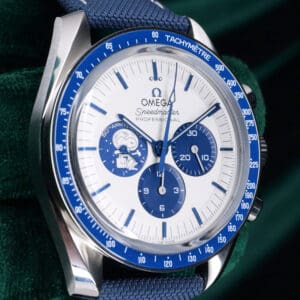
Story and scarcity flip that script fast. A limited-run piece like the 2015 Silver Snoopy Award reference 311.32.42.30.04.003, capped at 1,970 examples and retailed at $7,350, now changes hands around $40,000. Space-related editions and recognizable dials drive that kind of premium.

Daytona pricing sits higher and steadier because supply stays tight across almost every reference. Vintage anchors prove the point. A reference 6240 from the 1960s, the watch that introduced screw-down pushers, trades from roughly $85,000 to well past $150,000 depending on dial and condition, per Chrono24 and WatchCharts data.
At the top, materials and rarity send prices into another universe. A rose gold Rainbow Daytona, reference 116595RBOW, with its gem-set sapphire bezel, sells in the mid-six figures, commonly $400,000 to $650,000 as of 2026, with pavé versions crossing seven figures at auction. Precious metals plus gemstones move these into pure collector territory.


If you want help reading the market on a specific reference before you commit, that is exactly the kind of thing we walk buyers through. Send us the reference you are eyeing and we will give you an honest read on fair value.
Step back and two patterns stand out. Speedmaster demand spikes around space history and limited editions while standard Moonwatches stay easy to find. Daytona demand runs hot across the board, and rare materials, unusual dials, and vintage variants pull the strongest collector competition.
Notable Omega Speedmaster References

Speedmaster spans a wide range of case sizes, movements, and price points. Some hew closely to the classic Moonwatch, while others shrink the case or reach back into Omega’s own history. Here are three worth knowing before you shop, and our full Speedmaster buying guide covers the rest of the lineup.
1. Speedmaster Reference 310.30.42.50.01.001
This is the current hand-wound Moonwatch in its Hesalite form, the closest you can get to what NASA qualified back in 1965. Hesalite is acrylic rather than sapphire, so it picks up micro-scratches, but most buff right out with a dab of polish.
A solid steel caseback engraved “the first watch worn on the moon” hides the movement. If you want a display back instead, the sapphire sibling reference 310.30.42.50.01.002 is the one to chase.
Key specs:
- Movement: Omega Calibre 3861, hand-wound, Master Chronometer
- Case diameter: 42 mm
- Crystal: Hesalite front, solid engraved steel caseback
- Water resistance: 50 meters
- Power reserve: approx. 50 hours
- Magnetic resistance: up to 15,000 gauss
- Retail: $7,800; secondary market roughly $5,600 to $6,800
2. Speedmaster “Ed White” Reference 311.30.40.30.01.001
Omega reached deep into the vault for this one. It revives the legendary Calibre 321, the column-wheel movement that powered the earliest Speedmasters, including the watch Ed White wore on America’s first spacewalk in 1965.
At 39.7 mm it wears noticeably smaller and more vintage than the standard Moonwatch, with a black ceramic bezel, a step dial, and a sapphire caseback so you can admire the 321 at work.
Key specs:
- Movement: Omega Calibre 321, hand-wound, column wheel
- Case diameter: 39.7 mm
- Case thickness: approx. 13.7 mm
- Crystal: sapphire front and sapphire display caseback
- Water resistance: 50 meters
- Power reserve: approx. 55 hours
- Retail: $17,300; secondary market roughly $15,000 to $18,000
Related Models from Majestix
Omega Speedmaster Moonphase Black Dial Stainless Steel 44.25mm MINT CONDITION COMPLETE SET 304.30.44.52.01.001
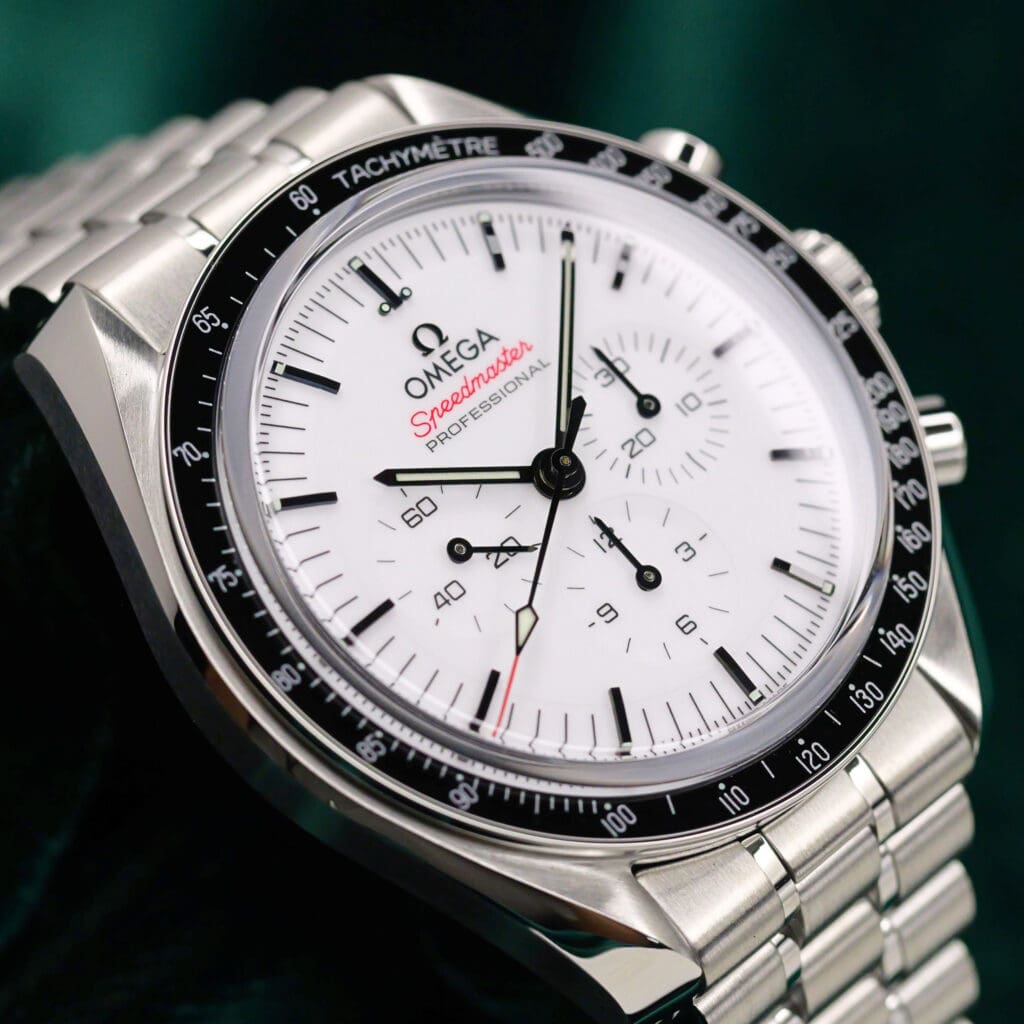
2026 NEW UNWORN Omega Speedmaster Moonwatch Professional White Dial Stainless Steel 42mm COMPLETE SET 310.30.42.50.04.001
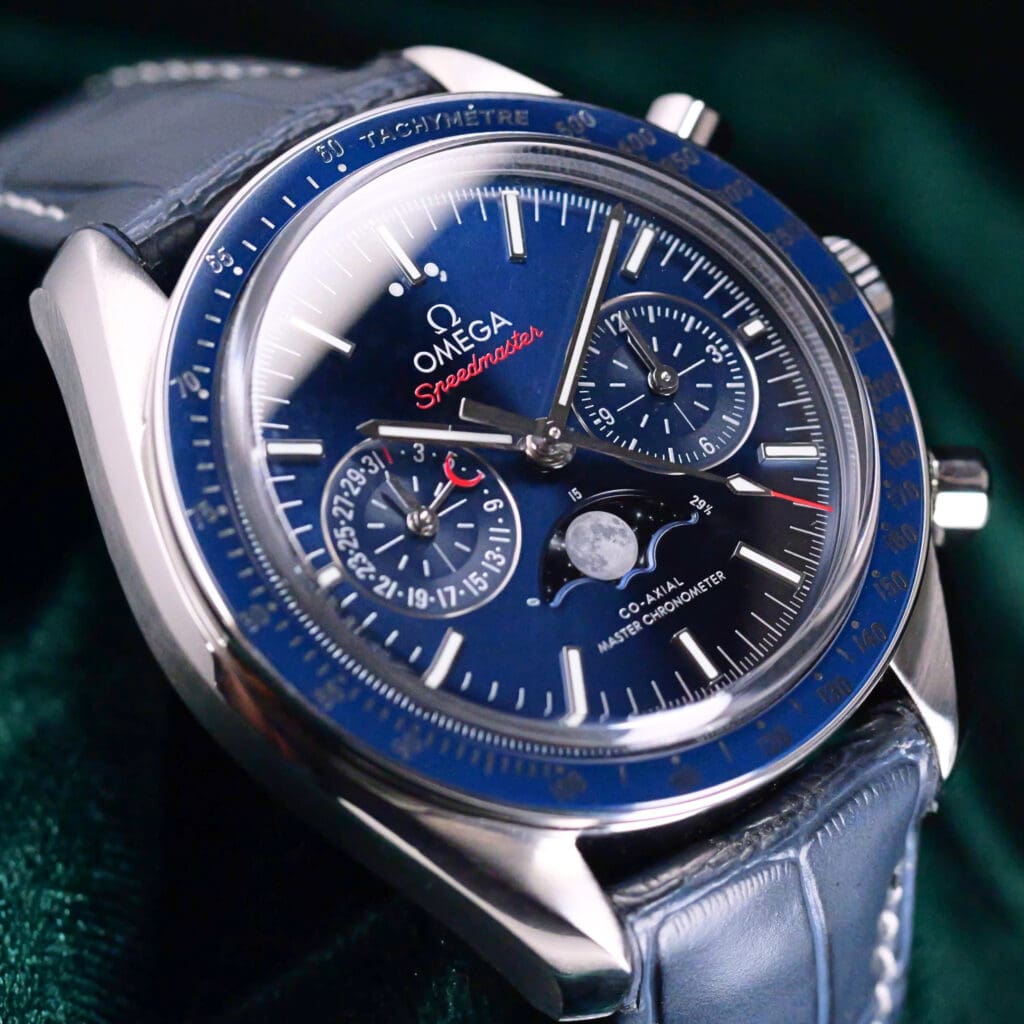
Omega Speedmaster Moonphase Blue Dial Blue Leather Strap Stainless Steel 44.25mm MINT CONDITION COMPLETE SET 304.33.44.52.03.001

Omega Speedmaster "Orbis Edition" 38mm Blue Dial Blue Bezel Stainless Steel Bracelet MINT COMPLETE SET 324.30.38.50.03.002
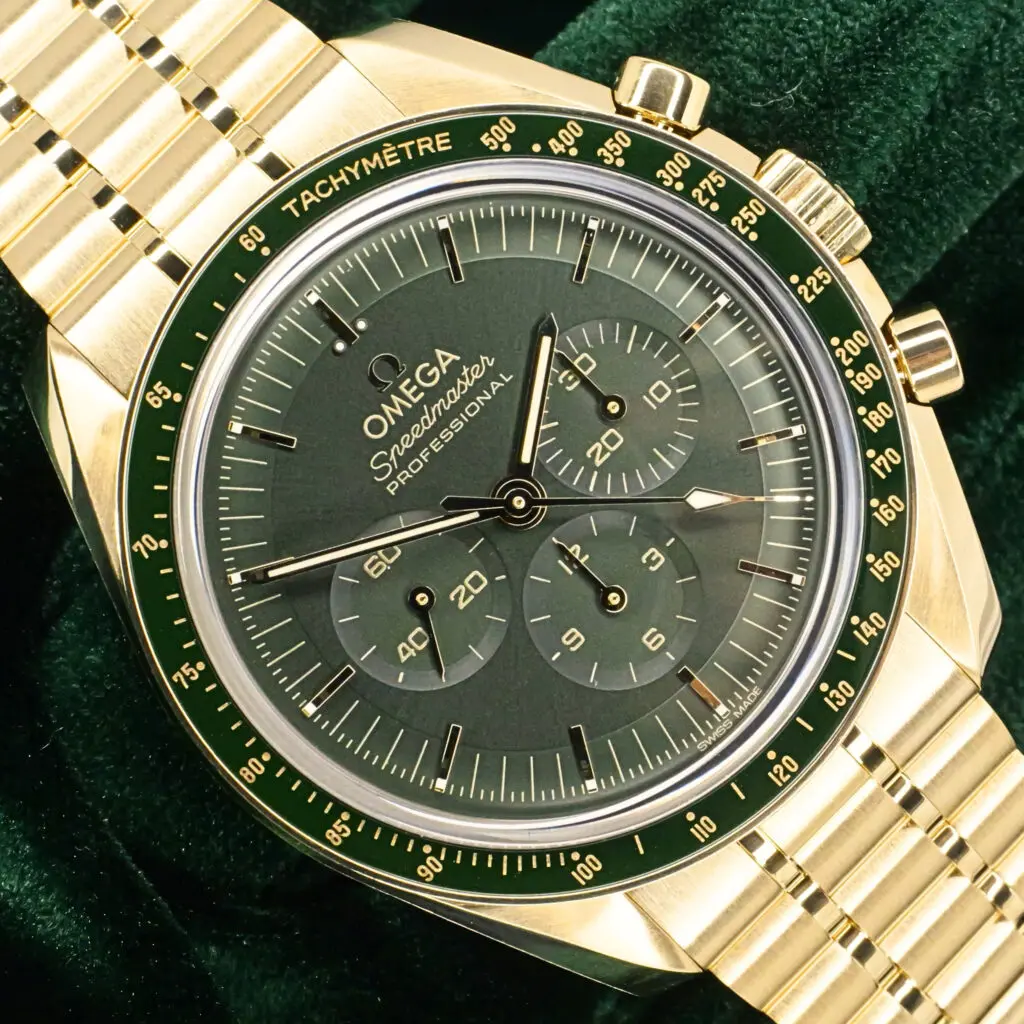
Omega Speedmaster Professional Moonwatch "Moonshine" Green Dial 18K Yellow Gold 42mm MINT CONDITION COMPLETE SET 310.60.42.50.10.001
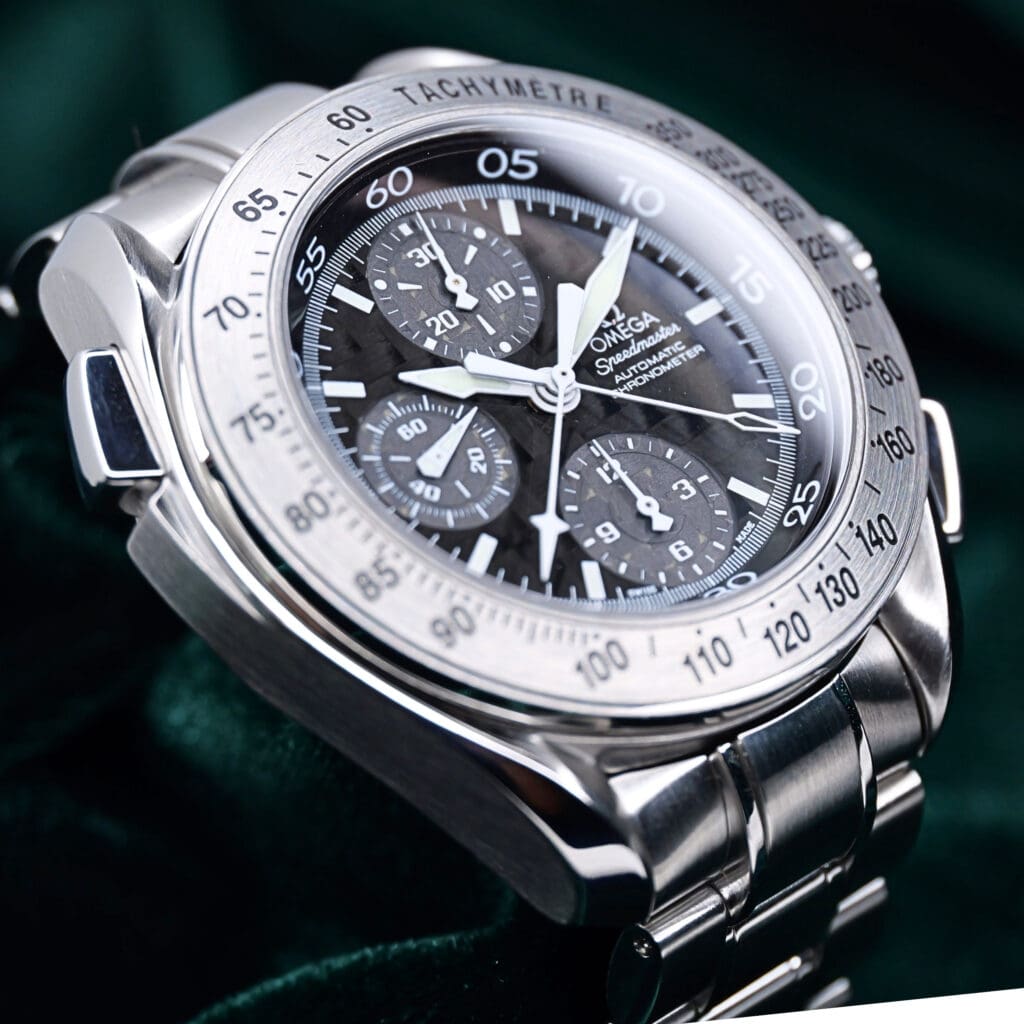
Omega Speedmaster Split-Seconds "Rattrapante" Black Carbon Fiber Dial Stainless Steel 42mm MINT CONDITION 3540.50
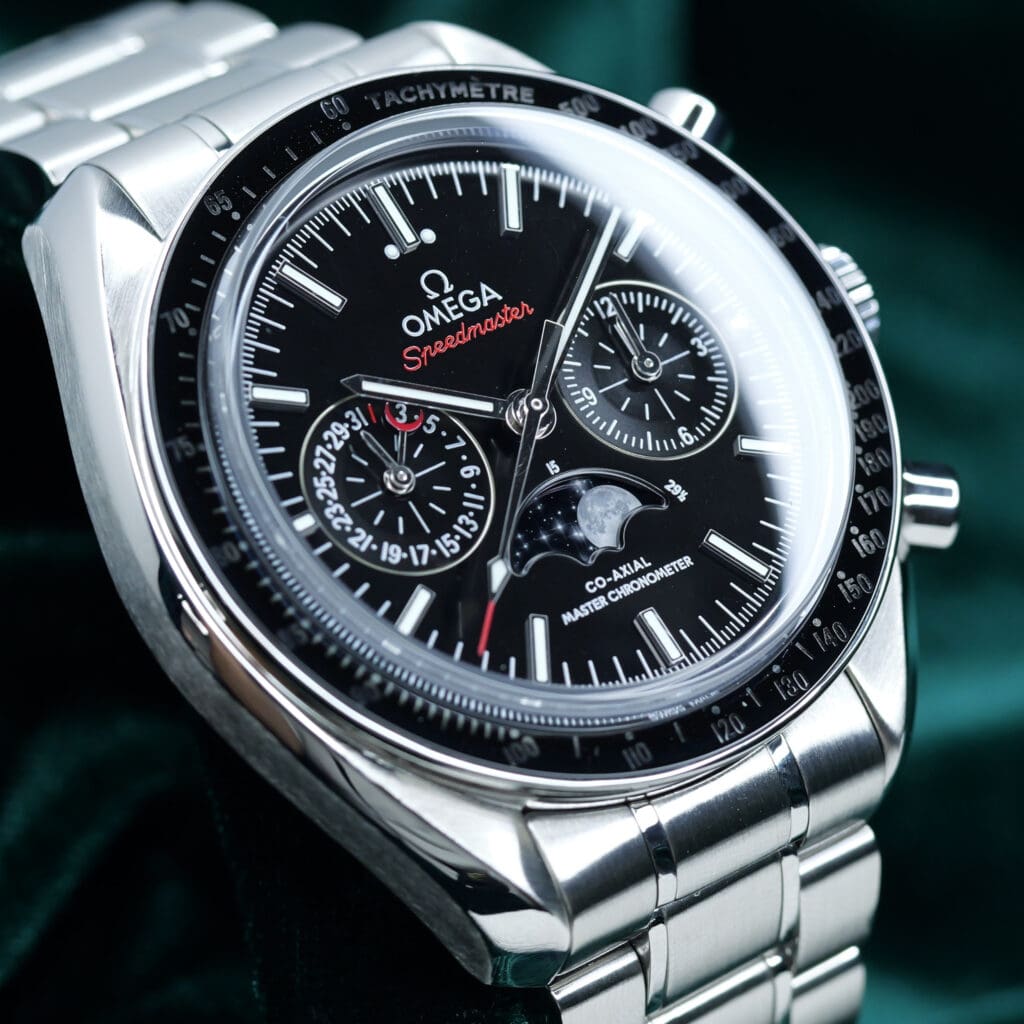
Omega Speedmaster Moonphase Co-Axial Master Chronometer Chronograph Black Dial Stainless Steel 44.25mm MINT CONDITION COMPLETE SET 304.30.44.52.01.001
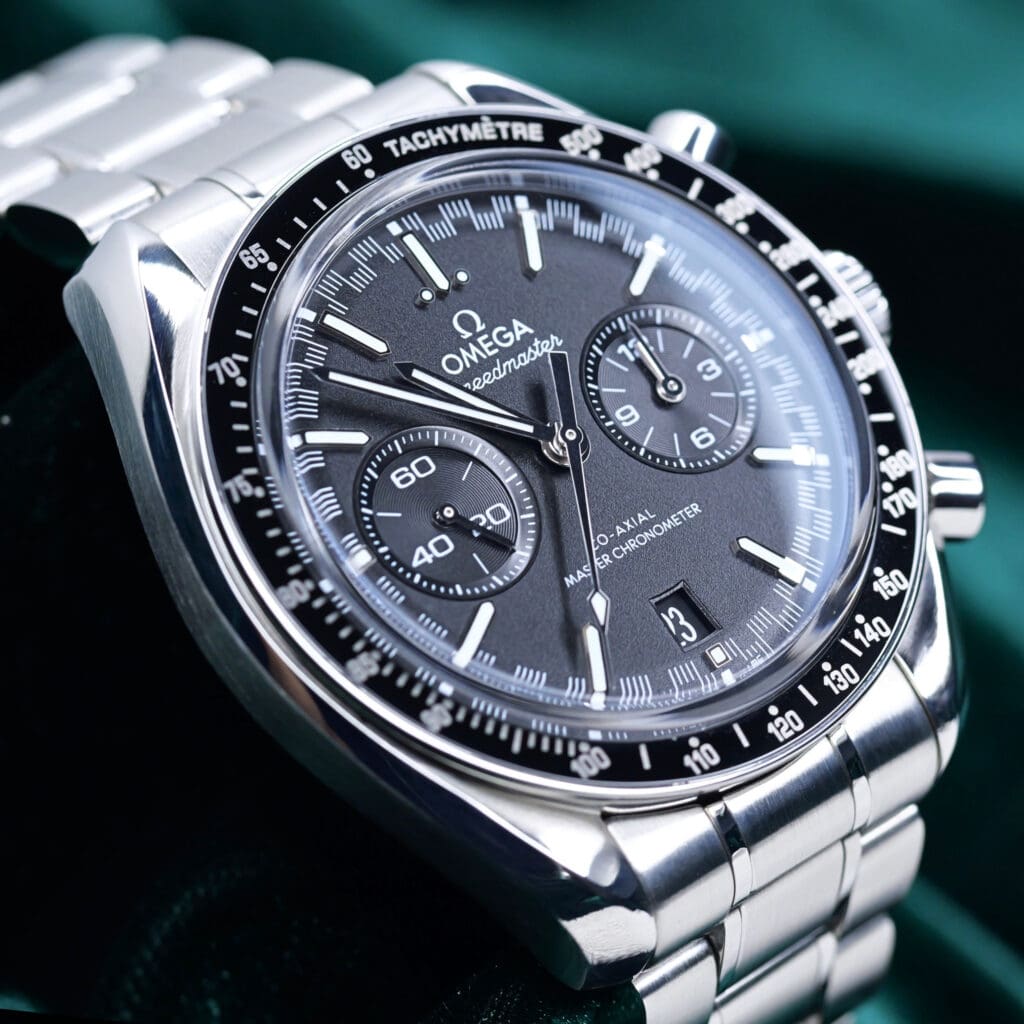
Omega Speedmaster Racing Co-Axial Master Chronometer Black Dial Stainless Steel 44.25mm MINT CONDITION COMPLETE SET 329.30.44.51.01.001
3. Speedmaster Reference 3513.30
For buyers who want the Speedmaster look without the hand-winding or the price tag, this is the entry point. Often called the Speedmaster Reduced, it runs an automatic movement, so there is no daily winding, and a date window sits at 3 o’clock. A silver dial with black subdials keeps everything legible at a glance.
If you are torn between this and the hand-wound Professional, how the Reduced and Professional stack up is a separate read.
Key specs:
- Movement: Omega Calibre 1152, automatic chronograph
- Case diameter: 39 mm
- Case thickness: approx. 14 mm
- Crystal: sapphire
- Water resistance: 50 meters
- Power reserve: approx. 44 hours
- Secondary market roughly $1,600 to $2,300
Notable Rolex Daytona References

Three modern steel references show how the Daytona evolved while keeping its core formula: a 40 mm case, three subdials, and a tachymeter bezel. What changes is the movement, the bezel material, and a few case details. Lining them up makes the progression easy to follow, and our full Daytona buying guide maps the rest of the range.
1. Daytona Reference 126500LN
This is the current steel Daytona, running the Calibre 4131 automatic introduced in 2023. A black Cerachrom ceramic bezel keeps the tachymeter scale sharp and shrugs off scratches that would mark a steel bezel. Screw-down pushers and the familiar three-subdial layout carry over unchanged.
It comes in black or white “Panda,” and the Panda commands the premium, so the dial differences are worth understanding before you choose. Retail lists around $16,900, but the waitlist reality means the grey market is where most buyers land.
Key specs:
- Movement: Rolex Calibre 4131, automatic chronograph
- Case diameter: 40 mm
- Crystal: sapphire
- Water resistance: 100 meters
- Power reserve: approx. 72 hours
- Hairspring: blue Parachrom, anti-magnetic
- Secondary market roughly $30,000 to $41,500 depending on dial
2. Daytona Reference 116500LN
Ceramic first reached the steel Daytona here, giving the watch its cleaner, more modern face before the 126500LN took over. Inside sits the Calibre 4130, a movement collectors trust for its simpler architecture and long service intervals. Black and white dials share the same three-subdial layout, with the white again pulling a small premium.
Key specs:
- Movement: Rolex Calibre 4130, automatic chronograph
- Case diameter: 40 mm
- Crystal: sapphire
- Water resistance: 100 meters
- Power reserve: approx. 72 hours
- Hairspring: blue Parachrom, anti-magnetic
- Secondary market roughly $27,000 to $34,000
More Daytonas
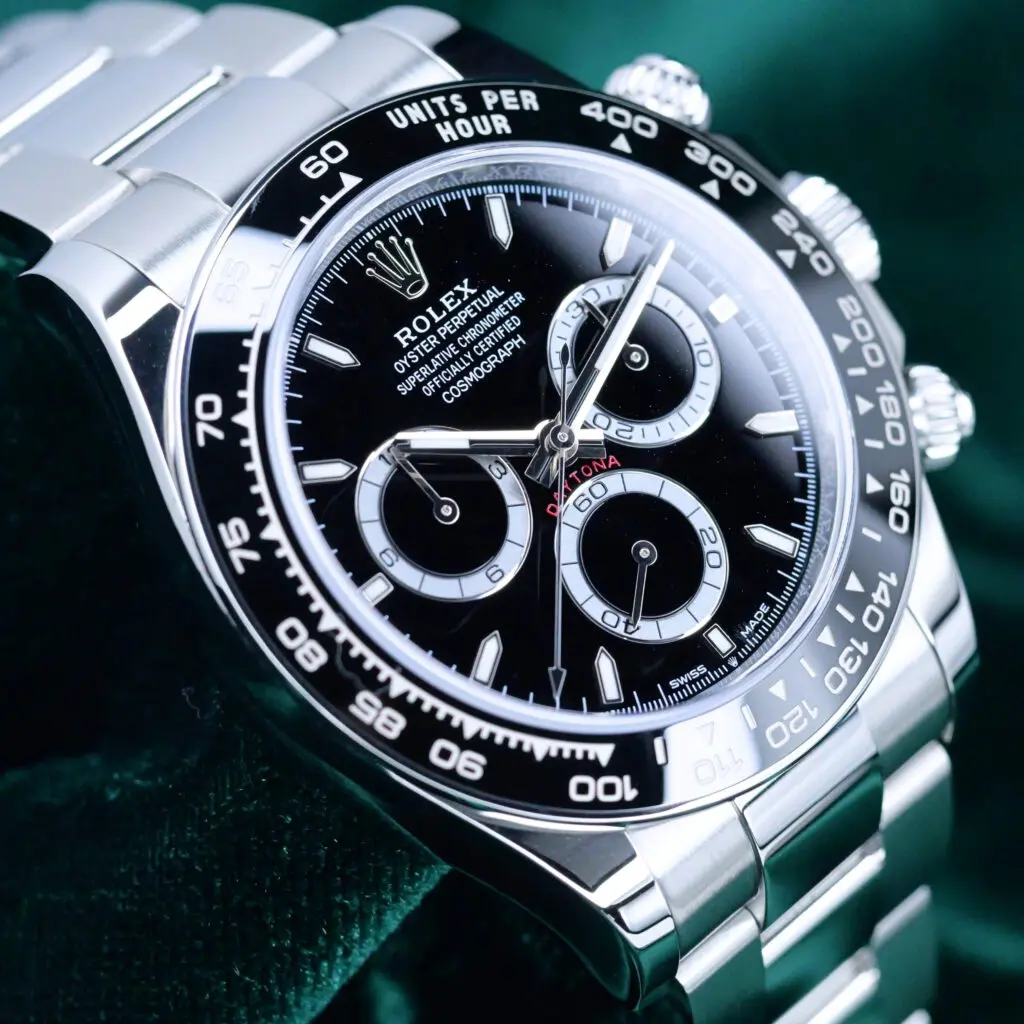
2026 Rolex Cosmograph Daytona Black Dial Black Ceramic Bezel Oyster Bracelet Stainless Steel 40mm MINT CONDITION COMPLETE SET 126500LN
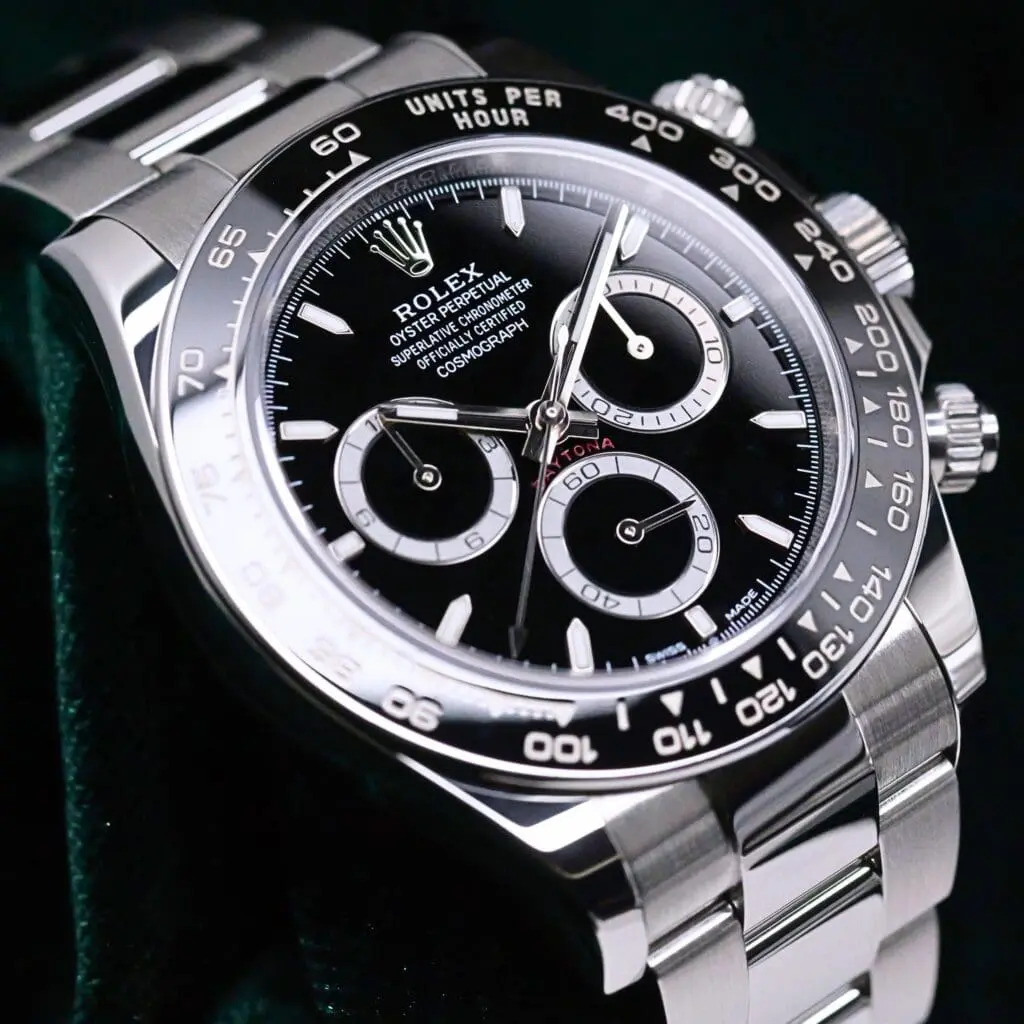
Rolex Cosmograph Daytona "Reverse Panda" Black Dial Black Ceramic Bezel Oyster Bracelet Stainless Steel 40mm MINT CONDITION COMPLETE SET 126500LN
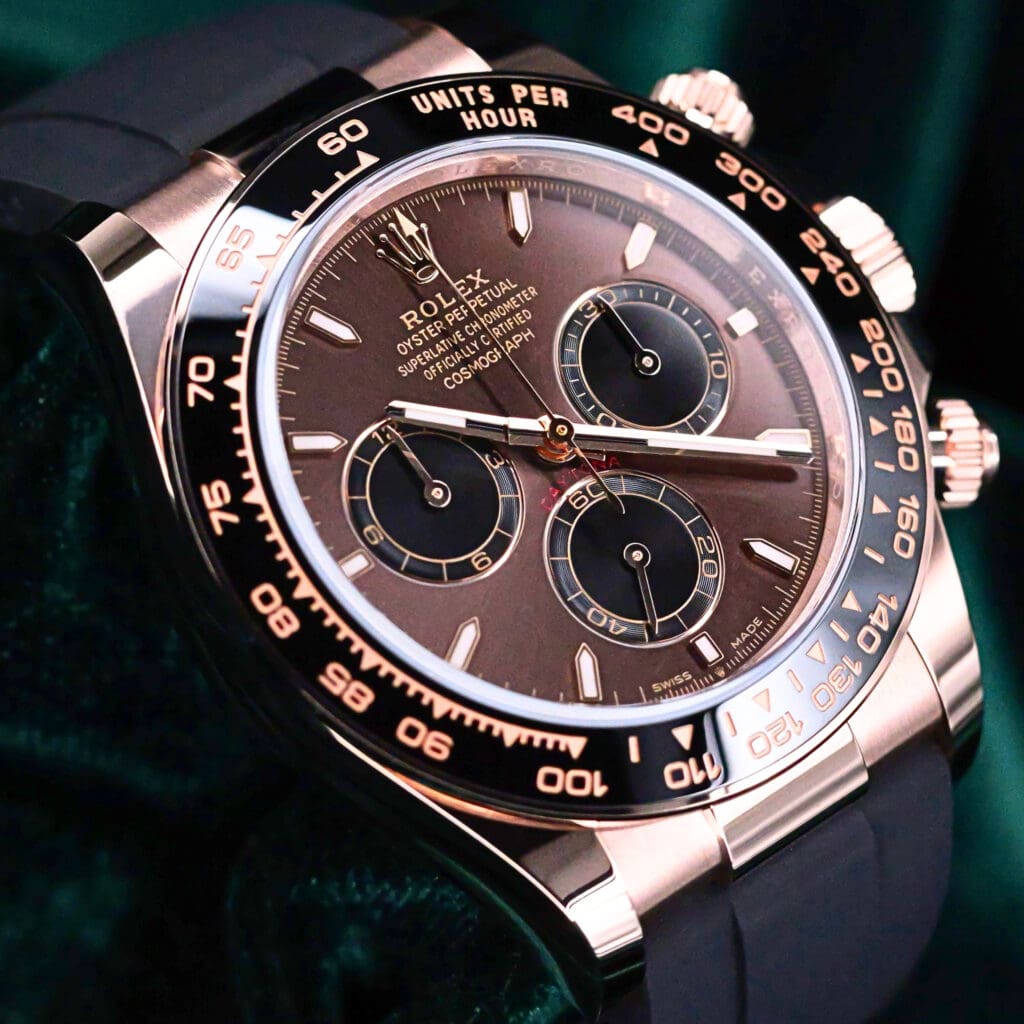
Rolex Cosmograph Daytona 40mm Chocolate Brown Dial Black Ceramic Bezel Black Subdials Black Oysterflex 18K Rose Gold MINT COMPLETE SET 126515LN
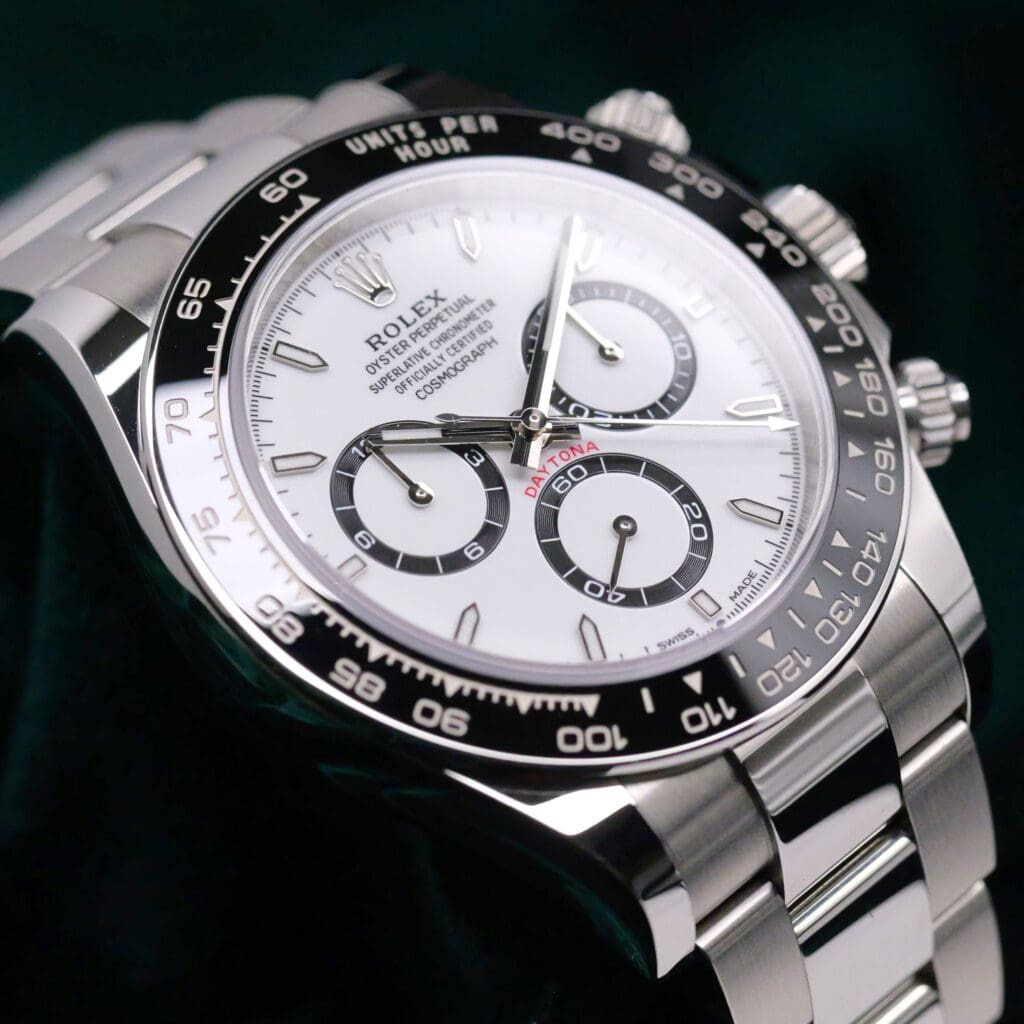
Rolex Daytona Cosmograph "Panda" White Dial Black Ceramic Bezel Oyster Bracelet Stainless Steel 40mm MINT CONDITION COMPLETE SET 126500LN-0001
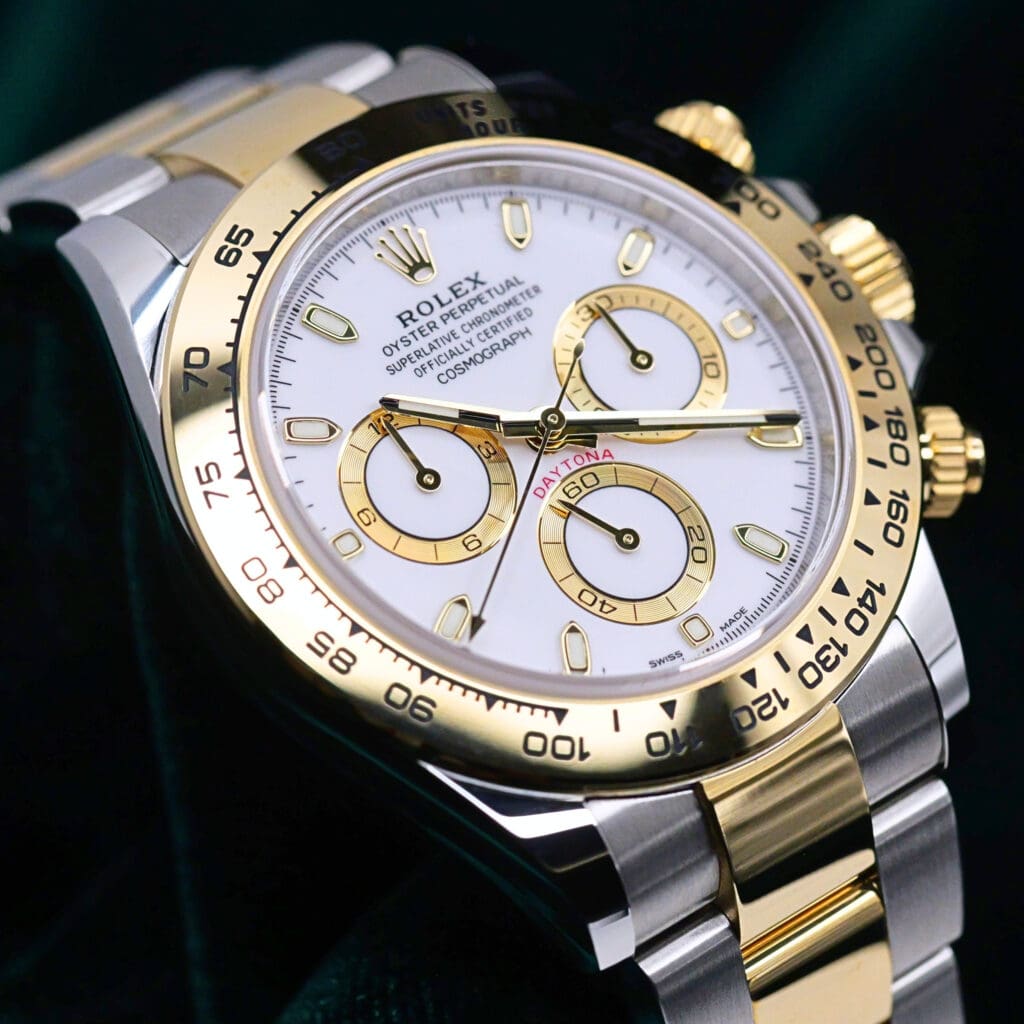
Rolex Cosmograph Daytona White Dial Gold Subdials Oyster Bracelet Two-Tone 18K Yellow Gold Stainless Steel 40mm MINT CONDITION COMPLETE SET 116503
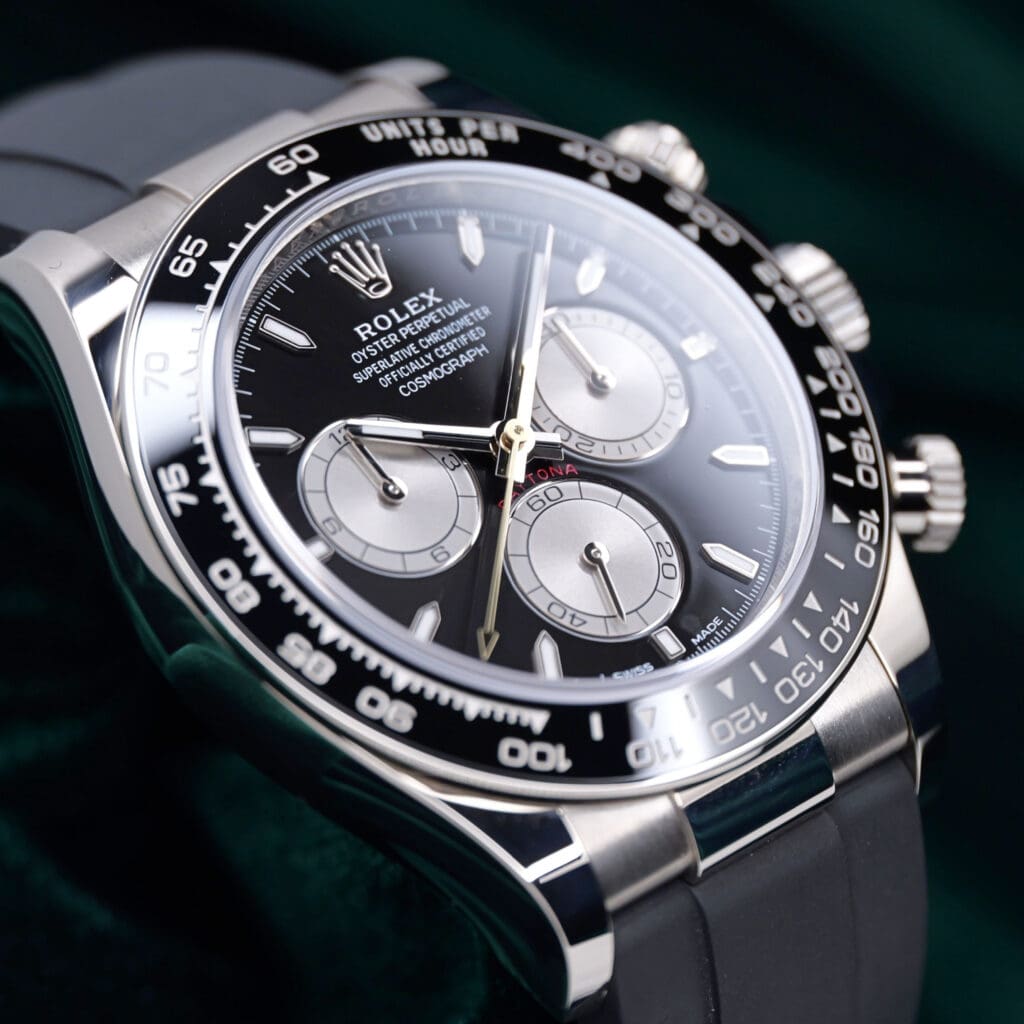
2026 NEW UNWORN Rolex Cosmograph Daytona "Baby Le Mans" Black Dial Silver Subdials Black Ceramic Bezel Black Oysterflex Strap 18k White Gold 40mm COMPLETE SET 126519LN
3. Daytona Reference 116520
Here is where the in-house era began. Reference 116520 debuted the Calibre 4130 in 2000, Rolex’s first fully in-house Daytona chronograph movement, replacing the older Zenith-based caliber.
It also marks the last steel-bezel Daytona, which gives it a brighter, more old-school look than the ceramic models that followed. Black and white dials trade within a few hundred dollars of each other, and late “APH” dial examples carry a collector premium.
Key specs:
- Movement: Rolex Calibre 4130, automatic chronograph
- Case diameter: 40 mm
- Crystal: sapphire
- Water resistance: 100 meters
- Power reserve: approx. 72 hours
- Hairspring: blue Parachrom, anti-magnetic
- Secondary market roughly $22,000 to $32,000
Omega Speedmaster vs Daytona: Which Watch Should You Choose?
Both watches grew out of racing, and both time elapsed seconds with a tachymeter bezel and three subdials. Yet they feel different the moment you start living with them. Matching the watch to how you spend your days makes the choice a lot simpler.
Choose the Omega Speedmaster if:
- You want a chronograph that feels like a tool, not a status symbol
- You enjoy the ritual of hand-winding and interacting with the watch
- You want variety across case sizes, movements, and dial designs
- You would rather buy at or near retail without chasing a waitlist
- You like a watch that reads as understated to everyone but the people who know
Choose the Rolex Daytona if:
- You want one of the most recognizable chronographs on the planet
- You prefer an automatic that runs with almost no daily input
- You value strong resale liquidity and instant market recognition
- You are comfortable paying a premium to secure the reference you want
- You want a tighter lineup where the references are easy to tell apart
Where to Buy Authentic Watches Online
999+ Timepieces Available
Explore Our Timepieces
Authenticated, unworn, and ready to ship worldwide.
Rolex · Audemars Piguet · Patek Philippe · Omega · Cartier · Richard Mille · Hublot · Tudor
Newly Listed
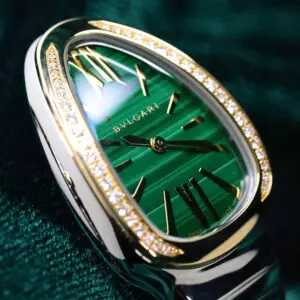
2026 NEW UNWORN Bvlgari Serpenti Tubogas Studs Capsule Limited Edition Green Dial Diamond Bezel Steel & 18k Yellow Gold 35mm COMPLETE SET 104360
$24,255.00
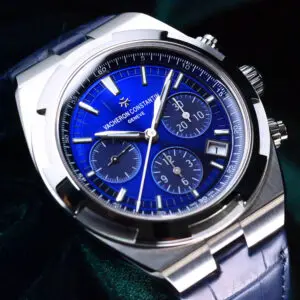
Vacheron Constantin Overseas Chronograph Blue Dial Blue Leather Strap Stainless Steel 42.5mm MINT CONDITION COMPLETE SET 5500V/110A-B148
$37,793.00
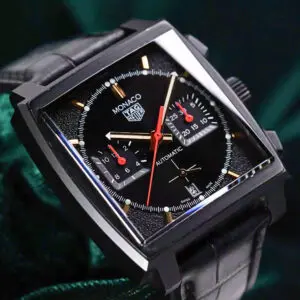
Tag Heuer Monaco Chronograph “Dark Lord” Special Edition Black Dial Black Leather Strap DLC Titanium 39mm MINT CONDITION COMPLETE SET CBL2180.FC6497
$8,135.00
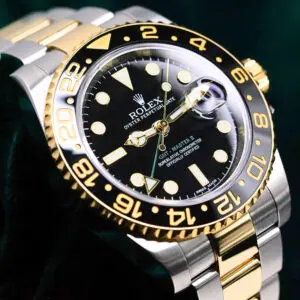
Rolex GMT-Master II “Green Arrow” Black Dial Black Ceramic Bezel Oyster Bracelet Two-Tone 18K Yellow Gold Stainless Steel 40mm MINT CONDITION COMPLETE SET 116713LN
$15,740.00
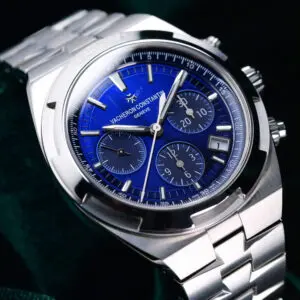
Vacheron Constantin Overseas Chronograph Blue Dial Stainless Steel 42.5mm MINT CONDITION COMPLETE SET 5500V/110A-B148
$37,793.00
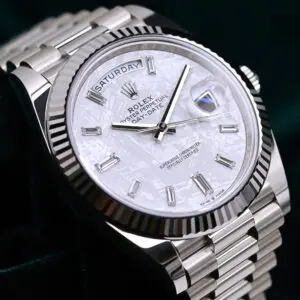
Rolex Day-Date Meteorite Baguette Diamond Dial Fluted Bezel President 18K White Gold 40mm MINT CONDITION COMPLETE SET 228239
$78,629.00
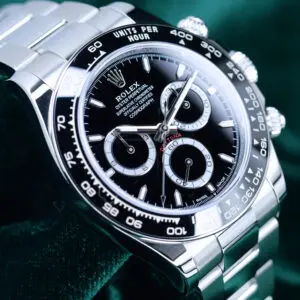
2026 Rolex Cosmograph Daytona Black Dial Black Ceramic Bezel Oyster Bracelet Stainless Steel 40mm MINT CONDITION COMPLETE SET 126500LN
$33,594.00
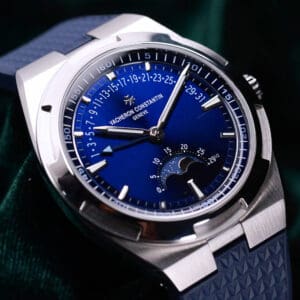
2025 Vacheron Constantin Overseas Moonphase Retrograde Date Blue Dial Blue Rubber Strap Stainless Steel 41mm MINT CONDITION COMPLETE SET 4000V/210A-B911
$52,800.00
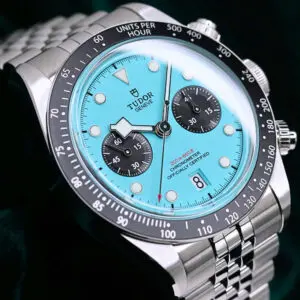
2025 Tudor Black Bay Chrono "Flamingo Blue" Turquoise Dial Black Bezel Stainless Steel 41mm MINT CONDITION COMPLETE SET 79360N-0024
$10,494.00
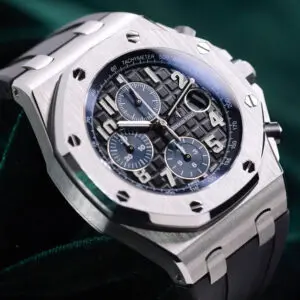
Audemars Piguet Royal Oak Offshore Chronograph "Batman" Black Dial Blue Accents Black Rubber Strap Stainless Steel 42mm MINT CONDITION COMPLETE SET 26470ST.OO.A028CR.01
$25,715.00
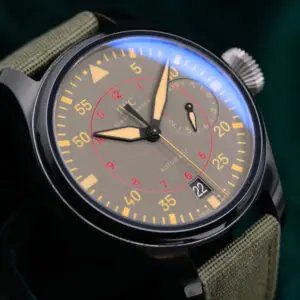
IWC Big Pilot's Watch Top Gun Miramar Grey Dial Green Textile Strap Black Ceramic 48mm MINT CONDITION COMPLETE SET IW501902
$7,240.00
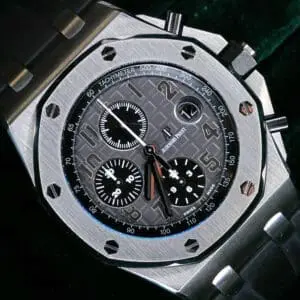
Audemars Piguet Royal Oak Offshore Chronograph "Elephant" Gray Dial Stainless Steel Rubber Strap 42mm 26470ST.OO.A104CR.01
$23,974.50
Where you buy a pre-owned watch matters as much as which one you pick, and a handful of legitimate online channels make sense for a Speedmaster or a Daytona.
Chrono24 is the largest marketplace, with buyer protection and an escrow service. eBay’s Authenticity Guarantee program now inspects watches above a price threshold before they reach you. Grailzee runs enthusiast-focused auctions worth watching for fair-priced pieces.
We also buy, sell, and trade luxury watches, and the reason clients come to us instead of a faceless listing is the conversation before the sale. You get tour videos of the exact watch, honest condition notes, and a real person who has handled the piece, not a stock photo and a price.
That approach is reflected in our 4.9-star Google rating from buyers who wanted to understand a watch fully before committing. You can browse our current collection any time. If you are weighing a specific Speedmaster against a specific Daytona and want a straight walkthrough of both, reach out and we will line up options that match what you are after.
Final Thoughts on Omega Speedmaster vs Daytona
Omega Speedmaster vs Daytona usually settles itself after a few weeks of real wear. Early excitement fades, routine takes over, and what remains is how the watch fits and how often you reach for it. A Speedmaster rewards anyone who enjoys winding; a Daytona rewards anyone who wants liquidity and a set-and-forget rotor.
Two tips most comparisons skip. First, try each on a NATO or rubber strap before deciding, since the Speedmaster transforms on a strap while the Daytona rarely leaves its Oyster. Second, factor service costs in: a Speedmaster service runs a few hundred dollars at many watchmakers, while a Daytona costs more and routes through Rolex.
Pick the one that matches your pace, and the decision stops feeling complicated.