
If you are weighing the Omega De Ville Trésor vs Prestige decision, you have probably noticed that both watches come from the same De Ville family and sit in similar dress-watch territory. The differences between them are real and specific, though, and they matter a great deal to how you actually live with one on your wrist.
This article walks through the specs, the ownership realities, the notable references worth considering, and the buyer each line genuinely fits. You do not need prior watch knowledge to follow along. The goal is a clear, honest picture of what separates these two collections so you can make the right call for yourself.
De Ville Trésor Overview
The Trésor name traces back to 1949, when Omega used it for a slim dress watch housing its legendary 30mm calibre. The name means “treasure” in French. Omega revived the Trésor as a full sub-collection in 2014, aimed at buyers who want a collector-grade mechanical dress watch with a visible movement and a manual-wind ritual. It sits at the premium end of the De Ville family.
Our Omega De Ville buying guide maps where each line fits in the wider family.
The defining feature is its manual-wind Co-Axial movement, visible through a sapphire caseback with no rotor blocking the view. Every mechanical reference carries Master Chronometer certification from METAS, tested to run between 0 and +5 seconds per day and resist magnetic fields up to 15,000 gauss.
The clean case and open caseback together make it the most collector-focused option in the De Ville catalogue.
Notable references of the De Ville Trésor:
- 435.13.40.21.03.001 / 435.13.40.21.03.002
- 435.13.40.22.01.001 / 435.13.40.22.06.001
- 435.53.40.21.03.001 / 435.53.40.22.03.001
De Ville Prestige Overview
The De Ville Prestige launched in 1994 as Omega’s answer to the classic, broadly accessible dress watch. It introduced two signature elements that remain today: the triple-apple bassine bezel and the seven-link polished bracelet.
The current third generation arrived in 2022, bringing Master Chronometer certification to all mechanical references and moving from the older caliber 2500 family to the newer 8800-series movements.
The Prestige is built for buyers who want a dress watch that works across more occasions without asking much of them. It comes in a far wider range of sizes, dial colours, materials, and bracelet options than the Trésor.
For someone who wants one watch to carry across business meetings, formal dinners, and smart-casual wear, the Prestige is structured for exactly that kind of rotation.
Notable references of the De Ville Prestige:
- 434.10.40.20.01.001 / 434.10.41.21.06.001
- 434.20.40.20.02.001 / 434.53.41.21.02.001
- 434.13.41.21.06.001 / 424.10.40.20.03.004
Related Models from Majestix
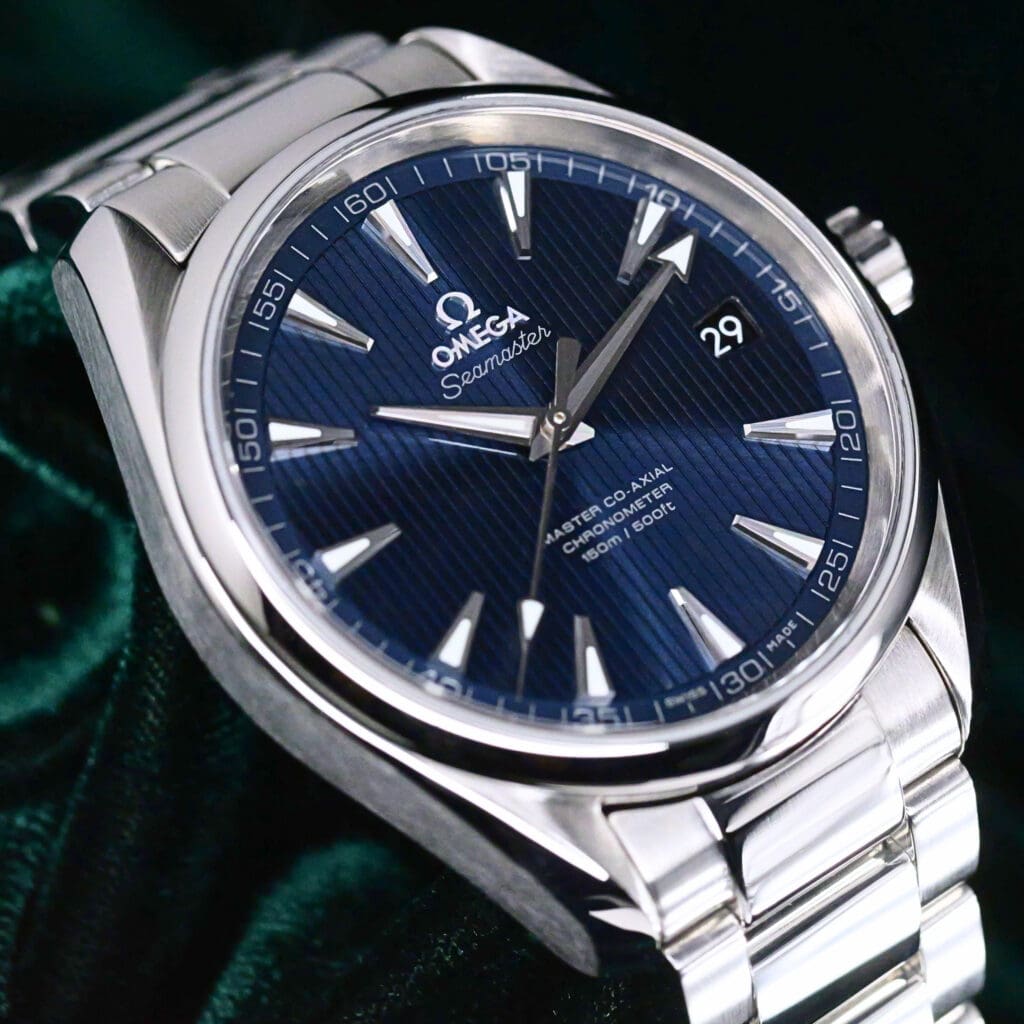
Omega Seamaster Aqua Terra 150M Master Co-Axial Chronometer Blue Teak Dial Stainless Steel 41.5mm MINT CONDITION COMPLETE SET 231.10.42.21.03.003
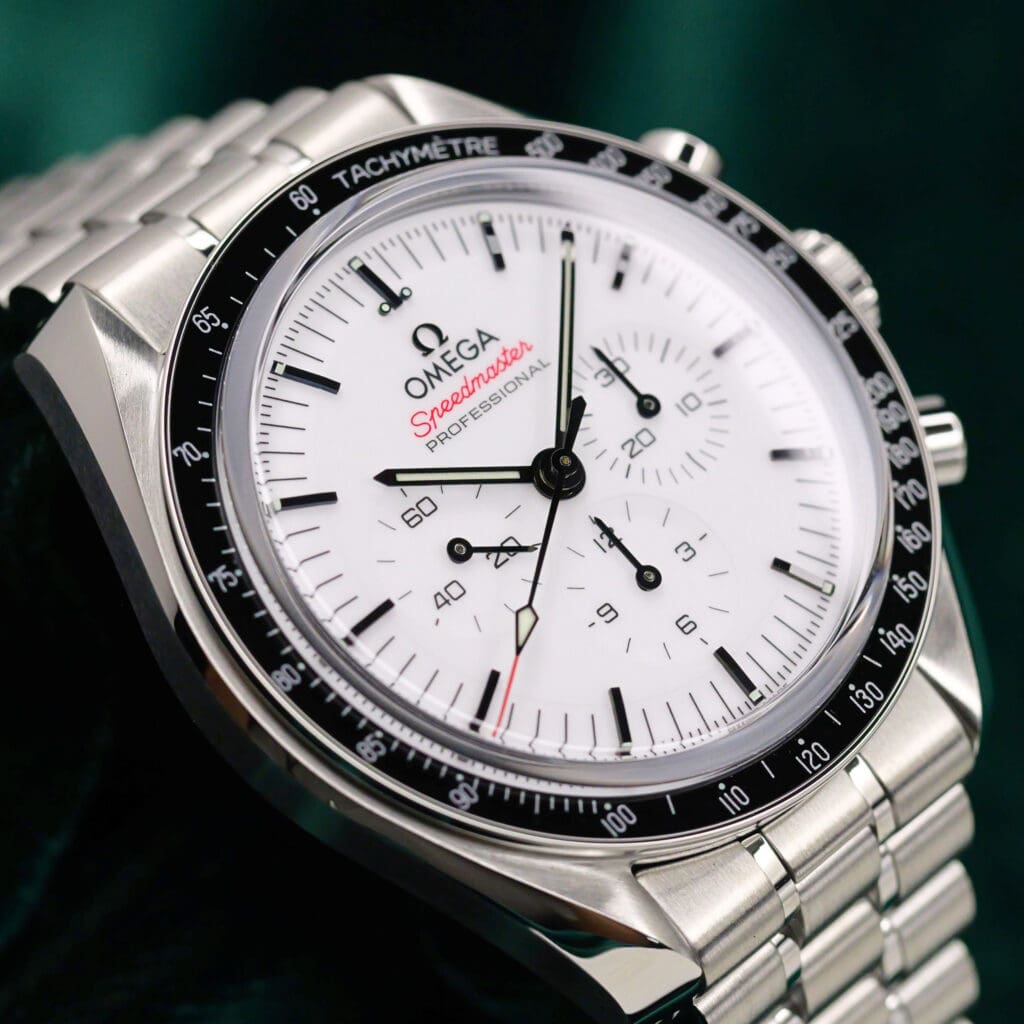
2026 NEW UNWORN Omega Speedmaster Moonwatch Professional White Dial Stainless Steel 42mm COMPLETE SET 310.30.42.50.04.001
Omega Speedmaster Moonphase Blue Dial Blue Leather Strap Stainless Steel 44.25mm MINT CONDITION COMPLETE SET 304.33.44.52.03.001
Omega Seamaster Planet Ocean 600M Black Dial Black Orange Ceramic Bezel Black Orange Rubber Strap Stainless Steel 43.5mm MINT CONDITION COMPLETE SET 215.32.44.21.01.001

Omega Speedmaster "Orbis Edition" 38mm Blue Dial Blue Bezel Stainless Steel Bracelet MINT COMPLETE SET 324.30.38.50.03.002
Omega Seamaster Planet Ocean 600M Black Dial Stainless Steel 43.5mm MINT CONDITION COMPLETE SET 215.30.44.21.01.001
De Ville Trésor vs Prestige: Most Notable Differences
This is where the two collections genuinely diverge. The differences below are objective, spec-level distinctions that directly affect how each watch feels and functions in real ownership. No other section of this comparison carries more weight for a buying decision.
1. Manual vs. Automatic

The Trésor runs on manual-wind movements across all mechanical references (calibers 8926, 8929, 8934, 8935). There is no rotor. The mainspring is wound by hand, typically every two to three days given the 72-hour power reserve.
That is a deliberate design choice: a dress watch should engage its owner. The winding ritual is part of the experience, not an inconvenience to be engineered away.
The Prestige Gen 3 uses self-winding automatic movements (calibers 8800, 8802, 8810, 8936) with a 55-hour power reserve. The rotor winds the mainspring through wrist motion, so the watch runs as long as it is worn regularly.
Both movement families carry identical Master Chronometer certification, so accuracy and magnetic resistance are equal across the two lines. The practical difference is purely about how energy enters the watch, and what kind of owner that suits.
2. Bezel Design

The Trésor case has a smooth, plain polished bezel with no decorative ridges. The case shape is minimal and restrained, closer to the design language of high-end independents than to a branded signature look. Nothing on the exterior competes with the dial for attention.
The Prestige carries the triple-apple bassine bezel, its signature element since 1994. Three rounded ridges frame the dial in a layered look, and the bassine profile gives the case a gentle curve from the side. On the wrist, the two watches read as fundamentally different designs even at a glance.
3. Bracelet Availability

The mechanical men’s Trésor (40mm) comes on a leather strap only. No metal bracelet exists for the main mechanical references. This ties the Trésor to formal and black-tie contexts. Leather sits cleaner under a dress-shirt cuff and reinforces the watch’s identity as a specialist piece.
The Prestige offers both a seven-link polished metal bracelet and a leather strap across most men’s Gen 3 references. The bracelet was updated in 2022 with reproportioned link widths, refined tapering, and a butterfly folding clasp with pushers replacing the older sliding clasp.
That flexibility lets the Prestige shift between formal and smart-casual wear depending on which option is fitted.
4. Case Size

The Trésor men’s mechanical lineup focuses on a single 40mm case. The ladies’ line adds a 36mm option, and the Mini Trésor sits at 26mm with a quartz movement. The size range is intentionally narrow, reflecting the collection’s specialist, collector-first positioning.
The Prestige Gen 3 spans from 27.5mm to 42mm, with men’s mechanical options at 40mm (three-hand date), 41mm (power reserve with small seconds), and a 42mm two-tone. Ladies’ models cover 27.5mm, 30mm, and 34mm.
For buyers with a specific wrist-size preference, or those who want a 41mm or 42mm presence, the Prestige is the only line that accommodates it. If you are unsure what suits you, our guide to the best watch size for your wrist helps you narrow it down.
5. Dial
The Trésor’s current mechanical men’s range keeps things restrained: steel or precious-metal cases, a small set of dial colours (blue, grey, silver, and precious-metal variants), and leather strap only. Each reference sits within a tight matrix of considered choices. That is part of the collection’s character, not a limitation.
The Prestige Gen 3 offers a much broader spread of dial colours through PVD treatments, including platinum-gold grey, salmon, linen, sky blue, and burgundy tones. Combined with case-material choices (steel, two-tone, full gold) and the bracelet-or-strap option, the configurations multiply quickly.
For a specific pairing of dial colour, metal, and bracelet, the Prestige is far more likely to have it.
6. Caseback
Both lines use a sapphire exhibition caseback on all mechanical references, but what you see through it differs considerably. The Trésor’s manual-wind movement has no rotor, so the full architecture sits open to view. The bridges carry Omega’s arabesque Geneva-wave decoration, and the balance assembly is visible without obstruction.
The Prestige’s automatic movement includes a rotor that covers part of the caseback view. The movement is well finished and visible, but the oscillating mass sits over a portion of the mechanism. If the exhibition caseback is a feature you actually care about, the Trésor gives you the more complete, architecturally open display.
Price and Market Demand

Both lines are bought for the pleasure of ownership, not for resale returns. That framing matters before looking at any numbers. The figures below reflect current Chrono24 and WatchCharts listings as of 2026, and gold references in particular have crept up alongside the metal price.
The Trésor: Premium Entry, Thin Secondary Liquidity
The Trésor steel entry reference (40mm mechanical, leather strap) retails in the $7,000–$7,800 range depending on configuration. On the secondary market, clean steel examples with full box and papers typically trade around $4,950–$6,500. Pre-2019 references with the earlier Cal. 8511 (not METAS-certified) trade lower, often $3,000–$4,500.
Secondary liquidity is thin. The Trésor is a specialist dress watch and usually takes longer to sell than mainstream Omega references like the Speedmaster or Seamaster.
The Prestige: Accessible Entry, Broader Market
The Prestige Gen 3 steel entry reference (40mm automatic, bracelet) now retails closer to $5,000–$5,500 — higher than many older guides state, since prices moved up through the third generation. Used Gen 3 steel examples typically trade around $3,000–$4,000, which makes it one of the softer entry points into the Omega range.
Gen 2 references (Cal. 2500, pre-Master Chronometer) trade lower, often under $2,500, and that gap reflects the real technical difference between the generations. Two-tone and gold Prestige references push the ceiling much higher, from roughly $8,000 to well over $20,000 depending on case material and dial.
Related Models from Majestix
Omega Seamaster Aqua Terra 150M Master Co-Axial Chronometer Blue Teak Dial Stainless Steel 41.5mm MINT CONDITION COMPLETE SET 231.10.42.21.03.003
2026 NEW UNWORN Omega Speedmaster Moonwatch Professional White Dial Stainless Steel 42mm COMPLETE SET 310.30.42.50.04.001
Omega Speedmaster Moonphase Blue Dial Blue Leather Strap Stainless Steel 44.25mm MINT CONDITION COMPLETE SET 304.33.44.52.03.001
Omega Seamaster Planet Ocean 600M Black Dial Black Orange Ceramic Bezel Black Orange Rubber Strap Stainless Steel 43.5mm MINT CONDITION COMPLETE SET 215.32.44.21.01.001
Omega Speedmaster "Orbis Edition" 38mm Blue Dial Blue Bezel Stainless Steel Bracelet MINT COMPLETE SET 324.30.38.50.03.002
Omega Seamaster Planet Ocean 600M Black Dial Stainless Steel 43.5mm MINT CONDITION COMPLETE SET 215.30.44.21.01.001
Omega Speedmaster Professional Moonwatch "Moonshine" Green Dial 18K Yellow Gold 42mm MINT CONDITION COMPLETE SET 310.60.42.50.10.001
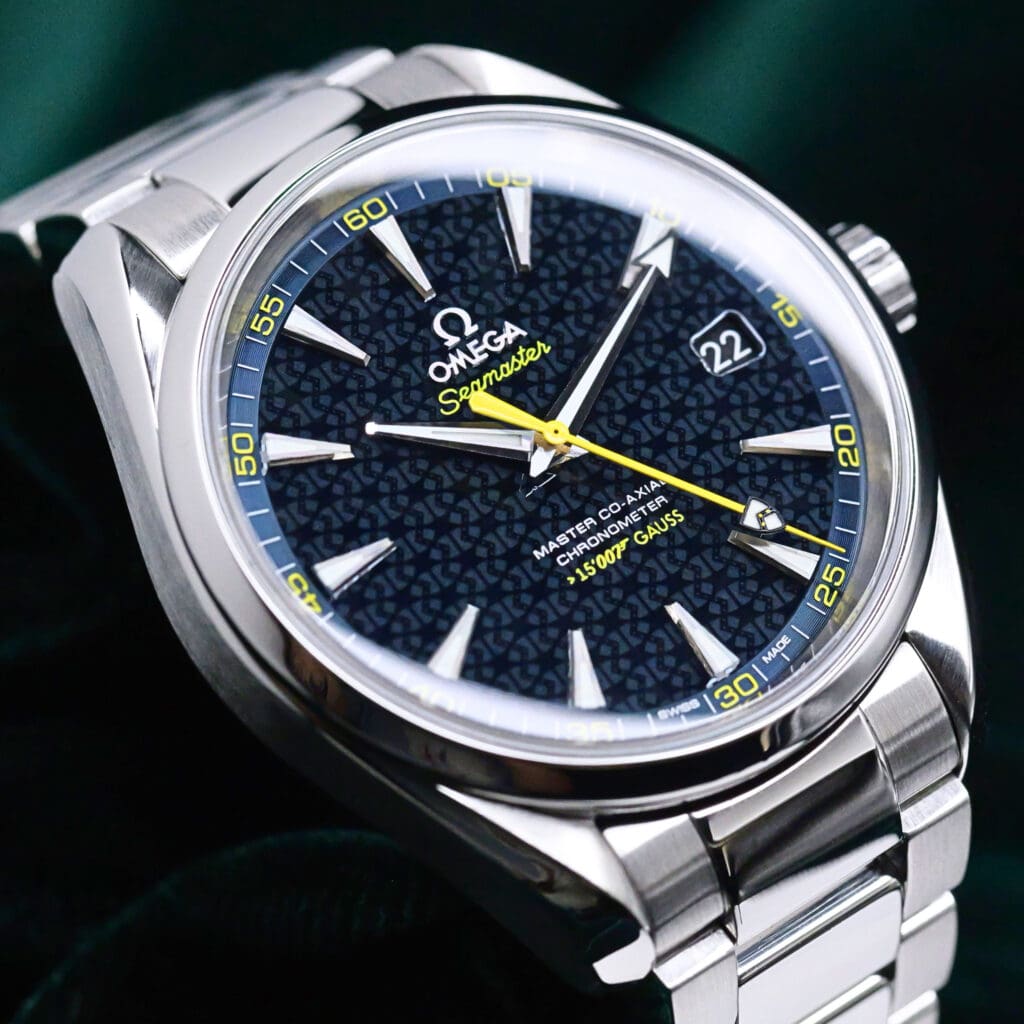
Omega Seamaster Aqua Terra 150M "James Bond Spectre" Blue Dial Yellow Accents Stainless Steel 41.5mm MINT CONDITION COMPLETE SET 231.10.42.21.03.004

Omega Speedmaster Split-Seconds "Rattrapante" Black Carbon Fiber Dial Stainless Steel 42mm MINT CONDITION 3540.50
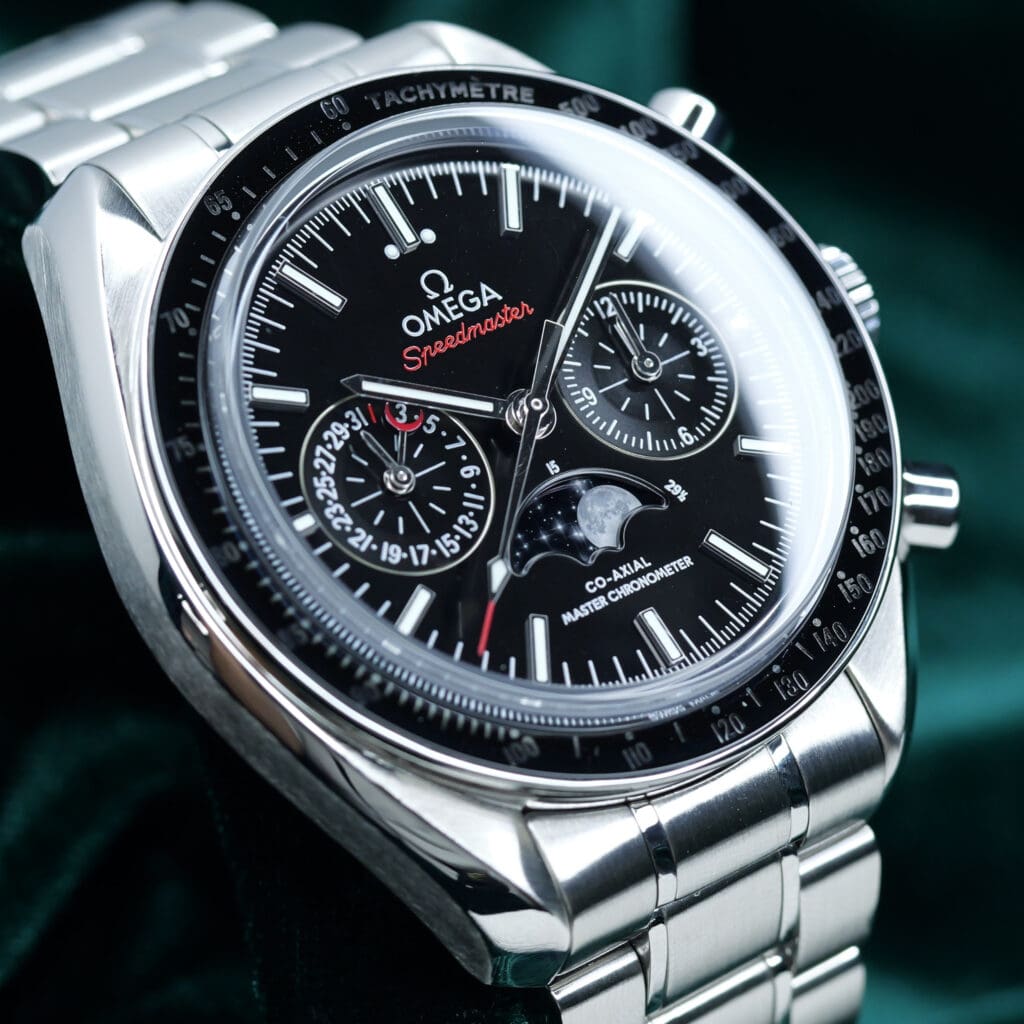
Omega Speedmaster Moonphase Co-Axial Master Chronometer Chronograph Black Dial Stainless Steel 44.25mm MINT CONDITION COMPLETE SET 304.30.44.52.01.001

Omega Seamaster Diver 300M "James Bond 007 Commander's Watch" Limited Edition White Dial Blue Ceramic Bezel Stainless Steel 41mm MINT CONDITION COMPLETE SET 212.32.41.20.04.001
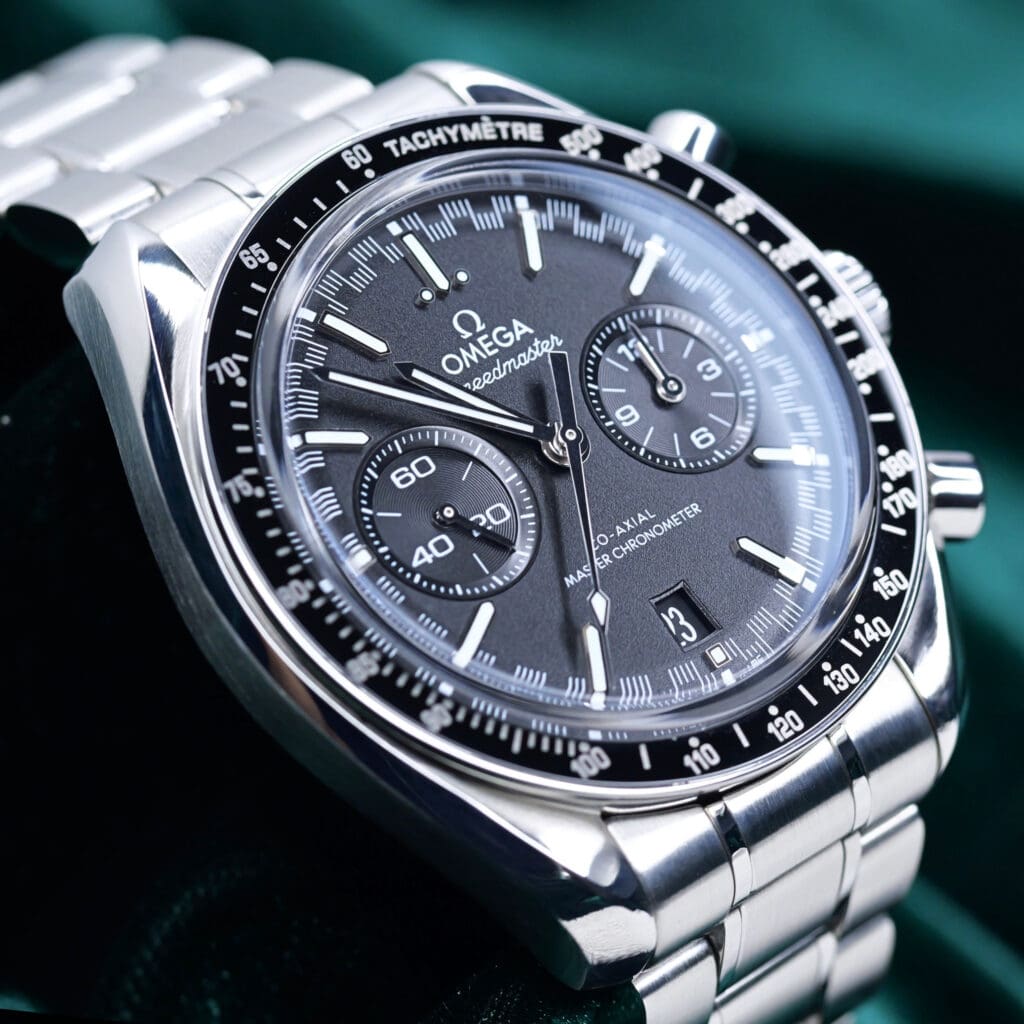
Omega Speedmaster Racing Co-Axial Master Chronometer Black Dial Stainless Steel 44.25mm MINT CONDITION COMPLETE SET 329.30.44.51.01.001
What Actually Moves Prices
Several practical factors influence the price of both collections on the secondary market.
The largest premium driver is a full set: the watch with its original box and papers. Buyers consistently pay more when the accessories are complete. An unpolished case also commands more, because collectors prefer original factory finishing. Refinished watches sell for less. These are among the things worth checking on any pre-owned example before you commit.
For the Trésor, dial colour matters more than most buyers expect. Blue domed and linen-textured dials tend to attract stronger demand than plain silver. On the Prestige side, movement generation is the biggest technical factor: Gen 3 Master Chronometer models hold value noticeably better than Gen 2 pieces on the Caliber 2500.
Precious-metal cases bring their own reality. They are harder to sell quickly at a fair price because the buyer pool is smaller. Service history also matters, especially for the manual-wind Trésor, where documented maintenance reassures a buyer.
Across both collections, most steel examples trade roughly 15 to 35 percent below retail, with precious-metal pieces discounting more steeply. For long-term ownership rather than speculation, a well-kept used example with a full set is usually the most rational entry point.
Notable De Ville Trésor References

The Trésor lineup is focused and deliberate. There are no redundant references here, and each one serves a distinct purpose within the collection.
1. 435.13.40.21.03.001 (Steel, Small Seconds)
This is the clearest entry into the mechanical Trésor and the reference that draws the most attention among enthusiasts.
The blue domed dial with 18K white-gold indexes is a standout in Omega’s current catalogue, and the small-seconds subdial at 6 o’clock keeps the layout clean without adding unnecessary complication. It sits at 40mm and roughly 10.1mm thick, thin enough to clear a dress-shirt cuff comfortably.
- Case size: 40mm
- Material: Stainless steel
- Movement: Cal. 8926, manual-wind, Master Chronometer
- Power reserve: 72 hours
- Caseback: Sapphire exhibition
- Typical range: $5,000–$6,500 used; around $7,300 retail
2. 435.13.40.22.06.001 (Steel, Power Reserve)
The power-reserve variant adds a subdial at 12 o’clock showing remaining mainspring tension, which is genuinely useful on a manual movement. The two-tone silvery dial reads as more neutral than the blue small-seconds and pairs across a wider range of formal attire. The Cal. 8934 inside is the same METAS-certified manual-wind family as the rest of the lineup.
- Case size: 40mm
- Material: Stainless steel
- Movement: Cal. 8934, manual-wind, Master Chronometer
- Power reserve: 72 hours
- Caseback: Sapphire exhibition
- Typical range: $5,500–$7,000 used; around $8,000 retail
3. 435.53.40.21.03.001 (Sedna Gold, Small Seconds)
The Sedna gold version is where the Trésor reaches its most formal expression. Omega’s proprietary Sedna gold has a warmer tone than standard rose gold and resists colour change over time. The movement carries the gold-bridge Cal. 8929, functionally the same as the steel version but visibly richer through the caseback.
- Case size: 40mm
- Material: 18K Sedna gold
- Movement: Cal. 8929, manual-wind, Master Chronometer
- Power reserve: 72 hours
- Caseback: Sapphire exhibition
- Typical range: $13,000–$18,000 used; around $19,000–$21,000 retail
Notable De Ville Prestige References

The Prestige lineup is wide. These are the references most directly relevant to the Trésor vs Prestige decision, chosen for how they compare against the Trésor in real terms.
1. 434.10.40.20.01.001 (Steel, Date, Bracelet)
The 40mm Gen 3 steel reference on the seven-link bracelet is the most practical and versatile entry in the Prestige lineup. The automatic Cal. 8800 with a 55-hour reserve keeps it running without input, and the date at 3 o’clock adds daily utility without crowding the dial.
This is the Prestige in its purest form: triple-apple bezel, polished bracelet, clean dial, automatic movement. For a first-time De Ville buyer, it covers the most ground without overcomplicating the decision, and it is the reference to line up first against the steel Trésor.
- Case size: 40mm
- Material: Stainless steel
- Movement: Cal. 8800, automatic, Master Chronometer
- Power reserve: 55 hours
- Caseback: Sapphire exhibition
- Typical range: $3,000–$4,000 used; around $5,500 retail
2. 434.10.41.21.06.001 (Steel, Power Reserve)
The 41mm power-reserve reference is the most technically complete men’s Prestige. The Cal. 8810 shows both a power-reserve indicator and a small-seconds subdial, making the dial more active without tipping into sport-watch territory.
Case thickness is about 10.8mm, a touch more substantial than the simple date version but still cuff-friendly on most wrists. The light “platinum-gold” grey dial reads as deliberately formal, and the 41mm case gives it stronger presence than the 40mm models. For buyers who want a multi-subdial layout inside a dress case, this is the most compelling Prestige currently available.
- Case size: 41mm
- Material: Stainless steel
- Movement: Cal. 8810, automatic, Master Chronometer
- Power reserve: 55 hours
- Caseback: Sapphire exhibition
- Typical range: $3,500–$5,000 used; around $6,800 retail
3. 434.20.40.20.02.001 (Two-Tone, Steel and Sedna Gold)
The two-tone Prestige combines stainless steel with Sedna gold accents. The result is warmer and more formal than all-steel, without the cost or weight of a full gold case. The seven-link mixed-metal bracelet is the defining feature and gives the watch a layered, jewelry-like look.
That bracelet also sets it apart from the Trésor, which stays on leather and a much simpler dress-watch approach. Two-tone configurations tend to hold secondary value slightly better than all-steel Prestige references because they appeal to a broader audience. For gold presence without a full gold price, this is the most efficient path in the line.
- Case size: 40mm
- Material: Steel and Sedna gold (two-tone)
- Movement: Cal. 8800, automatic, Master Chronometer
- Power reserve: 55 hours
- Caseback: Sapphire exhibition
- Typical range: $4,500–$6,500 used; around $8,500 retail
Which De Ville Should You Choose?

Both are strong dress watches. The decision comes down to how you plan to wear one, not which is technically superior. If you are also cross-shopping other Omega families, the Omega buying guide maps the wider range.
Choose the De Ville Trésor if:
- You want a manual-wind movement and don’t mind winding it every two to three days
- A caseback with a full, rotor-free movement view matters to you
- You prefer a minimal, unadorned bezel and clean case lines
- Formal and black-tie occasions are the primary context
- You prefer leather over a metal bracelet at all times
- You want the most collector-credible option in the De Ville family
Choose the De Ville Prestige if:
- You want a self-winding automatic that needs no winding routine
- A metal bracelet matters, or you want to alternate bracelet and strap
- You need a specific dial colour, size, or two-tone configuration
- Smart-casual versatility matters as much as formal capability
- You are buying at a lower entry price in steel
The tie-breaker: if you will wear it most days across different contexts, choose the Prestige. If it is a dedicated formal watch you want to engage with deliberately, choose the Trésor. Still cross-shopping outside Omega? Our De Ville vs IWC Portofino breakdown weighs it against the obvious dress-watch rival.
If you have shortlisted one or two references and want a second read before committing, send us the reference numbers you are weighing and we will walk you through condition, dial variants, and what a fair market number looks like right now.



Where to Buy an Omega De Ville Online
There are a handful of legitimate online channels for buying a De Ville Trésor or Prestige. Chrono24 aggregates dealer and private listings worldwide with buyer protection on escrowed payments. Worth knowing what to watch for on Chrono24 before you commit.
eBay covers both through its Authenticity Guarantee program, which routes eligible watches through a third-party check before delivery. Grailzee runs enthusiast auctions if you would rather bid than buy outright.
We also sell, buy, and trade luxury watches, and the reason clients pick us over a big marketplace is the layered communication before you commit. You get tour videos of the actual watch rather than stock photos, honest condition notes, and a direct conversation with a real person who has handled the piece. You are not buying blind off a listing.
That approach is reflected in our 4.9-star Google rating. If you want that kind of walkthrough on a specific Trésor or Prestige reference, reach out and we’ll help you source one that matches the dial, size, and budget you’re after.
Omega De Ville Trésor vs Prestige FAQ
Which holds its value better, the Trésor or the Prestige?
Neither is a strong investment, but the steel Prestige Gen 3 tends to be the safer resale. Its broader buyer pool and lower entry price make it easier to move. The Trésor holds a more stable price on desirable blue and linen dials, but thin liquidity means it can sit longer before selling.
For the bigger picture on how the brand retains value, our Omega vs Rolex resale value comparison is a useful reference.
Is the Trésor worth the premium over the Prestige?
Only if you specifically want what it offers: a manual-wind movement, a rotor-free caseback view, and a leather-strap dress watch for formal wear. On movement certification the two are equal, so you are paying for character and finishing, not better accuracy.
Can you put the De Ville Trésor on a bracelet?
Not from Omega on the main mechanical men’s references — they ship on leather only. You can fit an aftermarket bracelet or an Omega leather-to-deployant setup, but there is no factory metal bracelet for the 40mm mechanical Trésor. If a bracelet is non-negotiable, the Prestige is the line to look at.
999+ Timepieces Available
Explore Our Timepieces
Authenticated, unworn, and ready to ship worldwide.
Rolex · Audemars Piguet · Patek Philippe · Omega · Cartier · Richard Mille · Hublot · Tudor
Newly Listed

2026 NEW UNWORN Cartier Santos-Dumont Silver Dial Platinum Mesh Bracelet Platinum 31mm COMPLETE SET WGSA0124
$64,790.00

2026 Tudor Black Bay 58 Black Dial Jubilee Bracelet Stainless Steel 39mm MINT CONDITION COMPLETE SET 7939A1A0NU
$5,717.00

NEW UNWORN Rolex Submariner Date “Sub Date” Black Dial Black Ceramic Bezel Oyster Bracelet Stainless Steel 41mm COMPLETE SET 126610LN
$15,595.00
Rolex Cosmograph Daytona "Reverse Panda" Black Dial Black Ceramic Bezel Oyster Bracelet Stainless Steel 40mm MINT CONDITION COMPLETE SET 126500LN
$32,009.00
2026 NEW UNWORN Rolex Submariner No Date Black Dial Black Ceramic Bezel Oyster Bracelet Stainless Steel 41mm COMPLETE SET 124060
$15,219.00
Audemars Piguet Royal Oak Selfwinding Chronograph Bleu Nuit Nuage 50 Blue Dial Bracelet 18k Rose Gold 38mm MINT CONDITION COMPLETE SET 26715OR.OO.1356OR.01
$104,942.00
Rolex Datejust “Tuxedo” Black and Silver Dial 18K White Gold Fluted Bezel Stainless Steel Oyster 36mm MINT CONDITION COMPLETE SET 116234
$10,671.00
Vacheron Constantin Overseas Dual Time Silver Dial Brown Leather Strap 18K Rose Gold 41mm MINT CONDITION COMPLETE SET 7900V/000R-B336
$41,894.00
Rolex Sea-Dweller Deepsea James Cameron D-Blue Dial Black Ceramic Bezel Oyster Bracelet Stainless Steel 44mm MINT CONDITION 116660-0003
$14,272.00
Vacheron Constantin Overseas Dual Time Silver Dial 18K Rose Gold Brown Rubber Strap 41mm MINT CONDITION COMPLETE SET 7900V/000R-B336
$41,894.00
Rolex Lady-Datejust Champagne Linen Dial 18k Yellow Gold Fluted Bezel Jubilee Bracelet Two Tone Steel & Gold 26mm MINT CONDITION COMPLETE SET 69173
$9,345.00
2026 Rolex Datejust Blue Dial Smooth Bezel Jubilee Bracelet Stainless Steel 41mm MINT CONDITION COMPLETE SET 126300
$13,796.00
Final Thoughts on Omega De Ville Trésor vs Prestige
The Omega De Ville Trésor vs Prestige decision is really a question of identity and habit.
The Trésor asks something of its owner. You wind it every few days, you see the full movement through the caseback, and you wear it on leather to occasions that warrant it. If a dress watch is something you want to engage with rather than simply wear, the Trésor rewards that instinct in a way the Prestige is not designed to.
The Prestige fits into more of your life without requiring thought. It winds itself, comes on a bracelet if you want one, and handles the space between a business meeting and a dinner without asking you to change anything. For most buyers, that range of use is exactly what a dress watch should offer.
Budget matters too. At used prices the steel Prestige sits well below the steel Trésor, and both carry the same Master Chronometer certification, so you are not compromising on movement quality by choosing the more affordable line.
Two quick tips before you buy: prioritize a full set with box and papers, and on the Trésor, ask for recent service history and what a service costs since a hand-wound watch gets handled more often. Match the watch to how you actually dress, and the right one becomes obvious.