Knowing how to spot a fake Rolex Oyster Perpetual can feel tricky because the model looks simple, clean, and straightforward, which is exactly why counterfeiters love making duplicates. Many replicas get the basic shape right but fall apart once you check details like the dial finish, bracelet construction, or movement behavior.
In this guide, you’ll learn the exact checks that reveal fakes fast, including physical traits, movement clues, paperwork verification, and a full authenticity checklist. If you want to feel confident identifying a real Oyster Perpetual, follow this breakdown and use it whenever you evaluate a watch.
Overview of the Rolex Oyster Perpetual
The Rolex Oyster Perpetual is one of the brand’s most recognizable designs, known for its clean dial, simple functionality, and reliable Oyster case. It comes in several sizes and generations, each with small details that matter when authenticating a watch. Here are the key variations you should know before you check if an Oyster Perpetual is real:
Key Oyster Perpetual Sizes and Generations
| Size | Notable References | Key Notes |
| 28mm | 276200 | Smallest size; commonly paired with simpler dials. |
| 31mm | 277200 | Popular for smaller wrists; consistent marker layout. |
| 34mm | 124200, 114200 | Classic mid-size option; older versions use different lume. |
| 36mm | 126000, 116000 | Highly collected; includes vibrant lacquer dials. |
| 39mm | 114300 | Discontinued; known for blue, rhodium, and grape dials. |
| 41mm | 124300 | Most recent size; includes turquoise, coral red, and yellow dials. |
Oyster Perpetual Dial Variations
- Sunburst dials: Metallic radial finish with shifting tones; seen in blue, rhodium, and champagne.
- Lacquer dials: Smooth, glossy finish; found in turquoise, coral red, green, and black.
- Colored dials: Known from the 2020 release; often copied but fakes show uneven texture.
- Lume type: Chromalight with blue glow on modern references; older models used Super-LumiNova.
- Marker styles: Stick indices are standard; double markers at 3, 6, and 9 appear on select generations.
Different Oyster Bracelet Construction
- Hollow links: Found on older Oyster Perpetual models; lighter feel and more rattle.
- Solid links: Standard on modern references; heavier, smoother, and more refined.
- SEL (solid end links): Provide tighter case fit; common on most recent models.
- Clasp generations: Older stamped clasps vs. modern Oysterclasp with Easylink extension.
How to Spot a Fake Rolex Oyster Perpetual
Learning how to spot a fake Rolex Oyster Perpetual becomes easier once you break the process into physical traits, movement behavior, and paperwork clues. Here are the checks that reveal fakes quickly and reliably.
Physical Checks
Authenticating an Oyster Perpetual starts with the external details that most fakes get wrong. Here are the visual and structural features you should examine closely.
1. Case Finishing and Proportions
Look for crisp brushing on the top of the lugs and smooth, even polishing on the case sides. Fake models typically have softer edges, uneven transitions, or brushing that looks messy or inconsistent. The real Oyster Perpetual feels solid and precise because Rolex uses 904L Oystersteel, which holds crisp finishing. Any rattling or looseness from the case or bracelet is another sign that something’s off.
2. Dial Printing and Marker Alignment
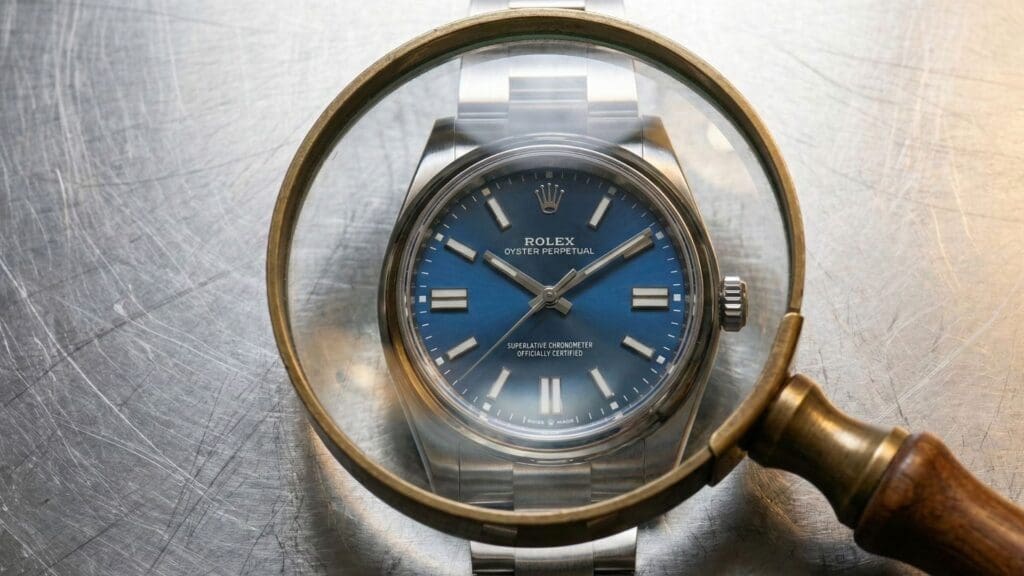
Check the sharpness of the Rolex coronet, the spacing of the text, and the alignment of the minute markers. Fake dials often show fuzzy printing, crooked indices, or lume plots that vary in size and placement. Modern references use Chromalight lume that glows bright blue, while replicas often glow green or fade quickly.
Pay attention to dial color as well, since many fakes struggle to match Rolex’s lacquer or sunburst tones.
3. Crystal and Rehaut Accuracy
A genuine Oyster Perpetual has a sapphire crystal that sits perfectly flush with the bezel and doesn’t distort the dial around the edges. On 2007–2020 models, the rehaut has laser-etched “ROLEX” text that should align precisely with the hour markers. The engraving should be sharp, evenly spaced, and cleanly cut. Newer references without rehaut text should still have a flawless, mirror-like rehaut with no clouding or unevenness.
4. Bracelet Fit and Clasp Quality
Solid end links on a real OP fit tightly against the case with no gaps or wiggle room. Fakes often use looser links or poorly machined pieces that create rattling or uneven spacing. The clasp should have crisp engraving and a smooth, confident closing action. The Easylink extension should deploy cleanly — many replicas get the thickness or movement of this mechanism wrong.
Movement Checks
Movement behavior reveals details even good replicas struggle to copy. Below are the internal cues that help you confirm a genuine Oyster Perpetual.
1. Smooth Seconds-Hand Sweep
The OP uses calibers like the 2232, 3130, or 3230, which produce a smooth and consistent seconds-hand motion. Although not a true “glide,” the movement never stutters or ticks like lower-grade replicas. Fakes commonly use cheap Miyota or Seagull movements that reveal themselves through uneven motion. If the hand visibly jumps between positions, the watch is almost certainly fake.
2. Proper Hacking and Winding Behavior
When you pull the crown to the time-setting position, the seconds hand should stop immediately: this is known as hacking. Many replicas don’t hack reliably or have a slight delay when pulling the crown. Winding a real OP feels smooth and controlled with no gritty sensation. Any grinding, slipping, or uneven resistance during winding is a warning sign.
3. Accurate Power Reserve
Depending on the reference, a genuine OP should run between 48 and 70 hours once fully wound. If the watch dies overnight despite being fully wound, the movement may not be a real Rolex caliber. Fake movements often have inconsistent power delivery and can stop randomly. Also watch for erratic amplitude, which shows up as sudden speed changes.
4. Chronometric Consistency
Authentic OP models maintain tight accuracy thanks to Rolex’s chronometer standards. A daily gain or loss over 20–30 seconds is unusual and often signals a non-Rolex movement inside. Replicas frequently run fast or slow because they lack the stability of Rolex’s balance assemblies. Dramatic fluctuations from one day to the next are another clue of a counterfeit movement.
Documentation and Packaging Checks
Verification is not complete until you confirm the watch’s paperwork and supporting items. Here are the external details that help prove authenticity.
1. Warranty Card Details
Modern Oyster Perpetual warranty cards contain embedded chips, specific font spacing, and strict formatting. The serial and reference numbers printed on the card must match the watch exactly, including dial color and bracelet type. Fake cards often use incorrect fonts, wrong spacing, or mismatched information. Scanning for consistency helps reveal counterfeits quickly.
2. Box and Tag Accuracy
The green Rolex box should correspond to the model era and should feel sturdy, with clean stitching and high-quality materials. Replicas often use boxes with the wrong texture, dimensions, or shade of green. Hangtags should match the reference and sometimes include COSC details depending on the generation. Printed fonts and plastic quality often give away fakes here.
3. Serial and Reference Verification
Serial numbers on post-2010 Oyster Perpetual models appear on the rehaut, while older versions have them engraved between the lugs. These engravings should be razor-sharp and consistent in depth. Replicas frequently use laser etching that looks too shallow or uneven. Cross-checking the serial with known production years can expose mismatches.
4. Purchase History and Seller Transparency
A trustworthy seller provides full, clear photos, verifiable details, and a consistent story about the watch’s origin. Sellers who avoid macro shots or decline to answer simple authenticity questions are often hiding something. A lack of service history or incomplete paperwork doesn’t automatically mean fake, but it increases risk. Transparency is one of the strongest indicators of legitimacy.

Complete Rolex Oyster Perpetual Authenticity Checklist
Use this checklist to review every major detail when confirming authenticity. Below is a table that summarizes what to inspect, what’s correct, and which red flags signal a fake:
| Item to Check | What to Look For | Red Flags |
| Case Finishing | The case should have crisp brushing, sharp edges, and clean transitions across all surfaces. The finishing should feel deliberate and never look soft or rounded. | Rounded edges or uneven finishing usually indicate poor machining. Any inconsistent texture across the lugs suggests low-quality workmanship. |
| Dial Printing | The printing should be razor-sharp with consistent spacing and perfectly aligned markers. A clean coronet and precise minute track are strong signs of authenticity. | Smudged text, crooked indices, or sloppy spacing appear frequently in fakes. Any visible printing flaw is an immediate red flag |
| Lume Color | Modern OP models use Chromalight, which glows a crisp blue with even brightness. Older models may glow green depending on the generation. | Green lume on a reference that should have Chromalight is a clear counterfeit sign. Weak or patchy lume also signals a |
| Hands and Markers | Hands and markers should have smooth edges, uniform finishing, and perfect alignment. Their lengths and proportions must match Rolex specifications. | Replica hands often have rough edges or mismatched shapes. Markers that tilt or sit unevenly indicate counterfeit components. |
| Crystal Fit | The sapphire crystal should sit flush with the bezel and show no distortion along the edges. Light should reflect evenly across the surface. | Cloudiness, distortion, or uneven fit are strong indications of a fake. Some replicas use mineral glass instead of sapphire. |
| Rehaut Engraving | On 2007–2020 models, the ROLEX rehaut text should align precisely with the markers. The coronet at 12 o’clock must be perfectly centered. | Misaligned engravings or incorrect fonts are easy-to-spot red flags. Shallow or blurry text indicates low-quality laser work. |
| Bracelet Links | Modern OP bracelets use solid links that feel dense and smooth. The bracelet should curve naturally and fit tightly against the case. | Hollow-feeling links on references that shouldn’t have them are a clear sign of a fake. Gaps or rattling at the end links are also common in replicas. |
| Clasp Function | The Oysterclasp should close smoothly with a confident snap. The Easylink extension must fold out cleanly and feel sturdy. | Stiff hinges or misaligned components reveal poor craftsmanship. Weak engraving or flimsy metal also indicate a replica clasp. |
| Movement Sweep | The seconds hand should move with a smooth, uninterrupted sweep. Any stuttering or hesitation should be investigated further. | Jerky or uneven motion is typical of clone movements. Ticking in distinct steps means the watch is not using a real Rolex caliber. |
| Hacking Function | When the crown is pulled out, the seconds hand should stop instantly. The action should feel precise and controlled. | A hand that doesn’t stop or pauses inconsistently suggests a fake movement. Delayed hacking behavior is also a red flag. |
| Power Reserve | A genuine OP should run 48–70 hours depending on its caliber. It should maintain consistent performance throughout that reserve. | If the watch dies overnight or loses power unpredictably, the movement may not be authentic. Poor power consistency is common in replicas. |
| Warranty Card | The card should have correct fonts, spacing, and embedded security features. The serial and reference numbers must match the watch exactly. | Incorrect spacing, cheap plastic, or mismatched data reveal a fake card. Printing errors or missing features also signal a counterfeit. |
| Box and Tags | The box should match the production era and feel sturdy with clean finishing. Hangtags must display correct reference information. | Generic boxes or wrong materials are common in replicas. Low-quality tags or mismatched details are additional red flags. |
| Serial Number | Engravings should be sharp, deep, and perfectly spaced. Placement must match the correct era of the model. | Shallow or uneven engravings often indicate a fake case. Serials that don’t align with known production years are major concerns. |
| Seller Transparency | A trustworthy seller provides clear photos, consistent details, and a reliable story. Service records and open communication add confidence. | Sellers who avoid questions or offer blurry images should be approached carefully. Vague histories or inconsistent information often hide authenticity issues. |
Final Thoughts on Spotting a Fake Rolex Oyster Perpetual
Knowing how to spot a fake Rolex Oyster Perpetual gives you real confidence when you’re buying, selling, or simply evaluating a watch. When you take your time with each detail, such as the dial, bracelet, movement behavior, and paperwork, you give yourself a huge advantage over even well-made replicas. If anything feels off while you’re checking a watch, trust that instinct and slow down.
You’re doing the right thing by learning these steps. Taking a little extra care now will save you from bigger problems later.

FAQs About How to Spot a Fake Rolex Oyster Perpetual
What is the quickest way to spot a fake Rolex Oyster Perpetual?
The fastest way to check authenticity is by inspecting the dial, since most fakes struggle with clean printing and proper alignment. Look closely at the Rolex coronet, the spacing of the text, and the minute track. A genuine OP dial is sharp and flawless under magnification. If anything looks smudged or uneven, it’s usually a fake.
Are the colorful dial Oyster Perpetual models more commonly faked?
Yes, the turquoise, coral red, green, yellow, and candy-tone lacquer dials are copied constantly due to their popularity. Fake versions often have uneven colors, dull shine, or incorrect shade matching. The authentic lacquer finish is smooth and rich with no patchiness. Many replicas also get the lume color wrong on these references.
Can I authenticate an Oyster Perpetual without opening the caseback?
Yes, many of the best authenticity checks can be done externally without opening the watch. Details like the rehaut engraving, bracelet fit, crystal clarity, and serial placement already reveal most fakes. Movement behavior (like sweep quality and hacking) adds another layer of certainty. A caseback inspection is only needed when you want full confirmation.
Should I buy an OP without papers if it passes visual checks?
Buying without papers is possible, but it raises the risk, so you’ll need to rely heavily on physical and movement checks. A trustworthy seller should provide clear photos, matching serials, and a consistent ownership story. If anything feels vague or rushed, step back and reassess. Papers aren’t everything, but transparency absolutely is.