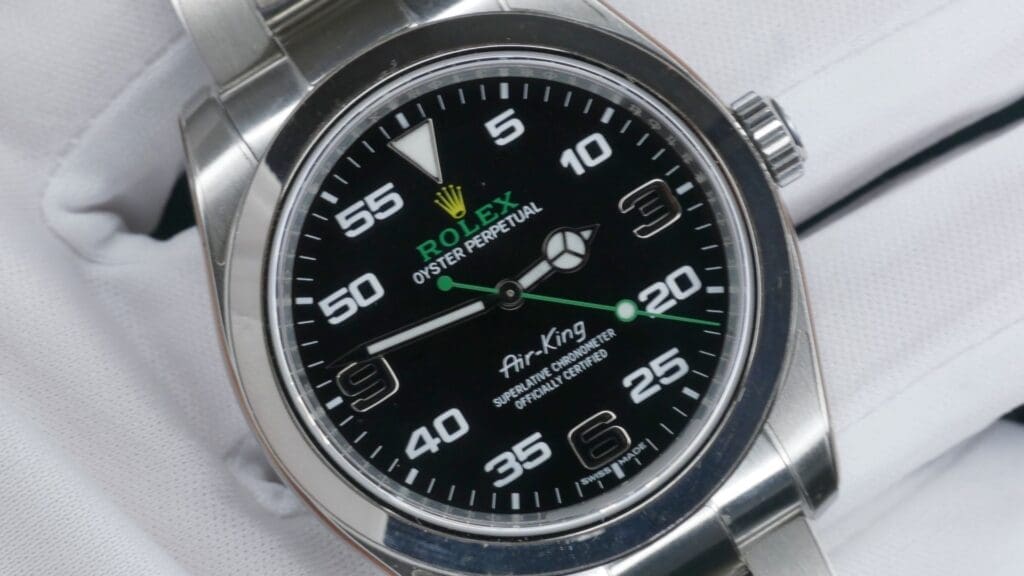
Setting a Rolex Air-King correctly starts with using the crown in the right position, aligning the hands with an accurate reference, and taking advantage of the hacking seconds feature for precise timing. Because the Air-King has no date window and uses a straightforward crown system, the process is simple once you understand how the movement responds to each click.
This guide covers how to set a Rolex Air King safely and accurately, including winding, time-setting technique, AM/PM identification, and the common mistakes that can affect long-term performance.
It helps to understand what makes the Air-King unique in the Rolex lineup before you attempt to adjust the watch.
Rolex Air-King Overview
The Rolex Air-King is one of the brand’s simplest three-hand watches, built around clean time-only functionality with no date window or additional complications. Most modern references, such as the 116900 and 126900, use Rolex’s Caliber 3131 or 3230, both featuring hacking seconds, strong magnetic resistance, and a smooth, consistent crown response for precise time-setting.
The watch uses Rolex’s Twinlock screw-down crown, which provides reliable water resistance and keeps the movement sealed when properly tightened.
Because the Air-King doesn’t include a quickset date or independent hour-hand function, the time-setting process focuses entirely on the crown’s final click and the movement’s hacking feature. These traits make the Air-King straightforward to adjust while still requiring careful handling to protect the crown tube and internal gears.
When you understand these key characteristics, the time-setting steps in the next section become easier, safer, and more accurate.

Rules Before Setting a Rolex Air-King
Before adjusting your Air-King, you need to understand how the crown and movement behave during winding and time setting. These rules help protect the stem, preserve water resistance, and keep the hands aligned correctly.
- Confirm the watch is dry. Any moisture around the crown increases the risk of slipping when you pull it out, which can put sideways pressure on the stem.
- Unscrew the crown fully before pulling. Partial unscrewing stresses the Twinlock threads and may cause the stem to sit off-center when you set the time.
- Wind the watch if it has stopped. A stable power reserve keeps the hands moving smoothly during adjustment and prevents hesitations while setting the exact minute.
- Only rotate the hands forward. Forward motion keeps the gear train engaged in the correct direction and prevents stress on the reversing wheels.
- Work in good lighting. Seeing the crown positions clearly reduces the chance of skipping clicks or pulling too hard.
- Stop if the crown feels gritty or rough. This can indicate dirt or dried lubrication in the tube; continuing to turn it may worsen the friction.
How to Set the Time on a Rolex Air-King
Modern Air-King models use hacking seconds and a simple crown system. Follow these steps to set the time safely, accurately, and without stressing the movement.
1. Unscrew the Crown – Turn the crown counterclockwise until it fully releases. The Twinlock crown should “pop” outward when free. Avoid pulling before the threads disengage to protect the crown tube.
2. Pull the Crown to the Final Click (Hacking Seconds Activates) – Gently pull the crown to the last position. The seconds hand will stop immediately; this feature allows precise synchronization and prevents drift while setting the hands.
3. Rotate the Hands Forward to the Correct Time – Turn the crown clockwise to move the hands forward. Forward motion keeps the gear train aligned and avoids backward tension that can affect long-term smoothness.
4. Identify AM/PM by Passing 12 O’Clock and Checking an External Reference – Rotate the hands past 12 and check an external reference (phone, atomic time, or clock) to confirm morning or evening hours. The Air-King has no date window, so this is the only reliable way to confirm AM/PM.
5. Align Seconds Using an Accurate Time Signal (NIST/GPS) – When the minute hand reaches the correct position, wait for a NIST, GPS, or atomic time signal. Push the crown in at the exact second to restart the movement in perfect sync.
6. Push the Crown In and Screw It Down Fully – Press the crown toward the case to restart the seconds, then screw it clockwise until tight.
How to Wind a Rolex Air-King Before Setting the Time
The Air-King needs sufficient power in its mainspring to move the hands smoothly during adjustment. Follow these quick steps to wind the watch properly before setting the time.
1. Unscrew the Crown – Turn the crown counterclockwise until it releases from the case. Make sure the threads are fully disengaged before winding to avoid uneven pressure on the stem.
2. Wind Forward 20–30 Turns – Rotate the crown clockwise with steady, even turns. Twenty to thirty winds bring the movement into a stable power range, preventing stuttering or hesitation in the hands when you adjust the time.
3. Pull the Crown to the Time-Setting Position – Gently pull the crown to the final click. This activates hacking seconds and stops the second hand so you can align the watch precisely with a reference time.
4. Set the Time Normally – Rotate the hands forward until they match the correct time and AM/PM. Forward rotation keeps the movement’s gear train under proper tension and prevents unnecessary strain.
5. Screw Down the Crown Completely – Push the crown inward to restart the seconds, then screw it down clockwise until secure. A tight seal restores water resistance and protects the movement from moisture.
How to Recognize AM/PM on a Rolex Air-King
The Rolex Air-King has no date window, so the watch cannot show AM or PM on its own. To determine the correct 12-hour cycle, rotate the hands forward past 12 o’clock and compare the position to an external time source such as your phone or an atomic clock.
If the reference shows morning hours and your watch has just crossed 12, you’re in the AM cycle; if it shows afternoon or evening, you’re in PM. This check ensures you set the time accurately and keeps your watch aligned with your daily schedule.
Common Mistakes When Setting a Rolex Air-King
Even though the Air-King has a simple, time-only movement, certain handling errors can strain the stem, affect accuracy, or compromise water resistance. These specific issues below happen often with this model, and each one is important to avoid.
1. Forgetting to Screw Down the Twinlock Crown
The Air-King uses a Twinlock screw-down crown, and leaving it even slightly loose breaks the seal that protects the movement. A partially open crown can let in moisture, especially during daily wear or handwashing. Always tighten the crown until you feel clean resistance — not a hard stop — to restore the watch’s water resistance.
2. Turning the Hands Backward on Rolex Calibers
Although the Air-King has no date mechanism to disrupt, backward rotation still places stress on the gear train. Reversing the hands can cause subtle tension in the intermediate wheels, which affects long-term smoothness. Forward rotation keeps the movement operating in its intended direction and reduces internal wear.
3. Setting the Time Without Using the Hacking Seconds Feature
Calibers used in the Air-King stop the seconds hand when the crown is pulled to the final click. Ignoring this feature and trying to “time” the seconds while the watch is still running leads to misalignment and drift. Using hacking seconds ensures precise synchronization with a reference signal and prevents the need for frequent readjustments.
4. Not Winding the Watch Enough After Long Inactivity
When the Air-King has been unworn for several days, the mainspring loses tension. Setting the time on a nearly empty power reserve can make the minute and second hands stutter or lag. Always wind 20–30 turns before adjusting — this stabilizes amplitude and keeps the hands moving cleanly.
5. Pulling or Twisting the Crown Too Aggressively
The crown stem on the Air-King is designed for smooth, controlled movement. Pulling it at an angle or twisting too forcefully can bend the stem or cause it to sit off-center. This leads to rough crown action and potential damage to the sealing tube. A straight, gentle pull is all the movement requires.
6. Adjusting Time With Wet Hands or in Humid Environments
Setting the time while your fingers are damp increases the chance of slipping and applying side pressure on the crown. High humidity can also introduce moisture around the open crown, even if water is not directly present.
Useful Tips for Setting a Rolex Air-King
Use these targeted techniques to keep your Air-King precise, protect its movement, and avoid subtle handling issues:
- Let the seconds hand settle before pushing the crown in.
After aligning the minute hand, wait one or two seconds for the hacking mechanism to stabilize so the seconds restart cleanly without a jump. - Hold the watch flat while setting.
A flat position keeps gravity from shifting the hands or applying uneven tension to the stem, especially when making fine minute adjustments. - Keep consistent finger pressure when turning the crown.
Sudden pressure changes can cause small, unintended hand jumps. Smooth, steady motion gives you better control over precise minute placement. - Use a microfiber cloth for grip.
Wrapping your fingertips with a soft cloth improves traction on the crown and prevents slipping that can lead to angled pulling or excess stem pressure. - Check the minute hand’s alignment with the markers.
Some watches show slight “hand drift” when the crown is pushed in. If it shifts slightly, pull the crown back out, make a micro-adjustment, and try again. - Avoid setting the watch immediately after exposure to temperature changes.
Moving from cold to warm environments can temporarily affect lubrication and metal contraction. Let the watch acclimate for a few minutes before adjusting. - Use a stable surface instead of holding the watch in mid-air.
Setting the time while the watch rests on a table or soft pad prevents wrist movement from transferring pressure to the stem. - Double-check the crown threads before tightening.
Make sure the crown sits straight against the tube before screwing in. Misaligned threading is a common cause of premature wear on Twinlock systems. - Set the time a minute ahead, then wait for the reference signal.
This technique helps you stop exactly on the target minute without rushing when the signal hits, resulting in cleaner synchronization. - Monitor performance over 24 hours after setting.
If the Air-King gains or loses more than a few seconds, note the pattern. It may indicate positional variance or the need for regulation.

Essential Takeaways for Smooth Time Setting
Setting a Rolex Air-King becomes simple once you understand how the crown, hacking seconds, and forward-hand rotation work together. With proper winding, the right crown position, and a reliable external time reference, the watch responds cleanly and stays stable throughout the adjustment.
Slow, controlled movements protect the gear train, and sealing the Twinlock crown fully keeps moisture out and preserves long-term performance. These small habits make setting the Air-King feel effortless and keep the movement running the way Rolex intended.
Take a moment to set it with care each time. Your watch will reward you with accuracy, consistency, and the confidence of a perfectly timed wrist.
FAQs About Setting a Rolex Air-King
Does the Rolex Air-King have a date to set?
No. The Rolex Air-King is a time-only model, so there is no date window or date mechanism to adjust. You only set the hour, minute, and seconds hands using the final crown position. This makes the Air-King simpler to operate compared with Rolex models that include a calendar function.
Should the seconds hand stop when I pull out the crown?
Yes. Modern Air-King movements include a hacking feature that stops the seconds hand when the crown reaches the last setting position. This allows you to match the time precisely with an accurate reference signal. If the seconds continue running, the crown may not be fully pulled out.
How many turns should I wind the Air-King before setting the time?
A good range is twenty to thirty full winds. This amount provides a stable power reserve and keeps the hands moving smoothly while you adjust the time. Winding too little can cause hesitation or drift, especially if the watch has been inactive for several days.
Why is my Air-King running a few seconds fast or slow?
A small daily variation is normal for mechanical movements. Factors like wrist position, temperature changes, or low power reserve can influence accuracy. If the watch consistently gains or loses several seconds each day, even after full winding, it may need a regulation check or routine service.