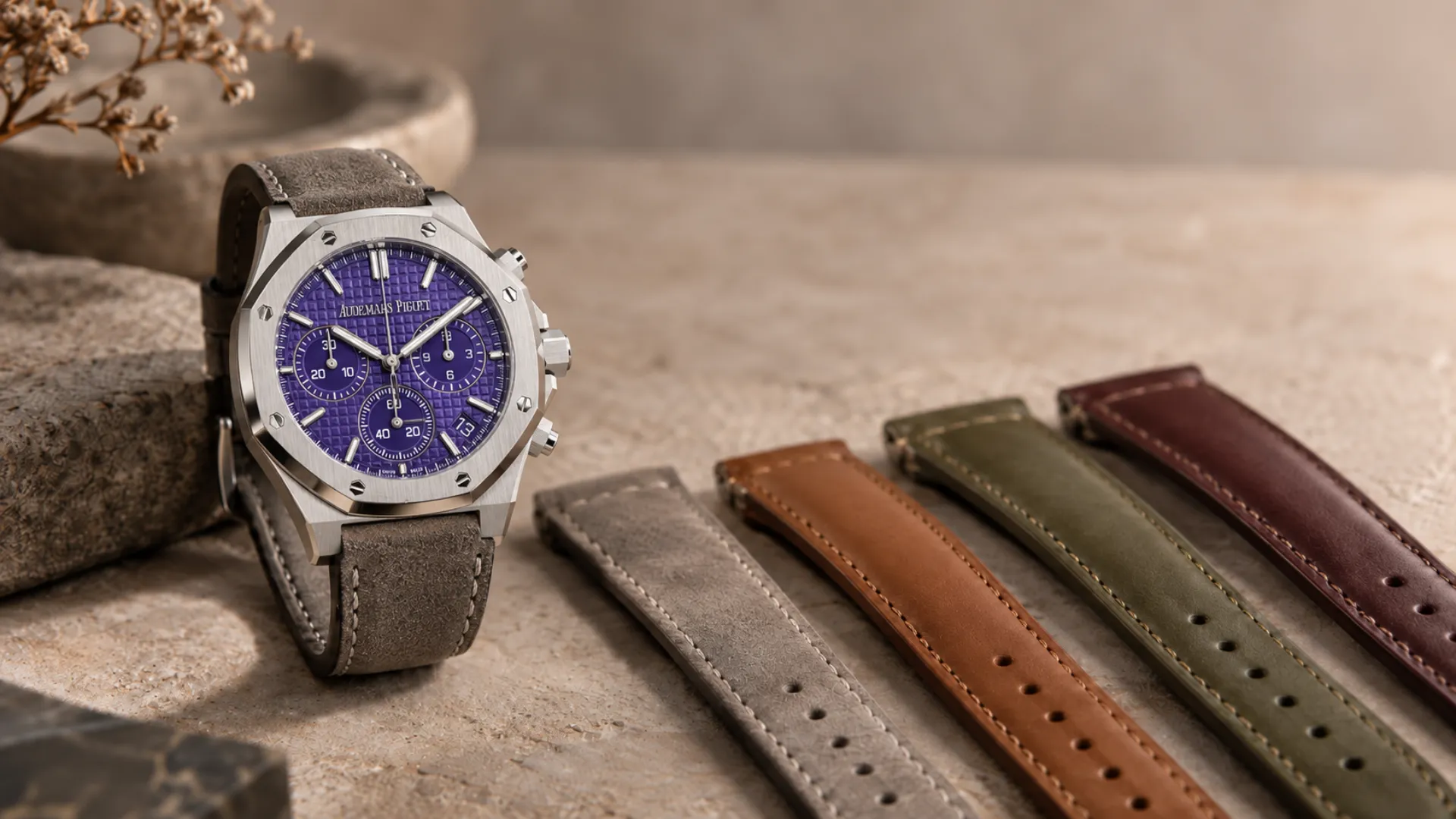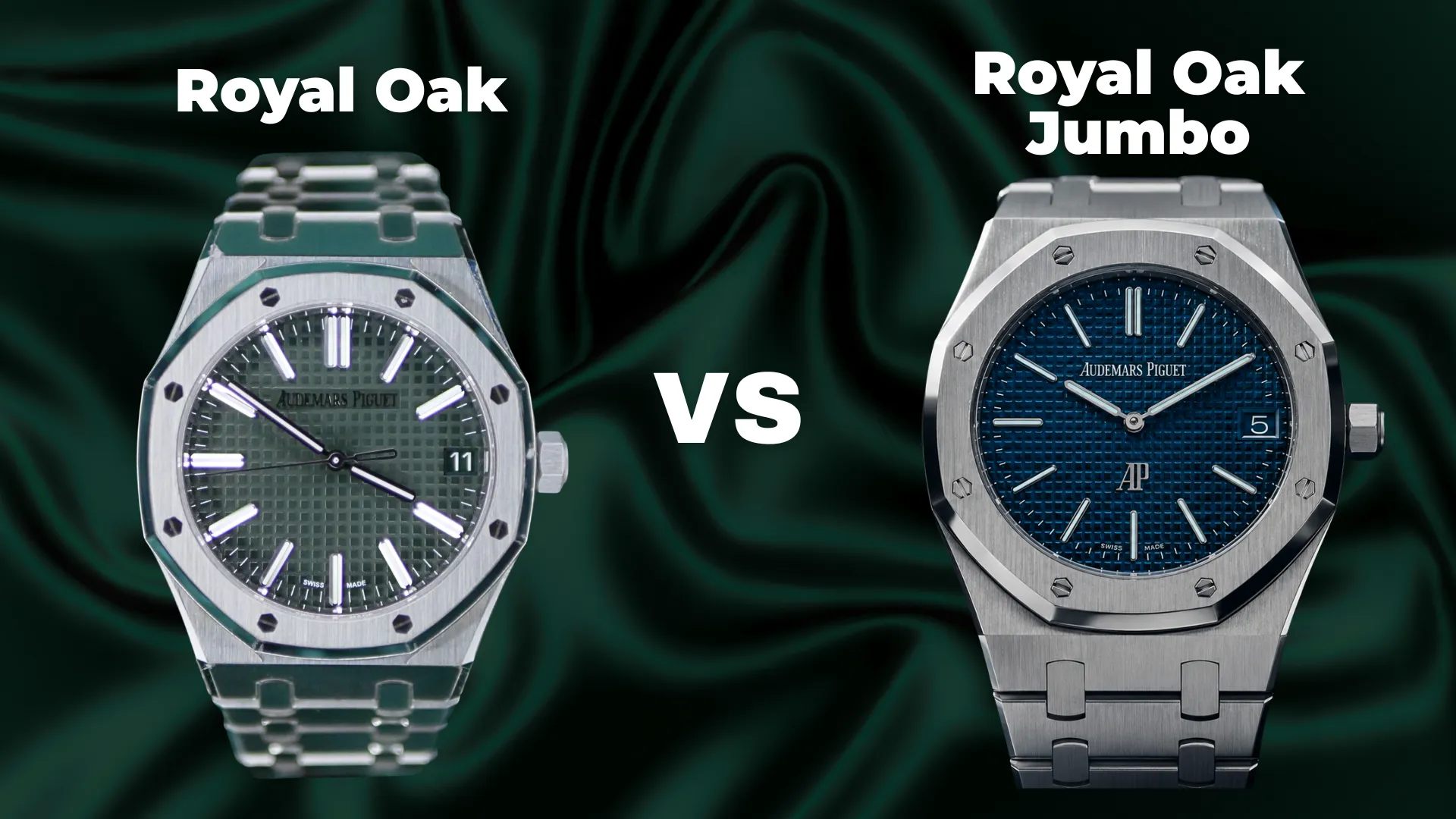
When you think of Audemars Piguet, the Royal Oak is the first watch that comes to mind. Released in 1972, it revolutionized the luxury watch world by creating the luxury sports watch category. It quickly became a favorite among collectors.
In 1993, Audemars Piguet introduced the Royal Oak Offshore, known as “The Beast.” With a larger 42mm case and materials like titanium and ceramic, the Offshore added size, power, and sportiness, appealing to those who wanted something bolder and more functional.
In this blog, we’ll dive into the Royal Oak and Royal Oak Offshore, exploring their design, heritage, and features. We’ll compare both to help you choose which one suits your collection. Whether you’re drawn to the classic elegance of the Royal Oak or the bold, sporty Offshore, both are exceptional timepieces. Let’s take a closer look.
The Audemars Piguet Royal Oak
When the Royal Oak was released, it set a new standard in luxury watches. Designed by the visionary Gerald Genta, it changed the way people viewed luxury timepieces. Unlike other watches of the time, it was the first collection by Audemars Piguet to use stainless steel for a luxury sports watch to break away from the traditional use of gold and platinum.
The 39mm case size was bold for its time, making a statement in an era of smaller watches. Its octagonal bezel with exposed screws became its signature, a design element still recognized today. This innovative approach didn’t just change the watchmaking industry – it created a whole new category: the luxury sports watch.
Features and Functions:
- Material: Stainless steel, integrated bracelet
- Case Size: Typically 41mm, some variations in 37mm and 39mm
- Thickness: 10.88mm
- Dial: Grande Tapisserie pattern (smaller squares) in various colors and finishes
- Movement: AP 2385 chronograph movement (with a 40-hour power reserve)
- Water Resistance: 50 meters
- Other Features: Chronograph complication, integrated bracelet, polished and satin finish
The Audemars Piguet Royal Oak Offshore
The Royal Oak Offshore was created as an evolution of the original Royal Oak, designed to attract a younger, more adventurous audience. Led by creative director Emmanuel Gueit, the Offshore kept the iconic features of the Royal Oak but enhanced them.
With a larger case, durable build, and more functional design, the Offshore pushed the boundaries of what a luxury sports watch could be. Its large size and strong presence earned it the nickname “The Beast,” a name that still stands today.
Features and Functions:
- Material: Titanium, ceramic, rubber (varies by model)
- Case Size: Typically 42mm, with some models ranging up to 44mm and 48mm
- Thickness: 14.9mm
- Dial: Mega Tapisserie pattern (larger squares) with Arabic numerals for easy reading
- Movement: AP 3126/3840 chronograph movement (55-hour power reserve)
- Water Resistance: 100 meters
- Other Features: Chronograph complication, rubber pushers and crown, tachymeter scale
Comparison of Features: Audemar Piguet Royal Oak vs. Royal Oak Offshore
Now, we’ll highlight the key differences that define these two prestigious models.
Case Size
The Royal Oak and Royal Oak Offshore differ significantly in case size, with the Offshore being the larger of the two.
Audemars Piguet Royal Oak:
- Diameter: 41mm
- Thickness: 10.88mm
- Lug-to-Lug Length: 51mm
Audemars Piguet Royal Oak Offshore:
- Diameter: 42mm to 48mm
- Thickness: 14.9mm
- Lug-to-Lug Length: 53mm
While the Royal Oak offers a classic size that suits a variety of wrist sizes, the Royal Oak Offshore caters to those who prefer a more substantial, powerful visual presence on the wrist. The Offshore is better suited for those with larger wrists or those who prefer a sportier, more commanding design.
Bezel
Both pieces share an iconic octagonal bezel design, but their construction differs slightly.
Audemars Piguet Royal Oak:
- Materials: Stainless Steel, Rose Gold, Yellow Gold, White Gold, Platinum, Ceramic and some other materials as well
- Features: Integrated with exposed screws on the bezel and a more subtle profile when comparing thickness
Audemars Piguet Royal Oak Offshore:
- Material: Also comes in Stainless Steel, Rose Gold, Yellow Gold, White Gold, Platinum, Ceramic and other materials as well
- Features: Larger screws for a more rugged appearance and stronger, more industrial look.
The Royal Oak Offshore uses larger screws and is available with ceramic bezels, giving it a more robust and sporty aesthetic, while the Royal Oak retains a more classic, understated look.
Crystal
Both models feature a sapphire crystal, but the construction of their crystals varies slightly to accommodate their design philosophies.
Audemars Piguet Royal Oak:
- Type: Sapphire Crystal
- Finish: Scratch-resistant, flat crystal.
Audemars Piguet Royal Oak Offshore:
- Type: Sapphire Crystal
- Finish: Also scratch-resistant but with a more curved finish on some models, adding to the eye-catching, modern appeal of the Offshore.
Early Royal Oak models, such as the Ref. 5402, 14802, and 15202, are notable for their flat sapphire crystals, keeping the design in line with their minimalist aesthetic. Similarly, vintage Royal Oak Offshore models, particularly the Ref. 25721ST from 1993, retain flat crystals, highlighting its tough appeal.
However, as the Royal Oak Offshore evolved, curved crystals began to appear in models like the Ref. 26400ST (2011) and Ref. 26470ST (2014). These slightly curved sapphire crystals introduced a sportier and more dynamic nature of the Offshore.
Dial
The dials of both watches maintain the classic “Tapisserie” pattern but with key differences in their design details.
Audemars Piguet Royal Oak:
- Pattern: Grande Tapisserie (smaller squares)
- Subdials: The most recent are 3, 6, 9 (on chronograph models) or depending on the generation of the model.
- Hour Markers: Applied markers, with a focus on elegance.
Audemars Piguet Royal Oak Offshore:
- Pattern: Mega Tapisserie (larger squares)
- Subdials: 6, 9, 12 (on chronograph models)
- Hour Markers: Stick markers and Arabic numerals for a more functional, legible design.
The Royal Oak Offshore opts for larger squares and Arabic numerals, making it more standout and easy to read, while the Royal Oak maintains a more subtle, classic aesthetic with smaller squares and a refined dial design.
Crown
The design for each crown reflects the sporty, strong-built nature of the Offshore compared to the elegant Royal Oak.
Audemars Piguet Royal Oak:
- Type: Screw-down crown, integrated into the case
- Function: Traditional design for minimalist appeal.
Audemars Piguet Royal Oak Offshore:
- Type: Oversized crown with rubber or ceramic coating
- Function: Designed for easier grip and adjustment during active use.
The Offshore’s crown is larger and more functional, tailored for sports enthusiasts, while the Royal Oak’s crown keeps a more discreet and refined profile.
Caseback
Both models feature sapphire casebacks, but their design philosophies differ.
Audemars Piguet Royal Oak:
- Caseback: Either a solid or transparent exhibition sapphire, allowing a view of the movement.
- Features: Clean, minimal aesthetic with a focus on craftsmanship.
Audemars Piguet Royal Oak Offshore:
- Caseback: It could either feature a solid caseback or a transparent sapphire exhibition caseback, often with additional decorative elements.
- Features: Engravings or special markings, especially in limited editions.
The Offshore caseback may feature additional decorative details and engravings, emphasizing its sportier, more personalized appeal, whereas the Royal Oak caseback is more elegant and straightforward.
Movements
Both models boast incredible movements, but there are differences in the calibers they use.
Royal Oak Movements:
1. Caliber 2121: Used in the original Royal Oak (Ref. 5402) and a few other models.
- Power Reserve: 40 hours
- Vibrations: 21,600 vph (3 Hz)
2. Caliber 2385: Found in Royal Oak Chronograph models (Ref. 26331ST, for example).
- Power Reserve: 40 hours
- Vibrations: 21,600 vph (3 Hz)
3. Caliber 4401: A newer, in-house chronograph movement used in models like Ref. 26470ST and modern Offshore Chronographs.
- Power Reserve: 70 hours
- Vibrations: 28,800 vph (4 Hz)
4. Caliber 4302: Found in newer Royal Oak models like Ref. 15500ST.
- Power Reserve: 70 hours
- Vibrations: 28,800 vph (4 Hz)
5. Caliber 3120: Used in models like Ref. 15400 and is one of Audemars Piguet’s most stable movements.
- Power Reserve: 60 hours
- Vibrations: 21,600 vph (3 Hz)
Royal Oak Offshore Movements:
1. Caliber 3126/3840: Found in the Royal Oak Offshore Chronographs (Ref. 25721ST, Ref. 26470ST).
- Power Reserve: 55 hours
- Vibrations: 21,600 vph (3 Hz)
2. Caliber 4404: A newer in-house movement used in the 43mm Offshore Chronograph models, such as Ref. 26470ST and Ref. 26400ST.
- Power Reserve: 70 hours
- Vibrations: 28,800 vph (4 Hz)
3. Caliber 2942: Seen in the first Offshore chronograph models, such as the “Beast” (Ref. 25721ST).
- Power Reserve: 40 hours
- Vibrations: 28,800 vph (4 Hz)
| Model | Caliber | Power Reserve | Vibrations |
| Royal Oak (Ref. 5402) | Caliber 2121 | 40 hours | 21,600 vph (3 Hz) |
| Royal Oak Chronograph (Ref. 26331ST) | Caliber 2385 | 40 hours | 21,600 vph (3 Hz) |
| Royal Oak Chronograph (Ref. 26240ST) | Caliber 4401 | 70 hours | 28,800 vph (4 Hz) |
| Royal Oak (Ref. 15500ST) | Caliber 4302 | 70 hours | 28,800 vph (4 Hz) |
| Royal Oak (Ref. 15450ST) | Caliber 3120 | 60 hours | 21,600 vph (3 Hz) |
| Royal Oak Offshore Chronograph (Ref. 26470ST) | Caliber 3126/3840 | 50 hours | 21,600 vph (3 Hz) |
| Royal Oak Offshore Chronograph (Ref. 26238ST) | Caliber 4404 | 70 hours | 28,800 vph (4 Hz) |
| Royal Oak Offshore Chronograph (Ref. 25721ST) | Caliber 2942 | 40 hours | 28,800 vph (4 Hz) |
All of the power reserves and vibration frequencies are consistent with the specific models referenced. The Caliber 4401 and Caliber 4404 are newer in-house movements that provide superior power reserve and higher vibrations compared to older calibers.
Lume
Both timepieces feature luminescence, but with different levels of intensity and placement.
Audemars Piguet Royal Oak:
- Lume: Applied to markers and hands (depends on generation and model), with a subtle glow for low-light conditions.
Audemars Piguet Royal Oak Offshore:
- Lume: Also applied to markers and hands (depends on generation and model) enhanced with larger, more vibrant lume markers, ensuring greater visibility in low-light.
The Royal Oak Offshore offers more visibility with brighter lume, suited for those who prioritize legibility in active environments.
Bracelet/Strap and Clasp
The bracelet designs complement the overall aesthetic of each watch, with the Offshore favoring versatility and the Royal Oak opting for refinement.
Audemars Piguet Royal Oak:
- Bracelet/Strap: Many AP watches come with a bracelet that matches the case material, such as an integrated steel bracelet with a brushed finish. Some models also feature an alligator strap, while others offer interchangeable rubber or leather straps.
- Clasp: Deployment or Double folding clasp for a secure and elegant fit, or pin buckle
Audemars Piguet Royal Oak Offshore:
- Bracelet/Strap: Some AP models come with a ceramic bracelet or other bracelet options that match the case, such as rose gold or yellow gold. Also, certain models feature rubber or alligator straps with a quick-release system, allowing you to switch straps easily without the need for a screwdriver.
- Clasp: Tang buckle or deployment clasp for comfort and adjustability.
The Royal Oak Offshore offers more strap variety, especially with its rubber options, perfect for an active lifestyle, while the Royal Oak maintains a premium bracelet that’s smooth and distinguished.
Water Resistance
Water resistance is an important feature for the Offshore, but both models offer solid protection.
Audemars Piguet Royal Oak:
- Water Resistance: 50 meters (suitable for light swimming and daily wear).
Audemars Piguet Royal Oak Offshore:
- Water Resistance: 100 meters (better suited for sports and active lifestyles).
With double the water resistance, the Royal Oak Offshore is better suited for those who engage in watersports or need a more rugged timepiece.
Variations
Both collections come in a variety of models, offering different materials and designs.
Audemars Piguet Royal Oak:
- Variants: Stainless steel, rose gold, platinum, ceramic, diamond-set options, and more
- Limited Editions: Released periodically, with some models as collector’s items (e.g. AP Perpetual Calendar Royal with frosted white gold)
Audemars Piguet Royal Oak Offshore:
- Variants: Stainless steel, titanium, ceramic, rose gold, and rubber straps
- Limited Editions: Frequently released, often with special collaborations (e.g., Michael Schumacher editions).
The Royal Oak Offshore offers a broader range of materials and a more diverse set of designs, catering to a wide variety of tastes.
Price Point
Price range reflects the materials, rarity, and complications found in each model.
When it comes to Audemar Piguet, it’s luxury with a price tag to match.
- As of March 2025, the starting price for a Royal Oak sits around $30K (this includes both MSRP and secondary market value) and can go as high as $300 to $400K for rare models.
- As for the Royal Oak Offshore, the starting MSRP is around $30K but in the secondary market, you can get one for as low as $22K. The upper range for Offshores is even higher with rare models going for as high as $1M.
Here’s a comprehensive chart comparing the features side by side.
| Feature | Audemars Piguet Royal Oak | Audemars Piguet Royal Oak Offshore |
| Case Size | 41mm diameter, 10.88mm thickness | 42mm-48mm diameter, 14.9mm thickness |
| Bezel | Signature octagonal, smaller screws | Larger screws, ceramic options |
| Crystal | Sapphire crystal | Sapphire crystal |
| Dial | Grande Tapisserie pattern, smaller squares, applied hour markers, with a focus on elegance. | Mega Tapisserie pattern, larger squares, Arabic numerals for a more functional, legible design. |
| Crown | Integrated into the case | Larger, often rubber or ceramic-coated |
| Caseback | Either a solid or transparent exhibition sapphire | Either a solid or transparent exhibition sapphire |
| Lume | Subtle, focused on legibility | More prominent, brighter lume |
| Bracelet/Strap and Clasp | Comes with a bracelet that matches the case material, such as an integrated steel bracelet with a brushed finish. Some models also feature an alligator strap, while others offer interchangeable rubber or leather strapsClasp: Deployment or Double folding clasp for a secure and elegant fit, or pin buckle | Come with a ceramic bracelet or other bracelet options that match the case, such as rose gold or yellow gold.Certain models feature rubber or alligator straps with a quick-release system, allowing you to switch straps easily without the need for a screwdriverClasp: Tang buckle or deployment clasp for comfort and adjustability |
| Water Resistance | 50 meters | 100 meters |
| Variations | Steel, rose gold, titanium, special editions | Steel, titanium, ceramic, limited editions |
| Price Point | $30,000 – $400,000 | $30,000 – $1,000,000 |
Royal Oak or Royal Oak Offshore? Which Ideal Timepiece Speaks to You?
Both the AP Royal Oak and Royal Oak Offshore are undeniably legendary, each catering to different tastes and lifestyles. The Royal Oak is a true classic, celebrated for its simple style and its key role in reshaping the luxury watch industry. It’s ideal for those who appreciate a watch that radiates timeless style.
Now, the Royal Oak Offshore? It’s a different breed. Bold, durable, and unapologetically larger, this is the watch for those who want something more functional with a sporty edge. Its design grabs attention, while its features make it a solid choice for active individuals who need a piece that’s as tough as they are.
In the end, it’s all about what fits your personal style. Do you want a watch that never goes out of fashion and keeps its refined appeal? Or does the confident, performance-driven nature of the Offshore speak to your adventurous side? With either choice, you’re securing a piece of AP’s legendary watchmaking – an addition that will always stand out in your collection.