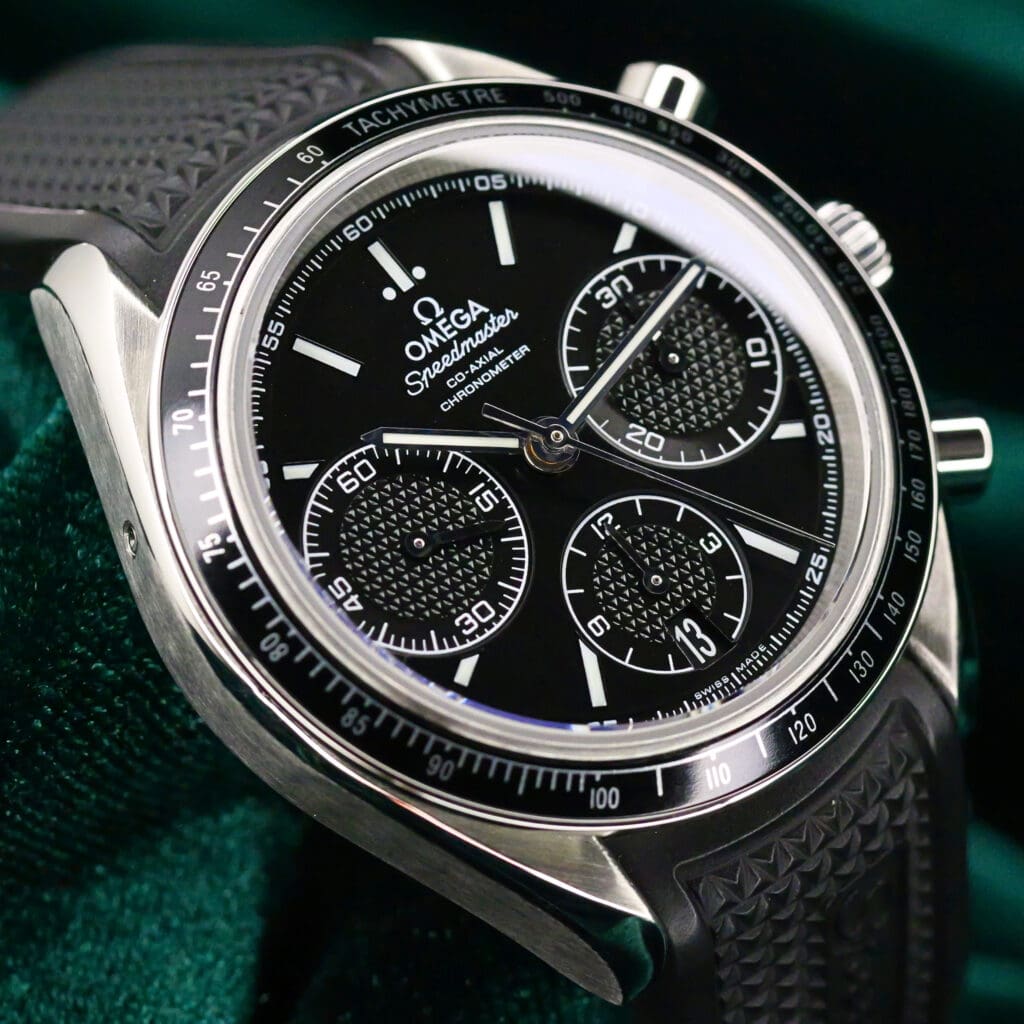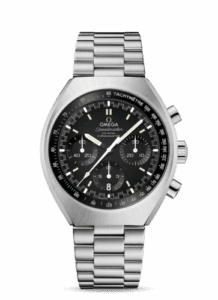

The Omega Speedmaster Racing 326.32.40.50.01.001 is a self-winding chronograph from the 40 mm Speedmaster Racing line. It pairs a black dial with a fixed tachymeter bezel and runs the Co-Axial calibre 3330, a column-wheel chronograph movement with COSC chronometer certification.
The Speedmaster Racing was introduced at Baselworld 2012 as a more accessible Co-Axial Speedmaster, sitting below the in-house calibre 9300 pieces in the range. It used the calibre 3300 family (calibre 3330 in the date versions), which carried the Co-Axial escapement, a silicon balance spring, and a column-wheel chronograph at a lower price point than the manufacture calibre 9300.
Within the collection this reference is a mid-range automatic chronograph rather than a flagship or a limited edition. It is one of several dial and strap configurations built on the same 40 mm case and calibre 3330. This specific reference carries the black dial and the black rubber strap.
The 40 mm Speedmaster Racing line was produced until around 2017, after which the Racing name moved to the larger 44.25 mm Master Chronometer case. This reference is discontinued.
The dial is black, with a glossy main surface and three textured sub-dials finished in a “Clous de Paris” (hobnail) pattern. The layout is a triple-counter chronograph: small seconds at 9 o’clock, a 30-minute chronograph counter at 3 o’clock, and a 12-hour chronograph counter at 6 o’clock, with the date window set inside the 6 o’clock sub-dial.

Hour markers are applied luminous batons, with a double marker at 12 o’clock and a minute track around the outer edge of the dial. The hour and minute hands are rhodium-plated and filled with luminous material. The central chronograph seconds hand and the sub-dial hands are blue, which sets the chronograph indications apart from the running time.
Printed dial text reads “OMEGA,” “Speedmaster,” “Co-Axial,” and “Chronometer” in the upper half, with “SWISS MADE” at the base of the dial below the 6 o’clock sub-dial. The dial is marked Chronometer, not Master Chronometer, which reflects the calibre 3330’s COSC certification rather than the later METAS standard.
The case is stainless steel, 40 mm in diameter, with a mix of brushed and polished surfaces and an asymmetric profile with crown guards. Published measurements put the case at 15.05 mm thick with a lug-to-lug length of 45.5 mm. The crown and chronograph pushers sit on the right side, with the crown carrying an embossed Omega logo.

The crystal is a domed sapphire with anti-reflective treatment. The caseback is a solid, screw-in back stamped with the Omega seahorse (Hippocampus) medallion. The crown is a push-pull type, and the watch is water resistant to 100 metres.
The bezel is fixed and made of stainless steel, fitted with a matt black aluminium tachymeter insert. The tachymeter scale is a decorative and functional timing scale used to calculate speed over a fixed distance by starting the chronograph and reading the scale against the central chronograph seconds hand. The bezel does not rotate.
This reference (suffix .32) is fitted with a black rubber strap. The strap has a textured surface that matches the sporty character of the dial and bezel, and it terminates in a stainless steel folding deployant clasp with a push-button release.

Length adjustment on the original strap is handled by freeing the longer strap section from the clasp’s two slideways, repositioning it, and reinserting it, rather than by removing links. The lug width is 19 mm.
The same watch was also offered on a stainless steel bracelet under the reference 326.30.40.50.01.001. This reference is the rubber-strap configuration.
The movement is the Omega Co-Axial calibre 3330, an automatic column-wheel chronograph. It runs at 28,800 vph (4 Hz), holds 31 jewels, and provides a power reserve of 52 hours.
The calibre uses Omega’s Co-Axial escapement with three levels, a silicon Si14 balance spring on a free-sprung balance, and a Nivachoc shock-absorber system. It is certified as a chronometer by the Official Swiss Chronometer Testing Institute (COSC).
Functions are central hours and minutes, small seconds at 9 o’clock, a date at 6 o’clock, and a chronograph reading through a central seconds hand, a 30-minute counter at 3 o’clock, and a 12-hour counter at 6 o’clock. The chronograph is operated with the two pushers flanking the crown: the upper pusher starts and stops the timing, and the lower pusher resets the counters to zero. The date is set through the crown.
The case, bezel, caseback, and clasp are stainless steel; Omega uses 316L stainless steel for this construction. The crystal is synthetic sapphire, produced by the Verneuil process and given an anti-reflective treatment. The bezel insert is anodised aluminium in matt black.
The hour markers and hands are metal with luminous fill; the running hands are rhodium-plated. The strap is rubber, and the strap clasp is stainless steel.
The overall material character is a steel sports chronograph with a rubber strap: hard-wearing, corrosion-resistant, and suited to daily and active use.
A full set for this reference from its original sale era typically includes:

Older version
Newer version
The box changed at the factory around mid-2015, moving from the red leatherette Gen 1 box to the tan wooden Gen 2 box. Both generations fall within this reference’s sale period, so which box is correct depends on when the specific example was delivered. For a full set, the box generation should match the sale period documented on the warranty card.
At original sale this reference qualified for Omega’s 48-month (four-year) manufacturer guarantee, applicable to its Co-Axial calibre with the Si14 silicon balance spring. Coverage was recorded on Omega’s red International Warranty card, retailer-stamped and dated at the point of sale, with a separate red pictograms card held in the document wallet.
Examples delivered from July 1, 2018 instead activated Omega’s five-year International Warranty, counted from the dated retail purchase rather than the factory-production date.
Older version
Newer version
Because the Gen 3 card records the retail purchase date rather than production, a card dated years after the reference left production reflects a new-old-stock example activated at sale, not a later manufacturing year. For resale, the stamped and dated warranty card remains the primary authenticity document for a full set; a blank, undated, or photocopied card is a weaker point of documentation.
On paper the watch is a 40 mm chronograph, but at 15.05 mm thick it wears taller than the diameter alone suggests. The 45.5 mm lug-to-lug keeps the footprint contained, so the case sits within a mid-size 40 mm envelope on the wrist while carrying real height.

It suits wrists in roughly the 6.5 to 7.5 inch range. The crown guards and pusher layout give it the presence of a working chronograph rather than a dress watch.
The black rubber strap is flexible and sits comfortably against the wrist, and the folding deployant clasp keeps the watch secure. The combination of steel case, textured dial, and rubber strap makes it a daily-wear sports chronograph rather than an under-cuff dress piece.
This reference is a single configuration: a 40 mm stainless steel case, black dial with Clous de Paris sub-dials, fixed steel tachymeter bezel, black rubber strap, and the Co-Axial calibre 3330. The dial colour and the rubber strap are what define this suffix within the 40 mm Racing family.
Neighboring references, which are separate watches whose specifications do not carry across: